
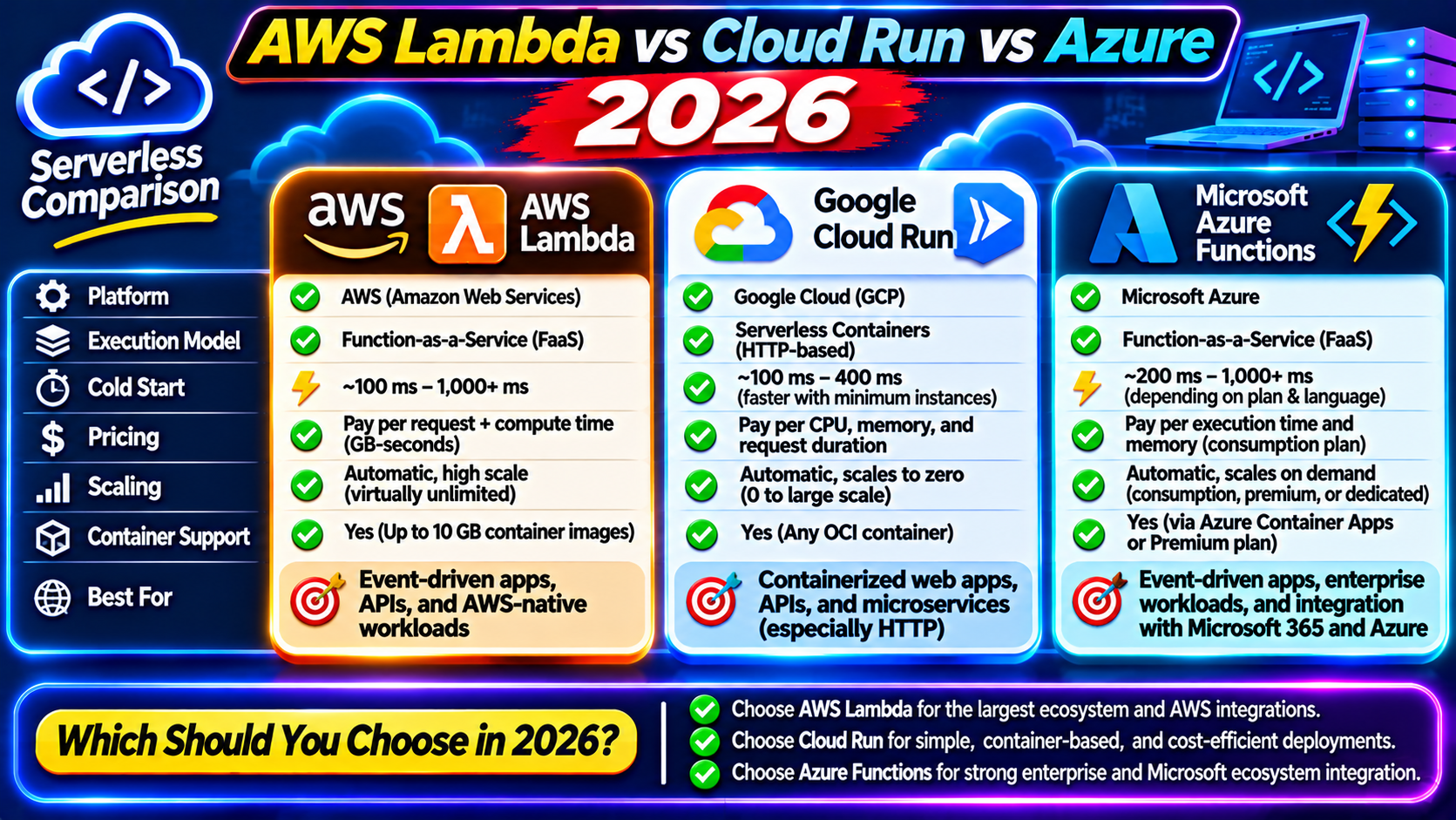
The short answer
AWS Lambda vs Cloud Run vs Azure Functions in 2026: Lambda wins for event-driven workloads and tight AWS integration; Cloud Run wins for containerized apps that need HTTP endpoints and up to 60-minute requests; Azure Functions wins if your stack is already .NET or Azure-heavy. All three offer year-end credit promos: AWS $300, Google $300, Azure $200. Full feature + pricing comparison below.
Serverless compute is now three roughly-equal giants plus a long tail. If you are choosing between AWS Lambda, Google Cloud Run, and Azure Functions for a new project in 2026, the decision comes down to: your existing cloud, your workload shape, and whether you want functions or containers. Here is the honest comparison.
AWS Lambda vs Cloud Run vs Azure Functions 2026 at a glance
| Feature | AWS Lambda | Google Cloud Run | Azure Functions |
|---|---|---|---|
| Unit of deploy | Function (ZIP, image, layer) | Container image | Function (ZIP, image) |
| Max request duration | 15 min | 60 min | 10 min (Consumption) / unlimited (Premium) |
| Cold start (typical) | 100-800 ms | 200-1200 ms | 300-1500 ms |
| Price per 1M requests | $0.20 | $0.40 | $0.20 |
| Price per GB-s compute | $0.0000166667 | $0.00002400 | $0.000016 |
| Free tier / month | 1M requests + 400,000 GB-s | 2M requests + 360,000 GB-s | 1M requests + 400,000 GB-s |
| Max memory | 10 GB | 32 GB | 14 GB (Premium) |
| GPU support | no | yes (L4, 2026+) | no (use Azure ML separately) |
| Scale to zero | yes (default) | yes (default) or min 1 | yes (Consumption) |
AWS Lambda: default pick for event-driven work on AWS
Lambda is the oldest and most mature serverless compute. If your event source is S3, DynamoDB streams, Kinesis, SQS, EventBridge, or API Gateway, Lambda is the path of least resistance.
- Native triggers for 200+ AWS services. Event-driven code becomes nearly zero-config.
- Lambda SnapStart (Java) and provisioned concurrency reduce cold starts to near-zero for latency-sensitive paths.
- Lambda Layers lets you share code and dependencies across functions.
- Lambda Extensions let you add telemetry, secrets managers, and sidecars (Datadog, Lumigo, Sentry) with no code changes.
- Container image deploy up to 10 GB (same as function size cap).
Pain points: 15-minute max duration is a hard ceiling. No GPU support (you offload to SageMaker or ECS). Cold starts on Python and Node are good; Java and .NET still have the tail latency problem without SnapStart.
Pick Lambda if you are on AWS, your workload is event-driven, each invocation finishes in under 15 minutes, and you want tight integration with S3/DynamoDB/EventBridge.
Google Cloud Run: default pick for containerized HTTP apps
Cloud Run runs any container that listens on an HTTP port. It is the easiest path from Docker image to serverless production.
- Deploy any container (Python, Node, Go, Rust, Java, .NET, PHP, Deno) that responds to HTTP. No framework lock-in.
- 60-minute request timeout (4x Lambda) covers long-running webhooks, data exports, and some batch jobs.
- Second-generation execution environment supports more Linux syscalls, GPU workloads (L4), and larger memory (32 GB).
- Cloud Run Jobs: run container jobs on a schedule or as a one-off, without the HTTP layer. Good for ETL.
- Pricing is slightly higher per-request but memory pricing is competitive.
- Scales to zero by default, or set min instances to 1+ to eliminate cold starts.
Pain points: HTTP requirement means pure event-driven (Pub/Sub consumer) needs the Pub/Sub push subscription pattern. More expensive than Lambda for short-lived requests at volume.
Pick Cloud Run if you want to deploy containers directly, you need requests longer than 15 minutes, you need GPU workloads, or your team already uses Google Cloud.
Azure Functions: default pick for .NET and Azure-first stacks
Azure Functions is the Microsoft answer. Best fit if you are already on Azure, write C# or F#, or integrate heavily with Dynamics / Microsoft 365.
- First-class .NET support (isolated worker model recommended). C# idioms match the broader Azure SDK.
- Durable Functions let you orchestrate long-running stateful workflows (sagas, human-in-the-loop) in code.
- Premium plan removes the 10-minute duration cap and offers always-ready instances.
- Logic Apps integration for low-code workflows alongside Functions code.
- Deep integration with Dataverse, Microsoft 365, and Azure Service Bus.
Pain points: Cold starts on Consumption tier are the worst of the three. Premium plan is expensive relative to Lambda or Cloud Run equivalent. SDK quality for non-.NET languages lags Lambda.
Pick Azure Functions if you are already on Azure, your team is primarily .NET, you need Durable Functions for orchestration, or you need tight Microsoft 365 integration.
Year-end credit promos: AWS $300 / GCP $300 / Azure $200
All three cloud providers run developer credit programs that effectively make small production workloads free for the first 90 days. Not exactly Black Friday, but worth knowing.
- AWS: New accounts get $300 in free credits across AWS services (Lambda + other). Usable within 6 months. Plus the Always-Free tier of 1M Lambda requests per month, no expiry.
- Google Cloud: New accounts get $300 free credits for 90 days. Plus the ongoing free tier of 2M Cloud Run requests + 360,000 GB-s per month.
- Azure: New accounts get $200 free credits for 30 days, plus 12 months of certain free services. Microsoft also offers $1,000 Azure credits through dev/test programs for specific scenarios.
Rule of thumb: start on whichever free tier covers your workload. For a side project with under 1M monthly requests, Lambda or Cloud Run Free Tier runs it indefinitely at $0.
Real cost example: 1M requests, 200ms avg, 512 MB memory
Let us price a realistic workload: 1 million invocations per month, 200ms average execution, 512 MB memory per invocation. That is 102,400 GB-s of compute.
- AWS Lambda: 1M requests at $0.20 = $0.20. 102,400 GB-s at $0.0000166667 = $1.71. Total: $1.91/month. Free tier covers it.
- Google Cloud Run: 1M requests at $0.40 = $0.40. 102,400 GB-s at $0.000024 = $2.46. Total: $2.86/month. Free tier covers it.
- Azure Functions (Consumption): 1M requests at $0.20 = $0.20. 102,400 GB-s at $0.000016 = $1.64. Total: $1.84/month. Free tier covers it.
At 10x volume (10M requests): Lambda $19.10, Cloud Run $28.60, Azure $18.40. At 100M requests (serious production): Lambda $191, Cloud Run $286, Azure $184. The cost gap matters once you are past the free tier.
Decision framework: which serverless to pick in 2026
Answer in order:
- Already on AWS and triggering from S3/DynamoDB/EventBridge? Lambda. Zero reason to go elsewhere.
- Deploying a containerized HTTP app that needs more than 15 minutes per request? Cloud Run.
- Need GPU in a serverless invocation? Cloud Run (currently the only one with it).
- .NET shop on Azure or need Microsoft 365 integration? Azure Functions.
- Need stateful long-running workflows? Azure Functions with Durable Functions, or Cloud Run with your own state store (Firestore, Cloud Tasks).
- Cost is the main criterion? Azure Functions Consumption slightly cheapest at scale. Lambda runs a close second. Cloud Run is 40-50% more expensive.
- Multi-cloud strategy or avoiding vendor lock-in? Cloud Run (standard container image works anywhere; Lambda layers and Azure durable functions are more coupled).
Cold start reality in 2026
The cold start conversation has shifted over the past 2 years as all three providers added mitigations.
- Lambda SnapStart (Java and Python) drops cold start to roughly 100-200ms for the first request. Enabled per-function. Adds slight deployment time.
- Cloud Run startup CPU boost gives containers extra CPU during cold start, cutting initialization time 30-50% on Node, Python, and Go.
- Azure Functions Always-Ready instances (Premium plan only) keep N instances warm. Eliminates cold starts for a fixed monthly cost.
- Provisioned concurrency (Lambda) and min-instances (Cloud Run) let you pay to keep N instances warm. Trade cost for latency on hot paths.
For most API workloads with regular traffic, cold starts are a non-issue in 2026. For latency-sensitive paths with sparse traffic, use the warm-instance features. For truly spiky, zero-latency-budget workloads, serverless may still not be the right pattern; consider ECS/Fargate or GKE/Cloud Run always-on instead.
Official documentation
Related infrastructure deals
The links below are affiliate links. We may earn a commission at no extra cost to you. See our affiliate disclosure for details.
- Kamatera cloud VPS (hourly billing, ideal for always-on alternative to serverless when cost matters)
- Cloudways managed hosting (Black Friday 50% off; good fit for apps that do not fit serverless shape)
AWS Lambda vs Cloud Run vs Azure Functions FAQ
Which is cheapest for a small side project?
All three have generous free tiers that cover a side project with under 1M monthly requests at $0. Lambda and Azure Functions have 1M requests + 400,000 GB-s free. Cloud Run offers 2M requests + 360,000 GB-s free. Pick based on your existing cloud, not price at this scale.
Which has the fastest cold starts?
Lambda with SnapStart (Java/Python) hits roughly 100-200ms consistently. Cloud Run with startup CPU boost on Node/Python/Go is close behind. Azure Functions Consumption has the slowest cold starts; upgrade to Premium plan with Always-Ready instances if you need consistent low latency.
Can I run a GPU workload on serverless?
Cloud Run added NVIDIA L4 GPU support in 2026; Lambda and Azure Functions do not have GPU. If you need GPU in a serverless invocation (model inference, video processing), Cloud Run is currently the only option. Alternative on AWS: SageMaker Serverless Inference. Alternative on Azure: Azure ML Managed Endpoints.
What is the maximum request duration in each?
Lambda 15 minutes (hard cap). Cloud Run 60 minutes (hard cap). Azure Functions Consumption 10 minutes, Premium plan unlimited. Cloud Run wins if you need long-running HTTP handlers; use Durable Functions on Azure or Step Functions on AWS for orchestrated long workflows.
Which has the least vendor lock-in?
Cloud Run, because you deploy a standard container image that also runs on Kubernetes, Cloud Run on GKE, Knative, or self-hosted Docker. Lambda requires AWS-specific trigger wiring and function signature. Azure Functions uses the FunctionsCore runtime plus trigger bindings. Portability: Cloud Run > Lambda > Azure Functions.
Do all three support Python, Node, Go, Rust, and other languages?
Cloud Run runs any container, so every language. Lambda officially supports Python, Node, Java, Go, Ruby, .NET, and custom runtimes via container images. Azure Functions supports C#/F#, JavaScript/TypeScript, Python, Java, PowerShell, and custom handlers. Rust is supported via custom runtime on Lambda and native container on Cloud Run.