
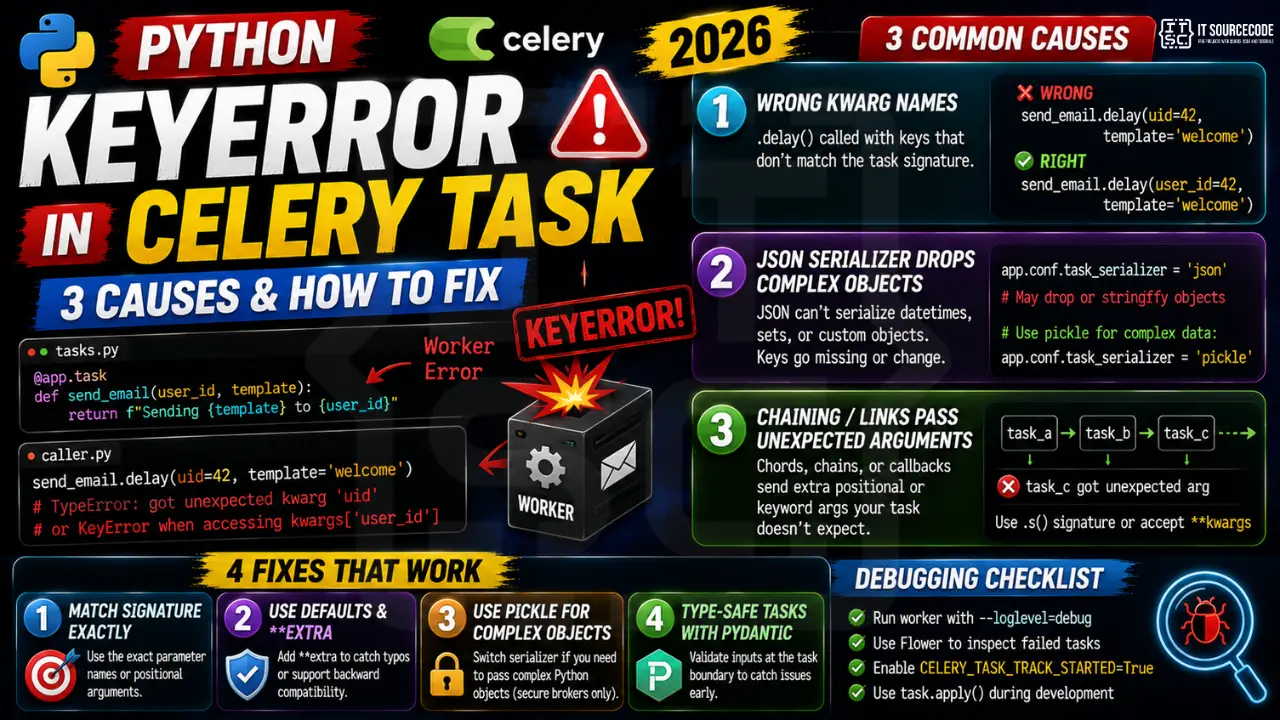
A Python KeyError when calling a Celery task usually means the worker received different keyword arguments than the task expected. Common 2026 causes: .delay() call with wrong kwarg names, the JSON serializer drops a complex object key, or task chaining passed an unexpected positional argument.
Minimal reproducer
# tasks.py
from celery import Celery
app = Celery('demo', broker='redis://localhost')

@app.task
def send_email(user_id, template):
    return f"Sending {template} to {user_id}"

# caller.py
send_email.delay(uid=42, template='welcome')
# Worker raises: TypeError: send_email() got unexpected kwarg 'uid'
# Or KeyError if you access kwargs['user_id'] in the task body
Fix 1: Match the task signature exactly
# Wrong
send_email.delay(uid=42, template='welcome')

# Right
send_email.delay(user_id=42, template='welcome')

# OR positional
send_email.delay(42, 'welcome')
Fix 2: Use named arguments with defaults
@app.task
def send_email(user_id, template='welcome', **extra):
    """Defensive task signature with **extra catches typos."""
    if 'uid' in extra:
        user_id = extra['uid']  # backwards-compat for callers
    return f"Sending {template} to {user_id}"
Fix 3: Switch serializer to pickle for complex objects
# celery_app.py
app = Celery('demo', broker='redis://localhost')
app.conf.task_serializer = 'json'  # default, safe but limited
# OR for complex objects:
app.conf.task_serializer = 'pickle'  # supports any Python object
app.conf.accept_content = ['pickle', 'json']
JSON serializer cannot serialize datetimes, sets, custom objects. They get dropped or stringified. Switch to pickle if you need to pass complex Python objects (with the caveat that pickle has security implications, never accept tasks from untrusted sources).
Fix 4: Type-safe tasks with Pydantic argument models
from pydantic import BaseModel

class EmailArgs(BaseModel):
    user_id: int
    template: str = 'welcome'

@app.task
def send_email(payload):
    args = EmailArgs(**payload)  # validates at task boundary
    return f"Sending {args.template} to {args.user_id}"

# caller
send_email.delay(payload={'user_id': 42, 'template': 'reset'})
Debugging Celery KeyError
- Set
CELERY_TASK_TRACK_STARTED=Trueto log task starts. - Run worker in foreground:
celery -A myapp worker --loglevel=debug - Inspect failed task in Flower (
pip install flower; celery -A myapp flower) for full kwargs trace. - Use
task.apply()instead of.delay()during dev for synchronous execution.
Understanding Celery task KeyError patterns
Celery workers run tasks in a separate process from your web app. This makes debugging harder because the KeyError happens inside the worker, not in the request handler. Three patterns cover most cases:
- Missing keys in serialized kwargs. Data serialized to JSON strips non-string keys or drops fields the worker expects.
- Race condition on shared state. Task A writes to a Redis or database cache, task B reads before A commits.
- Version mismatch between producer and worker. The web app and worker deployed at different times, using different task signatures.
Debugging Celery KeyError step by step
Follow this checklist when a Celery task raises KeyError. It works whether you use Redis, RabbitMQ, or SQS as the broker:
- Enable full task tracebacks. Set CELERY_TASK_TRACK_STARTED=True and CELERY_TASK_SEND_SENT_EVENT=True in your config so failed tasks show line numbers in flower or the logs.
- Log the incoming kwargs. Add task.logger.info(kwargs) at the top of the affected task. Confirm the dict has the key you are reading.
- Compare producer vs worker versions. Run git log both sides. A KeyError often means the producer added a new required key that the deployed worker does not know about.
- Reproduce locally. Launch a single worker with celery -A your_app worker –loglevel=DEBUG –concurrency=1 to see the exact frame that raises.
- Check retry behavior. If the task retries with the same broken kwargs, the KeyError repeats forever. Add max_retries=3 and give up cleanly.
Safe access patterns for Celery task kwargs
Once you know which key is missing, choose the safest fix based on whether the key is truly required or optional:
from celery import shared_task
from celery.utils.log import get_task_logger

logger = get_task_logger(__name__)

@shared_task(bind=True, max_retries=3)
def process_order(self, **kwargs):
    # Required keys: fail fast with KeyError, DO NOT retry
    try:
        order_id = kwargs["order_id"]
    except KeyError:
        logger.error("Missing order_id in Celery task kwargs")
        raise  # let it propagate, task marked FAILURE

    # Optional keys: use .get() with a default
    priority = kwargs.get("priority", "normal")
    metadata = kwargs.get("metadata", {})

    logger.info("Processing order " + str(order_id) + " priority=" + priority)
    return {"status": "ok", "order_id": order_id}
Testing Celery KeyError fixes
Before deploying, exercise the fix under realistic conditions:
- Unit test the task in isolation. Use pytest with pytest-celery to run the task synchronously and assert both success and KeyError paths.
- Integration test with a real broker. Spin up Redis in Docker, publish tasks with missing keys, confirm the worker handles them without infinite retries.
- Chaos-test with mixed producer versions. Deploy an old-version producer alongside a new-version worker (or vice versa). This surfaces version-mismatch KeyErrors before customers see them.
- Monitor task failure rate. Set up a Prometheus alert when celery_task_failed_total spikes above the baseline. KeyErrors show up here first.
When to use dict.get() vs try/except in Celery tasks
The two safe access patterns solve different problems. Pick based on whether the field is optional or required:
- Use dict.get(key, default) when the field is genuinely optional and a default value is meaningful. Example: kwargs.get(“priority”, “normal”).
- Use try/except KeyError when the field is required but you want to log a specific error message before propagating. Example: guarding order_id and returning a structured failure record.
- Never swallow KeyError silently. A silent except means the task appears to succeed but does nothing. Prefer to fail loudly and let Celery mark the task as FAILURE.
- Do not retry on KeyError. Retrying a task with the same broken kwargs gives you the same error. Instead, mark the task FAILURE and alert the dev team.
Official documentation
Frequently Asked Questions
Why does Celery task work in dev but fail in production?
Common cause: dev uses task.apply() or eager mode (CELERY_TASK_ALWAYS_EAGER=True) which runs synchronously in the caller process, bypassing serialization. Production uses a real broker (Redis, RabbitMQ) which serializes via JSON, exposing kwargs mismatches and unsupported types.
Should I use pickle or JSON serializer in Celery?
JSON for security and simplicity. Pickle only for trusted internal-only task queues where you need to pass datetimes, custom objects, or sets. Pickle is a known RCE vector if anyone untrusted can publish to the broker.
How do I pass a datetime to a Celery task?
Convert to ISO string before delay: send_email.delay(when=dt.isoformat()). In the task, parse back: from datetime import datetime; dt = datetime.fromisoformat(when). Alternatively switch to pickle serializer if security allows.
What is the difference between .delay() and .apply_async()?
.delay(*args, **kwargs) is a shortcut for .apply_async(args=args, kwargs=kwargs) with default options. Use .apply_async() when you need countdown, eta, queue, priority, or retry options.
How do I retry a Celery task that hits KeyError?
Use @app.task(bind=True, max_retries=3) and self.retry(countdown=60) inside the try/except. Avoid retrying on KeyError caused by code bugs (it will just fail again), retry only on transient external errors.

Angel Jude Suarez
Full-Stack Developer at PIES IT Solution
Focuses on Python development, machine learning, and AI integration. Has built production AI systems including OpenAI Whisper integration for medical transcription and GPT-4o-powered diagnosis assistance. Strong background in pandas, scikit-learn, and TensorFlow.
Expertise: Python · PHP · Java · VB.NET · ASP.NET · Machine Learning · AI Integration · OpenCV · Django · CodeIgniter
· View all posts by Angel Jude Suarez →