

Registration Form In HTML With Javascript Validation With Source Code
The Registration Form In HTML With Javascript Validation was developed using JavaScript, CSS and HTML, In this Javascript Project With Source Code It’s all about ensuring that the form’s validation is correct.
When the submit button is pressed, the project provides minimal mandatory form details that are validated. You may also utilize this validation to improve the look and functionality of your project.
A Registration Form Validation In Javascript Using Regular Expression Simply provide the user’s username, email address, password, and password confirmation. You can also confirm their validity by clicking the submit button.
Furthermore, the design of this project is quite basic, so the user will have no problems working on it. These validations add credibility to the concept and make it more realistic.
This Javascript Project With Source Code also includes a downloadable Project With Source Code for free, just find the downloadable source code below and click to start downloading.
I have here a suggested list of Best JavaScript Projects with Source Code Free to download and I’m sure this can help you to improve your skills in JavaScript programming and web development as a whole.
To start executing a Registration Form In HTML With Javascript Validation With Source Code, makes sure that you have any platform in creating a JavaScript, CSS, bootstrap, and HTML installed in your computer, in my case I will use Sublime Text.
Registration Form In HTML With Javascript Validation With Source Code : Steps on how to create the project
Time needed: 5 minutes
These are the steps on how to create Registration Form In HTML With Javascript Validation With Source Code
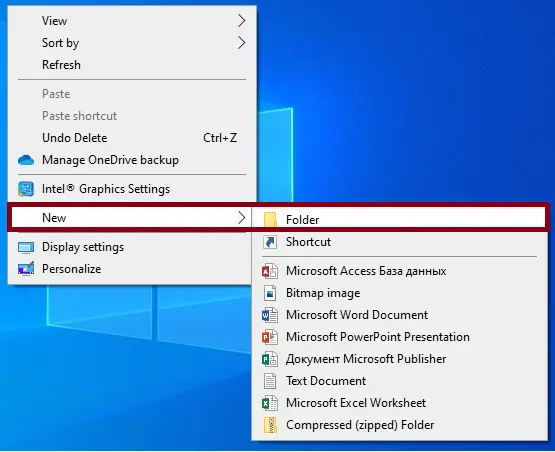
- Step 1: Create a folder.
First, create a folder and named it.

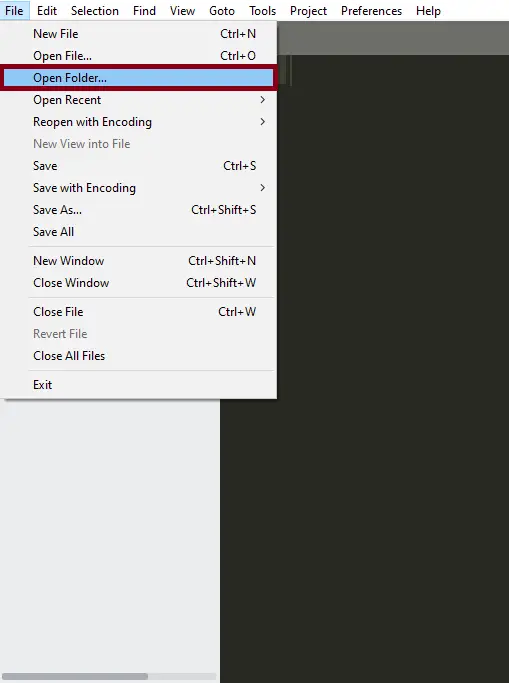
- Step 2: Open the folder in “Sublime Text”.
Second ,after creating a folder, open it in “sublime text“.

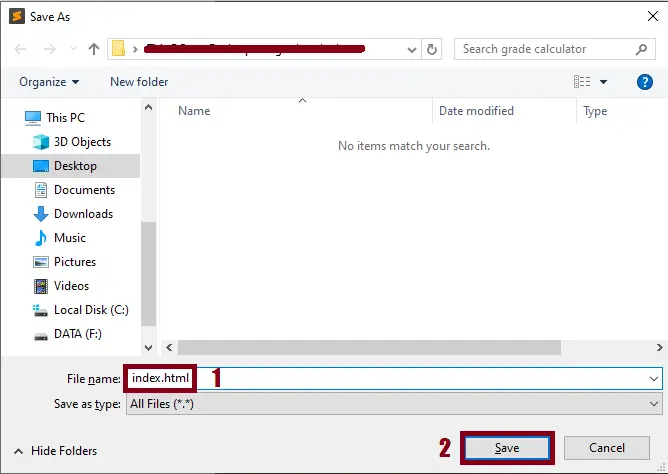
- Step 3: Create a html file.
Third, create a “html” file and save it as “index.html“

The code given below is for the html module
<!DOCTYPE html>
<html lang="en">
<head>
    <meta charset="UTF-8">
    <meta name="viewport" content="width=device-width, initial-scale=1.0">
    <link rel="stylesheet" href="style.css">
    <title>Form validation (IT SOURCECODE)</title>
</head>
<body>
<div class="container">
    <form id="form" class="form" autocomplete="off">
        <h2>Register with us</h2>
        <div class="form-control">
            <label for="username">Username</label>
            <input type="text" id="username" placeholder="Enter username">
            <small>Error message</small>
        </div>
        <div class="form-control">
            <label for="email">Email</label>
            <input type="text" id="email" placeholder="Enter email">
            <small>Error message</small>
        </div>
        <div class="form-control">
            <label for="password">Password</label>
            <input type="password" id="password" placeholder="Enter password">
            <small>Error message</small>
        </div>
        <div class="form-control">
            <label for="password2">Confirm Passsword</label>
            <input type="password" id="password2" placeholder="Enter password again">
            <small>Error message</small>
        </div>
        <button type="submit">Submit</button>
    </form>
</div>

    <script src="app.js"></script>
</body>
</html>
In this module which is the html module of the simple project.
The code given below is for the css module
<style>
    @import url('https://fonts.googleapis.com/css2?family=Open+Sans:wght@600&display=swap');

:root{
    --success-color:#2ecc71;
    --error-color: #e74c3c;
}

*{
    box-sizing: border-box;
}
body{
    background-color: #f9fafb;
    font-family:'Open Sans',sans-serif;
    display: flex;
    align-items: center;
    justify-content: center;
    min-height: 100vh;
    margin: 0;
}
.container{
    background-color: #fff;
    border-radius: 5px;
    box-shadow: 0 2px 10px rgba(0,0,0, 0.3);
    width: 400px;

}
h2{
    text-align: center;
    margin: 0 0 20px;
}
.form{

    padding: 30px 40px;

}
.form-control{

    margin-bottom: 10px;
    padding-bottom: 20px;
    position: relative;
}
.form-control label{

   color: #777;
   display: block;
   margin-bottom: 5px;
}
.form-control input{
    border: 2px solid  #f0f0f0;
    border-radius: 4px;
    width: 100%;
    padding: 10px;
    font-size: 14px;

}
.form-control input:focus{
    outline: 0;
    border-color: #777;
}
.form-control.success input{

    border-color:var(--success-color);

}
.form-control.error input{
    border-color:var(--error-color);
}

.form-control small{
    color: var(--error-color);
    position: absolute;
    bottom: 0;
    left: 0;
    visibility: hidden;
}

.form-control.error small{

    visibility: visible;
}

.form button{
    cursor: pointer;
    background-color: #3498db;
    border: 2px sold #3498db;
    border-radius: 4px;
    color: #fff;
    display: block;
    font-size: 16px;
    padding: 10px;
    margin-top: 10px;
    width: 100%;
}
</style>
In this module which is the css module of the simple project.
The code given below is for the javascript module
<script>
    const form=document.getElementById('form');
const username=document.getElementById('username');
const email=document.getElementById('email');
const password=document.getElementById('password');
const password2=document.getElementById('password2');


//Show input error message

function showError(input,message){
    const formControl=input.parentElement;
    formControl.className='form-control error';
    const small=formControl.querySelector('small');
    small.innerText=message;
}

function showSuccess(input){
    const formControl=input.parentElement;
    formControl.className='form-control success';

}

//Email

function isValidEmail(email)
{
    const re= /^(([^<>()\[\]\\.,;:\s@"]+(\.[^<>()\[\]\\.,;:\s@"]+)*)|(".+"))@((\[[0-9]{1,3}\.[0-9]{1,3}\.[0-9]{1,3}\.[0-9]{1,3}\])|(([a-zA-Z\-0-9]+\.)+[a-zA-Z]{2,}))$/;
    return re.test(String(email).toLowerCase());
}


form.addEventListener('submit',function(e){
    e.preventDefault();

    if(username.value===''){
        showError(username,'Username is required');
    }
    else{
        showSuccess(username);
    }
    if(email.value===''){
        showError(email,'Email is required');
    }else if(!isValidEmail(email.value)){
        showError(email,'Email is not valid');
    }
    else{
        showSuccess(email);
    }

    if(password.value===''){
        showError(password,'Password is required');
    }
    else{
        showSuccess(password);
    }
    if(password2.value===''){
        showError(password2,'confirm password is required');
    }
    else{
        showSuccess(password2);
    }


});


</script>
In this module which is the javascript module of the simple project.
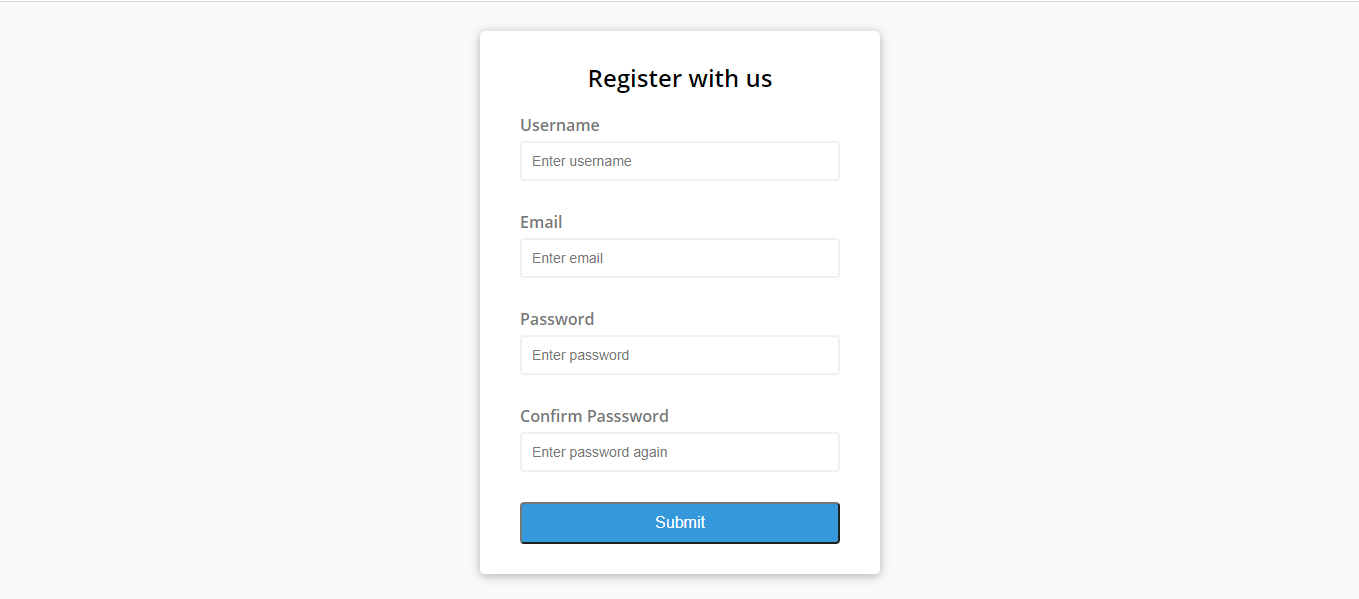
Project Output
| ABOUT PROJECT | PROJECT DETAILS |
|---|---|
| Project Name : | Registration Form In HTML With Javascript Validation |
| Project Platform : | JavaScript |
| Programming Language Used: | php,javascript,html,css |
| Developer Name : | itsourcecode.com |
| IDE Tool (Recommended): | Sublime |
| Project Type : | Web Application |
| Database: | None |
| Upload Date: | July 17, 2021 |
Downloadable Source Code
Summary
This JavaScript Project With Source Code is simply in HTML, CSS, and JavaScript. To start creating this Simple Javascript Project With Source Code, make sure that you have basic knowledge in HTML, CSS and Javascript.
This Javascript Game Project also includes a downloadable Javascript Game Project With Source Code for free.
Related Articles
- Todo List In JavaScript With Source Code
- Currency Converter Project in JavaScript with Source Code
- Calculator In JavaScript Source Code
- [SOLVED] How To Make A Live Chat In JavaScript With Source Code
Inquiries
If you have any questions or suggestions about Registration Form In HTML With Javascript Validation With Source Code , please feel free to leave a comment below.
Building Registration Form In HTML With Javascript Validation the modern way
- HTML5 form validation. Use required, type=”email”, pattern, and minlength attributes for browser-native validation.
- Custom JavaScript validation. addEventListener(‘submit’) and check values with regex or comparison before allowing the form to send.
- Real-time feedback. Use ‘input’ and ‘blur’ events to show validation errors as the user types, not after submit.
- Accessible errors. Add aria-invalid and aria-describedby so screen readers announce error messages correctly.
- Prevent double-submit. Disable the submit button after the first click until the response comes back.
Common security concerns
- Never trust client validation alone. Repeat every check on the server; JavaScript can be bypassed.
- Sanitize output. Escape any user-supplied text before rendering it back to prevent XSS.
- CSRF tokens. Backend forms need a rotating token to prevent cross-site form submission.
- Rate-limit login attempts. Block after 5 failures for 15 minutes to slow brute-force attacks.
Testing your form
- Try leaving each field blank to confirm required-field errors appear.
- Enter obviously wrong data (letters in a phone field, invalid email format) and confirm errors show.
- Confirm the submit button is disabled during network requests to prevent double-submit.
- Test with a screen reader to confirm error messages are read aloud.
Official documentation
Frequently Asked Questions
How does this JavaScript login or registration system work?
Form with username + password, password hashing via bcrypt.js or server-side, JWT or session-based auth, role-based redirect, logout, password reset.
What JavaScript runtime or browser does this project need?
Pure frontend projects (vanilla JS, Vue, jQuery) run in any modern browser (Chrome 90+, Firefox 88+, Safari 14+, Edge 90+) – no install needed. Node.js projects need Node.js 18 LTS or 20 LTS (download from nodejs.org). Run: npm install in project folder, then npm start or node app.js.
How do I run this JavaScript project locally?
For pure HTML/CSS/JS: open index.html in your browser, or use VS Code Live Server extension for auto-reload. For Vue projects: npm install then npm run dev (Vite) or npm run serve (Vue CLI). For Node.js: npm install then npm start. For projects with backend (PHP+MySQL): place in XAMPP htdocs, start Apache + MySQL, browse to localhost/project.
Can I use this JavaScript project for a BSIT capstone or thesis?
Yes. Extend it: add user authentication (JWT for SPA, sessions for traditional), role-based access, real backend (Node.js+Express+MongoDB or PHP+MySQL), responsive design (Bootstrap/Tailwind), PDF exports (jsPDF), real-time features (Socket.IO). Pair with Chapter 1-5 documentation matching your panel’s rubric.
Why am I getting ‘Uncaught ReferenceError’ or ‘Cannot read property of undefined’?
Three common JavaScript issues: (1) Script tag placement wrong, put

Angel Jude Suarez
Full-Stack Developer at PIES IT Solution
Focuses on Python development, machine learning, and AI integration. Has built production AI systems including OpenAI Whisper integration for medical transcription and GPT-4o-powered diagnosis assistance. Strong background in pandas, scikit-learn, and TensorFlow.
Expertise: Python · PHP · Java · VB.NET · ASP.NET · Machine Learning · AI Integration · OpenCV · Django · CodeIgniter
· View all posts by Angel Jude Suarez →
Looking for similar projects or tutorials?
Search for more source code, capstone projects, or programming tutorials