
Every BSIT student preparing for coding interviews eventually asks: should I grind LeetCode, HackerRank, or Codewars? All three offer thousands of practice problems. But they target different audiences, have different question styles, and cost different amounts. This 2026 comparison covers pricing, problem quality, interview focus, community, and specific advice for Philippine students preparing for local + remote US jobs.
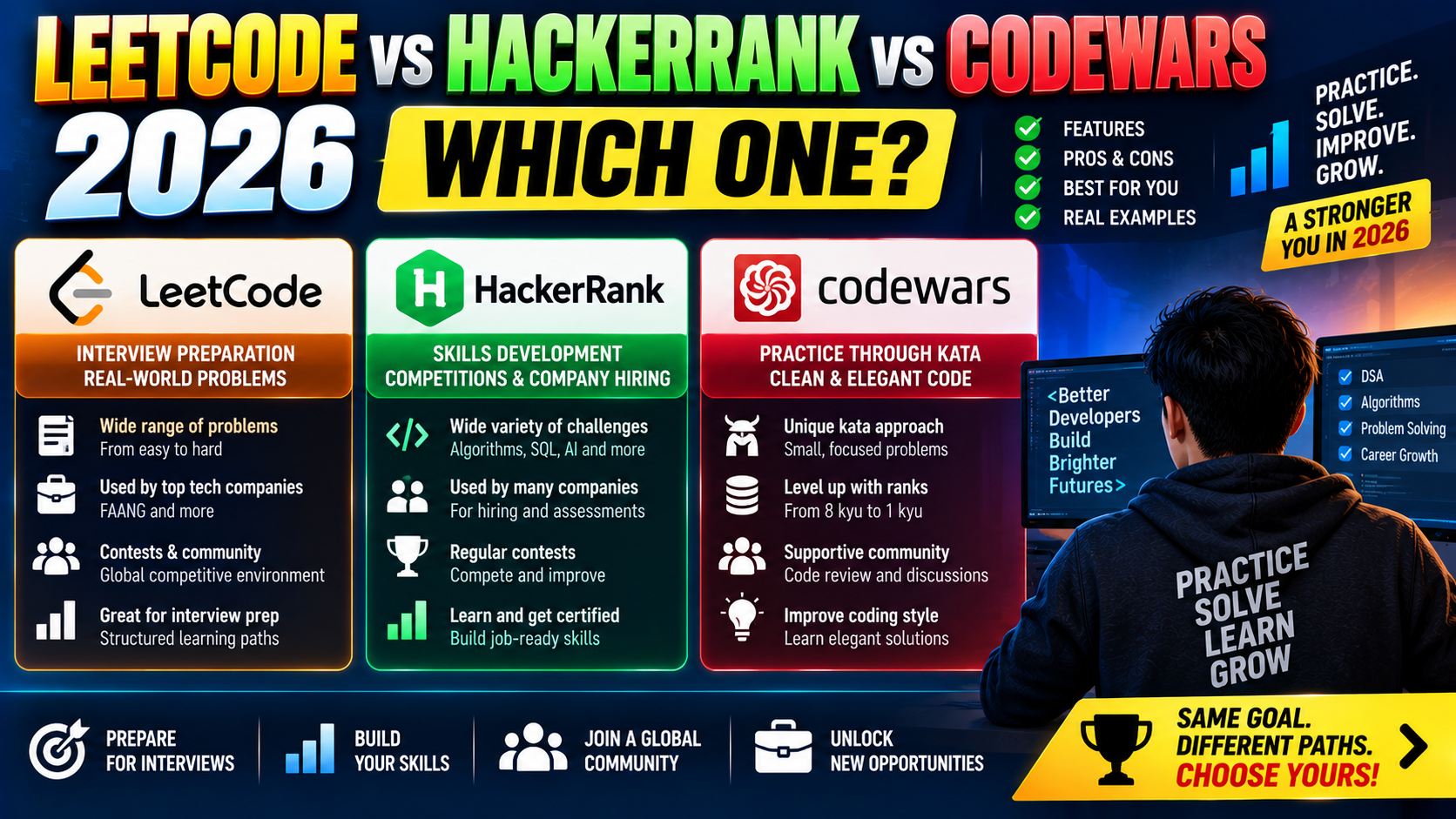
Quick 2026 verdict
Pick LeetCode if you are targeting FAANG or well-known tech companies. It has the exact problems those interviewers reuse. Pick HackerRank if you are targeting Manila enterprise shops (Accenture, IBM, Cognizant, JPMorgan, Concentrix). Most of them use HackerRank for online assessments. Pick Codewars if you want light daily practice with community feedback, not intense interview prep. In 2026 most PH students should split: HackerRank for the local assessment format + LeetCode for FAANG-adjacent interview prep.
Side-by-side comparison 2026
| Feature | LeetCode | HackerRank | Codewars |
|---|---|---|---|
| Problems available | 3,300+ | 2,500+ | 8,000+ (community) |
| Free tier problems | ~2,000 | Nearly all | All |
| Premium cost/month | $35 (annual: $159) | Free for candidates | $8 optional |
| Problem quality | Curated, FAANG-tested | Mixed, assessment-oriented | Community-created, uneven |
| Editorial solutions | Yes, well-written | Sometimes | Community solutions |
| Contests | Weekly + biweekly | Monthly | Ongoing kata |
| Company tags | Yes (Premium only) | Skill-tagged | No |
| Mock interviews | Yes (Premium) | Interview kits | No |
| Best for | FAANG interviews | Enterprise assessments | Daily practice |
LeetCode: the FAANG standard
LeetCode dominates the FAANG interview-prep space. If you interview at Google, Meta, Amazon, Netflix, Apple, Microsoft, Salesforce, Stripe, or almost any well-known tech company, they use LeetCode-style problems. Many interviewers admit to pulling questions directly from the site.
Strengths: curated 150-problem “NeetCode” list covers every major topic. Editorial solutions are clear and multi-language. Discuss tab has quality community solutions. Contests train you for real-time problem solving under pressure. Premium tier unlocks company-tagged problems (see exactly which questions each company asks).
Weaknesses: free tier is generous but company-tagged problems and detailed hints require premium. Premium at $35/month is not cheap for a PH student. Problems trend toward algorithm-heavy; if your target job is more system-design-focused, LeetCode alone is insufficient.
Best use: months 1-3 of your DSA study, do the NeetCode 150 on free tier. Upgrade to premium for 2 months during active FAANG job hunt to access company-tagged problems + mock interviews.
HackerRank: the enterprise assessment standard
HackerRank is where most Manila enterprise shops (Accenture Technology, IBM Philippines, Cognizant Manila, JPMorgan Manila, Sprout Solutions, PayMongo) send their online assessments. If you apply through these companies, expect a HackerRank link in your first email.
Strengths: free for candidates. “Interview Preparation Kit” gives you a structured path through the topics companies actually test. Problem statements are typically longer and more application-oriented than LeetCode. Also covers non-DSA topics: SQL, functional programming, regex, Linux shell.
Weaknesses: problem quality is inconsistent. Some are excellent; others are poorly worded or have unclear expected outputs. Community solutions are less curated than LeetCode. FAANG interviewers rarely use HackerRank so if that is your target, LeetCode gets more relevant practice.
Best use: before you apply to a HackerRank-using company, do 20-30 problems on the platform to acclimate to the interface. The 30 Days of Code and 10 Days of JavaScript tracks are excellent for beginners.
Codewars: the gamified daily practice
Codewars uses “kata” (community-authored problems) ranked from 8-kyu (easiest) to 1-kyu (extremely hard). Solving problems raises your rank, giving a gamified progression that keeps you coming back.
Strengths: extremely broad problem library across 50+ languages. Community solutions show clever one-liners and idiomatic patterns you would never think of. Great for learning language-specific tricks (Ruby, JavaScript, Elixir, Rust).
Weaknesses: problems are not organized by interview topic. Community-authored means quality is uneven. Some kata test obscure standard library features rather than algorithmic thinking. Neither FAANG nor enterprise shops use Codewars.
Best use: as a warm-up before a real study session, or as language-learning practice when you pick up a new language. Do NOT rely on it as your primary interview prep.
What NeetCode + AlgoExpert bring to the picture
Two additional platforms worth mentioning:
NeetCode.io (free + $19/mo): curated problem lists (150, 250, and All roadmaps) that map exactly to interview topics. Video explanations for every problem, walking through the thought process. Free tier covers everything most students need. NeetCode is where most FAANG-target students start in 2026.
AlgoExpert ($99/year): premium platform with 200+ curated problems + system design + behavioral prep. Higher quality than LeetCode’s average problem, but a smaller library. Worth it if you can afford $99/year AND want a structured curriculum rather than the “grind LeetCode randomly” approach.
The 2026 PH student’s recommended stack
Based on 8 years of watching PIES interns prepare for interviews:
- Month 1-3: NeetCode 150 (free) + LeetCode free tier for extra practice. All Easy/Medium.
- Month 4 (active job hunt, targeting FAANG): LeetCode Premium 2 months. Focus on company-tagged problems for the specific companies you interview at.
- Applying to Manila enterprise shops: 3-5 days on HackerRank before the online assessment to get familiar with the interface + typical problem format.
- Codewars: optional, as warm-up or for language variety.
- NeetCode Pro: optional at $19/month if you want video walkthroughs of every problem.
Common mistakes on all three platforms
- Solving 500 problems without pattern recognition. Better to solve 100 problems and be able to explain each solution’s pattern than 500 problems you forget in a week.
- Watching video solutions before trying. Kills learning. Struggle for 30 minutes, then read the editorial or watch NeetCode.
- Only doing Easy problems. The first Medium is a wall. Push through 5-10 Mediums with editorial help and it becomes normal.
- Ignoring the “Discuss” tab on LeetCode. The best solutions are almost never the official editorial. Community members post cleaner, faster, or more elegant approaches.
- Grinding on your phone. Real coding needs a keyboard + IDE. Phone practice is fine for reading but not for building muscle memory.
- Studying algorithms without whiteboarding. Interviews use plain Google Docs or paper. Practice explaining your solution out loud without syntax highlighting.
Official documentation
Frequently Asked Questions
Do I need LeetCode Premium?
Not in months 1-3. Free tier has 2,000+ problems, editorial solutions, and the NeetCode 150 fits entirely in free tier. Upgrade to premium only during the 1-2 month window when you are actively interviewing at FAANG. Company-tagged problems for your specific target list are worth the $35 for 2 months.
Which platform do Manila companies use for online assessments?
HackerRank dominates. Accenture Technology, IBM, Cognizant, JPMorgan Manila all send HackerRank links. PayMongo and Sprout use HackerRank or custom take-home. Concentrix uses CodeSignal occasionally. FAANG offices in Manila (Amazon, Meta) use their own internal platforms that are essentially LeetCode-style.
Are the paid subscriptions worth it for PH students?
During active interview season, yes. Two months of LeetCode Premium at $35 each = $70 (PHP 4,000). If it helps you land a job that pays PHP 40,000+/mo, the ROI is enormous. During learning phases (months 1-3) the free tier is enough.
Can I get by with only one platform?
Yes, if you pick well. LeetCode alone covers 80 percent of interview prep needs. Add HackerRank only for the online-assessment familiarity when applying to enterprise shops. Skip Codewars unless you enjoy the gamification.
What about CodeSignal, TopCoder, or Codeforces?
CodeSignal is used by some enterprise companies for assessments; worth 3-5 practice problems if you get one. TopCoder and Codeforces are competitive programming platforms, harder than interview prep needs. Great for building deep algorithmic skill but overkill for landing a junior developer job.
How do I stay consistent on these platforms?
Track streaks visibly. LeetCode shows a green square per day solved. Aim for at least 1 problem daily during study season. Discord study groups (r/leetcode has one) help with accountability. If you burn out, take 2 days off, then resume where you left off.
Related DSA + Interview tutorials
- DSA Roadmap for BSIT Students 2026
- Big-O Notation Complete Guide for Beginners 2026
- HashMap Deep Dive 2026 Python + Java + JavaScript
- Top 100 Coding Interview Questions 2026 (launches later today)
Official platforms
- LeetCode: interview prep + FAANG focus
- HackerRank: enterprise assessment standard
- Codewars: gamified kata practice
- NeetCode: curated 150-problem roadmap

Joken E. Villanueva
Founder & Lead Developer at PIES IT Solution
Founder of PIES Information Technology Solutions, a software company building production-grade applications for institutions across the Philippines. Over 8 years of hands-on full-stack development experience, currently leading the development of ClinicAI, an AI-powered clinic management platform.
Expertise: PHP · MySQL · JavaScript · AI Integration · SaaS Architecture · VB.NET · Database Design · Capstone Documentation · Java · View all posts by Joken E. Villanueva →