
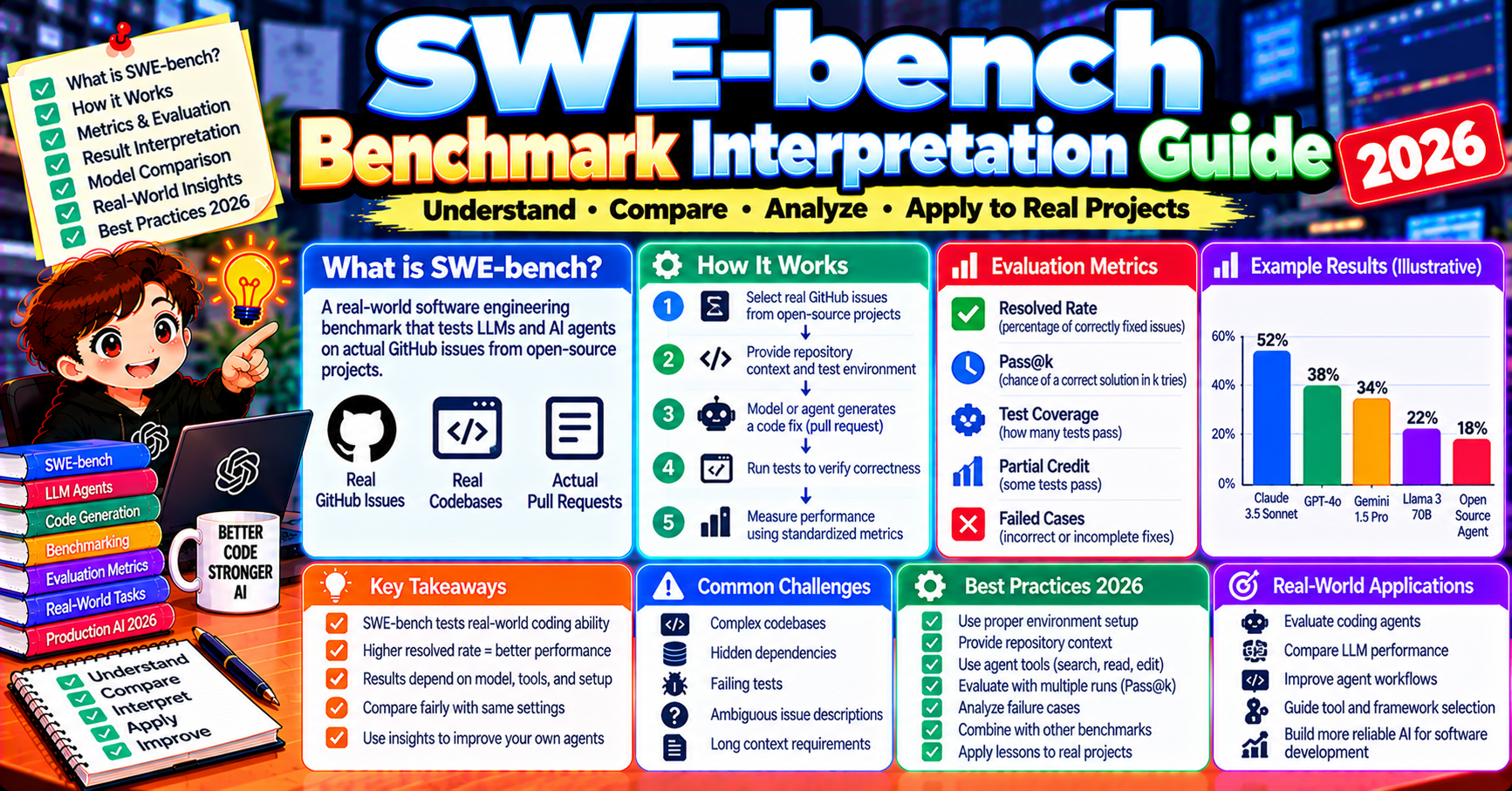
SWE-bench is the dominant coding-agent benchmark in 2026. Every major model release (Claude Opus 5.5, GPT-5, Gemini 2.5 Pro) announces a SWE-bench Verified score, and the top of the leaderboard shifts quarterly. Yet most engineers skimming the score don’t know what it actually measures or why scores differ wildly between model-provider announcements and third-party evaluations. This article decodes the benchmark: what the test is, what the scores mean, why Verified vs. non-Verified differs, how to read a leaderboard critically, and the specific limitations when applying benchmark scores to your real coding workloads.
What SWE-bench actually tests
SWE-bench (Princeton, released 2023) is a benchmark where agents are given real GitHub issues from popular Python repositories (Django, scikit-learn, matplotlib, requests, sympy, etc.) and asked to produce a patch that fixes the issue. The patch is scored:
- Pass: the patch applies cleanly AND the repo’s existing test suite still passes AND the newly-added issue-specific test passes
- Fail: anything else
The agent sees the issue description, the codebase, and must produce a working fix. No multiple choice, no stylistic grading. Either the tests pass or they do not.
The three SWE-bench variants
You will see scores reported against three variants. They are NOT comparable.
- SWE-bench (full): 2,294 issues. Original benchmark. Scoring is noisy because some issues are ill-specified, have broken test setups, or require info not in the repo.
- SWE-bench Lite: 300 issue subset chosen as “easier” and more deterministic. Faster to run; higher raw scores than full.
- SWE-bench Verified: 500 issue subset manually verified by human engineers as “well-specified and testable.” Became the industry-standard variant in 2024+ because scores are more trustworthy. **When someone says “SWE-bench score” without qualification in 2026, they almost always mean Verified.**
Rule: when reading a score, confirm which variant. “60% on SWE-bench Lite” and “60% on SWE-bench Verified” and “60% on SWE-bench full” are very different achievements.
What a 65% Verified score means in practice
65% on SWE-bench Verified means: given 500 real GitHub issues, the agent produces working patches on 325 of them (test suite passes) and fails on 175.
That is impressive but should NOT be read as “the agent writes correct code 65% of the time on any task.” Specifically:
- Issues in SWE-bench are from mature Python repos with excellent test coverage. Real-world repos are often less testable.
- Issues are discrete and bounded (“fix this bug on line 42”). Real tasks are open-ended (“add a feature that integrates with X”).
- The agent has unlimited time + API calls per issue. Production agents operate under cost + latency budgets.
- Agents are usually scaffolded (SWE-Agent, Agentless, Aider mode) with carefully tuned prompts. Out-of-the-box LLM scores without scaffolding are much lower.
Scaffolding matters more than model
A key insight that leaderboards hide: the agent scaffolding is often more impactful than the underlying LLM. The same LLM scores wildly different depending on the agent framework.
For example (approximate 2026 numbers):
- Claude Opus 5.5 raw (zero-shot, no scaffolding): ~15% Verified
- Claude Opus 5.5 + Agentless scaffolding: ~40%
- Claude Opus 5.5 + SWE-Agent + custom tools: ~55%
- Claude Opus 5.5 + Claude Code SDK + aggressive multi-turn: ~70%
The LLM is the same; what changes is: better prompts, better retrieval of relevant files, more iterations, specialized tools for test running. Half the leaderboard progress in 2024-2026 has come from scaffolding improvements, not model improvements.
Why vendor announcements differ from third-party scores
A model provider announces “70% Verified” and three weeks later an independent evaluator reports “58% Verified.” Why?
Common reasons:
- Scaffolding choice: vendor used their best internal scaffolding (optimized over months); evaluator used a standard public scaffolding (e.g., SWE-Agent default).
- Model version: vendor used an internal model variant that is not publicly available; the publicly-available model is slightly different.
- Prompt engineering: vendor spent weeks tuning prompts; evaluator used stock prompts.
- Test environment: subtle differences in Docker images, dependency versions, or test harness can shift pass rates 5-10 points.
- Sample selection: vendor may have run on a specific subset; evaluator ran on the full 500.
Rule: trust third-party reproducible scores over vendor announcements for cross-model comparisons.
How to use SWE-bench scores when picking a model
Don’t pick a model based purely on top SWE-bench score. Three better approaches:
1. Compare models at the same scaffolding level
Pick a scaffolding (e.g., SWE-Agent) and compare multiple models through it. Differences reflect model capability, not scaffolding differences.
2. Weight scores by cost per solved issue
A model that scores 65% at $5/issue is better than a model that scores 70% at $50/issue for most production workloads. Divide total cost by issues solved to get cost-per-fix.
3. Benchmark on YOUR codebase
SWE-bench is Python-only, popular-repo-only, well-tested-only. Your workloads may differ in language, maturity, test coverage. Pick 20-50 real tasks from your backlog, run candidate models through them, measure actual pass rate on your work.
Multimodal SWE-bench and SWE-bench Multimodal
Shipped mid-2026 as extensions:
- SWE-bench Multimodal: web-app issues where screenshots are part of the problem description. Tests whether an agent can use vision tools to understand UI bugs.
- Multilingual SWE-bench: issues from Rust, Go, TypeScript, Java repos. Tests whether an agent can generalize beyond Python.
Scores on these are generally LOWER than Python SWE-bench Verified because the agent tooling (file tools, Python-aware search) is more mature than vision + multilingual tooling. Expect the gap to narrow through 2027.
Specific caveats that leaderboards hide
- Test leakage: some SWE-bench issues’ answers may appear in model training data (if the GitHub repo is public and the fix was merged, the model may have memorized it). Verified subset tries to mitigate but cannot eliminate.
- Easy issues bias: Lite and Verified subsets are deliberately “clean” issues. Real-world issues in your repo are often messier.
- Oracle test knowledge: in some evaluation setups, the agent sees the test file that will judge its patch. This leaks hints about what the fix should do. “Oracle”-free evaluations score 10-20 points lower.
- Compute budget: agents are typically run until success or 30+ turns. Production agents cannot afford this; cost caps reduce real-world pass rates.
- Agent framework variance: same LLM + same model = different scores across SWE-Agent, Agentless, Aider. Compare apples to apples.
How to read a top-of-leaderboard claim
“X achieves 72% on SWE-bench Verified.”
Questions to ask before trusting it:
- Which exact variant (full / Lite / Verified)? Confirm Verified.
- Which scaffolding? SWE-Agent, Agentless, custom?
- Which model version? Snapshot date?
- Was oracle test file provided to the agent? Or oracle-free?
- How many compute turns allowed per issue?
- Who verified it? Vendor self-report or third-party?
- Is the agent scaffolding + model combination reproducible by me?
If any of these cannot be answered, treat the score as marketing, not science.
Beyond SWE-bench: other coding benchmarks worth knowing in 2026
- LiveCodeBench: competitive programming problems with weekly refresh (prevents training-data memorization). Measures algorithmic skill.
- Aider’s benchmark: edit-correctness on 133 Python coding tasks. Measures edit accuracy specifically (vs. SWE-bench’s issue-resolution).
- BigCodeBench: 1,140 practical coding tasks with real-world library usage. Measures ability to use common libraries correctly.
- SciCode: scientific computing tasks (astrophysics, chemistry, biology). Tests domain-specific coding capability.
No single benchmark captures “good at coding.” Use multiple benchmarks + your own workloads for a complete picture.
Frequently Asked Questions
Official documentation
Who’s at the top of SWE-bench Verified in late 2026?
Position shifts quarterly. Current (as of this writing) leading entries use Claude Opus 5.5, GPT-5, and custom-scaffolded agents in the 65-75% range. Check swebench.com for the current leaderboard; expect it to be different in 3 months.
Can I run SWE-bench myself?
Yes. The benchmark is open-source. Install from the swe-bench GitHub repo; it provides Docker-based evaluation harness. Running the full 500-item Verified takes 12-48 hours on a decent machine and $50-500 in LLM costs depending on model. Lite is 300 items, roughly 60% faster/cheaper.
What does “oracle test” mean?
In some SWE-bench evaluation modes, the agent is shown the test file that will judge its patch (so it knows exactly what behavior to produce). “Oracle” modes score higher because the agent has more information. “Oracle-free” modes are harder but more realistic. Always check whether reported scores are oracle or non-oracle.
Is a high SWE-bench score a good proxy for IDE autocomplete quality?
Weak proxy. SWE-bench tests multi-step issue resolution; autocomplete tests next-token prediction. A model can be great at autocomplete and poor at SWE-bench (and vice versa). Use HumanEval or specific autocomplete benchmarks for autocomplete quality.
Does SWE-bench measure code quality or just correctness?
Only correctness (tests pass). A patch that passes tests but is poorly written scores the same as a clean patch. For code quality assessment, pair SWE-bench score with manual review of a sample of generated patches, or use a secondary rubric.
How often does SWE-bench update?
Verified subset is static since 2024 for comparability. The Princeton team occasionally releases new SWE-bench variants (Multimodal, Multilingual) to prevent complete saturation and test new capabilities. Expect a new variant roughly annually.

Joken E. Villanueva
Founder & Lead Developer at PIES IT Solution
Founder of PIES Information Technology Solutions, a software company building production-grade applications for institutions across the Philippines. Over 8 years of hands-on full-stack development experience, currently leading the development of ClinicAI, an AI-powered clinic management platform.
Expertise: PHP · MySQL · JavaScript · AI Integration · SaaS Architecture · VB.NET · Database Design · Capstone Documentation · Java · View all posts by Joken E. Villanueva →