
Data Structures and Algorithms is the single most-asked topic in developer job interviews and the topic BSIT students find hardest to self-study. I have watched dozens of interns join PIES over the past 8 years, and the ones who could confidently talk through a binary tree traversal on a whiteboard were the ones who got the FAANG-adjacent offers and the multinational hires. This 2026 roadmap gives you a 4-month plan to go from zero to interview-ready, with Philippine-specific context for BSIT students who want jobs at Accenture, Concentrix, IBM, or remote US positions.
Quick 2026 verdict for BSIT students
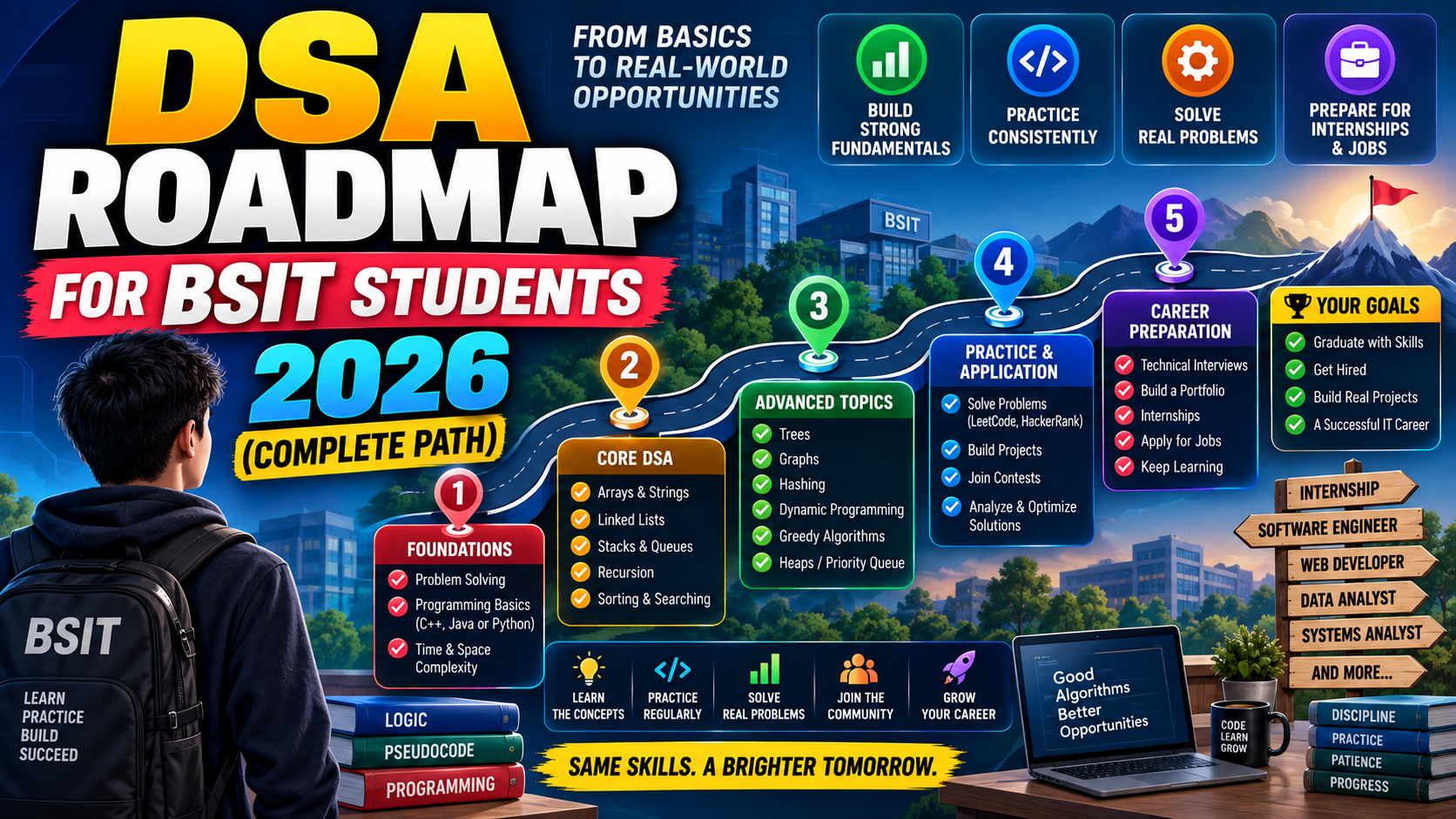
Study DSA for 4 months at 1-2 hours per day using Python (easiest syntax, matches most interview environments). Order: Big-O → Arrays → Strings → HashMap → Two Pointers → Stack + Queue → Binary Trees → BFS + DFS → Recursion → Dynamic Programming → Graphs. Solve 3-5 LeetCode problems per week per topic. By month 4 you can walk into a coding interview at Accenture, IBM, Cognizant, JPMorgan Manila, or Fully Managed and hold your own. This roadmap costs zero pesos.
Why DSA matters for BSIT students in 2026 (real Philippine context)
Every serious tech company that hires in the Philippines gives a coding interview. Accenture Technology, IBM, Concentrix, PayMongo, Kalibrr, Sprout Solutions, First Circle, Growsari, Talino Venture Labs, Great Deals E-commerce, and every remote US employer that hires PH developers. The interview looks the same across all of them: 30-45 minutes of live coding on Zoom, one algorithmic problem, then you explain your solution. If you cannot solve at least a LeetCode Medium in under 30 minutes, you fail the coding round and the interview ends there.
The DSA topic list has not changed since 2015. What changed in 2026: interviewers now expect Python or JavaScript for the coding round (not just Java), the problems trend toward “explain the tradeoff” rather than “recite the textbook solution,” and 40 percent of interviews now include a system design followup where they ask what data structure would fit a real-world scenario. Master the roadmap below and you handle all three.
Language choice: Python for BSIT students in 2026
The best DSA-study language for Philippine BSIT students in 2026 is Python. Reasons:
- Syntax stays out of the way. You focus on the algorithm, not memorizing generics or public static void main.
- Standard library is DSA-friendly.
collections.deque,collections.defaultdict,heapq, andbisectcover 90 percent of interview data structures out of the box. - LeetCode + HackerRank support it fully. Every problem has Python starter code.
- Most PH tech interviewers accept it. Even Java-first shops (Accenture, IBM) let you code in Python during the interview.
- Transfers to production work. Django, Flask, FastAPI backends run on the same syntax you use for LeetCode.
If your capstone was Java or PHP, that is fine. Learn Python fundamentals in one weekend (variables, loops, if/else, functions, lists, dicts), then do all DSA problems in Python from that point forward. Your Java or PHP knowledge stays useful for capstone documentation and long-term backend work.
Month 1: Foundations (Big-O + Arrays + Strings + HashMap)
Week 1: Big-O notation. Read our Big-O guide (linked below). By end of week you can state the time complexity of any nested loop, dict lookup, or recursive call.
Week 2: Arrays. Master the operations that come up in every problem: iterating, two-pointer scan, sliding window, prefix sum. Solve 5-10 LeetCode Easy problems tagged Array.
Week 3: Strings. String manipulation is the second-most-common interview topic after arrays. Practice: reverse a string in-place, check palindrome, anagram detection, substring search. 5 LeetCode Easy string problems.
Week 4: HashMap (dict + set). The single biggest performance boost technique for beginners. Learn the “trade space for time” pattern. Problems: two sum, group anagrams, contains duplicate, valid anagram, isomorphic strings. 5 LeetCode Easy problems.
Month 1 target: 25 total problems solved. If a problem takes more than 40 minutes, read the editorial and re-solve it a week later. Do not skip understanding for volume.
Month 2: Two Pointers, Stack, Queue, Binary Search
Week 5: Two pointers. Same array, two indexes moving. Foundational for palindrome, container with most water, valid palindrome, remove duplicates. 5 problems.
Week 6: Sliding window. Special case of two pointers. Problems: longest substring without repeating characters, minimum window substring, max consecutive ones. 5 problems.
Week 7: Stack + Queue. Learn list.append()/pop() for stack, collections.deque for queue. Problems: valid parentheses, min stack, implement queue using stacks, next greater element. 5 problems.
Week 8: Binary search. Not just on sorted arrays, on any answer space where you can check “is this too big or too small”. Problems: binary search, search in rotated sorted array, find first and last position, sqrt(x). 5 problems.
Month 2 target: 50 total problems. You should now be able to solve LeetCode Easy problems in under 15 minutes and Medium problems in 25-40 minutes.
Month 3: Trees, Recursion, DFS + BFS
Week 9: Binary trees. Traversals (inorder, preorder, postorder), max depth, symmetric tree, invert binary tree. 5 problems.
Week 10: Binary Search Trees. BST validation, insert into BST, kth smallest element. 5 problems.
Week 11: BFS + DFS. Two universal graph and tree traversal patterns. Problems: number of islands, clone graph, course schedule (topological sort), rotting oranges. 5 problems.
Week 12: Recursion. Not a separate topic but a way of thinking. Practice: fibonacci with memoization, tower of Hanoi, generate parentheses, subsets, permutations. 5 problems.
Month 3 target: 75 total problems. You should now be comfortable with recursion + backtracking patterns.
Month 4: Dynamic Programming, Graphs, Interview Simulation
Week 13: Dynamic Programming (1D). Fibonacci memoization, climbing stairs, house robber, coin change, longest increasing subsequence. 5 problems.
Week 14: Dynamic Programming (2D). Unique paths, longest common subsequence, edit distance, 0/1 knapsack. 5 problems.
Week 15: Graphs. Adjacency list representation, BFS shortest path, Dijkstra basics, cycle detection. 5 problems.
Week 16: Full mock interviews. Two per day for 5 days = 10 mocks. Use LeetCode assessment mode OR pair with a classmate. Time yourself strictly. If you cannot finish a Medium in 40 minutes, review that topic.
Month 4 target: 100+ total problems. You are now interview-ready for junior developer roles at Accenture, IBM, Cognizant, JPMorgan Manila, PayMongo, Sprout Solutions, First Circle, or remote US positions.
Free resources every BSIT student should use
- LeetCode. Free tier gives you 2,000+ problems with editorial solutions. Filter by topic + difficulty. Do NOT pay for premium in month 1-2, the free content covers everything.
- NeetCode.io. Free curated list of 150 problems that cover every interview topic. Video explanations for each. Follow the “NeetCode 150” list and you cover the roadmap above.
- YouTube: Kevin Naughton Jr, Back To Back SWE, Errichto. Long-form problem walkthroughs. Watch after you solve, not before, so you build your own intuition first.
- GeeksforGeeks. Deep-dive articles on every DSA topic with C++/Java/Python versions. Best supplement for BSIT students transitioning from Java.
- Big-O Cheat Sheet. bigocheatsheet.com, one-page reference for every data structure and sorting algorithm. Print and pin above your desk.
- MIT OpenCourseWare 6.006. Full MIT DSA course, free, videos + assignments + textbook. Formal but rigorous. Best if you want the theory as well as interview prep.
Study schedule that actually fits a BSIT semester
Every BSIT student I have mentored says the same thing: they cannot study 3-4 hours per day because of school. Here is a realistic 1-2 hour daily schedule that still gets you interview-ready in 4 months:
- Weekdays (Mon-Fri): 1 hour after class. 30 min reading + 30 min solving 1 problem. If problem takes longer, mark it and return the next day.
- Saturday: 2 hours. Solve 2 problems + review week’s progress.
- Sunday: Rest OR 1 hour “concept review” (re-read one Big-O rule, re-implement one data structure from scratch).
- Weekly cadence: 5 hours × 4 weeks × 4 months = 80 hours of DSA study. Enough to complete the NeetCode 150.
The trap: doing 6 hours in one weekend then nothing for a week. Consistency beats bursts every time. If you miss a day, do not double up the next day. Just resume.
Common Philippine BSIT student pitfalls
- Starting with the hardest topic (dynamic programming). DP is Month 4 for a reason. Skipping foundations makes you memorize solutions instead of understanding patterns. You fail the next problem the moment the setup changes.
- Solving problems in the wrong language. If your school taught Java, you may feel comfortable using Java for LeetCode. But Java verbosity slows you down in 45-minute interviews. Learn Python for DSA, keep Java for capstone.
- Watching solutions before trying. Watching a YouTube walkthrough before you have struggled with the problem teaches you nothing. Force yourself to spend 30 minutes trying, then read the editorial.
- Practicing without whiteboarding. LeetCode gives you syntax highlighting and auto-complete. Real interviews often use Google Docs or a plain whiteboard where those helpers do not exist. Practice at least 1 problem per week on paper.
- Undervaluing verbal explanation. “The interviewer wants to see you think” is a Manila career fair cliche because it is true. Practice explaining your solution out loud, in English, before the interview.
- Applying for FAANG before you are ready. Do not apply to Google or Microsoft in month 2. Apply to local shops (Accenture, IBM, Concentrix, Sprout, PayMongo) first, get real interview experience, then upgrade the target.
Where to apply after month 4
Once you finish the roadmap, target companies in this order:
- Manila tech shops (junior dev, PHP 20-40k/mo): Sprout Solutions, First Circle, PayMongo, Kalibrr, Great Deals, Growsari. Interviewers are BSIT-friendly and salary matches CS starters.
- Multinationals (junior dev, PHP 35-60k/mo): Accenture Technology, IBM Philippines, JPMorgan Manila, Cognizant Manila. Bigger interview loop but more predictable process.
- Remote US employers (junior dev, USD 800-2,500/mo): Toptal, Turing, Upwork, Deel-sourced remote roles. Higher pay in USD but harder interview loop and requires strong async English.
- US startups direct (junior dev, USD 2,500-5,000/mo): Apply through Y Combinator’s Work at a Startup board, AngelList, LinkedIn direct. Hardest to get but pays 5-10x local salaries once you land.
Most PIES interns start at Manila or multinational, work 1-2 years to build a portfolio, then jump to remote US. That path is realistic. Trying to skip directly to remote US as a fresh grad is possible but low probability.
Official documentation
Frequently Asked Questions
Can I follow this roadmap while still in school?
Yes. 1-2 hours per day is achievable during school terms if you cut YouTube or scrolling by that much. If your school schedule is heavy (thesis defense semester, board exam prep), stretch the roadmap to 6 months instead of 4. The topic order stays the same.
Do I need to know Java for FAANG interviews?
No. Google, Amazon, Meta, and Netflix all accept Python for their coding rounds as of 2026. Some interviewers may lean into Java-specific questions (thread safety, generics) but you can decline politely and reframe in Python. Amazon Philippines specifically accepts Python for the online assessment and technical rounds.
Is 100 problems enough or do I need 500?
100 well-understood problems beat 500 memorized solutions. If you can explain why your solution works, identify the underlying pattern, and adapt it to a similar problem, you are ready. Grinding 500 problems without pattern recognition is the top mistake I see BSIT students make.
Should I pay for LeetCode Premium?
Not in months 1-2. The free tier has 2,000+ problems with editorial solutions, which is enough for foundations. In month 3-4, if you are specifically preparing for FAANG interviews, Premium unlocks company-tagged problems that show which questions each company actually asks. USD 35/month for 2 months during active job hunt is worth it. USD 35/month indefinitely while learning is not.
How do I stay motivated through 4 months of daily practice?
Track streaks on LeetCode (visible on your profile). Solve with a classmate or Discord study group. Focus on small wins: “I solved my first Medium unassisted today” is worth celebrating. If you burn out, take 2-3 days off completely, not a whole week. Resume where you left off, do not restart from Big-O.
What if I finish the roadmap but still fail interviews?
The most common reason: problem-solving is fine but communication is weak. Interviewers score you on both. Practice explaining solutions out loud in English. Record yourself. Watch back. Second reason: nerves. Do 3-5 real interviews at low-stakes companies first before targeting your dream role. Nervous system adapts to interview settings faster than to problem types.
Related DSA + Interview tutorials
- Big-O Notation Complete Guide for Beginners 2026 (launched today)
- Recursion Explained with Real Examples 2026 (coming this week)
- Sorting Algorithms Cheat Sheet 2026 (coming this week)
- Top 100 Coding Interview Questions 2026 (coming next week)
Free study resources
- LeetCode: 2,000+ problems (free tier)
- NeetCode: 150-problem curated roadmap
- GeeksforGeeks: DSA articles by topic
- MIT OpenCourseWare 6.006: Introduction to Algorithms

Joken E. Villanueva
Founder & Lead Developer at PIES IT Solution
Founder of PIES Information Technology Solutions, a software company building production-grade applications for institutions across the Philippines. Over 8 years of hands-on full-stack development experience, currently leading the development of ClinicAI, an AI-powered clinic management platform.
Expertise: PHP · MySQL · JavaScript · AI Integration · SaaS Architecture · VB.NET · Database Design · Capstone Documentation · Java · View all posts by Joken E. Villanueva →