
The HashiCorp Terraform Associate (003) is the entry-level cert for infrastructure as code (IaC), and it has become one of the most cost-effective DevOps certs on the market in 2026. Terraform itself is used at almost every serious cloud team, from small Manila startups to global companies. Passing the exam is a strong signal that you can automate infrastructure instead of clicking through cloud consoles.
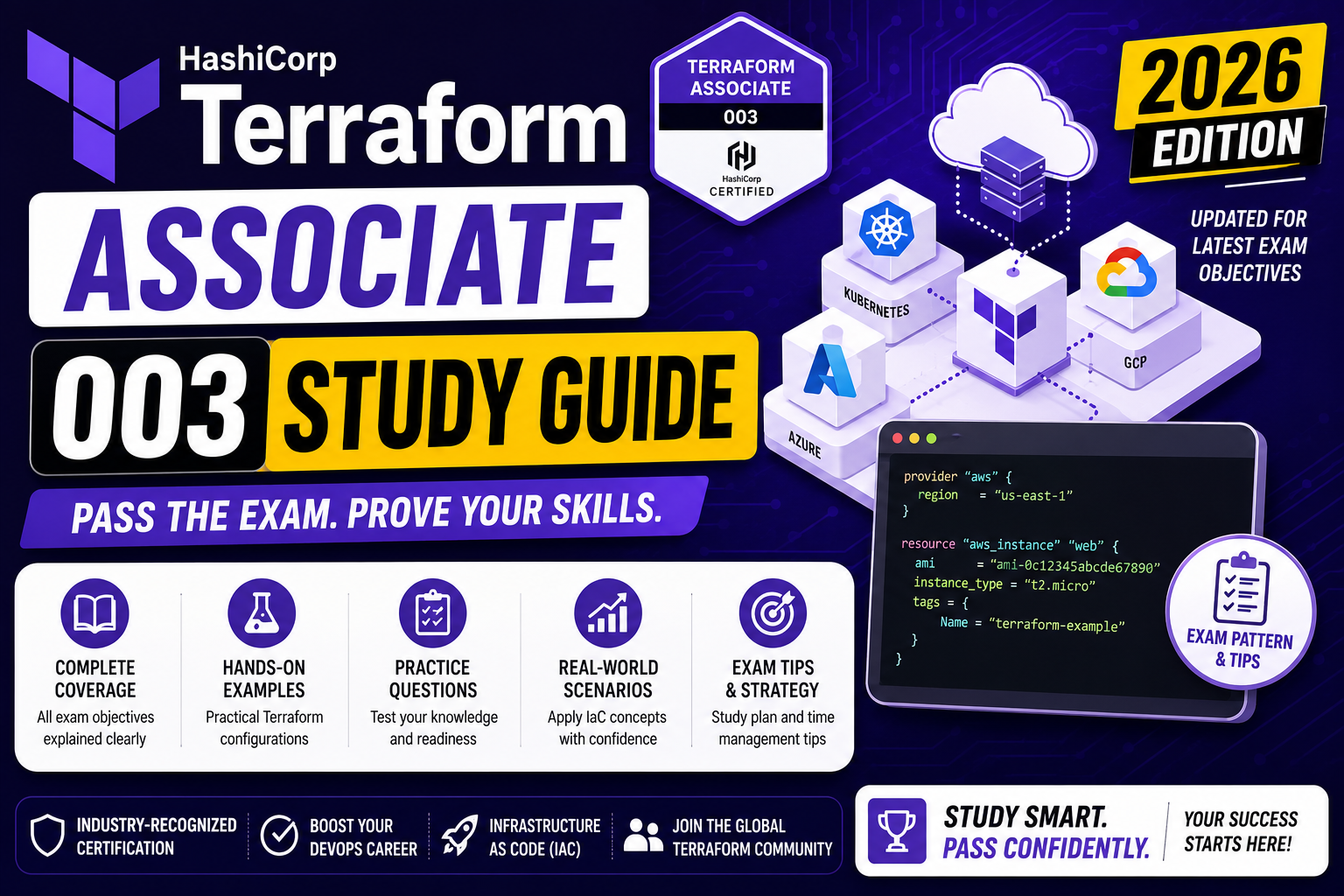
Here is the honest 2026 look at what the exam actually tests, how to prepare, real costs in PHP, and how the Terraform Associate compares to related DevOps certs.
Should you take the Terraform Associate exam?
Yes if any of these apply:
- You work as a sysadmin, cloud engineer, or SRE and want to move into DevOps
- You already use Terraform at work but want to formalize your knowledge
- You want a portable cert that works across AWS, Azure, GCP, and other clouds
- You are hunting for remote DevOps roles and need a resume boost
Skip if:
- You have never touched cloud infrastructure at all (start with AWS Cloud Practitioner or Azure AZ-900 first)
- You only use one specific cloud vendor and are happy with their native IaC tools (CloudFormation, Bicep)
- You are hiring at a company that has already standardized on Pulumi or CDK (learn those instead)
Exam details (2026 rates)
- Exam code: Terraform Associate 003 (introduced 2023, still current in 2026)
- Cost: USD 70.50 (about PHP 4,000)
- Format: 57 questions, mix of multiple choice, multiple select, true/false, matching
- Duration: 60 minutes
- Passing score: Not published by HashiCorp but industry consensus is around 70 percent
- Validity: 2 years
- Delivery: Online via PSI at any time (24/7 scheduling, no need to visit a physical center)
The USD 70.50 fee is by far the cheapest among major DevOps certs. AWS Cloud Practitioner is USD 100, Azure AZ-104 is USD 165, GCP ACE is USD 125. Terraform Associate gives you the most cert credibility per peso spent.
What the exam actually tests
HashiCorp publishes a public objectives sheet. The 9 domains and rough weighting:
- Understand infrastructure as code (IaC) concepts (approx 10 percent): Benefits over manual provisioning, idempotency, immutability
- Understand the purpose of Terraform (approx 10 percent): Multi-cloud, comparing to Ansible/Chef, use cases
- Understand Terraform basics (approx 15 percent): Providers, install, terraform init, terraform version
- Use Terraform outside core workflow (approx 5 percent): terraform import, terraform state, workspaces
- Interact with Terraform modules (approx 15 percent): Contents of a module, publishing to registry, versioning
- Use the core Terraform workflow (approx 15 percent): init, validate, plan, apply, destroy
- Implement and maintain state (approx 15 percent): Remote state, locking, sensitive data handling
- Read, generate, and modify configuration (approx 10 percent): HCL syntax, variables, outputs, functions
- Understand Terraform Cloud capabilities (approx 5 percent): Free tier features, run pipelines, VCS integration
The exam is heavy on the terraform CLI and HCL syntax. Expect direct questions like “What does terraform plan do?” and “Which of these are valid variable types?” It is not tricky, but it does require hands-on experience beyond just reading docs.
8-week study plan for working DevOps candidates
Assumes 6 to 8 hours per week (weekday evenings + weekend mornings). Compressible to 4 weeks if you can study full-time.
Week 1: Fundamentals
Read HashiCorp Terraform Overview and Introduction to IaC docs. Install Terraform locally. Run through the “Get Started” tutorial for your preferred cloud (AWS, Azure, or GCP).
Week 2: HCL syntax deep dive
Cover blocks, arguments, data types, expressions, functions. Write 5 to 10 small configurations from scratch (an S3 bucket, a VPC, a Compute Engine VM, an Azure Storage account).
Week 3: State management
Learn local vs remote state. Set up an S3 backend with DynamoDB locking (or Azure Blob with lease locking). Understand state file security, sensitive data, and how to safely modify state (terraform state rm, terraform state mv).
Week 4: Modules
Write your own module, publish to a private git repository, reference it from another config. Understand version constraints and module composition.
Week 5: Terraform Cloud and workspaces
Sign up for the Terraform Cloud free tier. Connect a GitHub repo, run a plan and apply via Terraform Cloud. Understand workspaces (both CLI workspaces and Terraform Cloud workspaces).
Week 6: Practice exams part 1
Take 2 to 3 practice exams. Whizlabs, Bryan Krausen’s Udemy course, and Tutorials Dojo all have solid Terraform Associate practice sets. Aim for 75 percent consistently.
Week 7: Weak area review
Go back to your weakest domain from practice exams. Common weak spots: functions, state manipulation, provider version constraints.
Week 8: Final practice and exam
Take one last full-length practice exam. Schedule the real exam via PSI. Sit the exam.
Where to take the exam in the Philippines
HashiCorp uses PSI as the exam vendor. The exam is 100 percent online, so there are no physical test centers to visit in Manila, Cebu, or Davao. Requirements:
- Windows or macOS laptop (Linux is not officially supported by PSI’s proctoring software)
- Webcam and microphone
- Stable internet connection (at least 1 Mbps upload)
- Quiet, private room during the exam
- Clean desk with no papers, phones, or other devices in view
- Valid government ID for the proctor identity check
Book at least 24 hours ahead. PSI slots are available 24/7 including weekends.
Salary lift for Filipino DevOps engineers
Real 2026 Philippine market signals:
- Junior sysadmin, no Terraform: PHP 55,000 to 80,000/mo
- Junior DevOps engineer with Terraform Associate: PHP 80,000 to 120,000/mo
- Mid-level DevOps engineer with Terraform + cloud cert (AWS SAA or Azure AZ-104): PHP 120,000 to 200,000/mo
- Senior DevOps or SRE with Terraform + Kubernetes cert: PHP 200,000 to 350,000/mo
- Remote for US or European DevOps teams: USD 4,000 to 10,000/mo (about PHP 230,000 to 570,000)
The Terraform Associate cert itself lifts salary by roughly PHP 15,000 to 30,000/mo for junior-to-mid transitions. Combined with an AWS SAA or Azure AZ-104, the combined cert package often unlocks 40 percent salary jumps.
Comparison with other DevOps entry certs
| Cert | Cost (USD) | Study weeks | PH salary lift |
|---|---|---|---|
| Terraform Associate 003 | 70.50 | 6 to 8 | PHP 15k to 30k/mo |
| AWS SysOps Associate | 150 | 10 to 14 | PHP 15k to 30k/mo |
| CKA (Kubernetes Admin) | 395 | 10 to 16 | PHP 25k to 50k/mo |
| Azure AZ-400 DevOps | 165 | 12 to 16 | PHP 20k to 40k/mo |
Terraform Associate gives the best cost-to-lift ratio at PHP 4,000 investment for a PHP 15,000+ monthly salary lift. Pair it with CKA within 12 months and you become genuinely hireable at senior DevOps rates.
Common mistakes and how to avoid them
- Studying only concepts, no hands-on: The exam tests you know terraform CLI commands and HCL syntax specifically. You have to write real config files, not just read about them.
- Skipping state management: State is 15 percent of the exam and one of the trickier topics. Do the S3 backend and remote state setup labs.
- Ignoring modules: Also 15 percent. Write your own module during study, not just use published ones.
- Rushing past HCL functions: Functions (lookup, merge, jsonencode, formatlist) show up in specific-syntax questions. Memorize the top 15.
- Forgetting Terraform Cloud features: Only 5 percent of the exam but pass or fail on these questions depends on knowing free tier limits.
Official HashiCorp documentation
Recommended courses (affiliate)
The links below are affiliate links. We may earn a commission at no extra cost to you when you enroll. See our affiliate disclosure.
- Bryan Krausen’s Terraform Associate 003 course (Udemy), the most-recommended prep course
- Terraform Associate Practice Exams (Udemy), full-length practice tests
- Infrastructure Automation with Terraform (Coursera), foundational course
- DataCamp Terraform track, hands-on labs
Frequently asked questions
How much does the HashiCorp Terraform Associate exam cost in the Philippines?
USD 70.50, roughly PHP 4,000 at 2026 exchange rates. This is by far the cheapest major DevOps cert. AWS Cloud Practitioner is USD 100, Azure AZ-104 is USD 165, and CKA is USD 395. Terraform Associate gives the best cost-to-credibility ratio in the DevOps cert market.
Can I take the Terraform Associate exam online from the Philippines?
Yes. HashiCorp uses PSI as the online proctoring vendor and there are no physical test centers required. You need a Windows or macOS laptop, webcam, mic, stable internet (1 Mbps upload minimum), a private quiet room, and a valid government ID. Slots are available 24/7 including weekends.
How long does it take to prepare for the Terraform Associate?
Assuming you have basic cloud experience (used AWS, Azure, or GCP consoles before), 6 to 8 weeks of part-time study (6 to 8 hours per week) is typical. Full-time study cuts this to 3 to 4 weeks. Complete beginners with zero cloud background need 3 to 4 months and should learn AWS or Azure basics first.
Does the Terraform Associate cert lift my salary in the Philippines?
Yes, typically PHP 15,000 to 30,000 per month lift for junior to mid DevOps transitions. The bigger effect is that it unlocks DevOps engineer roles that would otherwise skip your resume. Filipino DevOps engineers with Terraform Associate plus AWS SAA earn PHP 120,000 to 200,000 per month.
Should I get Terraform Associate before or after AWS Cloud Practitioner?
Get AWS Cloud Practitioner first if you have zero cloud background. It teaches AWS concepts you will use during Terraform practice (VPC, IAM, S3, EC2). Then take Terraform Associate 4 to 6 weeks later. If you already have AWS or Azure experience, skip straight to Terraform Associate.
Is Terraform being replaced by OpenTofu?
Not in the near term. OpenTofu is a fork of Terraform (created after HashiCorp switched to BSL license) but adoption is still small. Most Philippine and global companies continue to use Terraform. Learn Terraform first. If your target employer specifically uses OpenTofu, transitioning is easy since the CLI and HCL syntax are nearly identical.

Angel Jude Suarez
Full-Stack Developer at PIES IT Solution
Focuses on Python development, machine learning, and AI integration.
Expertise: Python · PHP · Java · VB.NET · ASP.NET · Machine Learning · AI Integration · OpenCV · Django · CodeIgniter · View all posts by Angel Jude Suarez →