
The data analyst path is one of the highest-return career pivots for Filipinos right now. Entry-level roles pay 30 to 55 thousand pesos a month, senior analysts clear 90 to 150 thousand, and the tools you need are free to learn on nights and weekends. You do not need a computer science degree. You do not need a certification to start. What you do need is a plan.
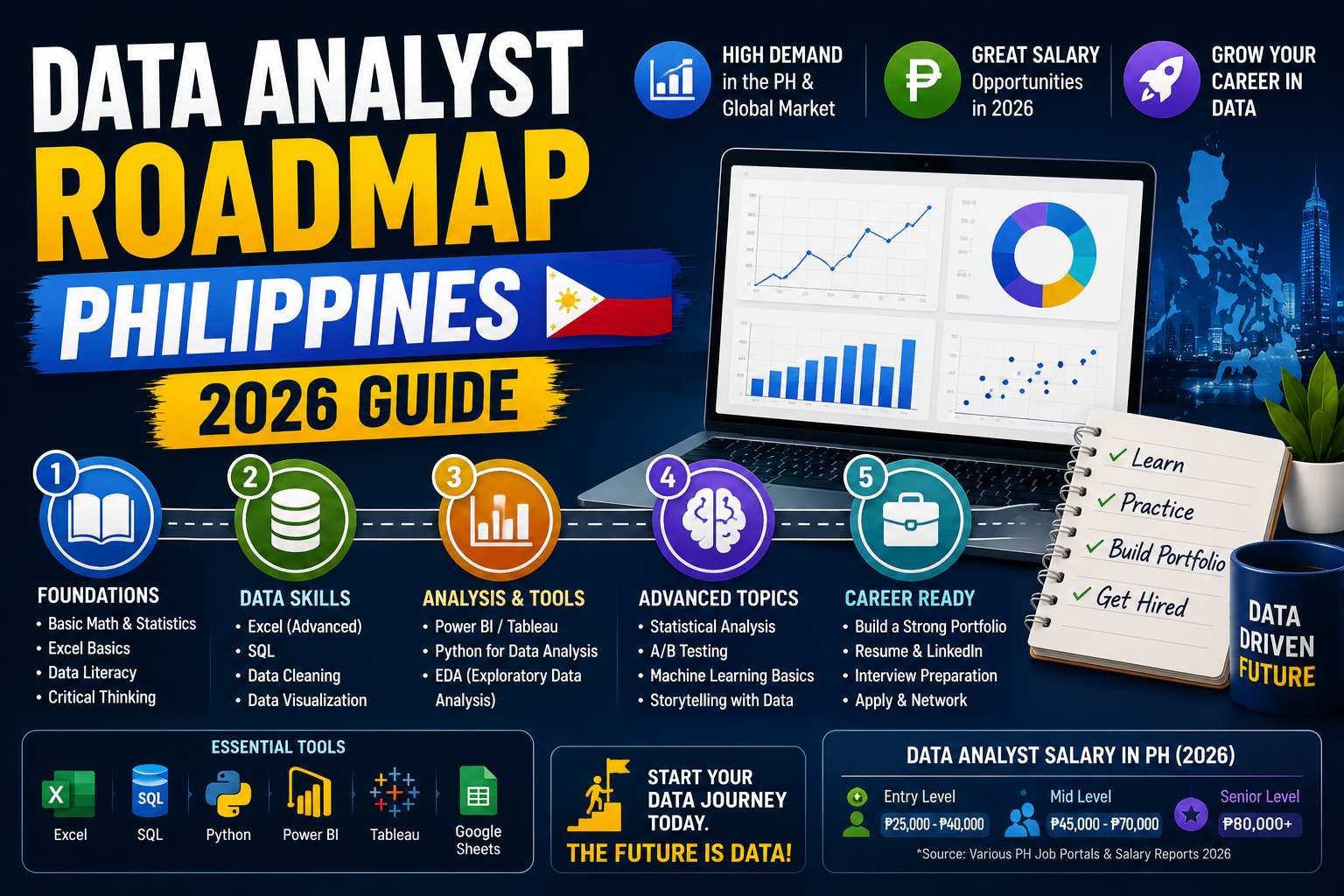
This is the roadmap I would follow if I were starting today from a business, accounting, or IT background. Twelve months, weekend study only, with the tools and projects that actually get you called for interviews at Philippine companies.
What a data analyst actually does in the Philippines
A data analyst turns messy business data into decisions. In a typical Philippine company (say, a fintech in BGC or a BPO in Cebu IT Park), that means:
- Pulling numbers from a database using SQL
- Cleaning and shaping the data in Python or Google Sheets
- Building a dashboard in Power BI or Tableau so managers can see trends
- Presenting the findings in a Monday morning meeting
The job is 60 percent data wrangling, 30 percent visualization and communication, and 10 percent actual math or statistics. If you can write clear English, ask good questions, and stay patient while a query runs, you already have half the skill set.
Data analyst salary in the Philippines 2026
Real 2026 rates pulled from job posts on JobStreet, Kalibrr, Indeed, and LinkedIn Philippines:
- Junior data analyst (0 to 1 year): PHP 28,000 to 45,000 per month
- Data analyst (1 to 3 years): PHP 45,000 to 75,000 per month
- Senior data analyst (3 to 5 years): PHP 75,000 to 120,000 per month
- Lead or analytics engineer (5 plus years): PHP 120,000 to 180,000 per month
- Remote analyst for US or European clients: USD 1,500 to 4,500 per month (roughly PHP 85,000 to 260,000)
Remote work pays the most because you compete for global rates. The tradeoff is you need a stronger portfolio to land that first remote client. Local corporate roles are easier to enter but cap earlier.
The 12-month roadmap: Excel to SQL to Python to BI tools
This is a weekend-study plan, roughly 8 to 10 hours per week. If you can double that, you finish in 6 months.
Months 1 to 2: Excel and Google Sheets fundamentals
Master formulas (VLOOKUP, INDEX MATCH, SUMIFS, XLOOKUP), pivot tables, and basic charts. Build a personal budget tracker and a monthly business report template. Free resources: Microsoft Support tutorials, the official Google Workspace Learning Center.
Months 3 to 4: SQL fundamentals
Learn SELECT, JOIN, GROUP BY, subqueries, and window functions. Practice on real datasets using SQLZoo, Mode Analytics tutorials, or LeetCode SQL problems. By the end of month 4 you should be comfortable writing a 30-line query with three joins and an aggregation.
Months 5 to 7: Python for data analysis
Focus on pandas, NumPy, and matplotlib. Do not spend time on machine learning yet. Build one small project each month: web scraping a real Philippine dataset, cleaning it with pandas, and producing a clear chart. Free path: freeCodeCamp Data Analysis with Python, or Kaggle Learn.
Months 8 to 10: Power BI or Tableau
Pick one. Power BI has more corporate PH jobs (Microsoft ecosystem is dominant in Manila). Tableau has more remote gigs and startup roles. Build 3 dashboards using real data: PSA population statistics, DTI trade data, or Kaggle datasets. Publish them on Tableau Public or your GitHub.
Months 11 to 12: Portfolio and applications
Put 3 to 5 projects on GitHub with clear README files. Write one Medium or LinkedIn post explaining what you learned from each. Update your LinkedIn headline to “Aspiring Data Analyst” and start applying. Aim for 15 applications per week.
Core tools every PH data analyst learns
The exact toolkit that shows up on 80 percent of Philippine data analyst job postings in 2026:
- SQL (Postgres or MySQL): Non-negotiable. Every company has a database.
- Excel or Google Sheets: You will use this every single day, even at senior levels.
- Python with pandas: The industry standard for data cleaning and analysis.
- Power BI or Tableau: Pick one and go deep.
- Git and GitHub: Required for any modern data role. Your portfolio lives here.
- One cloud (nice to have): BigQuery or Snowflake for senior roles. Learn it in year 2.
Certifications worth getting from the Philippines
Certifications are not required to get hired, but two of them noticeably lift callback rates in the Philippine market:
- Google Data Analytics Professional Certificate (Coursera): The most recognized entry-level cert in PH. Takes 3 to 6 months. Financial aid available so effective cost is usually under PHP 3,000.
- Microsoft PL-300 (Power BI Data Analyst Associate): Best signal for corporate roles in BGC and Ortigas. Exam fee is USD 165, about PHP 9,300. Worth it if you want to work at a bank, telecom, or large BPO.
Skip Datacamp certificates, Tableau desktop cert, and any bootcamp that costs more than PHP 30,000. Employers care about your projects, not your certificate wall.
Where Filipino data analysts get hired
The three biggest employer buckets in 2026:
- BPO analytics teams (Manila, Cebu, Davao): Concentrix, Teleperformance, Accenture, Cognizant. Highest volume of entry-level roles. Salary caps around PHP 70,000 without a lead role.
- Fintech and e-commerce (BGC, Ortigas, Makati): GCash, Maya, Shopee, Lazada, Kumu, Union Bank innovation labs. Better pay, more Python and SQL, harder interviews.
- Remote for US or Australian companies: Upwork, Toptal, and direct referral. Best pay by far. Requires a strong GitHub portfolio and clear English writing.
Portfolio projects that get interviews
Recruiters skim your GitHub in 90 seconds. These four project templates work reliably in the Philippine market:
- PSE stock price analysis dashboard: Pull daily closes for 10 PSE tickers, calculate 30-day moving averages, build a Power BI dashboard.
- Philippine COVID data pipeline: Ingest DOH case data, clean it in Python, publish weekly trend charts. Shows real ETL skill.
- E-commerce customer segmentation: Use a public Kaggle e-commerce dataset, cluster customers by RFM (recency, frequency, monetary), visualize the segments.
- OFW remittance trend report: BSP publishes monthly remittance data. Build a dashboard showing which countries send the most, seasonal patterns, and year-over-year growth.
Every project needs a README that explains the business question, the data source, your approach, and one clear insight. Recruiters read the README first.
Common mistakes I see beginners make
- Learning too many tools shallow instead of one deep: A candidate with 3 solid Power BI dashboards beats one with basic exposure to 6 tools.
- Ignoring SQL: Every interview I have watched includes at least one SQL question. Learn window functions.
- Skipping the portfolio step: “I finished a Coursera cert” gets you a rejection email. “Here are three dashboards I built” gets you an interview.
- Applying only to job boards: LinkedIn cold outreach to hiring managers works 3x better than JobStreet applications for tech roles.
- Chasing data scientist roles before data analyst experience: Data science requires 2 to 3 years of analyst work as a foundation. Do not skip.
Official documentation and free learning
Recommended courses (affiliate)
The links below are affiliate links. We may earn a commission at no extra cost to you when you enroll. See our affiliate disclosure.
- Google Data Analytics Professional Certificate (Coursera). The PH-recognized entry-level cert
- DataCamp Career Track: Data Analyst with Python. Interactive SQL + pandas practice
- Udemy: The Complete SQL Bootcamp. One-time low fee, lifetime access
- Udemy: Microsoft Power BI Desktop for Business Intelligence. The PL-300 study companion
Frequently asked questions
Can I become a data analyst in the Philippines without a computer science degree?
Yes. Most junior data analysts I know studied accounting, business administration, engineering, or communications. Companies hire on portfolio and interview performance, not on your major. What matters is that you can write SQL, clean data in Python or Excel, and explain your findings clearly.
How long does it take to land a first data analyst job?
Realistically 8 to 14 months if you study 8 to 10 hours per week and build a real portfolio. Some Filipinos with strong backgrounds (accounting graduates, IT support workers) do it in 4 to 6 months. Faster than that usually means they had prior SQL or Excel exposure.
Is data analyst better than data scientist for Filipinos starting out?
Yes, almost always. Data science requires strong math and machine learning foundations that take years to build. Data analyst is the correct first job because it teaches you real business context, SQL, and communication skills. You can transition to data science after 2 to 3 years as an analyst if you want.
Power BI or Tableau in the Philippine job market?
Power BI wins for corporate PH jobs (banks, telecoms, big BPOs) because they run Microsoft 365. Tableau wins for remote work and startup roles. If you plan to stay in Manila corporate, learn Power BI first. If you want remote gigs with US or European companies, Tableau is a slightly better bet.
Do I need to know statistics to be a data analyst?
Only the basics: mean, median, standard deviation, percentiles, and how to read a distribution. That is high school and college intro-statistics level. Advanced statistics (hypothesis testing, regression modeling) becomes important later if you move into data science, but no interviewer will grill you on it for an entry-level analyst role.
Are Philippine data analyst jobs open to fresh graduates?
Yes, especially in BPO analytics teams (Concentrix, Teleperformance, Accenture) and rotational programs at banks (BPI, Union Bank, BDO). Fresh graduates typically start at PHP 28,000 to 40,000 per month. A strong GitHub portfolio can push starting offers to PHP 50,000 even without work experience.

Leah Whynett Dela Pena
Technology Writer at PIES IT Solution
Leah Whynett Dela Pena is a technology writer at PIES IT Solution, author of 93 career and IT education guides at itsourcecode.com.
Expertise: Tech Careers · IT Education · Web Development Careers · Software Engineering Careers · Cybersecurity Careers · IT Certifications · Career Guidance · View all posts by Leah Whynett Dela Pena →