
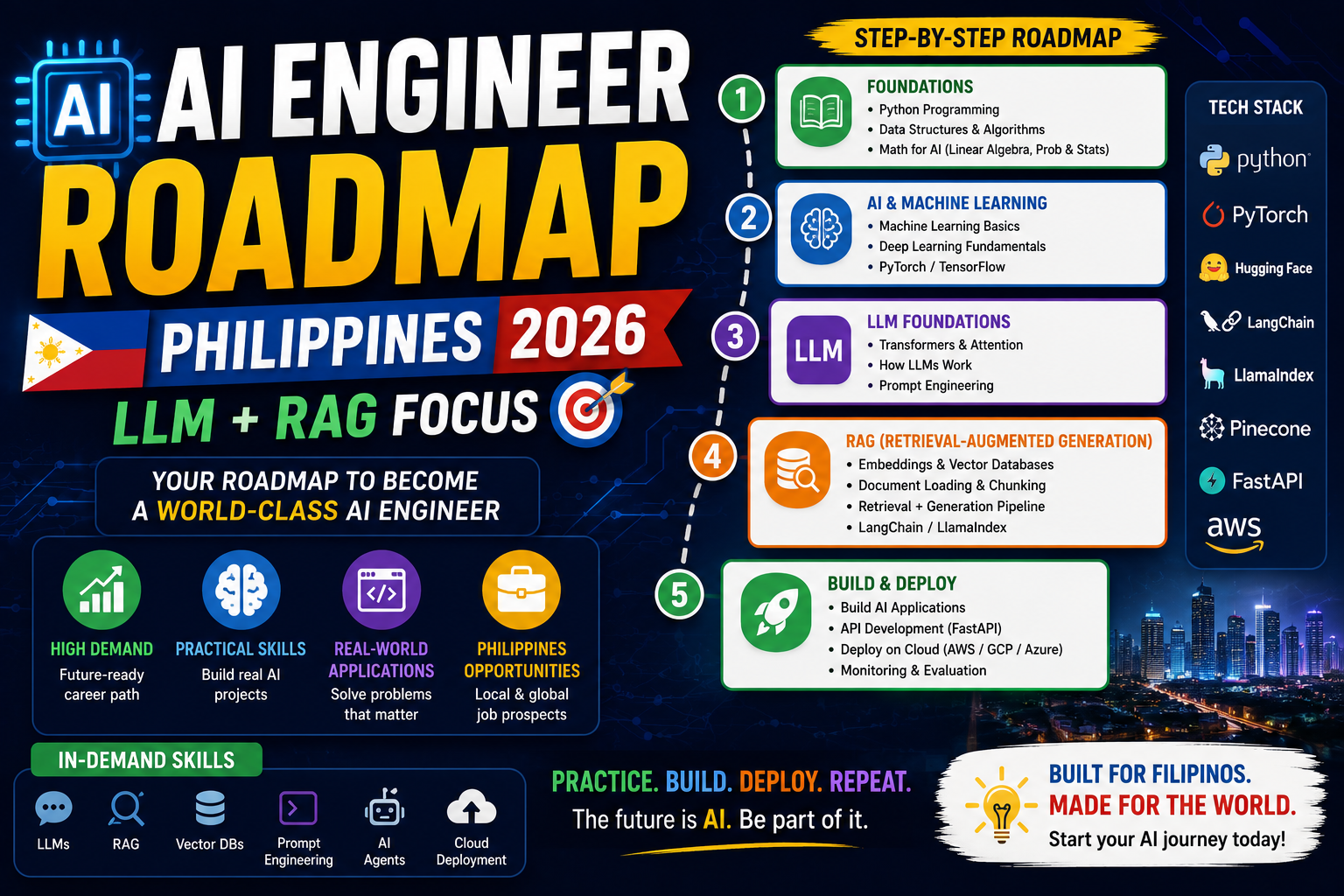
AI Engineer is one of the fastest-growing tech roles in the Philippines. Unlike traditional Machine Learning Engineer roles (which need deep PhD-level math), AI Engineer is a practical role focused on integrating existing AI models (OpenAI, Anthropic, open-source) into production applications. If you already work with Python and APIs, the path to AI Engineer takes 6-12 months of focused learning. This guide walks you through the skill roadmap, salary ranges, and how Filipino developers realistically make the jump.
What an AI Engineer actually does
Common day-to-day tasks:
- Integrate LLM APIs (OpenAI, Anthropic Claude, Google Gemini) into product features
- Build RAG (Retrieval-Augmented Generation) pipelines that combine your company’s data with an LLM
- Set up vector databases (Pinecone, Weaviate, Chroma) for semantic search
- Design prompts that reliably produce structured output
- Evaluate model quality with metrics and automated tests
- Monitor and optimize costs (LLM API calls, embeddings, vector store storage)
- Fine-tune smaller models when APIs are too expensive or too slow
Note: an AI Engineer is not a Machine Learning Engineer. ML Engineers train models from scratch (needs PyTorch, TensorFlow, and math). AI Engineers use existing models via APIs and build systems around them (needs Python, APIs, and system design). The AI Engineer path is faster to learn and equally in demand.
Salary ranges in the Philippines (2026)
Based on job postings across LinkedIn, Kalibrr, JobStreet, and remote-work boards:
- Junior AI Engineer (with 2-3 years dev + AI project experience): PHP 70,000 to 110,000 monthly.
- Mid-level AI Engineer (3-5 years, including 1-2 years focused AI work): PHP 120,000 to 180,000.
- Senior AI Engineer (5+ years, deep production AI experience): PHP 180,000 to 300,000.
- Lead AI Engineer / AI Architect: PHP 300,000 to 500,000+.
- Remote for US startups: USD 5,000-9,000 monthly (PHP 280,000-510,000).
- Remote for US mid-size AI companies: USD 7,000-14,000 monthly (PHP 400,000-800,000).
Salary in this role is higher than equivalent-tenure Web/Backend Developer roles by about 20-40%. The premium reflects scarcity: Filipino developers with real AI production experience are still few.
12-month roadmap (from Web Developer to AI Engineer)
Assumes you already have 2-3 years Python or JavaScript development experience.
Month 1-2: LLM API fundamentals
- Learn the OpenAI API and Anthropic Claude API (both work similarly).
- Build 3-5 small projects: a chatbot, a summarizer, a classifier.
- Learn prompt engineering: zero-shot, few-shot, system prompts.
- Understand token costs and how to estimate them.
Month 3-4: LangChain and orchestration
- Learn LangChain or LangGraph for building multi-step LLM workflows.
- Build a tool-using agent that calls external APIs based on LLM decisions.
- Understand chains, prompts, memory, and streaming responses.
Month 5-6: RAG and vector databases
- Learn how embeddings work (OpenAI text-embedding-3-small, Cohere embed-english-v3).
- Set up a vector database: Chroma (local, free), Pinecone (cloud, generous free tier), or Weaviate.
- Build a RAG chatbot that answers questions from a document corpus you upload.
- Learn chunking strategies, hybrid search, and re-ranking.
Month 7-8: Production deployment
- Deploy your RAG chatbot to a real cloud environment (AWS Lambda, Vercel, Railway).
- Add authentication, rate limiting, error handling, and logging.
- Instrument LangSmith or Langfuse for observability.
- Learn caching strategies to reduce API costs (Redis for prompt caching).
Month 9-10: Evaluation and optimization
- Learn how to build eval sets and test prompt/model changes systematically.
- Understand latency vs cost vs quality trade-offs.
- Try smaller models (Claude Haiku, GPT-4o-mini) for tasks where they suffice.
- Explore fine-tuning basics (OpenAI fine-tuning API).
Month 11-12: Portfolio and job hunt
- Write case studies for 2-3 real projects you built (blog posts or GitHub READMEs).
- Publish on LinkedIn and X to build visibility.
- Apply to AI Engineer roles at Filipino AI startups, remote positions on WeWorkRemotely, and LinkedIn.
- Interview process typically includes a coding challenge and a system design conversation.
Technical skills to master
- Python: Non-negotiable. All modern AI tooling is Python-first.
- OpenAI API + Anthropic API: Both are similar; know both because job listings alternate on which they mention.
- LangChain or LangGraph: Framework for composing LLM workflows. Alternatives: LlamaIndex, Instructor, direct API calls.
- Vector database (one of): Pinecone, Weaviate, Chroma, Qdrant. Most jobs use Pinecone or Chroma.
- Prompt engineering: Structured output, chain-of-thought, few-shot examples.
- Async Python (FastAPI): Modern AI systems are I/O heavy; async is essential for concurrent LLM calls.
- Basic Docker: Containerize your AI apps for deployment.
- Cost awareness: Read an LLM bill, know per-token costs, understand caching to reduce them.
Best Filipino companies hiring AI Engineers in 2026
- Local AI startups: First Circle, Cropital, ClinicAI, various YC-backed PH founders. Highest technical bar, most product-focused work.
- Fintechs: GCash, Maya, Union Bank (fraud detection, credit scoring with LLM assistance).
- BPOs with AI initiatives: Concentrix, TDCX, Accenture. Roles focused on internal automation.
- E-commerce with AI teams: Lazada, Shopee (recommendation, search, chatbot roles).
- SaaS with regional AI focus: Kumu, Sprout Solutions. Growing AI product teams.
Remote-first: Toptal AI, Turing AI, various YC-backed US startups actively hiring PH-based engineers.
What to build for your portfolio
The single biggest resume booster: a public GitHub project that solves a real problem, not a tutorial-follow-along. Ideas:
- Filipino-language chatbot that answers government services questions (SSS, BIR, PhilHealth) with RAG on official documentation.
- Small-business tool like an AI-assisted invoice generator or customer support bot for local sari-sari stores or barangay services.
- Academic assistant that helps BSIT students with capstone documentation using RAG on your school’s rubric.
- Meeting notes automator that transcribes Zoom recordings and generates action items via LLM.
Deploy it. Get real users (even 10 friends counts). Write a blog post about what you built and why. That documentation is often more compelling to interviewers than the code itself.
Common misconceptions about becoming an AI Engineer
- “I need a PhD in ML.” No. AI Engineer is an integrator role. ML Engineer needs advanced math. AI Engineer needs Python and system design.
- “I need to train my own LLM.” Very rarely. 95% of AI Engineer work is calling existing APIs and building around them.
- “AI is a bubble.” Even if hype dies, the integration skills transfer. Every SaaS company from 2027-2030 will have AI features. Someone builds them.
- “It’s too competitive.” Yes at Google Brain. No for Filipino AI Engineer positions where the applicant pool is still small.
- “I need expensive courses.” The best resources are free: Anthropic’s cookbook, OpenAI’s cookbook, LangChain docs, and building projects.
Official documentation
Frequently asked questions
How long does it take to become an AI Engineer from being a Web Developer?
Realistic 6-12 months of focused learning if you already have 2-3 years Python or JavaScript development experience. 3-6 months to be technically ready, 3-6 more months to build a portfolio and land your first AI-focused role.
Do I need to know PyTorch or TensorFlow for AI Engineer roles?
Not for most roles. AI Engineer typically uses LLM APIs (OpenAI, Anthropic), not custom neural networks. Machine Learning Engineer roles need PyTorch. Understand the distinction and target the right role for your background.
Is BSIT enough of a degree for AI Engineer roles?
Yes for most positions. Filipino AI startups and remote US employers care about your GitHub portfolio and technical interview performance more than degree specifics. BSIT with strong Python skills and 2-3 built AI projects is competitive.
Can I really earn USD 7,000 monthly as an AI Engineer remotely?
Yes at mid-to-senior level (3-5+ years of dev experience with focused AI work). US startups and mid-size companies increasingly hire PH-based AI engineers at those rates via LinkedIn, RemoteOK, Toptal, and direct outreach. Portfolio + English communication + timezone overlap matter.
Should I focus on OpenAI or Anthropic APIs first?
Learn one deeply, then the other quickly. OpenAI has broader ecosystem tooling. Anthropic Claude has better reasoning and lower cost at similar quality. Most jobs use one or the other; knowing both makes you competitive across all listings.
Is AI Engineer a safe career path or is it a fad?
Even if LLM hype cools, the integration and system design skills transfer to any next-wave technology. Also, most enterprises have not yet adopted AI meaningfully; the demand curve is early. Job stability for AI Engineers is high for at least the next 3-5 years.