
Ask “how much does a programmer earn?” and the only honest answer is: it depends entirely on where you sit on the map. A senior backend engineer in San Francisco can clear $250,000 a year while a senior with the exact same skills in Manila might earn $45,000, a 5x gap for the same work. Stretch that across the global salary spectrum and the spread hits roughly 10x between the cheapest and the most expensive markets in the world.
That gap isn’t just unfair, it’s also the single biggest career lever a programmer in a low-cost country has. In 2026, with remote-first hiring now mainstream at companies like Toptal, Deel, Remote.com, Andela, and most early-stage YC startups, a developer in the Philippines, India, or Vietnam can credibly earn 3-5x the local salary by working for a US, EU, or AU employer, without leaving home. The hard part isn’t the visa anymore; it’s knowing where to look and what to negotiate.
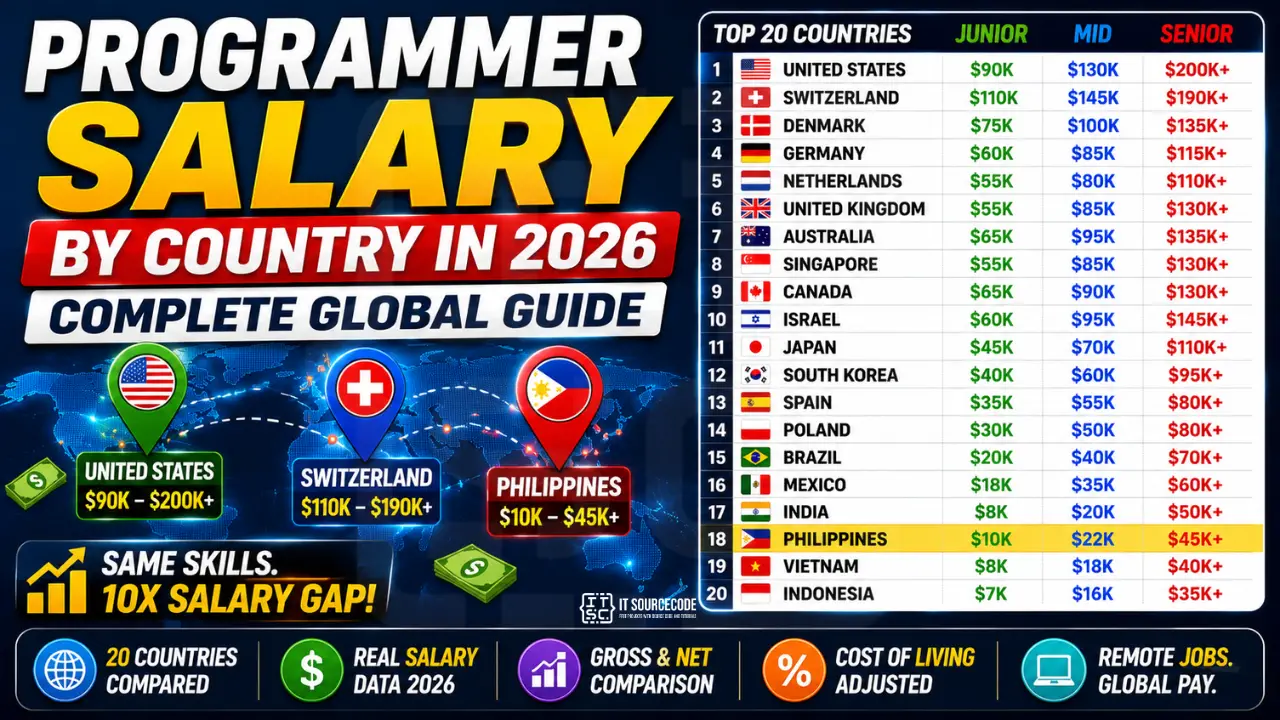
This guide compares programmer salaries across 20 major countries in 2026, breaks down the factors that move the numbers (cost of living, tax, demand, language, remote-friendliness), and gives a concrete playbook for raising your own pay, whether you stay where you are, move abroad, or take the increasingly popular “live in a cheap city, earn a foreign salary” route.
📌 Quick answer: The highest programmer salaries in 2026 are in the United States ($90K-$200K), Switzerland ($110K-$190K), and Israel ($60K-$145K). The lowest nominal salaries are in Indonesia ($7K-$35K), Vietnam ($8K-$40K), and India ($8K-$50K). But raw USD pay is misleading, when you adjust for cost of living and tax, Switzerland, Germany, and Singapore deliver the best real-world purchasing power, while remote-work arbitrage (earning US/EU money while living in the Philippines, India, or Vietnam) gives the single highest lifestyle uplift available to a developer in 2026.
How Programmer Salaries Are Calculated (Methodology)
Before staring at the numbers, it helps to know what’s actually inside them. Programmer compensation in 2026 is almost never a single base figure, it’s a stack with four layers:
- Base salary: the fixed gross amount your contract guarantees. The figures in this guide refer to base unless otherwise noted.
- Bonus: performance, signing, retention, or annual bonuses. Adds 5-25% on top of base at most companies; up to 50%+ at top US tech firms.
- Equity (RSUs / stock options): common at US-listed tech companies and startups. At FAANG-class employers, equity often equals or exceeds base. In most of Europe and Asia outside Singapore and Israel, equity is rare for non-founder employees.
- Benefits: health insurance, pension, paid leave, training budget, equipment. In high-tax countries (Germany, Denmark, Netherlands) the benefits stack is significant; in low-tax countries (Singapore, UAE, parts of Asia) you trade benefits for cash.
Two more variables matter when comparing across borders:
- Gross vs net: a $100K salary in Denmark (~52% effective tax) is closer to $48K take-home; the same $100K in Dubai or Singapore is closer to $85K-$95K take-home. Always compare net for lifestyle, gross for career benchmarking.
- PPP-adjusted vs USD nominal: Purchasing Power Parity adjusts for the fact that $1 buys more rice in Manila than in Manhattan. PPP-adjusted, a $40K salary in the Philippines is worth roughly $90K-$100K of “US lifestyle.” Nominal numbers undersell what a salary actually buys in low-cost countries.
Programmer Salaries: 20 Countries Compared (2026)
Below are 2026 median annual base salaries in USD for software developers / programmers, broken into Junior (0-2 years), Mid (3-5 years), and Senior (6+ years). Numbers reflect national medians, capital cities and tech hubs run 20-50% above; provincial markets run 10-30% below. Ranges come from cross-referencing Stack Overflow, Levels.fyi, Glassdoor, Payscale, and local recruiter reports for 2025-2026.
🇺🇸 United States: $90K / $130K / $200K
Still the global salary leader. SF Bay Area and NYC senior engineers at FAANG-class companies routinely clear $300K-$500K with equity. Austin, Seattle, Boston follow at 80-90% of SF rates. Remote-only US roles cluster at the lower end of national medians.
🇨🇭 Switzerland: $110K / $145K / $190K (CHF)
Highest median pay in Europe. Google Zurich, Meta Zurich, and a strong domestic finance/pharma sector push numbers up. Cost of living is also the world’s highest, Zurich rent for a 1BR can hit $2,800/month. Net purchasing power still excellent.
🇩🇰 Denmark: $75K / $100K / $135K (DKK)
High gross, very high tax (45-55% effective). But strong public services (free healthcare, free university) mean net stress is lower than the tax rate suggests. Copenhagen is the main hub.
🇩🇪 Germany: $60K / $85K / $115K (EUR)
Europe’s largest tech market by headcount. Berlin and Munich pay 10-15% above national median. EU Blue Card makes it the most accessible path for non-EU developers; many PH and Indian engineers relocate here. Senior salaries above $115K usually mean staff/principal level.
🇳🇱 Netherlands: $55K / $80K / $110K (EUR)
Amsterdam tech scene is dense with international startups and US satellites (Uber, Booking, Adyen). The “30% ruling” tax break for foreign hires materially boosts net income for the first 5 years.
🇬🇧 United Kingdom: $55K / $85K / $130K (GBP)
London commands a 20-25% premium over the rest of the UK. Strong fintech (Revolut, Wise, Monzo), AI (DeepMind), and US satellite offices. Post-Brexit visa friction has eased the labour-market squeeze; salaries grew 12-18% nominally between 2023 and 2026.
🇦🇺 Australia: $65K / $95K / $135K (AUD)
Sydney and Melbourne anchor the market. Banking, mining tech, and a growing AI/cybersecurity sector. Skilled migration program (subclass 189/190 visas) is one of the more accessible paths for senior developers from PH/India.
🇸🇬 Singapore: $55K / $85K / $130K (SGD)
Low tax (effective 10-18% at most developer salary levels), regional HQs for nearly every US tech company, easy travel hub for Asia. Tech Pass and EP visas favour senior engineers. Cost of living high but compensated by tax savings.
🇨🇦 Canada: $65K / $90K / $130K (CAD)
Toronto and Vancouver dominate. Express Entry remains a friendly immigration path. Salaries trail US peers by 25-40% even though the talent and tooling are identical, a known frustration that pushes many Canadian devs to remote-US roles.
🇮🇱 Israel: $60K / $95K / $145K (USD-pegged for many roles)
Highest per-capita tech density outside Silicon Valley. Strong cybersecurity, AI, and chip-design sectors. Tel Aviv pays at near-US levels for senior engineers, especially in security and ML.
🇯🇵 Japan: $45K / $70K / $110K (JPY)
Foreign-friendly tech roles (Mercari, LINE, Rakuten, plus US satellite offices) pay 30-50% above traditional Japanese employers. Domestic SI firms remain notoriously underpaid. English-speaking foreign engineers are in heavy demand.
🇰🇷 South Korea: $40K / $60K / $95K (KRW)
Samsung, LG, Naver, Kakao, Coupang dominate domestic hiring. Long working culture, high pressure, but senior backend and ML salaries at top firms approach Singapore-tier.
🇪🇸 Spain: $35K / $55K / $80K (EUR)
Madrid and Barcelona are growing remote-friendly hubs. Spain’s digital nomad visa (introduced 2023) attracts foreign remote workers; local salaries are catching up to NL/DE slowly but remain lower.
🇵🇱 Poland: $30K / $50K / $80K (PLN/EUR)
Eastern Europe’s most mature outsourcing and product market. Warsaw, Krakow, Wroclaw host major US/EU R&D centers. Excellent C++/Java/embedded talent pool.
🇧🇷 Brazil: $20K / $40K / $70K (USD-equivalent)
Largest Latin American developer market. Time zone overlap with the US (1-3 hours from EST) makes Brazil a top remote-hire region for US companies via Deel and Remote.com. Local cost of living moderate.
🇲🇽 Mexico: $18K / $35K / $60K (USD-equivalent)
Nearshoring darling. Mexico City and Guadalajara are major destinations for US companies offloading work from higher-cost regions. Senior salaries paid in USD via contractor arrangements can exceed local USD-equivalent ranges considerably.
🇮🇳 India: $8K / $20K / $50K (INR)
The world’s largest developer talent pool. Bengaluru, Hyderabad, Pune, and Gurgaon command 1.5x-2x premium over the national median. Senior engineers at FAANG India offices regularly clear $80K-$150K base + significant equity, the top 5% of Indian developers earn more than the median in many EU countries.
🇵🇭 Philippines: $10K / $22K / $45K (PHP/USD)
Manila/Makati/BGC and Cebu IT Park BPO and product tech roles pay 30-50% above provincial markets. Local SI firms anchor the lower end; multinational product offices (Globe Labs, GCash, Maya, ShopBack, plus regional Google/Microsoft hires) anchor the top. Remote roles for US/AU clients via Toptal, Arc, or direct contracts routinely double or triple local senior pay, see our full Philippine SE salary deep-dive for company-by-company numbers.
🇻🇳 Vietnam: $8K / $18K / $40K (VND)
Hanoi and Ho Chi Minh City. Strong outsourcing market (FPT, TMA, KMS); product startups growing. Remote-for-US roles increasingly common.
🇮🇩 Indonesia: $7K / $16K / $35K (IDR)
Jakarta dominates. Unicorn ecosystem (Gojek, Tokopedia/GoTo, Bukalapak, Traveloka) pays at the top end of local market. Vast junior talent pool; senior shortage. Cost of living among the lowest in this guide, purchasing power on a senior local salary is comparable to a US$60-70K equivalent lifestyle.
Quick Comparison Table: Senior Programmer Salary (2026)
| Country | Junior | Mid | Senior | Tax burden |
|---|---|---|---|---|
| United States | $90K | $130K | $200K | Medium (state-dependent) |
| Switzerland | $110K | $145K | $190K | Low-Medium |
| Denmark | $75K | $100K | $135K | Very high (45-55%) |
| Germany | $60K | $85K | $115K | High (35-42%) |
| Netherlands | $55K | $80K | $110K | High (30% ruling helps) |
| United Kingdom | $55K | $85K | $130K | Medium-High |
| Australia | $65K | $95K | $135K | Medium-High |
| Singapore | $55K | $85K | $130K | Very low (10-18%) |
| Canada | $65K | $90K | $130K | Medium-High |
| Israel | $60K | $95K | $145K | Medium |
| Japan | $45K | $70K | $110K | Medium |
| South Korea | $40K | $60K | $95K | Medium |
| Spain | $35K | $55K | $80K | Medium-High |
| Poland | $30K | $50K | $80K | Medium (B2B contracts much lower) |
| Brazil | $20K | $40K | $70K | Medium-High (PJ contracts ~10%) |
| Mexico | $18K | $35K | $60K | Medium |
| India | $8K | $20K | $50K | Medium |
| Philippines | $10K | $22K | $45K | Medium (self-employed ~8%) |
| Vietnam | $8K | $18K | $40K | Medium |
| Indonesia | $7K | $16K | $35K | Medium |
What Drives Salary Differences?
The 10x global salary gap isn’t random. Five forces stack on top of each other to produce the spread you see in the table above.
1. Demand vs supply of developers. The US, Switzerland, and Israel have far more open tech roles than they have local senior engineers, every salary above $150K in this guide reflects that scarcity. India and the Philippines have the opposite imbalance: huge talent pools competing for fewer high-paying domestic seats. Remote work is the safety valve that lets supply in low-cost markets reach demand in high-cost ones.
2. Cost of living. Local salaries broadly track local rent and grocery prices, because employers compete with each other to attract people who can actually afford to live nearby. This is why nominal pay in San Francisco is 4x Manila’s, but a $1,800 SF studio costs more than a 3-bedroom Cebu condo. Always compare cost-adjusted, not nominal.
3. Taxation and benefits. A high gross in Denmark and Germany loses 40-50% to tax, but those countries return value via free healthcare, public transit, and education. Singapore and the UAE keep nearly all of the gross but you pay for everything privately. The honest comparison is “net cash + value of subsidized services.”
4. Language and culture fit. English-default markets (US, UK, AU, SG, parts of NL and SE) hire from a wider global pool, and pay more for it. Japan, South Korea, and France pay foreign-friendly tech roles a premium specifically because the local talent who speak fluent English is scarce.
5. Remote-friendliness. The biggest shift between 2020 and 2026: companies that hire globally have, on average, equalized pay 30-50% toward US levels for senior roles. A Philippines-based engineer at a remote-first US startup in 2026 can earn $80K-$120K, figures that were unimaginable from a local employer 5 years ago.
Remote Work in 2026: Earn Foreign Salary, Live Local Cost-of-Living
For a developer in the Philippines, India, Vietnam, or anywhere with a strong USD/local-currency gap, this is the single highest-leverage career move available in 2026. Earning $60K USD while paying Philippines rent and groceries puts you at lifestyle-equivalent of roughly a $130K-$150K US salary, with most of that gap going straight into savings.
Where to find remote-first roles:
- Toptal: vetting bar is high (top 3% claim), but accepted developers reliably earn $40-$120/hr USD on real client projects.
- Arc.dev: strong for full-time remote roles with US/EU companies; lower bar than Toptal, faster hiring.
- Deel and Remote.com: Employer of Record platforms used by thousands of US/EU companies to hire globally. Apply directly to companies who list “available via Deel” in their job posts.
- Andela: heavy focus on Africa originally, now global; long-term placements with US tech companies.
- Working Nomads, Remote OK, We Work Remotely: job boards aggregating remote-friendly listings across thousands of companies.
- LinkedIn (with the “Remote” filter): still the highest-conversion channel for senior hires. Combine with LinkedIn Premium if you’re applying actively, InMail credits and applicant-ranking insights pay back the subscription within 1-2 months.
- Direct outbound: the highest-paying route. Find 20 companies you actually want to work for, find the engineering manager on LinkedIn, send a one-paragraph DM with a portfolio link. Conversion is 5-15%.
Tax implications (PH-specific): Filipino developers working as independent contractors for foreign clients are typically classified as “professional / self-employed” by BIR. The 8% flat income tax option (in lieu of graduated rates + percentage tax) applies if annual gross is below the VAT threshold and you opted in on your COR. Register with BIR within 30 days of your first foreign payment, keep PayPal/Wise/Payoneer statements, and file quarterly. Penalties for skipping registration are larger than the tax itself; don’t try to fly under the radar at scale. (Not tax advice, consult a Philippine CPA for your specific situation.)
Success-pattern observations: Filipino and Indian developers most successful at landing US/EU remote roles in 2026 share three traits, (1) a polished GitHub portfolio of 3-5 real shipped projects, not just course exercises; (2) clear public writing (blog, dev.to, or LinkedIn posts) demonstrating technical thinking; (3) certifications in one high-demand specialization (cloud, ML, security, see our best tech certifications 2026 guide). All three are achievable in 6-12 months of deliberate effort.
Programmer Salary by Specialization (Global Average)
Same country, same years of experience, but the specialization moves pay by 30-100%. These are 2026 global averages of the senior-level premium or discount versus the “generalist full-stack” baseline:
- ML / AI Engineer: +40% to +100%. The single hottest specialization in 2026. LLM ops, RAG, agentic systems, and applied ML all command top-of-band pay. Top US firms pay $400K+ for senior ML; the global gradient holds.
- DevOps / SRE / Platform: +20% to +35%. Cloud-native (Kubernetes, Terraform), observability, and SRE discipline reliably out-earn application devs.
- Security Engineer: +25% to +50%. AppSec, cloud security, and red-team roles in particular. Demand outpaces supply almost everywhere.
- iOS Mobile: +10% to +20%. Still commands a premium over Android in most markets due to smaller talent pool.
- Android Mobile: baseline; close to full-stack pay in most countries.
- Backend: baseline. The widest job pool and the most established salary bands.
- Full-stack: baseline to slight discount. High demand at smaller companies; mid-tier pay at large companies.
- Frontend: -5% to -15% vs backend at senior level. React/TypeScript senior level do close the gap; pure CSS/visual roles trail.
- Data Engineer: +15% to +30%. Snowflake, dbt, Spark, streaming, strong demand from every mid-size+ company.
- Game Dev: -10% to -30%. Pay below enterprise tech in most countries; passion-driven industry with oversupply.
- Web3 / Blockchain: Volatile. Crashed from 2022 peaks; senior Solidity/Rust contract engineers still earn $100K-$200K at active protocols, but job count is a fraction of 2021-2022.
How to Increase Your Programmer Salary in 2026
Five concrete levers, in roughly the order of effort-to-payoff ratio:
1. Get one strategic certification. Not five, one, in a high-demand area. AWS Solutions Architect, Google Cloud Professional, or a focused security cert (OSCP, CISSP) measurably moves resumes past the screening filter and raise offers by 10-25%. See our 2026 best tech certifications guide for the ROI breakdown.
2. Specialize in a premium niche. Pick one of the top-paying specializations above (ML/AI, security, cloud platform, data engineering) and build 12 months of real, shipped work in it. Generalist full-stack pay tops out faster than specialist pay in every market.
3. Negotiate properly. Two non-negotiable rules: (a) never share your current salary or salary history in a first interview, answer with “I’m looking for a role in the $X-$Y range for someone with my skills.” (b) When you receive an offer, always counter at least once, asking for 15-25% more or for specific equity. Recruiters expect this; the worst case is “no, this is our best”, which costs you nothing. Skipping negotiation is the single most expensive habit in any developer’s career.
4. Move to a higher-paying country, or work remotely for one. The math is brutal: 3 years of effort to raise your skill level by 30% will rarely match the salary uplift of changing geography. EU Blue Card to Germany, Australian skilled migration, or Canada’s Express Entry are the three highest-ROI relocation paths for senior PH/Asian engineers. Remote-for-US is the lower-risk version of the same trade.
5. Build a public portfolio of real shipped projects. Not coursework, not tutorials, actual projects with real users (or at least a working live URL). Three to five strong projects on GitHub plus a one-page personal site beats every other resume signal at the senior level. If you need ideas, browse our 150 best capstone project ideas, many translate cleanly into portfolio-grade projects.
Salary Trends 2024-2026: What’s Actually Happening
Three shifts have re-shaped the salary landscape since 2024:
AI assistance has compressed junior pay, expanded senior pay. Companies that previously hired 5 junior developers to handle routine work now hire 2-3, augmented by Copilot / Cursor / Windsurf. That’s pushed junior salaries flat or slightly down in nominal terms in many markets. The flip side: senior engineers who design systems, review AI-generated code, and own outcomes are worth more, and being paid for it. The “missing rung” between junior and senior is the most talked-about hiring problem of 2026.
The 2023-2024 layoffs are over, but the bar is higher. Hiring resumed in 2025-2026, but companies remain stricter on signal-to-noise: portfolio, certifications, and proven shipped work matter more than years on a resume. This actually favours self-taught and bootcamp developers with strong portfolios over degree-only candidates with thin GitHubs.
What’s growing fastest. Applied ML/AI engineering, cloud security, platform/SRE, and data engineering all show double-digit YoY salary growth in 2025-2026 data. Frontend (pure UI) and traditional QA have stagnated. Mobile and game dev are mixed. The cleanest predictor of salary growth in your career is whether your specialization is on the upper or lower half of this list, pick accordingly.
Philippine developer salary compared to Netherlands, US, and remote work
Philippine developers frequently ask two related questions in 2026: (1) how does local compensation compare to Netherlands or US salaries, and (2) is going abroad or working remote worth it. The numbers below are Sep 2026 medians pulled from Glassdoor, Levels.fyi, and Payscale for mid-level developer roles (3-5 years experience):
- Philippines local employer: 40,000-90,000 PHP/month (~715-1,600 USD). Top tier (senior dev at Manila multinational) reaches 150,000-250,000 PHP/month.
- Netherlands (mid-level): 55,000-75,000 EUR/year (~5,000-6,800 USD/month). Cost of living in Amsterdam or Utrecht is 2-3x higher than Manila.
- US (mid-level, remote-friendly regions): 100,000-160,000 USD/year (~8,300-13,300 USD/month). West Coast (San Francisco, Seattle) trends 15-30 percent higher.
- Remote US employer from Philippines: 3,000-8,000 USD/month depending on role and employer. Cost of living stays Philippine, effective spending power roughly matches a Netherlands-based dev.
Seattle vs Bay Area vs remote for tech developers
US developers considering location in 2026 face a shifting landscape. Rough compensation medians for a senior developer (5-8 years):
- San Francisco Bay Area: 220,000-350,000 USD total comp. Highest cash + equity but 3-4x the housing cost of median US cities.
- Seattle: 200,000-320,000 USD total comp. Only 20-30 percent lower than Bay Area with 40-50 percent cheaper housing. No state income tax on individuals.
- Austin, Denver, Raleigh: 160,000-240,000 USD. Cost of living further below Seattle. Growing tech scenes but shallower talent pool.
- Fully remote (US employer, any US city): 150,000-230,000 USD. Location-independent pay bands are increasingly common but a slight discount vs on-site major-market roles.
The 2026 trend: Seattle is the practical sweet spot for developers who want Bay-Area-level compensation without Bay-Area-level cost of living. Fully remote is competitive if you live in a lower-cost US city or abroad, but starting-salary compression is real for candidates who are geographically flexible.
Frequently Asked Questions
Which country pays programmers the most in 2026?
The United States pays the highest nominal programmer salaries in 2026, with senior engineers in the SF Bay Area and NYC clearing $250K-$500K total compensation at top tech firms. Switzerland leads Europe at $190K median for senior-level. Israel ranks third globally for senior tech pay, especially in cybersecurity and AI. Adjusted for tax and cost of living, Singapore and Switzerland deliver the best net purchasing power. How much does a programmer earn in the Philippines in 2026?
In 2026, programmer salaries in the Philippines range roughly from $10,000/year (₱560K) for juniors to $22,000/year (₱1.2M) for mid-level and $45,000/year (₱2.5M+) for senior developers, with Manila/BGC/Makati and Cebu IT Park commanding a 30-50% premium over provincial markets. Remote roles for US/AU clients via Toptal, Arc, or direct contracts routinely double or triple these numbers. See our full Philippine SE salary deep-dive for company-by-company figures. Can a programmer in the Philippines really earn a US salary remotely?
Yes, and it’s the single highest-leverage career move available to Filipino developers in 2026. Senior PH-based engineers working remotely for US companies via Toptal, Deel, Remote.com, or direct contracts routinely earn $60,000-$120,000 USD/year. The combination of US salary and PH cost of living creates a purchasing power equivalent to roughly $130K-$150K in the US. The hard part isn’t the visa anymore; it’s building a portfolio strong enough to compete with global applicants. What is the highest-paying programming specialization in 2026?
ML / AI Engineering is the highest-paying specialization globally in 2026, with senior salaries running 40-100% above generalist full-stack pay. Cloud security, platform/SRE, and data engineering follow. Frontend (pure UI) and game development sit at the lower end. Specializing in a premium niche is one of the highest-ROI moves any developer can make. Do programmers in India earn more than in the Philippines?
On the median, salaries in India and the Philippines are roughly comparable, India: $8K junior, $20K mid, $50K senior vs Philippines: $10K junior, $22K mid, $45K senior in 2026 USD-equivalent. India’s top tech hubs (Bengaluru, Hyderabad) and major product companies (FAANG India offices) pay significantly higher than the national median, sometimes reaching $100K-$150K base for senior engineers, figures less common in the Philippines, where the top-tier compensation is more often unlocked via remote-for-US roles. Is it better to relocate abroad or work remotely from the Philippines?
Both are valid, but the math depends on lifestyle priorities. Relocating (Germany via EU Blue Card, Australia via skilled migration, Canada via Express Entry) delivers higher gross pay, social benefits, and a long-term path to citizenship, but you pay full local cost of living. Remote-for-US from the Philippines delivers higher net purchasing power because you spend in pesos while earning in dollars, but you carry self-employment tax and benefits responsibility yourself. Many Filipino senior engineers choose remote-first for 5-10 years to build savings, then relocate later. How much do junior programmers earn globally in 2026?
Junior programmer salaries in 2026 range from about $7,000/year in Indonesia and Vietnam to $110,000/year in Switzerland and $90,000/year in the United States. The PH/India junior range sits at $8K-$10K. AI assistance has compressed junior hiring across most markets, companies hire fewer juniors and expect a stronger portfolio from those they do hire. Building 3-5 shipped projects during your studies is now the most reliable path to a junior offer above the local median. What is the difference between gross and net programmer salary?
Gross is the contracted annual amount before tax and social contributions. Net is what actually lands in your bank account after tax. The spread varies enormously: Denmark and Germany take 40-55% of gross, the US averages 20-30% federal+state, Singapore and the UAE take under 18%. A $100K Danish salary nets ~$48K take-home; a $100K Singapore salary nets ~$85K-$90K. Always compare net for lifestyle and gross for career benchmarking. What sources are these 2026 programmer salary numbers from?
Ranges in this guide are cross-referenced from Stack Overflow Developer Survey, Levels.fyi (especially for US tech tier), Glassdoor, Payscale, regional recruiter reports for 2025-2026, and locally-sourced data for the Philippines. All figures are medians, not guarantees, individual pay varies widely by company, specialization, and negotiation. Use these as benchmarks for what’s normal, not promises of what you’ll earn. How can I increase my programmer salary fastest?
In rough order of payoff: (1) get one strategic certification in a high-demand area like AWS, GCP, or security (10-25% offer lift); (2) specialize in ML/AI, security, or data engineering (30-100% premium over generalist); (3) negotiate every offer: never share salary history; counter at least once (15-25% upside per role); (4) move to a higher-paying country or work remotely for one (2-5x salary uplift); (5) build a public portfolio of 3-5 real shipped projects (raises every other lever). See our best tech certifications guide for step 1.
📌 Ready to grow your developer career?
Start with our 2026 PH software engineer roadmap, prep for interviews with our PH interview question guide, browse the highest-ROI tech certifications for 2026, or pick a portfolio project from our 150 best capstone project ideas.
Final Recommendation
The 2026 programmer salary landscape rewards two specific moves more than any others: specialize in a premium niche (ML/AI, cloud security, data engineering, SRE), and open your geographic options: either by relocating to a higher-paying country or by working remotely for one from a low-cost base. Either move reliably 2-3x’s a developer’s lifetime earnings; doing both compounds.
For students and early-career developers in the Philippines, India, and similar markets, the practical sequence is: build a strong portfolio during school → land a local job for 1-2 years to learn at speed → pick one premium specialization → earn one strategic certification → transition to remote-for-foreign-employer at the 3-5 year mark. The pay jump at that transition is often 2-4x, the single largest financial step most developers ever make.
🎯 Your next steps:
- Identify your target salary band, pick a country + experience level from the table above and treat it as your 12-month goal
- Read our deep-dive on how much software engineers earn in the Philippines for company-by-company context
- Map your career path with our 2026 PH software engineer roadmap
- Pick one strategic certification from our best tech certifications 2026 guide, it pays back in months, not years
- Build a portfolio that gets you interviewed, start with our 150 best capstone project ideas
- Need the right machine to ship serious portfolio work? See our 2026 programming laptop guide
- Prep for interviews with our Philippine SE interview questions
Earning a different number than what you see here? Drop your country, experience, and specialization in the comments, anonymous data points help future readers calibrate. We refresh this guide every 6 months as new salary data lands.

Adrian Mercurio
Full-Stack Developer at PIES IT Solution
Specializes in building complete capstone projects with full documentation. Strong background in PHP/MySQL development and database design. Has personally built and tested over 30 capstone-ready projects with ER diagrams, DFDs, and chapter-by-chapter thesis documentation.
Expertise: PHP · Laravel · Database Design · Capstone Projects · C# · C · C++ · Python · AI Projects · View all posts by Adrian Mercurio →
Recommended career and negotiation books
The links below are affiliate links. We may earn a commission at no extra cost to you when you sign up or buy. See our affiliate disclosure.