
Cybersecurity in the Philippines is no longer a niche specialization, it’s one of the highest-paid, fastest-growing tracks in PH tech in 2026. Banks are losing tens of millions of pesos per year to fraud and ransomware. The National Privacy Commission (NPC) is fining companies for Data Privacy Act violations. The Cybercrime Investigation and Coordinating Center (CICC) is actively hiring. BPO giants like Accenture, Concentrix, IBM, and Cognizant are running 24/7 Security Operations Centers (SOCs) out of Manila, Cebu, and Davao, and they cannot fill seats fast enough.
For BSIT and BSCS graduates, this is the clearest career arbitrage available right now: cybersecurity roles pay 30-50% more than general IT at the same experience level, the work is remote-friendly (you can earn USD from foreign employers), and the entry barrier is reasonable if you follow a structured plan. A master’s degree isn’t required. OSCP isn’t necessary on day one. What matters is strong fundamentals, one entry-level certification, and proof that you can do the work.
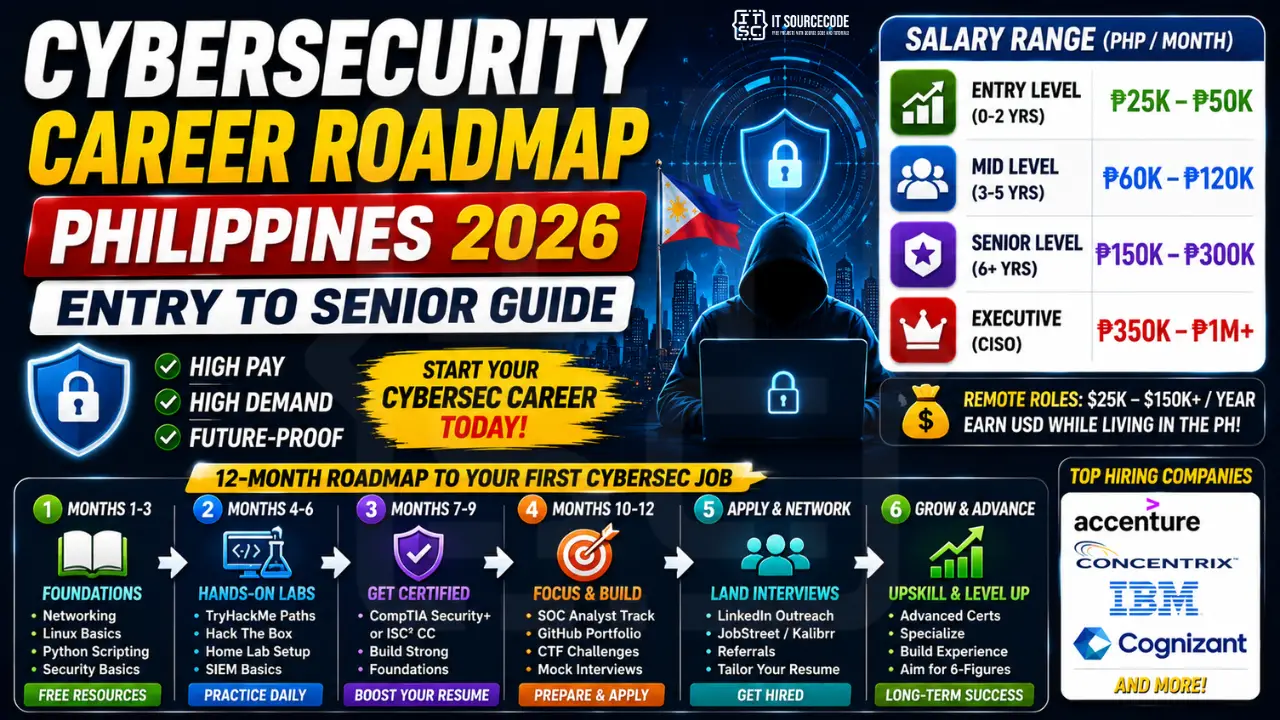
This guide is the full roadmap, from “I just graduated BSIT” to “I’m a SOC analyst earning ₱45,000/month within 12-18 months”, calibrated to the actual Philippine market in 2026. We cover salary ranges from real PH job postings, the certifications recognized by local employers (not just the ones Reddit talks about), the 12-month self-study plan, and an honest read on which path is realistic vs which is YouTube hype.
📌 Quick answer (TL;DR roadmap): The realistic 12-18 month path from BSIT graduate to first cybersec job in the Philippines: Months 1-3: networking, Linux, Python scripting, security fundamentals (free: TryHackMe + Cybrary). Months 4–6: Complete hands-on labs (TryHackMe paths, Hack The Box Starting Point, and a home lab). Next, during months 7–9, earn CompTIA Security+ or ISC2 CC. Finally, in months 10–12, focus on the SOC analyst track, build a GitHub portfolio, and apply to cybersecurity teams at Accenture, Concentrix, and IBM. Expected starting salary: ₱25K-50K/month. Cap at 5 years: ₱120K+/month. Remote for foreign employer: $40K-150K USD/year.
Why Cybersecurity is a Top Career in the Philippines (2026)
Three forces are converging to make 2026 the best year in Philippine history to start a cybersecurity career.
1. The Data Privacy Act is finally being enforced. The National Privacy Commission (NPC) has issued record fines and compliance orders in 2024-2026, banks, telcos, e-commerce platforms, and even hospitals are now legally required to have dedicated security teams, Data Protection Officers (DPOs), and incident response capability. Every NPC-regulated entity (which is almost everyone handling personal data) needs cybersec staff. This is regulatory demand, not optional spend.
2. The BPO industry runs the world’s SOCs from PH soil. Accenture, Concentrix, IBM, Cognizant, TaskUs, Sutherland, and dozens of mid-tier firms operate 24/7 Security Operations Centers from Manila, Cebu, Clark, and Davao, serving Fortune 500 clients in the US, EU, and Australia. These SOCs need entry-level analysts in volume. The job posting boards (JobStreet, LinkedIn, Kalibrr) show 500-1,000+ open cybersec roles at any given time.
3. Remote work for foreign employers normalized. Filipino cybersec analysts are now hired directly by US, Singapore, and Australian companies via UpWork, Toptal, Deel, and direct LinkedIn outreach, earning USD salaries while living in PH. A mid-level Filipino SOC analyst can earn $40K-80K USD/year remote, which is ₱185K-370K/month, multiples of the local rate.
The salary premium is real. A general BSIT graduate going into helpdesk or junior dev typically earns ₱18K-28K/month entry. A cybersec entry-level role (SOC analyst, junior pentester) starts at ₱25K-50K/month, and the curve is steeper. By year 3, the gap widens to 40-60%. Specializations like cloud security, application security, and incident response push salaries past ₱150K/month domestically and well past USD six figures remote.
Cybersecurity also has lower offshoring risk than general dev work, the skills are sensitive, the work involves access to live production systems, and clients (especially in finance and healthcare) want trusted, vetted personnel. The career is durable.
Cybersecurity Career Paths in 2026
“Cybersecurity” is not one job. It’s a family of roles with very different day-to-day work, required skills, and salary ceilings. Pick your target before you start studying, the path to SOC analyst is different from the path to penetration tester.
SOC Analyst (Entry-Level: Most Realistic First Job)
Sits in front of a SIEM dashboard (Splunk, Microsoft Sentinel, IBM QRadar, Elastic) and investigates security alerts. Triages incidents, escalates real attacks, closes false positives. Shift work is common (24/7 SOCs run 3 shifts). This is where 80% of cybersec careers in the Philippines start, Accenture, Concentrix, IBM all hire SOC L1 analysts straight out of BSIT/BSCS with a Security+ cert. Realistic. Stable. Not glamorous. Salary: ₱25K-45K/month.
Penetration Tester / Ethical Hacker
Hired to attack systems before real criminals do. Web app pentests, network pentests, red team engagements. The role everyone wants because of the YouTube glamour, but realistically, you need 1-2 years SOC experience or strong CTF/HackTheBox track record before any PH firm hires you for it. Salary: ₱45K-150K/month, higher for OSCP-certified senior level. Top employers: Secuna, Aprio, Synacktiv (consulting), or in-house red teams at banks.
Cloud Security Engineer
Hardens AWS, Azure, and GCP environments. Configures IAM, VPCs, security groups, KMS, GuardDuty, encryption at rest. Massive demand in 2026 as PH companies (and BPO clients) migrate to cloud. Requires solid DevOps fundamentals + a cloud certification (AWS Security Specialty, AZ-500). Salary: ₱70K-200K/month domestic, $80K-150K USD remote. This is one of the highest-paying cybersec specializations.
Application Security Engineer (AppSec)
Embedded with development teams. Reviews code for security issues (SAST, DAST, SCA tools like Snyk, Semgrep, Checkmarx). Threat-models new features. Trains developers on secure coding. Requires real coding experience, typically a dev who learned security, not the other way around. Salary: ₱60K-180K/month. Common at fintechs and banks.
Security Engineer (Generalist)
The Swiss Army knife. Designs and implements security controls, firewalls, EDR (CrowdStrike, SentinelOne), email security, DLP, MFA rollouts. Bridges between SOC (operations) and architecture. Strong career growth path; many CISOs started here. Salary: ₱60K-150K/month.
GRC Analyst / IT Auditor (Less Coding)
Governance, Risk, and Compliance. Maps controls to frameworks (ISO 27001, NIST CSF, PCI-DSS, NPC Data Privacy Act compliance). Conducts audits, writes policies, manages vendor risk. Best path for BSIT graduates who don’t love coding, heavy on documentation, frameworks, and stakeholder management. Big at the Big 4 (KPMG, EY, PwC, Deloitte) and Philippine banks. Salary: ₱40K-140K/month. CISA cert helps.
Incident Response / DFIR
The fire brigade. When ransomware hits or a breach is detected, IR teams contain, eradicate, and recover. DFIR (Digital Forensics and Incident Response) is the deeper specialization, memory forensics, disk imaging, malware reverse engineering. High-stakes, on-call work. Salary: ₱80K-200K/month. Often consulting (Mandiant-style firms operating in PH).
CISO (Long-Term Goal)
Chief Information Security Officer. Executive-level. Reports to CEO or board. Owns the entire security program, strategy, budget, team, board reporting. 10-15 years of experience typical, with CISSP, CISM, and ideally an MBA or executive leadership track. Salary in PH: ₱350K-1M+/month for enterprise CISOs at banks, telcos, BPO. This is the long game.
Cybersecurity Salary Ranges in the Philippines 2026
Numbers below are pulled from current JobStreet, LinkedIn, and Kalibrr postings (May-June 2026), cross-referenced with Glassdoor PH and direct anonymous reports from cybersec professionals in our network. Ranges reflect actual offers, not hopeful asking salaries.
| Experience Level | Domestic PH (Monthly) | Remote for Foreign Employer (Annual USD) | Common Roles |
|---|---|---|---|
| Entry (0-2 yrs) | ₱25,000 – ₱50,000 | $25K – $50K | SOC L1, Junior GRC, IT Auditor I |
| Mid (3-5 yrs) | ₱60,000 – ₱120,000 | $60K – $100K | SOC L2/L3, Pentester, Cloud Sec Eng, AppSec Eng |
| Senior (6+ yrs) | ₱150,000 – ₱300,000 | $100K – $150K+ | Senior Security Eng, Lead Pentester, IR Lead, Security Architect |
| Executive (CISO) | ₱350,000 – ₱1M+ | $180K – $300K+ | CISO, VP Security, Head of Cyber |
Compared to general IT roles: a BSIT graduate going into help desk earns ₱18K-25K/month. Junior dev (PHP/Java/JavaScript) ranges ₱22K-35K/month. A SOC analyst at the same experience level, entry-level, BSIT graduate, fresh from a Security+ cert, starts at ₱30K-45K/month. The premium widens at mid-level: a 5-year backend dev makes ₱60K-90K, while a 5-year senior SOC analyst or cloud security engineer pulls ₱80K-150K. Compare with international programmer salaries if you’re benchmarking remote opportunities.
Why remote pays so much more: US/EU companies pay PH cybersec talent at “PH market + 30-50% loyalty premium”, still 50-70% cheaper than hiring a US engineer at $150K-220K. That arbitrage funds USD salaries that look enormous in pesos. Companies hiring this way in 2026: Deel, Remote, Toptal, Andela, plus direct hires at startups via LinkedIn.
The 12-Month Self-Study Roadmap
This is the no-fluff plan. If you commit 10-15 hours per week consistently for 12 months, you will be employable at the SOC L1 level by month 12. We’ve watched dozens of BSIT graduates execute exactly this path.
Months 1-3: Foundations
Build the substrate. Skip this and you’ll memorize cert questions without understanding anything.
- Networking (TCP/IP, OSI, DNS, HTTP, TLS, routing, firewalls): Professor Messer’s free Network+ videos (YouTube), full playlist, 25 hours.
- Linux command line: OverTheWire Bandit (free CTF), gets you fluent in bash, file permissions, ssh, grep, awk.
- Python scripting basics: our free Python tutorial, focus on file I/O, requests, sockets, basic automation.
- Security concepts: Professor Messer’s Security+ video series (free, full playlist), even before you take the exam, this builds vocabulary.
- Foundational reading: our guide to digital security types and tools covers the core defensive concepts.
Months 4-6: Hands-On Skills
Theory without hands is useless. This is where you start breaking things in a lab.
- TryHackMe, Complete Beginner Path + SOC Level 1 Path (free tier covers most of it; premium at $14/mo unlocks advanced rooms).
- HackTheBox, Starting Point + Tier 1 machines (free).
- Build a home lab: a Windows VM, a Kali Linux VM, a vulnerable target like Metasploitable2 or DVWA, all free in VirtualBox.
- PortSwigger Web Security Academy (completely free), best free training for web app security, period.
- Start documenting: write up every box/room you solve on a personal GitHub Pages blog. This becomes your portfolio.
Months 7-9: First Certification
Pick ONE. Don’t try to do both. Recruiters want a cert on your CV, any reputable entry cert opens doors.
- CompTIA Security+ (recommended): the industry standard. Exam fee ₱18-25K. Study with Professor Messer (free) + Jason Dion practice exams (Udemy, ₱500-1,500 on sale). 8-10 weeks of focused prep.
- (ISC)² CC (Certified in Cybersecurity): free first attempt via (ISC)² One Million Certified initiative. Easier than Security+ but less recognized in PH job market.
- Take the exam at a Pearson VUE PH center (Makati, Quezon City, Cebu, Davao) or remotely via OnVue.
Months 10-12: Specialize + Apply
By now you have foundations + hands-on + cert. Now you specialize and start applying.
- SOC Analyst track (most realistic): TryHackMe SOC Level 2 Path, learn Splunk fundamentals (free Splunk Fundamentals 1 course), Microsoft Sentinel basics.
- Pentester track (longer road): HackTheBox Academy Pentester Path, work toward eJPT (eLearnSecurity Junior Pentester) as a stepping stone before OSCP.
- Polish portfolio: 5-10 documented HTB/THM writeups on GitHub Pages, a LinkedIn rewrite mentioning your cert and lab work, contributions to open-source security tools if possible.
- Apply: JobStreet, LinkedIn, Kalibrr, search “SOC analyst”, “security analyst”, “junior pentester”, “GRC analyst”. Target Accenture, Concentrix, IBM, Cognizant, banks, and PH security consultancies. Expect 50-100 applications before first offer.
This roadmap is calibrated for the realistic median. Some BSIT graduates land jobs at month 8 with just Security+; others take 18 months. Either is fine, the goal is the first role, after which growth is rapid.
Best Cybersecurity Certifications for the PH Job Market
PH recruiters and hiring managers look for specific certifications. These are the ones that actually move the needle on a Filipino cybersec CV in 2026, ranked by ROI for entry-level candidates.
CompTIA Security+ (SY0-701)
Cost: ₱18-25K (often discounted via vouchers) • Difficulty: Moderate • Recognition in PH: Very high, appears in nearly every BPO SOC job description as required or preferred. Verdict: If you only earn one cert in 2026, make it this one. It’s the universally accepted entry-level proof.
(ISC)² CC (Certified in Cybersecurity)
Cost: Free first attempt (One Million Certified initiative, still running in 2026), then $50/year maintenance • Difficulty: Easy-Moderate • Recognition in PH: Growing, lower than Security+. Verdict: A no-brainer to add to your CV, free to take, and (ISC)² is a respected brand. Don’t substitute for Security+ if you can afford both.
CEH (Certified Ethical Hacker)
Cost: ₱50-80K • Difficulty: Moderate • Recognition in PH: Still strong in PH government, military, and BPO compliance roles, even though the international cybersec community considers it overpriced. Verdict: Worth it specifically if you target DICT, AFP, NPC, CICC, or government contractor work. Otherwise, OSCP delivers more skill per peso.
AWS Certified Security – Specialty
Cost: $300 (₱17K) • Difficulty: Hard • Recognition in PH: High for cloud-focused roles, growing fast in 2026. Verdict: Pairs perfectly with Security+ to unlock cloud security engineer roles. Often a salary multiplier, adding this cert can push you from ₱60K to ₱90K+ in cloud roles. Don’t attempt without AWS Solutions Architect or SysOps Associate first.
GCIH / GSEC (SANS Institute)
Cost: $8,000-9,000 (typically employer-sponsored) • Difficulty: Hard • Recognition in PH: Gold standard among senior practitioners. Verdict: Don’t pay out of pocket. Get hired first; then push for SANS as part of your training budget after 2-3 years.
OSCP (Offensive Security Certified Professional)
Cost: $1,599 (₱90K+) for PWK course + first exam attempt • Difficulty: Very hard, 24-hour practical exam • Recognition in PH: Highly respected for offensive roles. Verdict: The legitimate pentest-career credential. Do NOT attempt as your first cert, you’ll burn out and waste money. Target it at month 18-24 of your career, after Security+ and 6+ months of HackTheBox grinding.
For a complete certification deep-dive across all of tech (cloud, dev, data, security), see our best tech certifications 2026 guide.
Top Cybersecurity Employers in the Philippines
Where the jobs actually are. Save this list, these are the names to search on JobStreet, LinkedIn, and Kalibrr.
- Banks (in-house security teams): BDO, BPI, Metrobank, Security Bank, UnionBank, RCBC, Land Bank, DBP. All have growing SOCs, fraud teams, and pentest groups. Stable, well-paid, conservative.
- Telcos: Globe Telecom, PLDT/Smart, Converge, massive infrastructure, large SOC operations, in-house red teams.
- BPO security delivery (the volume hirer): Accenture (largest cybersec hirer in PH), Concentrix, IBM Philippines, Cognizant, TaskUs, Sutherland, Sitel, Genpact. Most fresh BSIT cybersec careers start here.
- Government: CICC (Cybercrime Investigation and Coordinating Center), NPC (National Privacy Commission), DICT, AFP cyber units, PNP Anti-Cybercrime Group. Lower pay, strong stability, valuable government clearance experience.
- Cybersecurity consulting firms (local): Secuna, Aprio, Cyberhaven PH, Pentestify, plus Big 4 audit (KPMG, EY, PwC, Deloitte), strong path for GRC, audit, and consulting careers.
- Fintechs and e-commerce: GCash (Mynt), Maya, Lazada, Shopee, fast-growing AppSec and cloud security teams, higher comp than legacy banks.
- Remote for foreign clients: UpWork, Toptal, Deel, Remote, Andela, Crossover. Once you have 1-2 years of local experience + a strong portfolio, foreign USD-paying roles open up.
Free + Paid Cybersecurity Resources
You can become job-ready spending almost nothing. Here’s the curated list, free first, then paid only if you’re getting value from the free tier.
Free Resources (Start Here)
- TryHackMe (free tier): gamified learning paths, hands-on labs in your browser. The “Complete Beginner” and “Pre-Security” paths are free.
- HackTheBox Starting Point: first 6 boxes free, no subscription required.
- PortSwigger Web Security Academy: completely free, the best web app security training on the internet, written by the makers of Burp Suite.
- Cybrary: free introductory courses on Security+, ethical hacking, networking.
- Professor Messer (YouTube): free, full-length video courses for Network+, Security+, A+.
- OverTheWire Bandit: free Linux/CTF wargame, gets you fluent in the shell.
- NIST publications: NIST SP 800-53, NIST CSF, NIST 800-61 (incident response). Free PDFs, industry-standard references.
- SANS Reading Room: thousands of free whitepapers.
- MITRE ATT&CK Framework: free taxonomy of attacker techniques. Required reading.
Paid Resources (Worth the Money)
- TryHackMe Premium: $14/month (₱800). Unlocks all rooms + SOC Analyst and Pentester learning paths. Worth it once you finish the free tier.
- HackTheBox VIP: $14/month. Unlocks all retired machines + writeups. Best for serious pentest aspirants.
- HackTheBox Academy: pay-per-module or subscription. Structured pentest training.
- INE / eLearnSecurity (eJPT, eCPPT): solid stepping stones before OSCP.
- Coursera / Udemy: Jason Dion’s Security+ practice exams are gold (₱500-1,500 on sale). Coursera has Google and IBM cybersec certs with PH-affordable subscription pricing.
- Cloud Academy: cloud security paths (AWS, Azure, GCP). Strong for cloud-focused careers.
- SANS On-Demand: expensive ($8K+), almost always employer-sponsored. Wait until you’re hired.
Common Mistakes New Cybersecurity Students Make
After watching hundreds of BSIT students attempt the cybersec transition, we see the same five mistakes repeatedly. Avoid them.
- Chasing OSCP too early. OSCP is the YouTube fantasy cert. Attempting it without 6+ months of HackTheBox grinding + solid Linux + scripting fundamentals leads to failed exam attempts, wasted money, and burnout. Earn Security+ first, then eJPT, then OSCP.
- Ignoring networking and OS fundamentals. You cannot defend or attack what you don’t understand. Spend the first 3 months on Network+, Linux, and basic Python before touching any “hacking” content. Students who skip this hit a hard wall at the intermediate level.
- No portfolio = no interview. A cert alone won’t get you past HR. Document your TryHackMe and HackTheBox writeups on GitHub Pages. Build a personal blog. Contribute to a security project on GitHub. Recruiters search for evidence.
- Not engaging with the community. The Philippine cybersec community (DEF CON Philippines, ROOTCON, PUGAD security meetups, local Discord servers like ROOTCON Discord and Cyberbayan) is small, friendly, and well-connected. Most jobs flow via referral. Show up, ask questions, help others.
- Refusing the SOC analyst job because it “isn’t pentesting.” SOC L1 is the realistic on-ramp. Two years there will teach you more about real attacks than any course. Pentest roles come after. Don’t wait 18 months for a pentest offer that won’t come, take the SOC job, learn, transition.
Official cybersecurity authorities and cert bodies
Recommended VPN
The link below is an affiliate link. We may earn a commission at no extra cost to you. See our affiliate disclosure.
Frequently Asked Questions
Is cybersecurity a good career in the Philippines in 2026?
How long does it take to become a cybersecurity analyst in the Philippines?
What is the entry-level cybersecurity salary in the Philippines?
What is the best cybersecurity certification for the Philippine job market?
Can I learn cybersecurity for free in the Philippines?
Do I need a degree to work in cybersecurity in the Philippines?
What’s the difference between SOC analyst and penetration tester?
Which Philippine companies hire cybersecurity analysts?
How much do remote cybersecurity jobs pay Filipinos?
Is OSCP worth it for Filipino cybersecurity professionals?
📌 Ready to start your cybersecurity career?
Start with our digital security foundations guide, compare top tech certifications for 2026, and benchmark expected pay against our programmer salary by country guide.
Final Recommendation
Cybersecurity in the Philippines in 2026 is the rare career path that combines high demand, premium salaries, remote-work optionality, and a clear entry on-ramp for BSIT/BSCS graduates. If you’re willing to commit 12-18 months of focused, structured self-study, not random YouTube content, you can land a ₱30K-50K/month SOC analyst role even without prior industry experience. The compounding from there is rapid: ₱60K+ by year 3, ₱100K+ by year 5, and USD remote opportunities once you have a portfolio.
The honest take: SOC analyst is the realistic first job, not penetration tester. The BPO security delivery industry hiring at Accenture, Concentrix, IBM, and Cognizant is enormous, stable, and pays better than helpdesk or junior dev. It’s a foothold, not a ceiling. Many of the senior pentesters, cloud security engineers, and CISOs in PH today started as SOC L1 analysts five to ten years ago.
🎯 Your next steps:
- Bookmark this page, refer back to the 12-month roadmap monthly to track your progress
- Start the first foundations block this week: Professor Messer Network+ on YouTube + create a free TryHackMe account
- Read our digital security foundations guide for the core defensive concepts
- Compare cybersec to other PH tech paths with our software engineer roadmap Philippines 2026
- Benchmark target salaries with our software engineer Philippines salary guide
- Plan your cert path with our best tech certifications 2026 guide
- Need a capstone idea that doubles as a portfolio piece? Browse our 150 capstone project ideas, pick a security-focused one
Currently working through this roadmap or already in a PH cybersec role? Drop your experience, salary range, or questions in the comments, we update this guide quarterly based on what’s working in the actual job market.

Adrian Mercurio
Full-Stack Developer at PIES IT Solution
Specializes in building complete capstone projects with full documentation. Strong background in PHP/MySQL development and database design. Has personally built and tested over 30 capstone-ready projects with ER diagrams, DFDs, and chapter-by-chapter thesis documentation.
Expertise: PHP · Laravel · Database Design · Capstone Projects · C# · C · C++ · Python · AI Projects · View all posts by Adrian Mercurio →