
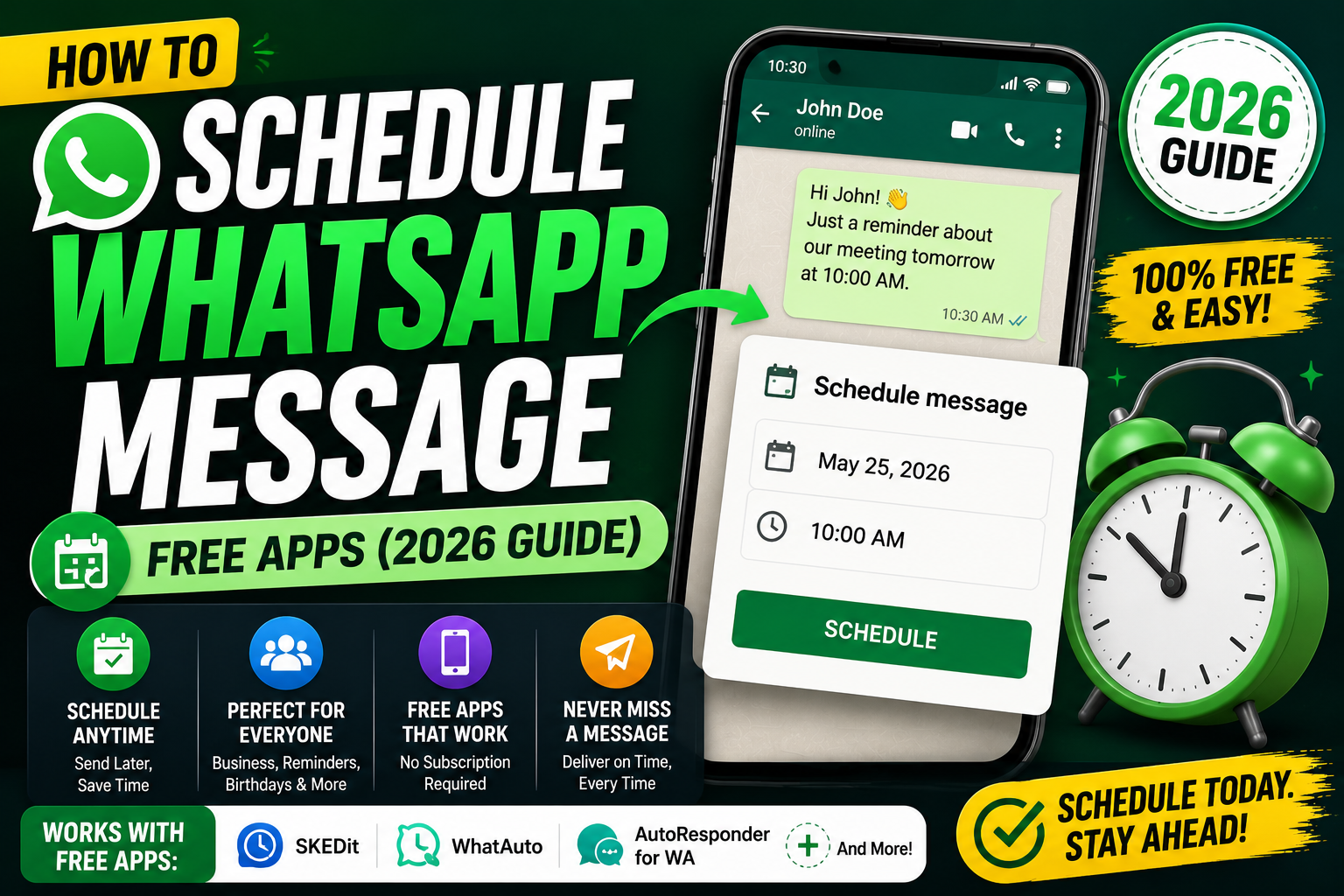
Scheduling a WhatsApp message ahead of time is useful for birthday greetings, reminders, business follow-ups, or messages to friends in different time zones. Native WhatsApp does not support scheduling, but Android has free third-party apps and iPhone can use Shortcuts. This 2026 tutorial covers every method.
Method 1: SKEDit for Android (free, most popular)
- Install SKEDit from Google Play Store.
- Open the app.
- Sign up (email or Google).
- Tap + button > WhatsApp.
- Choose contact.
- Type message.
- Set date and time.
- Tap Schedule.
- SKEDit runs in background; sends message at scheduled time.
Free tier: 10 scheduled messages/month. Paid: unlimited.
Method 2: SKEDit permissions setup
SKEDit requires accessibility permission to auto-send messages:
- After install, SKEDit prompts to enable Accessibility.
- Settings > Accessibility > SKEDit > Enable.
- Grant permission to send messages via WhatsApp.
- SKEDit only uses this permission for scheduled sends, no data collection.
Method 3: WhatsApp Business (recommended for businesses)
- Install WhatsApp Business (separate from personal WhatsApp).
- Set up as a business.
- Tap message compose > select recipient.
- Business features include: quick replies, greeting messages, away messages.
- Not full scheduling, but auto-responses cover many use cases.
Method 4: iPhone Shortcuts (free workaround)
- Open iPhone Shortcuts app.
- Tap + > Automation > Create Personal Automation.
- Choose Time of Day.
- Set specific date/time.
- Add Action > Search “WhatsApp” > Send Message.
- Enter phone number and message text.
- Save.
- At specified time, iPhone opens WhatsApp with the message ready. You still need to tap Send.
Note: iOS Shortcuts don’t send automatically for privacy reasons. You tap Send manually.
Method 5: Third-party business tools
- WATI: full WhatsApp Business API scheduling. From ~$40/month.
- Wappblaster: bulk scheduling for marketing.
- Interakt: scheduling + automation for small businesses.
- Sirena.ai: WhatsApp CRM + scheduling.
Legitimate business tools; not for personal use.
Best use cases for scheduling
- Birthday and anniversary messages.
- Reminders to friends (Christmas, holidays).
- Business follow-ups.
- Messages to friends in different time zones (send at their morning).
- Client reminders / appointments.
Ethics of scheduling
- Personal messages should feel authentic. If you’re always “sending at 8 AM sharp”, pattern is obvious.
- Business: totally acceptable. Standard practice.
- Don’t schedule apologies or sensitive messages, reads as insincere.
- Personal messages: better to write and send in the moment when possible.
Alternative: Recurring reminders
- Rather than scheduling one-off messages, use phone reminders.
- Set reminder for “Message Mom’s birthday” on the day.
- Reminder fires, you write the message in the moment.
- Feels more authentic than scheduled auto-send.
Why WhatsApp doesn’t offer native scheduling
- WhatsApp Business API supports it (for business accounts, paid).
- Consumer WhatsApp keeps it off to prevent spam-scheduling.
- Product philosophy: messages should be sent when written.
- May change in future updates as user demand grows.
Common scheduling issues
- SKEDit didn’t send: phone was off or WhatsApp signed out at scheduled time. Ensure phone stays on.
- iOS Shortcuts asks to open manually: correct, iOS security. Cannot fully automate WhatsApp send.
- SKEDit needs accessibility permission repeatedly: some phone updates reset accessibility. Re-grant.
- Third-party app blocked by WhatsApp: rare; happens if app violates WhatsApp terms. Try different app.
- Scheduled message sent to wrong contact: double-check recipient in the schedule setup.
Common WhatsApp mistakes to avoid
- Not backing up chats before switching phones. Chat history disappears if you skip the backup step. Always back up to Google Drive (Android) or iCloud (iPhone) before the switch.
- Sharing large videos without compression. Original quality uses your phone data quota and takes longer to send. WhatsApp’s default compression is usually fine.
- Trusting “last seen” as availability. People turn it off. Do not judge responsiveness by last seen visibility.
- Forgetting about disappearing messages. Sensitive info shared in a chat with disappearing messages goes away. Do not use for shared reference material.
- Publishing personal number for business. Use WhatsApp Business for business contacts. Keeps personal separate.
Power-user tips for WhatsApp
- Use WhatsApp Web on desktop. Type faster on a real keyboard. Sync happens instantly.
- Star important messages. Long-press > Star. Access the Starred section from the Chats menu to jump back later.
- Reply privately in group chats. Long-press a message > Reply Privately. Removes the person from group awareness of your reply.
- Enable Two-Step Verification. Prevents SIM-swap account theft. Settings > Account > Two-step verification.
- Mute noisy groups. Chat info > Mute notifications > Always. Message you when directly @-mentioned only.
WhatsApp vs Telegram vs Signal
WhatsApp is the largest user base worldwide. Best if everyone you know already uses it. End-to-end encryption by default.
Telegram offers larger group sizes (200,000 members), file sharing up to 2 GB, and bot API. Not encrypted by default (secret chats are).
Signal is the privacy champion. Best encryption, minimal metadata, non-profit funded. Smaller user base means fewer contacts already on it.
Most Philippines and Southeast Asia users lean WhatsApp for personal, Telegram for larger groups and file sharing. Signal picks up as privacy consciousness grows.
Best practices summary
- Enable 2-factor authentication. Blocks SIM-swap attacks that hijack WhatsApp accounts.
- Regular backups. Weekly automatic backup to Drive or iCloud. You will thank yourself when you lose the phone.
- Use Voice Messages sparingly. Text respects the recipient’s time. Voice for tone-heavy conversations only.
- Mute non-essential groups. Family groups do not need to buzz every 10 seconds.
- Separate personal and business. WhatsApp Business or dedicated phone for work contacts.
WhatsApp Business vs personal WhatsApp
WhatsApp offers two apps: WhatsApp Messenger for personal use and WhatsApp Business for small businesses. Both are free but serve different purposes.
- Business profile. Display business name, address, hours, and website. Personal WhatsApp lacks these fields.
- Automated messages. Set up greeting messages, away messages, and quick replies. Personal WhatsApp requires manual typing every time.
- Product catalog. Showcase up to 500 products directly in the chat. Great for small stores.
- Labels for organization. Tag customers as “New”, “Paid”, “Follow up”. Personal WhatsApp only has starred messages.
- Broadcast lists. Send announcements to up to 256 contacts at once. Both apps support this but Business has better tracking.
WhatsApp Web and desktop workflow
Once you connect WhatsApp Web to your phone, you can type on your desktop keyboard which is dramatically faster than mobile typing. A few tips:
- Keep phone connected to internet. WhatsApp Web relays through your phone. Phone offline = Web disconnects.
- Use keyboard shortcuts. Ctrl+N new chat, Ctrl+Shift+M mute, Ctrl+F search. Full list in Menu > Keyboard shortcuts.
- Log out from Web when done on shared computer. Menu > Log out. Prevents others from reading your chats.
- Download the desktop app. Faster than the web version, works even when browser is closed.
- Emoji shortcuts. Type
:smile:or:heart:for quick emoji. Works in both mobile and desktop.
Privacy best practices for WhatsApp
- Review privacy settings. Settings > Privacy. Control who sees your Last Seen, Profile Photo, About, and Status.
- Turn on Read Receipts thoughtfully. Disabling them hides your read status from others but also hides theirs from you.
- Use Disappearing Messages for sensitive info. Auto-delete after 24 hours, 7 days, or 90 days.
- Enable Two-Step Verification. Settings > Account > Two-step verification. Prevents SIM-swap account takeover.
- Verify group invites. Settings > Privacy > Groups > “My Contacts” prevents strangers from adding you to random groups.
Official documentation
Recommended productivity apps and resources
The links below are affiliate links. We may earn a commission at no extra cost to you when you buy or sign up. See our affiliate disclosure.
Quick step-by-step summary (click to expand)
- Understand the limitation. WhatsApp does not include native message scheduling in 2026. You need a helper app or shortcut.
- For Android. Install SKEDit or Scheduler for WhatsApp from Play Store. Grant Accessibility Service permission when asked.
- For iPhone. Open Shortcuts app. Create a new Automation with Time trigger. Add Send Message via WhatsApp action.
- Compose the scheduled message. Pick the contact, type the message body, set the exact send date and time.
- Enable and verify. Toggle the schedule on. On send time, your phone screen may briefly show WhatsApp opening automatically.
Frequently Asked Questions
Does WhatsApp allow scheduling natively?
Only WhatsApp Business API for paid business accounts. Consumer WhatsApp does NOT allow native scheduling for personal use.
Is scheduling with third-party apps safe?
SKEDit is trusted with 100+ million downloads. Grant accessibility permission, app uses it only for scheduling. Avoid unknown apps.
Can I schedule to a group?
Yes with SKEDit and similar. Choose group as recipient. Message sends to all group members.
Will WhatsApp add native scheduling?
Possibly. User demand is growing. WhatsApp has added many features (disappearing messages, multi-device), scheduling may be next. Currently no confirmed plans.
Are scheduled messages ethical?
Business use: fully acceptable. Personal use: recipients may notice patterns (always exact time). For meaningful messages, write in the moment. Reminders are a better alternative.

Caren Bautista
Technical Writer at PIES IT Solution
Responsible for crafting clear, well-structured, and beginner-friendly content across the platform. Handles the writing, proofreading, and editorial review of tutorials, guides, and documentation to ensure every article is accurate, readable, and easy to follow.
Expertise: Technical Writing · Content Creation · Documentation · Editorial Writing · JavaScript · TypeScript · View all posts by Caren Bautista →