
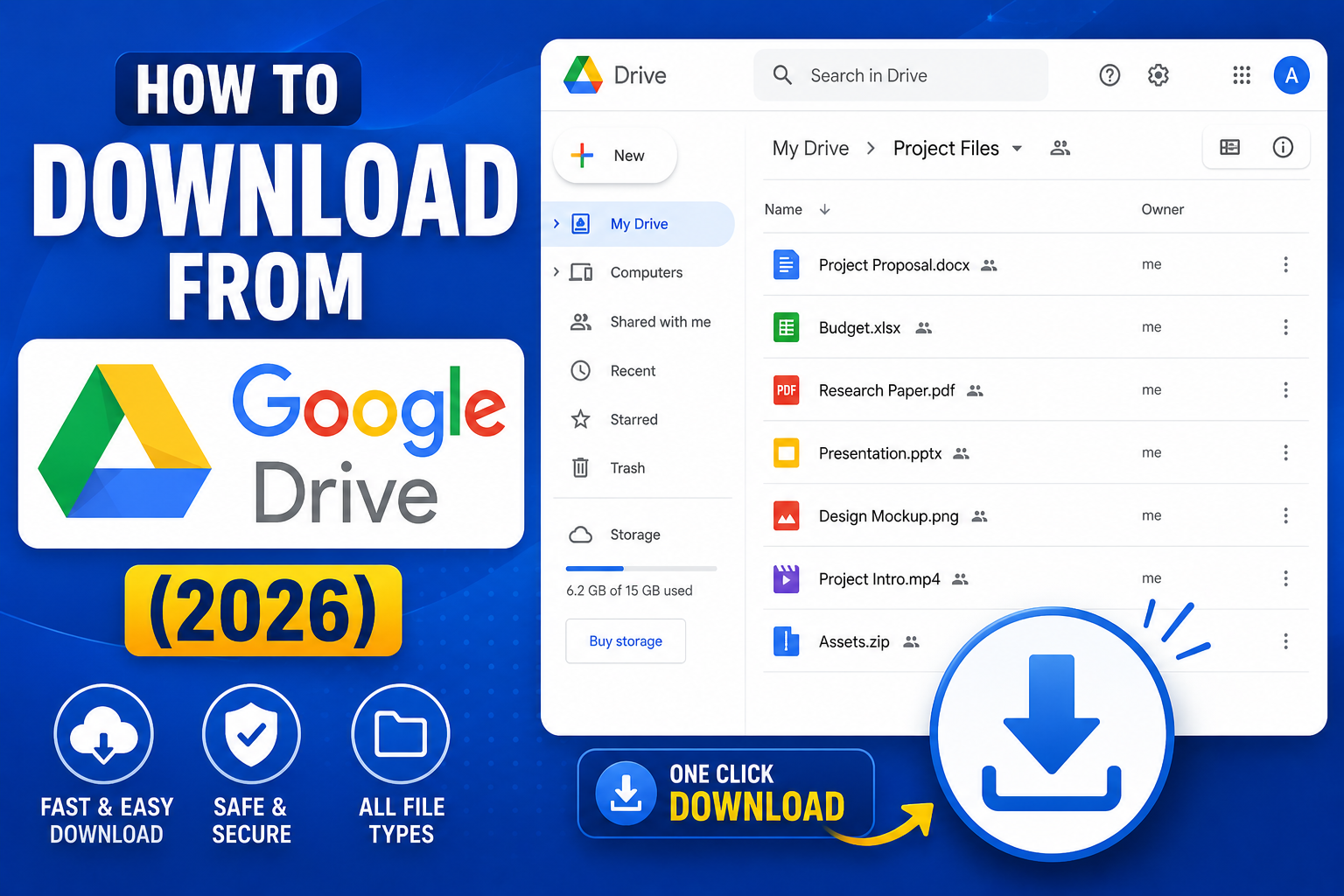
Downloading files from Google Drive is essential for offline access, migration to another service, or local backup. Drive supports single-file downloads, batch downloads (zipped), folder downloads, and format conversion for Google Docs/Sheets. This 2026 tutorial covers every download method.
Method 1: Download a single file
- Open Google Drive.
- Right-click the file.
- Click Download.
- File saves to your default Downloads folder.
For Google Docs/Sheets/Slides files, Drive converts to Word/Excel/PowerPoint format automatically.
Method 2: Download multiple files (as ZIP)
- Select multiple files by clicking + Ctrl-click (Cmd-click on Mac).
- Right-click one of the selected files.
- Click Download.
- Drive zips them into one .zip archive.
- The zip downloads to your Downloads folder.
To select all in a folder: Ctrl+A (Cmd+A on Mac).
Method 3: Download an entire folder
- Right-click the folder.
- Click Download.
- Drive zips the folder + all contents + subfolders.
- Unzip after download to restore original folder structure.
Download Google Docs/Sheets in specific format
Native Google files convert on download. To pick a format:
- Open the Google Doc/Sheet/Slide.
- Go to File > Download.
- Pick format:
- Docs: PDF, Word (.docx), OpenDocument (.odt), RTF, plain text, HTML, EPUB.
- Sheets: PDF, Excel (.xlsx), OpenDocument (.ods), CSV, TSV, HTML.
- Slides: PDF, PowerPoint (.pptx), OpenDocument (.odp), plain text, JPEG/PNG (current slide), SVG.
Download from a shared file (not owner)
- Open the shared file link.
- Click File > Download.
- Or click the download icon (arrow-down) at the top-right of the preview.
Note: if the owner disabled downloading, this option won’t appear. See “Download disabled” section below.
Download from Google Drive mobile
- Open the Drive app.
- Tap the three-dot menu next to a file.
- Tap Download.
- File saves to your device’s Downloads folder.
- On iOS: Files app > On My iPhone > Downloads. On Android: Files > Downloads.
Make file available offline in mobile
- Open Drive app.
- Tap three-dot menu > Make available offline.
- File caches to the phone.
- Access even without internet under Drive > Offline files.
Download disabled, what to do?
If the file owner disabled Viewer/Commenter download:
- Ask the owner to enable download (Share > gear icon > uncheck the restriction).
- Alternate: request Editor access. Editors can always download.
- If nothing else works: use screenshots (limited but sometimes only option).
Download entire Drive via Google Takeout
For migrating away from Google or backing up everything:
- Go to takeout.google.com.
- Select Google Drive (or any Google services).
- Click Next step.
- Choose file type (.zip default), size (up to 50 GB per archive), and delivery method (email link or Drive/OneDrive/Dropbox export).
- Click Create export.
- Google emails a download link when the archive is ready (usually within hours to a few days).
Common download issues
- “Download failed” for zip: file too large (Drive caps zips at ~2 GB). Download individual files instead.
- Google Docs opens instead of downloading: right-click file > Download (not left-click, which opens).
- Cannot download shared file: owner disabled download. Contact them or request Editor access.
- Download stuck: check internet speed, browser tab still open, and available disk space.
- Downloaded file corrupt: try again. Rarely, Drive’s server had a temporary issue.
Common Google Drive mistakes to avoid
Even experienced users hit the same pitfalls with file storage, sharing, and collaboration. Being aware of these traps saves hours of debugging and rework.
- Not checking sharing permissions before sending. A file shared with “Anyone with the link” behaves differently from “Restricted.” Always verify who can access before you share externally.
- Working on a shared file without version history awareness. Google Workspace keeps version history, but collaborators can overwrite your work. Use File > Version history > See version history to review changes.
- Ignoring the auto-save indicator. The “All changes saved in Drive” indicator confirms your work is persisted. If it says “Saving…” for too long, your connection may be unstable.
- Forgetting to check on mobile. Some formatting and features render differently on the Google Workspace mobile apps. Test on your phone before sending important content.
- Not using keyboard shortcuts. Google Workspace has extensive shortcuts (press Ctrl+/ or Cmd+/ to see them all). Learning the top 5-10 shortcuts saves significant time.
Power-user tips for Google Drive
Once the basics are solid, these techniques let you work faster and with more control.
- Use templates as starting points. Google Workspace includes free templates for common documents. Access via File > New > From template gallery. Customize once, reuse forever.
- Master search operators inside Drive. Search operators like
type:document,owner:me, andbefore:2025-01-01narrow results dramatically. Combine multiple operators for precise filters. - Use offline mode when your connection is unreliable. Enable offline access in Drive settings so you can keep working during network outages. Changes sync automatically when you reconnect.
- Set up Google Workspace apps on desktop. Drive for Desktop syncs files to your local machine and integrates with File Explorer or Finder. Works better than the web interface for large files.
- Bookmark important documents. Star files in Drive to see them at the top of your Home view. Great for daily reference documents.
Real-world workflow examples
Concrete scenarios where these features solve everyday problems:
For students and BSIT capstone teams: Use shared Google Docs for capstone documentation, with real-time collaboration replacing back-and-forth email attachments. Version history preserves an audit trail of who wrote what.
For freelancers and consultants: Combine Google Drive folders (per client) with shared permissions for smooth handoffs. Clients can view or comment without needing separate accounts.
For small teams: A shared Drive folder plus a linked Google Sheet as project tracker gives structured collaboration without paying for enterprise tools.
Best practices summary
The pattern that works across nearly every Google Workspace use case:
- Start simple, add complexity when needed. A basic Doc or Sheet solves 90 percent of cases. Only add scripts, add-ons, or complex formulas when the simple version breaks.
- Version history is your safety net. Every serious edit should be reversible via File > Version history.
- Share thoughtfully. Restricted sharing beats Anyone-with-link for anything sensitive. Add specific emails for tighter control.
- Mobile-check before sending. A quick preview on your phone catches layout issues that never show up on desktop.
- Learn keyboard shortcuts. The top 10 shortcuts save 30 minutes a week if you use Workspace daily.
Official documentation
Recommended storage and backup resources
The links below are affiliate links. We may earn a commission at no extra cost to you when you buy or sign up. See our affiliate disclosure.
Quick step-by-step summary (click to expand)
- Open Google Drive. Go to drive.google.com and sign in with your Google account.
- Locate the file or folder. Navigate to the file or folder you want to download. Use the search bar if it is nested deep.
- Right-click and choose Download. Right-click the item and choose Download from the context menu. On mobile, tap the three-dot menu.
- Wait for the download to finish. Google Drive will compress folders into a ZIP archive. Larger folders take longer to prepare.
- Extract if needed. If the download is a ZIP file, right-click it and choose Extract All to access the individual files.
Frequently Asked Questions
Why did my Google Doc download as .docx?
Right-click > Download defaults to Word format for Docs. For PDF or other formats, open the Doc first > File > Download > pick specific format.
Can I download a Google Drive folder without a Google account?
Yes, if the folder is shared as “Anyone with the link”. No account needed to download. If sharing is restricted to specific emails, you need to sign in with an authorized account.
How large a folder can I download at once?
Drive zip download works up to about 2 GB. For larger folders, break into subfolders and download separately, or use Google Takeout (up to 50 GB per archive).
Can I schedule automatic downloads?
Not natively. Use Drive for Desktop for continuous local sync (which is like automatic download). Or use a third-party sync tool like rclone for scripted downloads.
Does downloading count against my Drive storage?
No. Downloading is one-way transfer to your device. Your Drive storage stays exactly the same. Only uploading uses storage quota.

Adrian Mercurio
Full-Stack Developer at PIES IT Solution
Specializes in building complete capstone projects with full documentation. Strong background in PHP/MySQL development and database design. Has personally built and tested over 30 capstone-ready projects with ER diagrams, DFDs, and chapter-by-chapter thesis documentation.
Expertise: PHP · Laravel · Database Design · Capstone Projects · C# · C · C++ · Python · AI Projects · View all posts by Adrian Mercurio →