
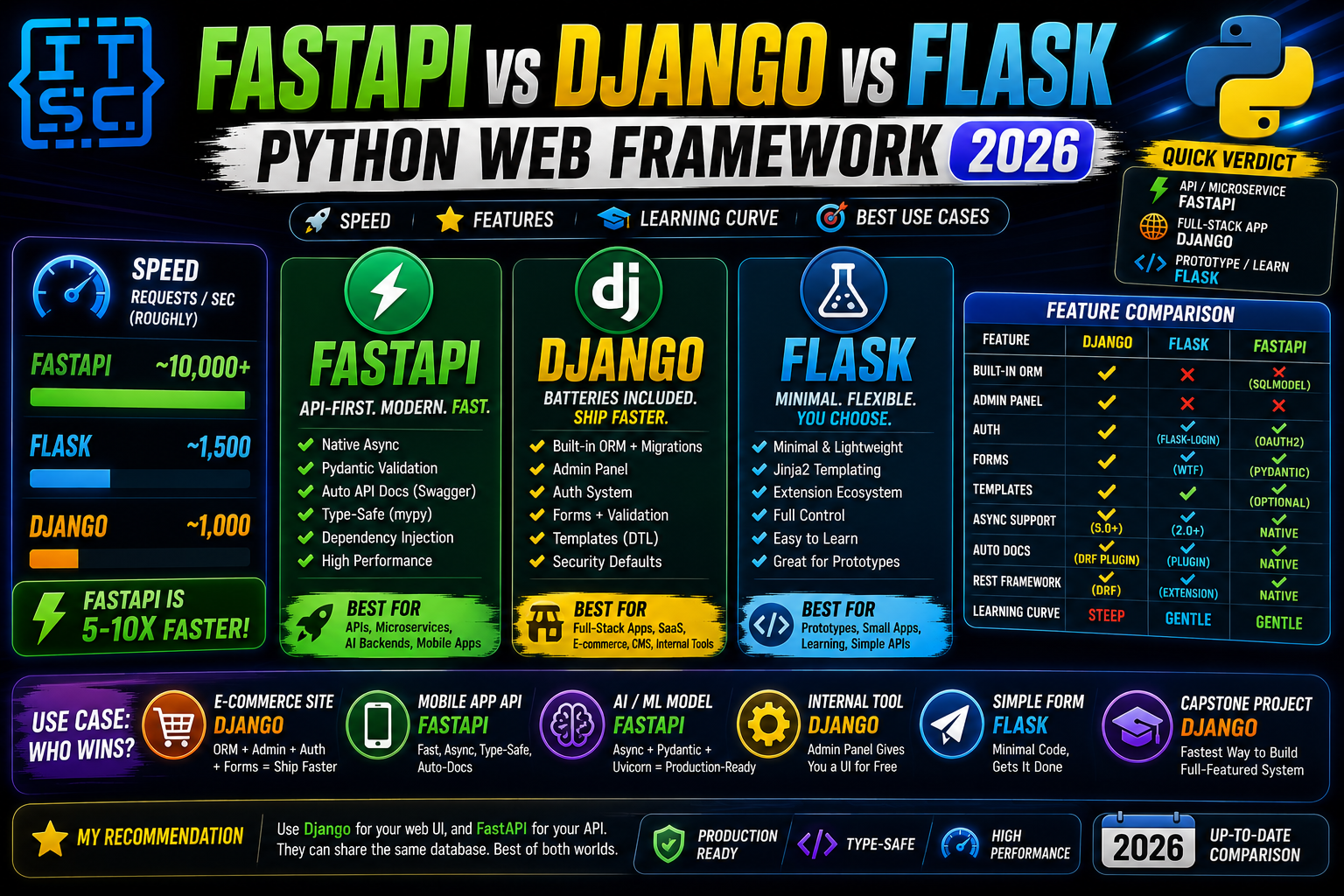
FastAPI, Django, and Flask are Python’s three most popular web frameworks in 2026. I’ve built production systems on all three. Each has strengths, and the choice depends on what you’re building. This comparison covers speed, features, learning curve, and clear recommendations by use case.
Quick verdict
- Building a REST/GraphQL API: pick FastAPI.
- Building a full-stack web app: pick Django.
- Learning Python web dev: pick Flask (or FastAPI).
- Microservice: FastAPI (async + fast).
- Prototype quickly: Flask (least ceremony).
Framework philosophy
- Django: “batteries included”, ORM, admin, auth, forms, templates all built-in.
- Flask: minimal, just routing and templating. You pick every extension.
- FastAPI: API-first, modern type-safe validation, async native, auto-docs.
Speed comparison
| Framework | Requests/sec (roughly) |
|---|---|
| Django | ~1,000 |
| Flask | ~1,500 |
| FastAPI | ~10,000+ |
FastAPI is 5-10x faster due to async support and Starlette’s efficient async runtime.
Feature comparison
| Feature | Django | Flask | FastAPI |
|---|---|---|---|
| Built-in ORM | Yes | No (SQLAlchemy) | No (SQLModel/SQLAlchemy) |
| Admin panel | Yes | No | No |
| Auth built-in | Yes | Flask-Login | OAuth2 helpers |
| Forms | Yes | Flask-WTF | Pydantic |
| Templates | Yes | Yes (Jinja2) | Yes (Jinja2 optional) |
| Async | Yes (5.0+) | Yes (2.0+) | Native |
| Auto API docs | Via DRF plugin | Via plugin | Native (Swagger) |
| REST framework | DRF (add-on) | Flask-RESTful | Native |
| Learning curve | Steep | Gentle | Gentle |
Django: full-stack web framework
# views.py
from django.shortcuts import render
from .models import Book

def book_list(request):
    books = Book.objects.filter(published_year__gte=2020)
    return render(request, 'books/list.html', {'books': books})

# Django includes:
# - ORM with migrations
# - Auto admin panel at /admin
# - Auth system with User model
# - Forms with validation
# - Session management
# - Templating with Jinja-like DTL
# - i18n, CSRF, security defaults

# Perfect for: e-commerce, CMS, SaaS with UI
Flask: minimalist
from flask import Flask, jsonify

app = Flask(__name__)

@app.route('/api/books')
def books():
    return jsonify([{'title': 'Book 1'}, {'title': 'Book 2'}])

# Flask includes:
# - Routing
# - Templating (Jinja2)
# - That's it. Everything else is add-ons.

# Perfect for: microservices, quick prototypes, learning
FastAPI: modern API framework
from fastapi import FastAPI
from pydantic import BaseModel

app = FastAPI()

class Book(BaseModel):
    title: str
    year: int

@app.post('/books')
async def create_book(book: Book):
    return {'id': 1, 'title': book.title, 'year': book.year}

# FastAPI includes:
# - Native async
# - Auto request validation via Pydantic
# - Auto OpenAPI docs at /docs
# - Type-safe (mypy compatible)
# - JSON serialization
# - Dependency injection

# Perfect for: APIs, microservices, AI backends
Use case: e-commerce site
Winner: Django. ORM + admin panel + auth + forms = ship faster. django-oscar / Saleor / Wagtail exist.
Use case: mobile app backend API
Winner: FastAPI. Fast, async, type-safe, auto-docs. Perfect for JSON APIs.
Use case: AI/ML model deployment
Winner: FastAPI. Async support + Pydantic + Uvicorn + Docker = production-grade AI API. Used by OpenAI, HuggingFace.
Use case: internal tool with UI
Winner: Django. Admin panel gives you a UI for free.
Use case: simple form submission
Winner: Flask. Minimal code, gets it done.
Use case: capstone project (BSIT)
Winner: Django. Fastest to build a full-featured system panels expect (admin, auth, DB).
My real-world recommendation
I use both Django + FastAPI in the same project sometimes:
- Django for the admin UI + web pages (marketing, blog, settings).
- FastAPI for the API layer (mobile app, integrations, AI endpoints).
They can share a database. Each handles what it’s best at.
Learning path for beginners
- Start with Flask, teaches you routing, request/response basics.
- Move to FastAPI, modern async patterns, Pydantic validation.
- Learn Django when building full-stack web apps.
Job market
- Django: most listings, salary premium.
- Flask: many listings, often as “familiar with”.
- FastAPI: growing fast, high demand for modern startups.
Common fastapi mistakes to avoid
- Skipping the “why” before adopting a new tool. Modern Python tools (uv, Ruff, Polars) are fast and clean. But adopting them without understanding what problem they solve wastes time. Read the tool’s motivation section first.
- Migrating everything at once. Legacy code bases have too many surprises. Migrate one module at a time and test after each step.
- Ignoring backwards compatibility. New Python tools sometimes break with older Python versions. Verify your target Python version supports the tool before committing.
- Trusting benchmarks blindly. “10x faster than X” often means “10x faster for one specific workload”. Test with YOUR data before assuming the benchmark generalizes.
- Not reading the CHANGELOG. Every dependency upgrade may break something. Skimming the changelog for breaking changes takes 2 minutes and saves hours.
Adoption path for fastapi
- Read official docs cover-to-cover for the core concepts. Yes, cover-to-cover.
- Complete the official tutorial project. Follow along exactly, no shortcuts.
- Adapt one small piece of your existing project to the new tool. Ship it.
- If it survives 2 weeks in production, expand adoption.
- If it caused issues, rollback and reassess whether the tool fits your use case.
When to use vs when to stick with what you know
Modern Python tools offer real improvements over their predecessors, but “better” is not the same as “necessary for you.” Consider adopting when:
- Your current tool is slow enough to block productivity (uv/Ruff speedups matter here).
- You are starting a new project with no legacy constraints.
- Your team has bandwidth to learn and support the new tool.
- The tool has been stable and community-adopted for 12+ months.
Stick with your existing tools when: production stability is critical and you have working infrastructure; your team is small and cannot afford learning curves; the tool is early-stage and API may change.
Ecosystem integration considerations
Every new Python tool interacts with the broader ecosystem. Before committing, check:
- Does your CI/CD pipeline support it? Most tools have GitHub Actions and GitLab CI templates.
- Does your IDE support it? VS Code and PyCharm have first-class support for most modern tools. Older editors may lag.
- Do dependency scanners (Snyk, Dependabot) recognize it? Ensures security updates get flagged.
- Is there production monitoring integration? Datadog, Sentry, New Relic support matters for production.
For teams shipping production Python code, the ecosystem answer is often more important than the tool answer. A slightly-worse tool that plays well with your stack beats a slightly-better tool that fights it.
Best practices summary
- Read the docs before Stack Overflow. Official docs are cleaner and more accurate than forum answers.
- Pin versions in production. Locked dependencies prevent surprise breakage. Update deliberately, not accidentally.
- Test after every dependency upgrade. Run the full test suite. Catch regressions before deployment.
- Contribute back. Report bugs, submit fixes, write tutorials. The tools improve when users engage.
- Reassess yearly. The Python ecosystem moves fast. What was best last year may be second-best today.
Official documentation
Recommended web framework resources
The links below are affiliate links. We may earn a commission at no extra cost to you when you buy or sign up. See our affiliate disclosure.
Frequently Asked Questions
Is FastAPI replacing Django?
Not fully. FastAPI dominates APIs. Django dominates full-stack. Both grow. They serve different needs.
Can I use Django for APIs?
Yes with Django REST Framework (DRF). Popular, mature. Slower than FastAPI but Django-integrated. Fine for many use cases.
Is Flask dead?
No. Still popular for microservices and learning. Development slowed but not dead. Great for small projects.
Which is easiest to learn?
Flask (minimal) → FastAPI (adds validation/async) → Django (steepest but most complete). Flask teaches fundamentals fastest.
Can I use them together?
Yes. Common pattern: Django for admin + web, FastAPI for API. They can share a database. Best of both worlds.

Angel Jude Suarez
Full-Stack Developer at PIES IT Solution
Focuses on Python development, machine learning, and AI integration. Has built production AI systems including OpenAI Whisper integration for medical transcription and GPT-4o-powered diagnosis assistance. Strong background in pandas, scikit-learn, and TensorFlow.
Expertise: Python, PHP, Java, VB.NET, ASP.NET, Machine Learning, AI Integration, OpenCV, Django, CodeIgniter · View all posts by Angel Jude Suarez →