
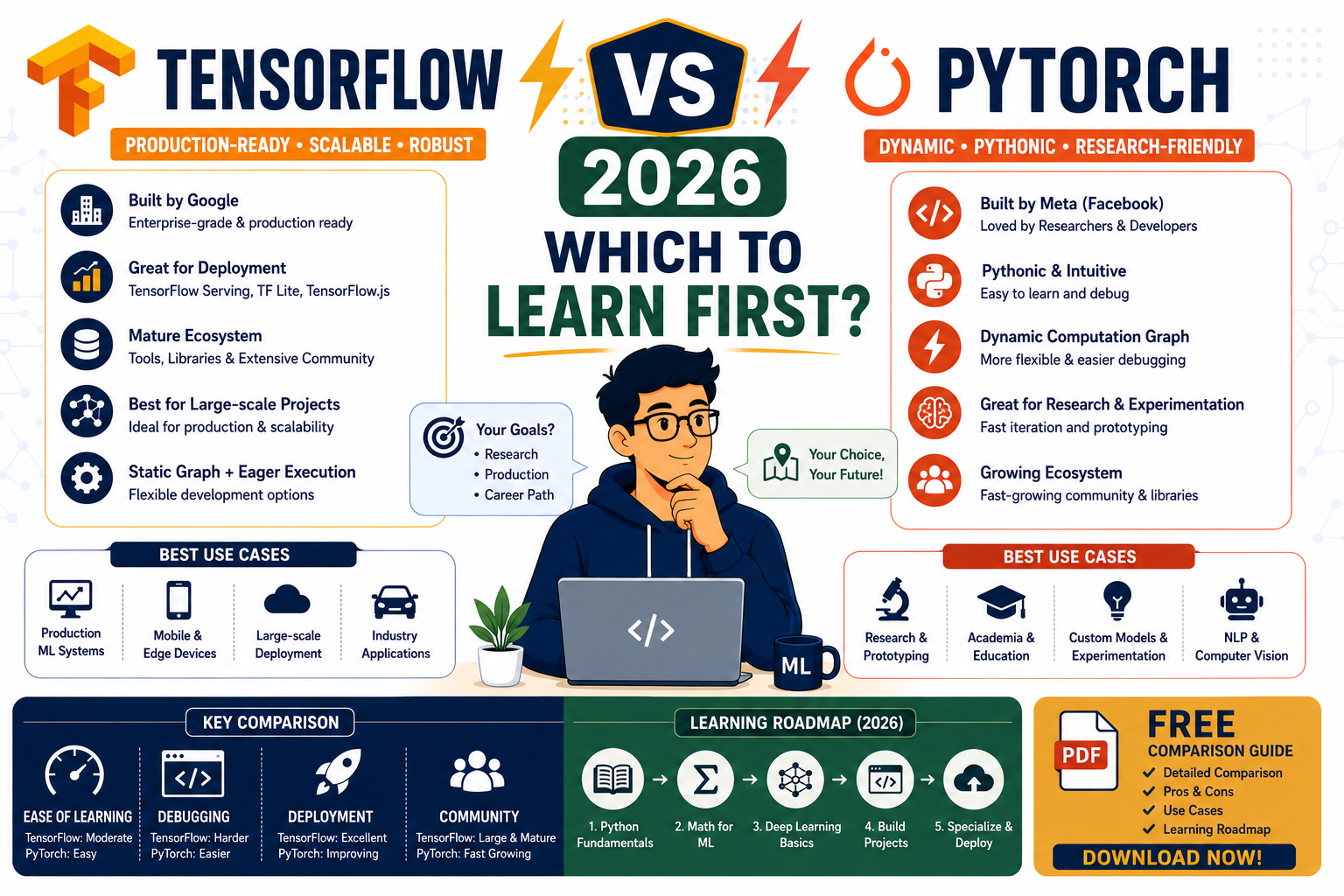
TensorFlow and PyTorch are the two deep learning frameworks that matter in 2026. Both can train the same models, both run on the same GPUs, and both ship with mature ecosystems. But they still have very different personalities. This is the honest 2026 comparison for developers picking a framework for their first serious ML project.
Quick answer for 2026
Pick PyTorch if you are a student, researcher, or developer learning ML in 2026. It is what the research community, Hugging Face, and most new tutorials use. Pick TensorFlow if you are joining a team that already runs it in production, deploying to mobile with TensorFlow Lite, or shipping to Google Cloud Vertex AI where the tooling is TensorFlow-first.
What TensorFlow actually is in 2026
TensorFlow is Google’s deep learning framework, first released in 2015. Version 2.x made it eager-execution by default and unified the API around Keras. By 2026 the ecosystem includes TensorFlow Core, Keras 3 (framework-agnostic), TensorFlow Lite for mobile and edge, TensorFlow.js for browser, TensorFlow Extended (TFX) for production pipelines, and TensorFlow Hub for pretrained models.
What TensorFlow gives you in 2026:
- Keras 3 high-level API that works with TensorFlow, JAX, and PyTorch backends
- TensorFlow Lite for iOS, Android, Raspberry Pi, and microcontrollers
- TensorFlow Serving for gRPC and REST inference at scale
- Deep Google Cloud integration (Vertex AI, TPU pods, BigQuery ML)
- Production-grade model versioning and monitoring via TFX
What PyTorch actually is in 2026
PyTorch is Meta’s deep learning framework, first released in 2016 and now maintained by the PyTorch Foundation. It became the research community’s default around 2020 and has widened its lead every year since. By 2026, an overwhelming majority of new papers on arXiv include PyTorch code, and most Hugging Face model releases ship PyTorch checkpoints first.
What PyTorch gives you in 2026:
- Pythonic API that feels like normal NumPy code with autograd
- torch.compile for near-native performance without leaving eager mode
- Native distributed training with FSDP, DDP, and pipeline parallelism
- ExecuTorch for on-device inference on mobile and embedded targets
- TorchServe for production serving
- Deep integration with the Hugging Face ecosystem (transformers, datasets, accelerate, PEFT, TRL)
Real code comparison: training a small neural network
The same problem in both frameworks: a two-layer classifier on a toy dataset, trained for a few epochs.
PyTorch version
import torch
import torch.nn as nn
import torch.optim as optim

# Dummy data
X = torch.randn(1000, 20)
y = torch.randint(0, 2, (1000,))

# Model
model = nn.Sequential(
    nn.Linear(20, 64),
    nn.ReLU(),
    nn.Linear(64, 2),
)

loss_fn = nn.CrossEntropyLoss()
optimizer = optim.Adam(model.parameters(), lr=1e-3)

# Train
for epoch in range(10):
    logits = model(X)
    loss = loss_fn(logits, y)
    optimizer.zero_grad()
    loss.backward()
    optimizer.step()
    print(f"Epoch {epoch}, loss: {loss.item():.4f}")
TensorFlow (Keras 3) version
import numpy as np
import keras
from keras import layers

# Dummy data
X = np.random.randn(1000, 20).astype("float32")
y = np.random.randint(0, 2, size=(1000,))

# Model
model = keras.Sequential([
    layers.Dense(64, activation="relu", input_shape=(20,)),
    layers.Dense(2),
])

model.compile(
    optimizer=keras.optimizers.Adam(learning_rate=1e-3),
    loss=keras.losses.SparseCategoricalCrossentropy(from_logits=True),
)

model.fit(X, y, epochs=10, batch_size=32)
Both are readable. Keras is more concise for standard training loops, PyTorch is more explicit about every step and easier to debug when something goes wrong inside the loop. Beginners often find Keras faster to start with. Researchers prefer PyTorch because they can print, inspect, and modify anything at any point without wrapper magic in the way.
Performance in 2026
Performance is close enough that framework choice rarely bottlenecks a real project in 2026.
- Training speed: roughly tied on modern GPUs when both use their compiled paths (torch.compile in PyTorch, jit_compile in TensorFlow).
- Multi-GPU: both handle it well. PyTorch FSDP and TensorFlow’s DTensor + ParallelStrategy each cover the same ground.
- TPU: TensorFlow is still the smoother path on Google Cloud TPUs. PyTorch on TPU works via PyTorch/XLA and is stable in 2026, but not as first-class.
- CUDA vs ROCm: PyTorch has better AMD ROCm support in 2026, which matters if you rent MI300X instances.
- Mobile inference: TensorFlow Lite has the longer track record for iOS and Android. PyTorch ExecuTorch closed most of the gap in 2025 to 2026.
Deployment and production
Both frameworks can serve production traffic, but they favor different stacks:
TensorFlow deployment stack: TensorFlow Serving for gRPC or REST inference, TFX for pipeline orchestration, Vertex AI for managed model hosting on Google Cloud, TensorFlow Lite for mobile and edge, TensorFlow.js for the browser.
PyTorch deployment stack: TorchServe for REST, vLLM for LLM serving (best-in-class throughput in 2026), Triton Inference Server for multi-framework production, ExecuTorch for mobile and edge, ONNX for cross-framework export.
For LLM inference specifically, PyTorch plus vLLM has become the de facto standard in 2026. TensorFlow does not have an equivalent to vLLM at the same maturity level.
Hiring market in 2026
Job postings tell the same story every year for the last three: PyTorch listings outnumber TensorFlow listings on LinkedIn and Indeed, particularly in ML research and generative AI roles. TensorFlow still leads for classical ML production roles, mobile ML, and Google-shop enterprise teams.
What this means for developers picking a framework in 2026:
- ML research or generative AI role: learn PyTorch first, always.
- Mobile ML (iOS/Android) role: learn TensorFlow Lite first.
- MLOps or data engineering role: learn both, focus on the one your target company runs.
- BSIT capstone or personal portfolio: PyTorch is the safer bet because every popular tutorial in 2026 uses it.
When to pick TensorFlow in 2026
Pick TensorFlow when:
- Your team already runs TensorFlow in production and switching is not free
- Your deployment target is mobile (TensorFlow Lite is still the most stable path)
- You are on Google Cloud Vertex AI and want the smoothest integration
- You need TensorFlow.js for browser-side inference
- You want Keras 3’s ability to swap TF, JAX, or PyTorch backends without rewriting model code
When to pick PyTorch in 2026
Pick PyTorch when:
- You are a student, researcher, or self-learner starting out
- You will work with Hugging Face models (which is most modern LLM work)
- You want the most active research community and the freshest paper implementations
- You value explicit, Pythonic code you can step through in a debugger
- You are training or fine-tuning LLMs and need vLLM for serving
- You want the widest job market signal for ML research roles
Official documentation
Where to train and deploy your models
The links below are affiliate links. We may earn a commission at no extra cost to you if you purchase through them. See our affiliate disclosure for details.
- Kamatera GPU cloud for training on A10G, A100, and H100 instances
- OnSpace AI for hosting AI inference endpoints in production
- Rheinwerk Publishing for deep learning and Python engineering books
Frequently asked questions
Is TensorFlow dying in 2026?
No. Google continues active TensorFlow development and Keras 3 is a real second act. But PyTorch has clearly won the research and generative AI segments, and the gap widens each year. TensorFlow remains the safer pick for mobile ML, edge deployment, and existing production stacks.
Which framework is easier to learn for a beginner?
Keras 3 (on top of TensorFlow) is arguably easier to write for standard training. PyTorch is easier to debug because you can print, inspect, and modify tensors at any step. Most 2026 tutorials use PyTorch, so learning PyTorch first means more relevant learning resources for the projects you actually want to build.
Which framework is better for a BSIT capstone project in 2026?
PyTorch, in almost every case. Panels are more familiar with PyTorch, Hugging Face demos in PyTorch are easier to adapt, and every new pretrained model ships PyTorch weights first. Choose TensorFlow only if your capstone specifically targets mobile deployment with TensorFlow Lite.
Can I learn both at the same time?
You can, but you will progress faster by picking one and going deep for 3 to 6 months. The concepts (tensors, autograd, optimizers, loss functions, backprop) are the same. Once you understand them in one framework, switching takes a weekend. Beginners who split time between both often stall on both.
What about JAX?
JAX is a strong third choice, popular inside Google research and for TPU-heavy workloads. It has a steeper learning curve and a smaller community. For 2026, treat JAX as an advanced framework you learn after PyTorch or TensorFlow, not instead of them.
Do I need a GPU to learn either framework?
Not for learning. Both frameworks run on CPU for small tutorials. Once you move to real datasets and modern models, you need a GPU. The cheapest paths are Google Colab (free T4 GPU with limits), Kaggle notebooks (free P100 or T4), or rented instances from Kamatera, RunPod, or Vast.ai starting around $0.30 per hour.
For structured deep learning coursework covering both frameworks, the Deep Learning Specialization on Coursera (Andrew Ng) and the ML tracks on DataCamp remain the most-recommended starting points in 2026 for developers coming from a non-ML background.
Bottom line for 2026 ML developers
For most developers starting in 2026, PyTorch is the right pick. It matches where the research community, tutorials, and job market are headed. TensorFlow is far from dead but has settled into the roles it does best: mobile deployment, existing production stacks, and Google Cloud shops.
Do not pick a framework based on hype alone. Pick based on your actual target: the job you want, the project you are building, the team you are joining. If you get stuck deciding, start with PyTorch on Kaggle or Colab, build one small classifier, and see how it feels. Feel free to comment below if you want a suggestion on which starter project matches your goals.

Angel Jude Suarez
Full-Stack Developer at PIES IT Solution
Focuses on Python development, machine learning, and AI integration. Has built production AI systems including OpenAI Whisper integration for medical transcription and GPT-4o-powered diagnosis assistance. Strong background in pandas, scikit-learn, and TensorFlow.
Expertise: Python · Machine Learning · AI Integration · OpenCV · Django · PyTorch · TensorFlow · LangChain · OpenAI SDK · Anthropic SDK · View all posts by Angel Jude Suarez →