
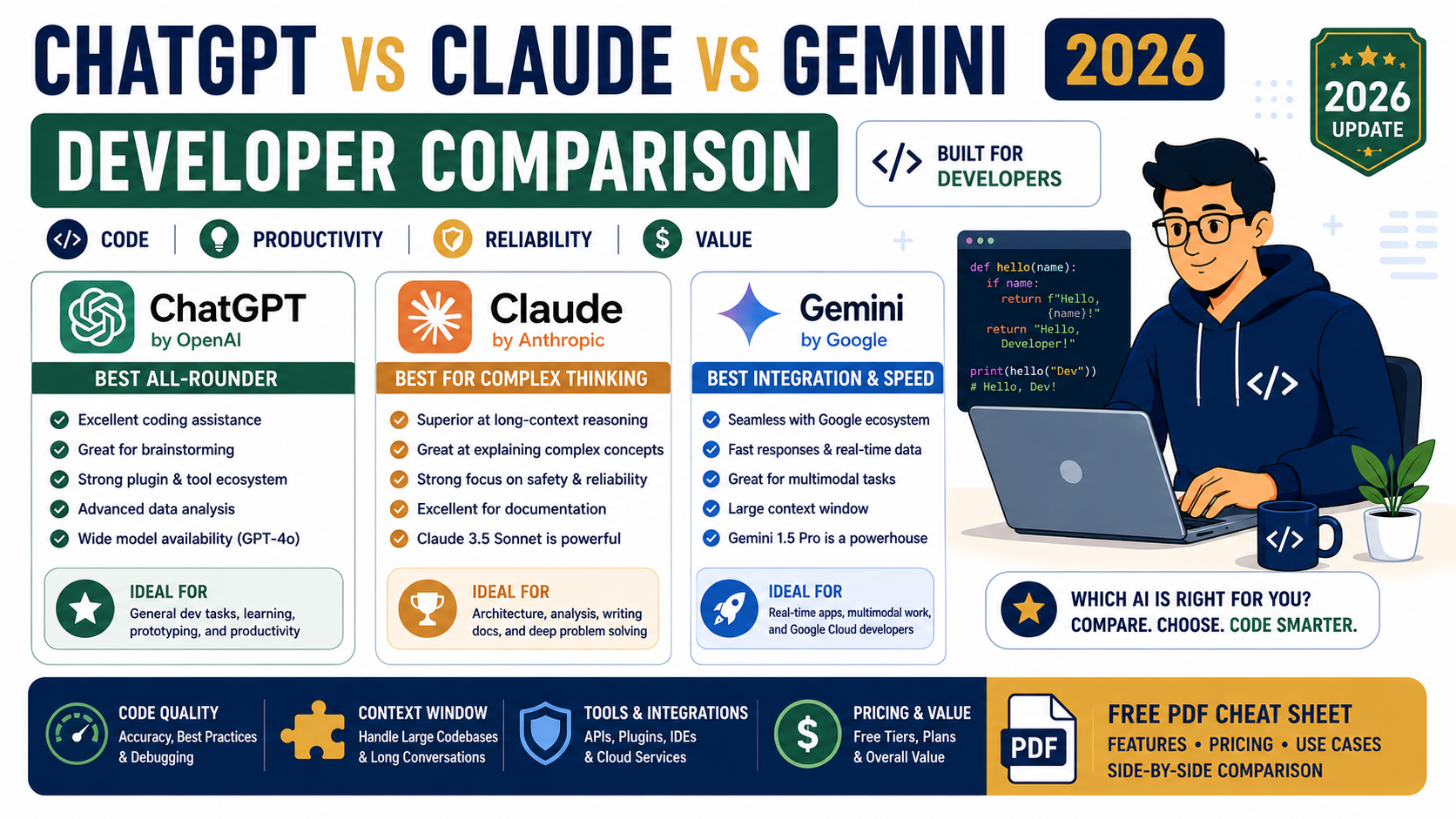
If you are picking a large language model to build with in 2026, the three real choices for developers are OpenAI’s ChatGPT (GPT-5), Anthropic’s Claude (Claude 4.7 Sonnet, Claude Opus 4.7), and Google’s Gemini (Gemini 2.5 Pro, 2.5 Flash). Each wins on different axes. This is the honest comparison based on integrating all three into production apps over the last 12 months.
Quick verdict for 2026 developers
Claude for coding, complex reasoning, and long-context work (best at following intricate instructions). ChatGPT for the widest ecosystem, most third-party integrations, and cheapest overall pricing. Gemini for multimodal work (video, audio, images together) and when you already run on Google Cloud infrastructure. Most production teams end up using two or three depending on the task.
What each model actually is in 2026
ChatGPT (GPT-5 family)
OpenAI’s flagship line as of 2026. GPT-5 was released in early 2026 with a unified reasoning architecture (no more separate “reasoning” vs “chat” model tiers). Handles up to 400K tokens of context in the standard tier, more via specialized endpoints. Available via chat.openai.com, ChatGPT desktop apps, and the OpenAI API.
- Best-known models: GPT-5 (flagship), GPT-5-mini (fast + cheap), GPT-5-nano (embedded use cases)
- Context window: 400K tokens standard
- Multimodal: text + images + audio + basic video understanding
- API pricing (2026): $1.25/M input, $10/M output for GPT-5 flagship
- Real-time voice mode: yes (native)
- Tool use / function calling: mature, well-documented
Claude (Anthropic’s flagship line)
Anthropic released Claude 4.7 in mid-2026. Two tiers: Claude Opus 4.7 (flagship, best reasoning) and Claude Sonnet 4.7 (balanced cost/performance). Anthropic is the recognized leader for coding tasks and long-context work as of 2026.
- Best-known models: Claude Opus 4.7, Claude Sonnet 4.7, Claude Haiku 4.5 (fast tier)
- Context window: 200K tokens standard, 1M available on request
- Multimodal: text + images + PDF, no native audio or video
- API pricing (2026): $3/M input, $15/M output for Sonnet 4.7
- Extended thinking: yes (opt-in reasoning mode for complex problems)
- Best-in-class: coding tasks, long-form writing, careful instruction following
Gemini (Google DeepMind)
Google’s Gemini 2.5 Pro launched late 2025 and reached feature parity with GPT-5 through 2026. Deep integration with Google Cloud services (Vertex AI, BigQuery, Google Workspace). Best multimodal support of the three (native video understanding, audio generation).
- Best-known models: Gemini 2.5 Pro (flagship), Gemini 2.5 Flash (fast + cheap), Gemini Nano (on-device)
- Context window: 2M tokens (largest in industry)
- Multimodal: text + images + audio + video (best-in-class)
- API pricing (2026): $1.25/M input, $10/M output for 2.5 Pro (matches OpenAI)
- Live API: yes (real-time voice + video conversation)
- Google integration: native access to Google Search, YouTube, Maps via tool use
Real API pricing comparison (2026)
| Model | Input $/M | Output $/M | Context | Best for |
|---|---|---|---|---|
| GPT-5 (flagship) | $1.25 | $10 | 400K | Ecosystem breadth |
| GPT-5-mini | $0.15 | $0.60 | 400K | High-volume cheap |
| Claude Opus 4.7 | $15 | $75 | 200K | Hardest reasoning |
| Claude Sonnet 4.7 | $3 | $15 | 200K | Coding, production apps |
| Claude Haiku 4.5 | $0.80 | $4 | 200K | Fast + cheap Claude |
| Gemini 2.5 Pro | $1.25 | $10 | 2M | Multimodal, huge context |
| Gemini 2.5 Flash | $0.30 | $2.50 | 1M | Cheap multimodal |
For most production workloads in 2026, the flagship API cost per million tokens is: GPT-5 = Gemini 2.5 Pro (both $1.25/$10), Claude Sonnet 4.7 = 2.4x more expensive on input, 1.5x on output, Claude Opus 4.7 = 12x more expensive than the cheap tier. Pick based on task fit, not just price.
Coding tasks: which one wins in 2026
Claude Sonnet 4.7 leads independent coding benchmarks (SWE-bench, LiveCodeBench, HumanEval+) throughout 2026 by 5-15 percentage points over GPT-5 and Gemini 2.5 Pro. This is why every major AI coding assistant (Cursor, Windsurf, Zed, GitHub Copilot’s premium tier, Claude Code) defaults to Claude for their heavy coding workflows.
What Claude does better on code in practice:
- Follows multi-file refactoring instructions without losing state
- Preserves existing code style and conventions in a codebase
- Handles ambiguous requirements by asking clarifying questions
- Writes tests that actually match your existing test framework
- Better at debugging (understanding stack traces + finding root causes)
Where GPT-5 catches up in 2026:
- Faster for one-shot simple tasks (write a Python function, generate a regex)
- Better at generating creative code (game dev, generative art, unusual algorithms)
- More reliable for languages outside the Python/JavaScript mainstream (Rust, Zig, Elixir)
Gemini 2.5 Pro’s coding is competent but rarely the first pick unless you need the 2M context window (e.g., analyzing a 50-file codebase at once).
Long-context work: Gemini and Claude ahead
If your app processes long documents (contracts, books, codebases), context window matters more than model quality per token. In 2026:
- Gemini 2.5 Pro (2M context): read an entire codebase or a 500-page PDF in one call
- Claude Opus / Sonnet (200K standard, 1M on request): also excellent at retention (needle-in-haystack tests near 99% at 200K)
- GPT-5 (400K standard): solid but retention drops noticeably above 250K tokens
For legal, academic, or research work with long documents, start with Gemini or Claude. GPT-5 is usable but its “attention” degrades faster at maximum context.
Multimodal tasks: Gemini wins
Gemini 2.5 Pro is the only one of the three with native video understanding in 2026. If your app needs to process video content (transcription, scene detection, visual Q&A over recorded footage), Gemini is the clear pick. GPT-5 handles video via frame sampling, Claude does not process video at all.
For audio (transcription + generation), OpenAI’s Whisper + GPT-5 audio combo is more mature than Gemini’s Live API for pure speech-to-text tasks. But Gemini’s Live API is better for real-time bidirectional voice conversations (think Google Voice Assistant integration).
For image understanding, all three are roughly comparable in 2026. Gemini slightly edges out on complex charts and technical diagrams.
Ecosystem and integration in 2026
ChatGPT (OpenAI) has the largest third-party ecosystem: LangChain, LlamaIndex, Vercel AI SDK, Hugging Face, and virtually every AI dev tool defaults to OpenAI-compatible APIs. If you want a plugin-and-play integration, this ecosystem depth matters.
Claude (Anthropic) has grown fast in 2026. Their Model Context Protocol (MCP) shipped in late 2024 has become the de facto standard for tool integration by 2026, with 500+ MCP servers available. Cursor, Zed, Claude Code, and most IDE integrations use MCP natively.
Gemini (Google) integrates best with Google Cloud services (Vertex AI for MLOps, BigQuery for analytics, Google Workspace for docs), and Firebase for mobile apps. Weakest of the three for third-party dev tool integrations.
Which one to pick for your project in 2026
- Building a coding assistant / dev tool: Claude Sonnet 4.7 (best coding, best instruction following)
- Building a general-purpose chatbot: GPT-5-mini (cheapest, biggest ecosystem)
- Building a document analysis tool: Gemini 2.5 Pro (2M context, cheap flagship pricing)
- Building a multimodal app (video, audio, images): Gemini 2.5 Pro (native video support)
- High-volume production API: GPT-5-mini for cheap ($0.15/M input), Claude Haiku for balance ($0.80/M)
- Complex agentic workflows (multi-step reasoning + tool use): Claude Opus 4.7 with extended thinking
- Building on Google Cloud already: Gemini 2.5 Pro via Vertex AI (unified billing + IAM)
Frequently asked questions
Which model is safest to build production apps on in 2026?
All three are production-ready in 2026 with 99.9%+ API uptime SLAs. Claude has the strictest content safety defaults (rarely produces harmful output). GPT-5 has the most third-party integrations for compliance tools (Azure OpenAI for HIPAA workloads, SOC 2 certifications). Gemini has the deepest Google Cloud audit tools. For most non-regulated production apps, all three are safe choices.
Can I switch between them easily if my needs change?
Yes if you use an abstraction layer. LangChain, LlamaIndex, LiteLLM, and Vercel AI SDK all support switching between OpenAI, Anthropic, and Google APIs with a config change. Direct API integrations require rewriting for each provider (different SDKs, different request formats). Recommendation: use LiteLLM in production so you can A/B test models without code changes.
Which is best for Filipino developers building side projects on a budget?
GPT-5-mini at $0.15/$0.60 per million tokens is the cheapest for high-volume side projects. Gemini 2.5 Flash at $0.30/$2.50 is comparable and has a generous free tier via Google AI Studio (worth using for prototyping). Claude Haiku 4.5 at $0.80/$4 is more expensive per token but generally produces higher-quality output that needs fewer retries, so the true cost per successful response may be similar. All three accept international payment methods (credit cards, PayPal, Wise) for PH-based developers.
How do the free tiers compare in 2026?
ChatGPT (chat.openai.com) has a free tier with rate-limited GPT-5 access (about 10 messages every 3 hours). Claude (claude.ai) has a free tier with rate-limited Sonnet 4.7 access (about 5-10 messages per day). Gemini (gemini.google.com) has the most generous free tier for Gemini 2.5 Flash (nearly unlimited for reasonable use) plus paid Advanced tier for 2.5 Pro. For pure prototyping, Gemini free tier goes furthest.
Which one handles Tagalog and Bisaya best for PH-market apps?
GPT-5 has the best Tagalog fluency of the three (trained on more Filipino-language content). Claude and Gemini both handle Tagalog competently but occasionally slip into unnatural translations. For Bisaya/Cebuano, all three are weaker than for Tagalog because there is less training data. If building a Filipino-language app in 2026, test all three on your specific use case before committing.
Which model has the best BSIT capstone integration story in 2026?
Any of the three works well for a BSIT capstone project. The most impressive defense demos in 2026 use Claude Sonnet 4.7 for the actual AI logic (best output quality) via LangChain or Anthropic SDK. Document your API costs, prompt engineering approach, and safety considerations in your methodology chapter. Panels appreciate seeing understanding of the AI system, not just that it works. Free tier of Gemini or ChatGPT is enough to prototype before your defense.
For teams that pair LLM output with polished writing workflows, tools like Grammarly catch tone and grammar issues before content ships, and Notion works well as a shared prompt library so teammates can version and reuse prompts across projects.
Bottom line for 2026 developers
You are not picking one model for everything anymore in 2026. Most production teams use Claude for coding and complex reasoning, GPT-5-mini or Gemini Flash for high-volume cheap tasks, and Gemini 2.5 Pro when they need long context or multimodal support. If you can only pick one to learn deeply, Claude Sonnet 4.7 gives you the widest capability with modern developer workflows in 2026. If you can only pick one for a budget-conscious project, GPT-5-mini via OpenAI API is the safest low-cost bet.
Official documentation
Related AI dev tools
The links below are affiliate links. We may earn a commission at no extra cost to you when you sign up. See our affiliate disclosure for full details.
- OnSpace AI — AI-first app builder with multi-model support (works with GPT-5, Claude, Gemini). 20% revenue share on referrals.
- Thunderbit — AI web scraper Chrome extension for feeding real-time data to your LLM apps.
- Cloudways — hosting for your LLM-powered production app. $14/mo starting.

Angel Jude Suarez
Full-Stack Developer at PIES IT Solution
Focuses on Python development, machine learning, and AI integration. Has built production AI systems including OpenAI Whisper integration for medical transcription and GPT-4o-powered diagnosis assistance. Strong background in pandas, scikit-learn, and TensorFlow.
Expertise: Python · Machine Learning · AI Integration · OpenCV · Django · PyTorch · TensorFlow · LangChain · OpenAI SDK · Anthropic SDK · View all posts by Angel Jude Suarez →