
Choosing a state manager for a React app in 2026 usually comes down to two candidates: Zustand or Redux Toolkit. Both are actively maintained, well-documented, and used at scale. The differences show up in bundle size, ceremony, and how the code feels to write. This guide compares them head-to-head with the same store implemented in both, plus the decision criteria that actually matter in 2026.
Quick 2026 verdict
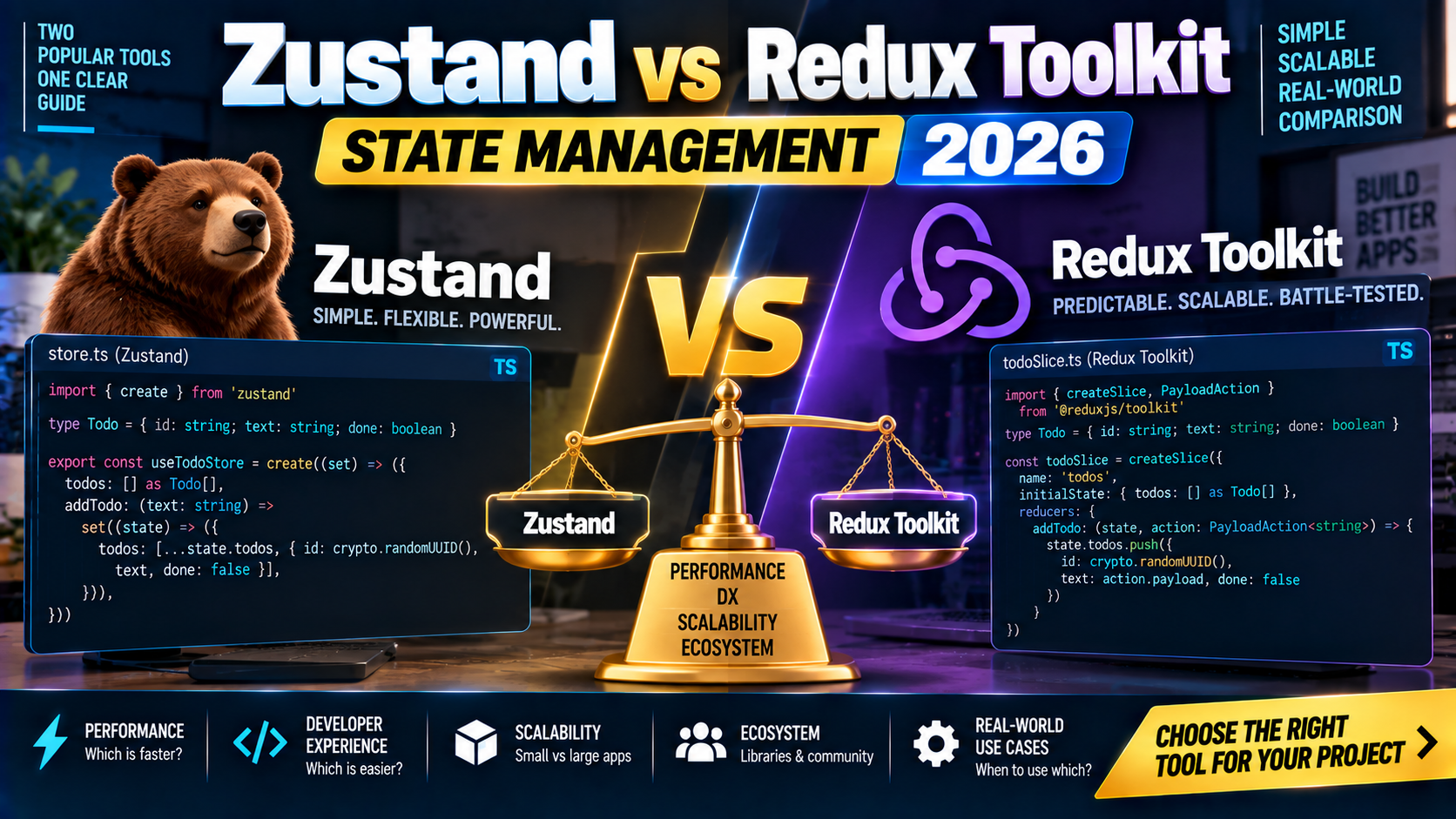
For most new React apps in 2026, Zustand wins: 4KB gzipped, near-zero boilerplate, no provider required, works fine with React Server Components. Pick Redux Toolkit when you have an existing Redux codebase, a large team that benefits from strict opinions, or hard requirements around time-travel debugging + Redux DevTools. Beyond those cases, Zustand’s ergonomics win more often than not.
Same store, both libraries
A simple counter store with actions and derived state.
Zustand version
// src/stores/counter.ts
import { create } from 'zustand';

interface CounterState {
  count: number;
  increment: () => void;
  decrement: () => void;
  reset: () => void;
}

export const useCounter = create<CounterState>((set) => ({
  count: 0,
  increment: () => set((s) => ({ count: s.count + 1 })),
  decrement: () => set((s) => ({ count: s.count - 1 })),
  reset: () => set({ count: 0 }),
}));

// Use in a component
function Counter() {
  const { count, increment, reset } = useCounter();
  return (
    <div>
      <p>{count}</p>
      <button onClick={increment}>+</button>
      <button onClick={reset}>Reset</button>
    </div>
  );
}
Redux Toolkit version
// src/store/counterSlice.ts
import { createSlice, PayloadAction } from '@reduxjs/toolkit';

const counterSlice = createSlice({
  name: 'counter',
  initialState: { count: 0 },
  reducers: {
    increment: (state) => { state.count += 1; },
    decrement: (state) => { state.count -= 1; },
    reset: (state) => { state.count = 0; },
  },
});

export const { increment, decrement, reset } = counterSlice.actions;
export default counterSlice.reducer;

// src/store/index.ts
import { configureStore } from '@reduxjs/toolkit';
import counterReducer from './counterSlice';
import { TypedUseSelectorHook, useDispatch, useSelector } from 'react-redux';

export const store = configureStore({
  reducer: { counter: counterReducer },
});

export type RootState = ReturnType<typeof store.getState>;
export type AppDispatch = typeof store.dispatch;

export const useAppDispatch: () => AppDispatch = useDispatch;
export const useAppSelector: TypedUseSelectorHook<RootState> = useSelector;

// src/main.tsx (wrap the app)
import { Provider } from 'react-redux';
import { store } from './store';

<Provider store={store}><App /></Provider>

// Use in a component
function Counter() {
  const count = useAppSelector((s) => s.counter.count);
  const dispatch = useAppDispatch();
  return (
    <div>
      <p>{count}</p>
      <button onClick={() => dispatch(increment())}>+</button>
      <button onClick={() => dispatch(reset())}>Reset</button>
    </div>
  );
}
Same functionality. Zustand: 14 lines. Redux Toolkit: 34 lines + provider wrapping + typed* hook boilerplate.
Numbers that matter (2026)
| Aspect | Zustand | Redux Toolkit |
|---|---|---|
| Bundle size (gzipped) | ~4 KB | ~14 KB (with react-redux) |
| Provider required | No | Yes |
| Async logic pattern | Just call async functions | createAsyncThunk / RTK Query |
| DevTools | Redux DevTools compatible (opt-in middleware) | Redux DevTools first-class |
| Middleware ecosystem | Small but sufficient (persist, immer, devtools) | Large (thunks, sagas, RTK Query, etc.) |
| TypeScript setup | Minimal, one interface | Multi-file (slice, RootState, typed hooks) |
| Learning curve | Very shallow | Moderate (slices, actions, reducers, selectors) |
Zustand: patterns that matter
Selectors (avoid re-renders)
// Re-renders on ANY store change (bad for big stores)
const state = useCounter();

// Re-renders only when count changes (good)
const count = useCounter((s) => s.count);

// Multiple fields with shallow comparison
import { useShallow } from 'zustand/react/shallow';
const { count, increment } = useCounter(
  useShallow((s) => ({ count: s.count, increment: s.increment }))
);
Async actions
export const useUsers = create<UsersState>((set) => ({
  users: [],
  loading: false,
  error: null,

  fetchUsers: async () => {
    set({ loading: true, error: null });
    try {
      const res = await fetch('/api/users');
      set({ users: await res.json(), loading: false });
    } catch (e) {
      set({ error: (e as Error).message, loading: false });
    }
  },
}));
No thunks. No middleware. Just an async function that calls set().
Persist to localStorage
import { create } from 'zustand';
import { persist } from 'zustand/middleware';

export const useSettings = create<SettingsState>()(
  persist(
    (set) => ({
      theme: 'light',
      setTheme: (t) => set({ theme: t }),
    }),
    { name: 'settings' }   // localStorage key
  )
);
Redux Toolkit: where it shines
RTK Query (server state)
RTK Query is a data-fetching layer built on top of Redux Toolkit. If you already use RTK, adding RTK Query gives you React Query-like ergonomics with Redux DevTools + Redux state integration.
import { createApi, fetchBaseQuery } from '@reduxjs/toolkit/query/react';

export const usersApi = createApi({
  reducerPath: 'usersApi',
  baseQuery: fetchBaseQuery({ baseUrl: '/api' }),
  endpoints: (build) => ({
    getUsers: build.query<User[], void>({ query: () => 'users' }),
  }),
});

export const { useGetUsersQuery } = usersApi;

// In a component:
const { data, isLoading } = useGetUsersQuery();
Redux DevTools + time-travel
The Redux DevTools browser extension gives you a complete action log, replay, jump-to-state, and dispatch-history that many teams find worth the boilerplate. Zustand can use the same extension via the devtools middleware but Redux Toolkit’s integration is deeper and better-documented.
Pick Zustand when
- You are starting a new React app in 2026
- You want minimum boilerplate and fastest developer velocity
- Your app has moderate global state (5-20 slices), not thousands of actions
- You value small bundle size (Zustand adds ~4KB)
- Your team is small and does not need enforced conventions
Pick Redux Toolkit when
- You have an existing Redux codebase (migration cost is real; RTK modernizes it in place)
- Team is large and benefits from strict conventions
- You need RTK Query for a Redux-centered data layer (though React Query + Zustand is a comparable combo)
- Time-travel debugging is a must-have for QA / debugging workflow
- You use Redux Saga or need complex side-effect orchestration
What about Jotai, Valtio, Signals?
Other 2026 state managers you may hear about:
- Jotai: atomic state model, similar spirit to Recoil (which is now discontinued). Great for granular subscription. Very lightweight (~3KB).
- Valtio: proxy-based, mutate state like a plain object. Feels almost too simple. From the same author as Zustand.
- Signals (preact/signals-react): fine-grained reactivity, very fast, but the mental model is different from React’s default render cycle.
All three are fine choices. Zustand vs Redux Toolkit remains the mainstream comparison because those two dominate real-world React codebases in 2026. Explore the smaller options once you have a preference for atomic vs store-shaped state.
Frequently Asked Questions
Is Redux dead?
No. Redux Toolkit is actively maintained and used at scale by many companies. Classic Redux with hand-written reducers, action types, and connect() is dead; nobody writes new Redux code that way in 2026. RTK is the modern way.
Do I need a state manager if I use React Query?
Often no. React Query handles server state (data from your API) very well. What is left is local UI state (open dialogs, selected filters, form drafts). For that, either useState/useReducer suffices, or you add a small store like Zustand. Reach for Redux Toolkit only if your local UI state is complex or needs Redux DevTools.
Does Zustand work with React Server Components?
Yes for client-side state. Because Zustand does not require a provider and is entirely client-only, you can create stores inside Client Components without issue. Just make sure the store creation happens inside a "use client" file and that you do not try to read Zustand state inside a Server Component (Server Components have no client state).
Can I migrate from Redux to Zustand incrementally?
Yes. Both can coexist. Add Zustand for new features and gradually port old Redux slices as you touch them. There is no runtime conflict; they are independent state layers. Full migration on a large codebase takes weeks-to-months depending on how many slices you have.
Which has better TypeScript support?
Both are solid. Zustand’s setup is one interface + one create<State> call. Redux Toolkit needs the RootState/AppDispatch pattern + typed hooks. Both give you full type safety in components; Zustand takes fewer lines to get there.
Which is faster?
Both are fast enough for real apps. Zustand’s selector model gives fine-grained subscriptions with minimal re-renders. Redux Toolkit with reselect can achieve the same. In practice, the perf difference is invisible unless you have a pathological amount of state.
Related Modern Web Dev tutorials
- Next.js 15 Complete Beginner Guide 2026 (First App)
- React 19 vs React 18 Migration Guide 2026
- TypeScript Complete Beginner Tutorial 2026
- Bun vs Node.js 2026 (coming this week)
Official documentation

Glay Eliver
Programmer & Technical Writer at PIES IT Solution
Glay Eliver is a programmer and writer at PIES IT Solution, author of over 600 tutorials at itsourcecode.com. Specializes in JavaScript tutorials, Microsoft Office how-tos (Excel, Word, PowerPoint), and Python error debugging covering ImportError, TypeError, AttributeError, ModuleNotFoundError, and JavaScript ReferenceError.
Expertise: JavaScript · MS Excel · MS Word · MS PowerPoint · Python · ModuleNotFoundError · JavaScript ReferenceError · Pygame · View all posts by Glay Eliver →