
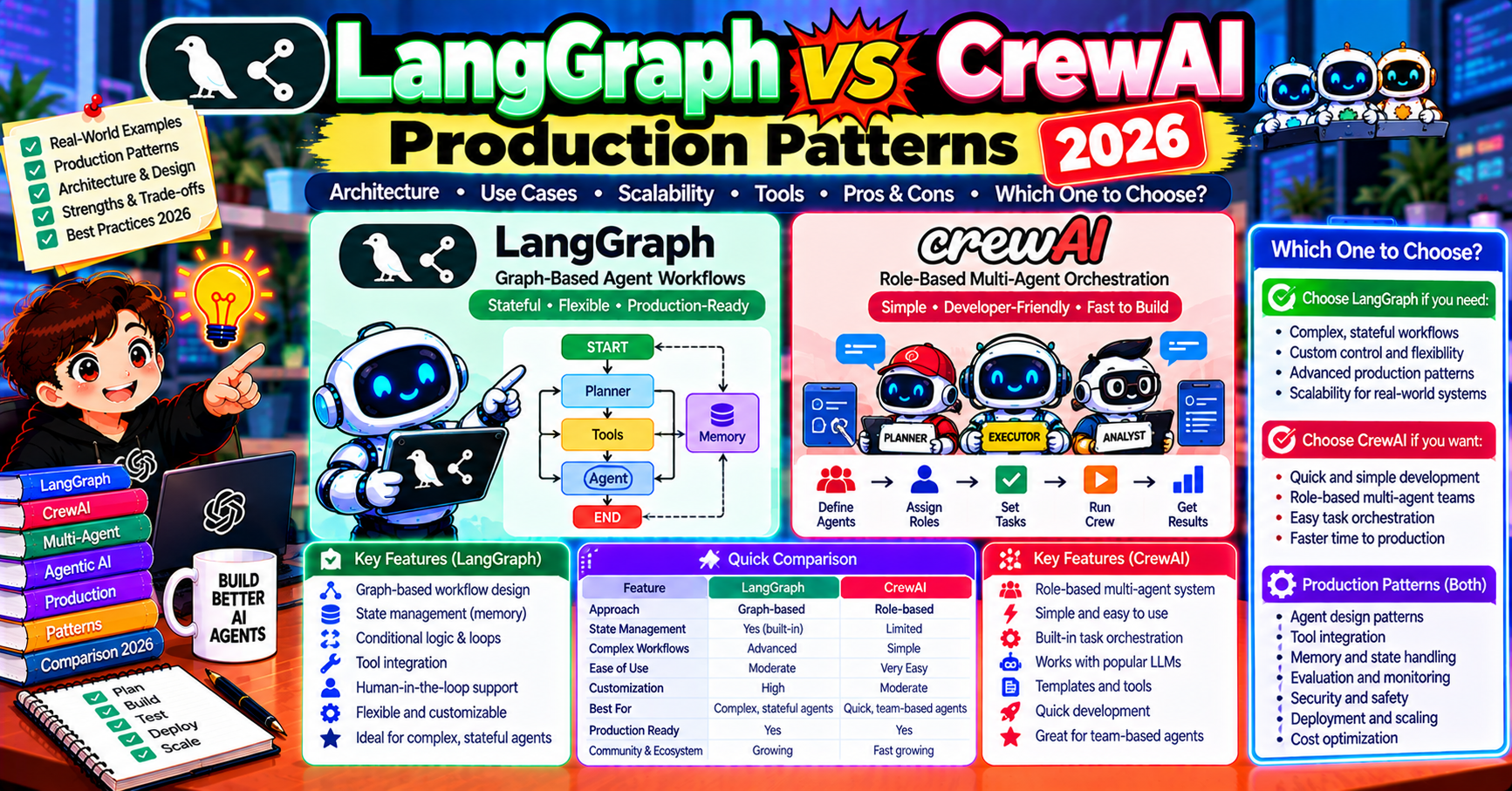
LangGraph and CrewAI both ship multi-agent systems to production in 2026, but at scale the differences between them matter more than the quick-start API comparisons suggest. This article covers the specific production patterns that distinguish them: state persistence, failure recovery, cost control at scale, team-of-teams composition, and operational observability. If you are picking between the two for a system that will run millions of agent-executions per month, read this before you commit.
The production problem that most tutorials ignore
Agent tutorials show you building a working demo. Production asks different questions. What happens when the LLM API goes down mid-run? When one of your 20 agents returns a malformed response? When a user cancels mid-execution? When you need to replay a failed run to debug? When budget caps need to enforce across thousands of concurrent agents? These are the patterns that separate frameworks.
State persistence: who wins
LangGraph: first-class. Compile your graph with a checkpointer backend (SQLite, Postgres, Redis, MongoDB) and every state transition persists atomically. Restart your service mid-run and the agent picks up from the last checkpoint. Thread IDs isolate conversations between users.
from langgraph.checkpoint.postgres import PostgresSaver

app = graph.compile(checkpointer=PostgresSaver.from_conn_string(DB_URL))
config = {"configurable": {"thread_id": user_id}}
app.invoke(initial_state, config=config)
# ... service crashes
app.invoke(None, config=config) # resumes from last checkpointCrewAI: memory module provides within-crew-run + across-run memory but no state checkpointing. If a crew.kickoff() crashes mid-run, you restart from scratch. Workaround: break workflows into smaller crews with task-level outputs persisted to your own storage, and resume by starting a new crew from the saved intermediate output.
Verdict: LangGraph wins decisively for crash recovery. CrewAI requires DIY state management.
Human-in-the-loop interrupts
LangGraph: compile with interrupt_before=["approve_payment"] and the graph pauses, saves state, and returns to your code before entering the named node. You present the pending action to a human; they approve or reject; you resume with app.invoke(None, config) or edit the state and resume with modifications.
CrewAI: supports human input via UserProxyAgent-like patterns but less structured. You can require human approval between tasks by inserting a task that blocks on input(), but there is no native checkpoint-pause-resume primitive. Workaround: break the crew into multiple crews with human review between.
Verdict: LangGraph for anything requiring approval gates on destructive actions.
Cost control at scale
Multi-agent systems multiply LLM costs. Both frameworks let you set per-agent model choices, but production enforcement differs:
LangGraph: nodes are plain Python functions, so you add arbitrary pre-call cost checks:
def llm_node(state):
    user_id = state["user_id"]
    monthly_spend = get_user_spend(user_id)
    if monthly_spend > state["budget_cap"]:
        return {"error": "budget exceeded"}
    # proceed with LLM call
    response = llm.invoke(state["prompt"])
    track_spend(user_id, estimate_cost(response))
return {"output": response}CrewAI: enforce at the LLM-provider level via your own LLM wrapper or via LangChain middleware. Less convenient inline, more work at wiring time, but same end effect.
Verdict: tie. Both can enforce; LangGraph is more natural about it.
Parallel execution
LangGraph: fan-out at the edge level (one entry node to multiple downstream nodes) with automatic fan-in on the shared state. Independent branches run concurrently; the framework handles the wait + merge.
CrewAI: tag tasks with async_execution=True and the framework runs them concurrently when they do not share context dependencies.
Both support parallel execution; LangGraph’s model is more explicit about which branches can run in parallel vs sequentially. For complex graphs with many parallel subtasks, LangGraph’s explicit control-flow pays off in debugging.
Team-of-teams composition
Both frameworks support hierarchical structures (one team using another as a sub-component) but the mechanics differ:
LangGraph: subgraphs. A compiled graph is itself a callable; add it as a node in a parent graph. State flows between parent and child via state-schema compatibility.
research_subgraph = research_builder.compile()

main_graph = StateGraph(MainState)
main_graph.add_node("research", research_subgraph)
main_graph.add_node("write", write_node)
main_graph.add_edge("research", "write")CrewAI: hierarchical process mode with a manager agent that routes tasks to crews. Less explicit than LangGraph’s subgraph composition but more conceptually tidy if your workflow actually has a manager-worker hierarchy.
Verdict: LangGraph for arbitrary composition; CrewAI if your workflow genuinely has a manager-worker shape.
Observability
LangGraph: first-class LangSmith integration. Set env vars, every graph execution auto-traces with per-node input/output, cost, latency. Replay broken runs by thread_id. Visual graph diagram shows execution flow. LangSmith costs money at scale ($39/user/month plus) but worth it for production.
CrewAI: AgentOps integration (pip install agentops + API key). Dashboard shows per-crew runs with cost + latency + conversation. Also integrates with Langfuse and Phoenix via middleware. Less tightly coupled than LangGraph-LangSmith but more flexible across providers.
Verdict: tie. LangGraph has tighter LangSmith integration; CrewAI has broader observability-provider options.
Error handling patterns
Production agents fail. How each framework handles failures:
LangGraph: nodes are plain functions, so try/except at the node level handles errors. State updates on failure (e.g., setting an error field) flow through subsequent conditional edges to recovery nodes.
CrewAI: tasks have callbacks (on_failure) that can trigger recovery logic. Agents retry failed tool calls automatically up to a configurable limit (max_retry_limit).
Both are workable; LangGraph gives you explicit error-handling edges in your graph (visible in the diagram), CrewAI keeps error handling implicit (set via config).
When each framework wins: production decision matrix
| Production need | Pick LangGraph | Pick CrewAI |
|---|---|---|
| Checkpointing + resume | ✓ | |
| Human-in-the-loop gates | ✓ | |
| Fastest time-to-prototype | ✓ | |
| Non-engineer collaboration (YAML config) | ✓ | |
| Role-based workflow (clear job titles) | ✓ | |
| Explicit state machine shape | ✓ | |
| Complex conditional flow | ✓ | |
| Deep LangChain / LangSmith integration | ✓ | |
| Low-code / readable-config stakeholder review | ✓ |
Common hybrid pattern: CrewAI inside LangGraph
Real-world large systems sometimes combine both: LangGraph as the top-level orchestrator for state management and interrupts; CrewAI “crews” as the implementation of specific nodes where the role-based abstraction fits naturally.
def research_crew_node(state):
    crew = Crew(agents=[researcher, analyst], tasks=[...])
    result = crew.kickoff(inputs={"topic": state["topic"]})
    return {"research_output": str(result)}

graph.add_node("research_crew", research_crew_node)
The outer LangGraph handles checkpointing, interrupts, and overall state. The inner CrewAI handles its specific workflow. Both ecosystems coexist cleanly.
Migration guidance
Teams that start with CrewAI prototypes and later need production features sometimes migrate to LangGraph. The migration path:
- Keep CrewAI agents (their system prompts and tool configs are reusable)
- Rewrite the orchestration layer as a LangGraph state machine
- Wrap each CrewAI agent as a LangGraph node (invoke the agent, return its output as state update)
- Add checkpointing + interrupts as needed
- Gradually move agents from CrewAI-wrapped to native LangGraph nodes as you need more control
Expected migration effort: 2-5 days for a 3-5 agent system. The agent logic (prompts, tools) is roughly 80% of the work and is reused; the orchestration (20%) is the rewrite.
Frequently Asked Questions
Official documentation
Which framework has lower LLM cost at scale?
LangGraph tends to run slightly cheaper because explicit control flow prevents conversational overhead loops. CrewAI’s hierarchical mode adds LLM calls for manager routing (one extra call per task delegation). On a 1M-task-per-month workload, expect LangGraph to be 10-20% cheaper than CrewAI hierarchical.
Can I switch frameworks mid-project?
Yes but costs 1-3 engineer-weeks per 5-agent system. Prompts and tools reuse cleanly; orchestration code does not. Make the pick carefully at project start. Prototype in CrewAI if speed matters, then migrate to LangGraph when production reliability matters is a documented pattern.
Do production shops ever use both?
Yes. Common pattern: LangGraph for the top-level state machine, CrewAI as internal node implementations where role abstraction fits. Avoid AutoGen in the mix; its conversational metaphor conflicts with the state-machine metaphor.
How mature is CrewAI vs LangGraph as of 2026?
Both are v1.0+ production-ready. LangGraph has slightly more production-feature polish (checkpointing, interrupts). CrewAI has slightly more community momentum (role abstraction appeals broadly). Pick based on your production requirements, not maturity concerns on either.
What about enterprise support?
LangGraph Platform (LangChain Inc) and CrewAI Enterprise (CrewAI Inc) both offer paid support tiers with SLAs. Pricing starts around $500-1,500/month for small teams. For strict enterprise compliance (SOC 2, data residency), both have options; evaluate each per your requirements.
Can either framework handle real-time streaming to users?
Yes. LangGraph’s app.stream() yields events as nodes execute; forward these to your frontend via SSE. CrewAI has callback hooks for streaming agent output; similar pattern. Both work with LangChain’s streaming abstractions for token-level streams from the underlying LLM.

Joken E. Villanueva
Founder & Lead Developer at PIES IT Solution
Founder of PIES Information Technology Solutions, a software company building production-grade applications for institutions across the Philippines. Over 8 years of hands-on full-stack development experience, currently leading the development of ClinicAI, an AI-powered clinic management platform.
Expertise: PHP · MySQL · JavaScript · AI Integration · SaaS Architecture · VB.NET · Database Design · Capstone Documentation · Java · View all posts by Joken E. Villanueva →