
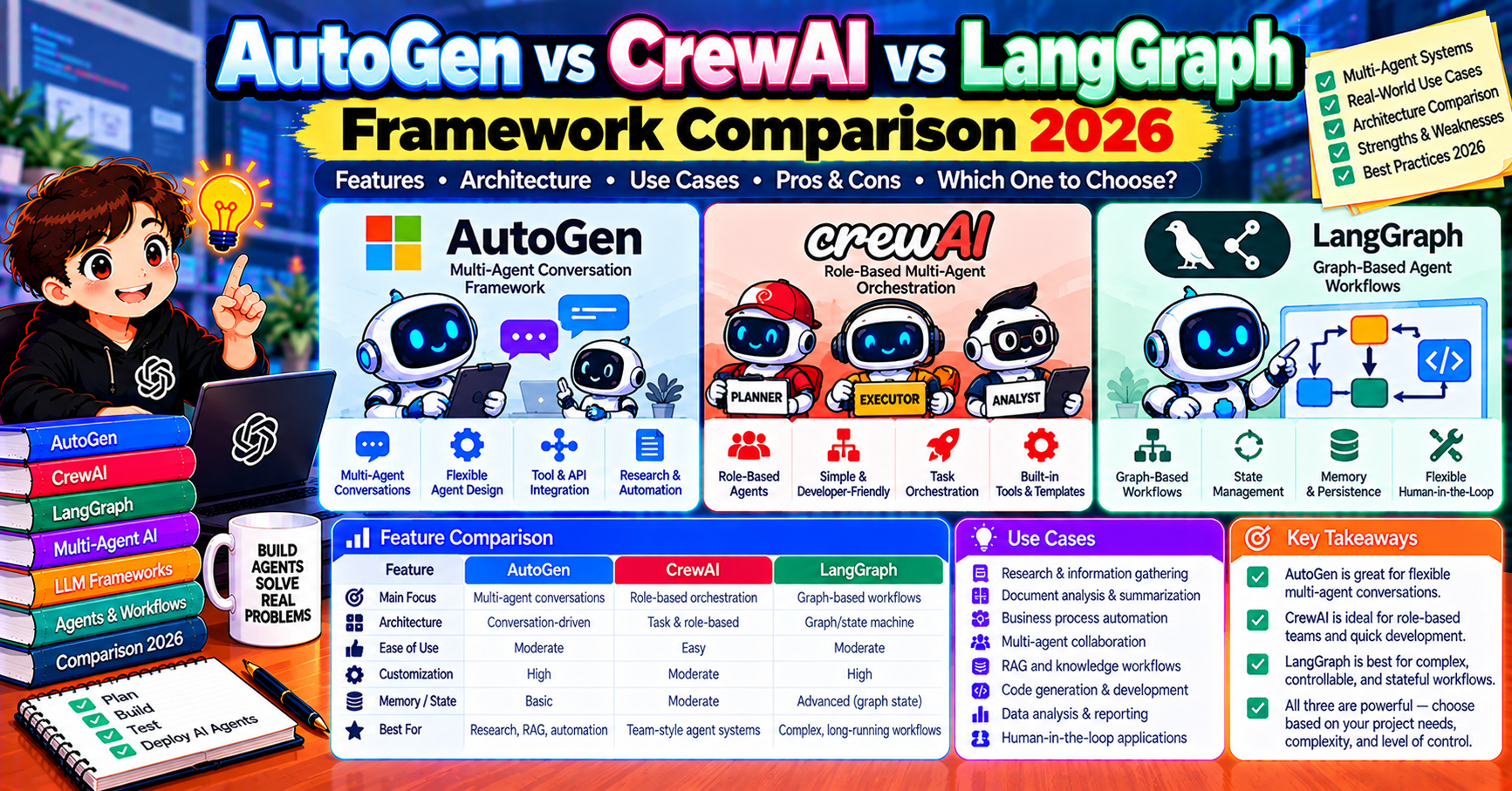
Multi-agent frameworks moved from research curiosity to production baseline in 2026. AutoGen, CrewAI, and LangGraph dominate the Python ecosystem for building systems where multiple AI agents coordinate on a task. All three solve the same problem differently, and picking the wrong one wastes months of implementation work. This article compares the three on architecture philosophy, setup, debugging, production-readiness, and the specific tradeoffs that decide which fits your use case.
What each framework actually is
AutoGen (Microsoft Research): conversational multi-agent framework. Agents talk to each other in natural language inside a group chat; the framework handles turn-taking and tool invocation. Latest major release in 2026 added Magentic-One, a prebuilt multi-agent system for web tasks. Opinionated toward conversation-based coordination.
CrewAI: role-based orchestration. You define agents with specific roles (researcher, writer, reviewer), assign tasks, and the framework handles handoffs between them. Opinionated toward sequential or hierarchical task flows that mirror how human teams work. Significantly simpler developer experience than AutoGen.
LangGraph (LangChain team): state-machine orchestration. You define nodes (functions), edges (control flow), and shared state; the framework runs a graph where agents call tools, update state, and route to the next node based on conditions. Lowest-level of the three. Maximum flexibility.
Setup comparison
CrewAI (easiest):
from crewai import Agent, Task, Crew

researcher = Agent(
    role="Market Researcher",
    goal="Find current pricing for competitor products",
    backstory="You have 10 years of competitive-intelligence experience.",
    tools=[search_tool],
)

writer = Agent(
    role="Technical Writer",
    goal="Summarize findings into a clear brief",
    backstory="You write for executives who need facts, not fluff.",
)

task1 = Task(description="Research prices of X, Y, Z", agent=researcher)
task2 = Task(description="Write a 300-word summary", agent=writer, context=[task1])

crew = Crew(agents=[researcher, writer], tasks=[task1, task2])
result = crew.kickoff()
Readable, declarative, 20 lines total. CrewAI’s role + goal + backstory abstraction is deliberately human-friendly.
AutoGen (conversational):
from autogen import ConversableAgent, GroupChat, GroupChatManager

user = ConversableAgent("user", human_input_mode="NEVER")
researcher = ConversableAgent("researcher", system_message="Research prices...",
                               llm_config={"model": "gpt-4o"})
writer = ConversableAgent("writer", system_message="Write a summary...",
                           llm_config={"model": "gpt-4o"})

group = GroupChat(agents=[user, researcher, writer], max_round=10)
manager = GroupChatManager(groupchat=group, llm_config={"model": "gpt-4o"})

user.initiate_chat(manager, message="Compare prices of X, Y, Z")
Also compact but the group-chat metaphor is different. Agents see each other’s messages; the manager picks who speaks next. Looser control than CrewAI’s explicit task graph.
LangGraph (state machine):
from langgraph.graph import StateGraph, END
from typing import TypedDict

class State(TypedDict):
    query: str
    research: str
    summary: str

def research_node(state):
    return {"research": research_fn(state["query"])}

def write_node(state):
    return {"summary": write_fn(state["research"])}

graph = StateGraph(State)
graph.add_node("research", research_node)
graph.add_node("write", write_node)
graph.add_edge("research", "write")
graph.add_edge("write", END)
graph.set_entry_point("research")

app = graph.compile()
result = app.invoke({"query": "Compare prices of X, Y, Z"})
More explicit about control flow. State flows node to node by typed updates. Debugging is cleaner because you can inspect state at any point.
Debugging experience
Multi-agent systems fail in weird ways. Which framework helps you understand WHY matters a lot in production.
- LangGraph: best debugging story. State is explicit and typed; you can snapshot it at any node, replay from any node, or inject a different state to test downstream nodes in isolation. Built-in LangSmith integration shows the full execution trace with input/output per step.
- CrewAI: medium. Logs each task’s input and output. Supports callbacks that fire per step. Agent conversations are visible but harder to replay from mid-flight.
- AutoGen: hardest. Group chats are emergent conversations that can take different paths each run. You see all messages but reconstructing “why did the manager pick agent X to speak next” requires reading the manager’s internal selection prompt.
Production-readiness in 2026
All three can run in production, but they handle production concerns differently:
| Production concern | AutoGen | CrewAI | LangGraph |
|---|---|---|---|
| State persistence (resume after crash) | manual | memory module | built-in checkpointer |
| Human-in-the-loop interrupts | basic | medium | first-class |
| Streaming responses | yes | partial | yes |
| Observability | AgentOps integration | AgentOps integration | LangSmith native |
| Enterprise support | Microsoft/Azure | CrewAI Inc | LangChain Inc (LangGraph Platform) |
| LTS version policy | 0.4+ stable (2024+) | 0.8+ stable | 0.2+ stable |
Which framework wins by use case
- You want a prototype that works in a day: CrewAI. Role abstraction gets you to a running demo faster than the others.
- You need production reliability with checkpointing + human-in-the-loop: LangGraph. Checkpointer +
interrupt_beforeare first-class. - Your agents genuinely need to converse (hand-off ideas, debate, refine): AutoGen. The group-chat metaphor fits conversational workflows naturally.
- You want deep LangChain / LangSmith integration: LangGraph (same ecosystem).
- You have Azure OpenAI as your primary LLM: AutoGen (Microsoft-aligned).
- Your team is enterprise with compliance review: LangGraph Platform or AutoGen enterprise. CrewAI has smaller enterprise footprint.
- You want to build web-browsing agents: AutoGen Magentic-One is purpose-built for this.
- You need fine-grained control over state transitions and parallel execution: LangGraph. CrewAI and AutoGen’s higher abstractions hide the state machine.
Running them together
Not common but possible. One real pattern: LangGraph as the top-level orchestrator, with CrewAI “crews” as individual node implementations. Lets you use CrewAI’s role abstraction where it fits naturally while keeping LangGraph’s state machine for overall flow control.
Avoid combining AutoGen with the other two unless you have a specific reason; the conversation metaphor conflicts with state-machine metaphors and debugging becomes genuinely hard.
Cost per agent-run
Multi-agent systems multiply LLM cost. Rough per-run economics on a 5-step task with 3 agents using Claude Sonnet 5.5:
- Single-agent baseline: ~$0.015 per task
- CrewAI (sequential 3 agents, 5 steps): ~$0.08 per task
- AutoGen (group chat, 10 rounds): ~$0.15 per task
- LangGraph (parallel-aware, 5 nodes): ~$0.06 per task
LangGraph tends to be cheapest at scale because explicit control flow prevents the agent-overhead loops that AutoGen’s conversational metaphor sometimes encourages. CrewAI falls in between.
Decision shortcut
- Prototype fast: CrewAI
- Production + reliability: LangGraph
- Conversational use cases: AutoGen
- Deep LangChain shop: LangGraph
- Azure/Microsoft shop: AutoGen
- Web-browsing agents specifically: AutoGen Magentic-One
Ecosystem health check (what to watch before committing)
Framework choice is a 1-2 year bet. Three signals that predict whether a framework will still be viable when you need it to be:
- Commit cadence on the main repo. Look at the GitHub insights tab. Healthy frameworks ship meaningful commits weekly; stagnant ones go 2-3 months between releases. LangGraph, CrewAI, and AutoGen all pass this bar as of late 2026.
- Enterprise customer disclosures. Press releases, case studies, or named customers on the vendor site indicate real production usage (not just hype). LangGraph has Rakuten and Elastic in public case studies; CrewAI has mentions from Deloitte and PwC; AutoGen has Microsoft internal + Novo Nordisk disclosure.
- Breaking-change history. Check the CHANGELOG for how often the framework introduces breaking changes. CrewAI had a messy v0.4 to v0.8 migration; LangGraph has been more stable since 0.2; AutoGen 0.2 to 0.4 was a complete rewrite. Pick frameworks with cleaner migration histories if long-term stability matters more than latest features.
Migration cost estimates
Switching frameworks mid-project is costly. Realistic estimates for a 5-agent production system (based on real teams that have migrated in 2025-2026):
- CrewAI to LangGraph: 2-4 weeks for a 5-agent system. Agent logic transfers cleanly; orchestration is a rewrite. Common path when a team outgrows CrewAI’s abstractions.
- LangGraph to CrewAI: 2-3 weeks. Easier because CrewAI is more opinionated; you compress complex LangGraph flows into simpler CrewAI patterns.
- AutoGen 0.2 to AutoGen 0.4: 3-6 weeks because 0.4 is a full API rewrite. Not a cross-framework migration but worth the effort to drop legacy 0.2 code.
- AutoGen to LangGraph: 3-5 weeks because conversational logic has to be rewritten as explicit state transitions.
Pick carefully upfront. Migration costs discourage casual switching once a system is live.
Frequently Asked Questions
Official documentation
Can I migrate between these frameworks later?
Partially. The agent logic (prompts, tools, business rules) migrates cleanly. The orchestration code does not; you rewrite the control flow in whichever framework you move to. Plan to switch at a project boundary, not mid-feature. Common migration path: CrewAI prototype to LangGraph production.
Which one scales best with many agents (10+)?
LangGraph. The explicit state machine stays comprehensible as agent count grows. AutoGen group chats become chaotic past 5-6 agents (manager picks poorly, conversations loop). CrewAI’s sequential model works up to 7-8 agents but hierarchical mode becomes necessary beyond that.
Does any of them support non-OpenAI models?
All three support Anthropic, Google, local Ollama models, and anything OpenAI-compatible. LangGraph has the strongest integration (via LangChain’s provider abstractions). CrewAI and AutoGen both have decent multi-provider support.
Can agents share memory across runs?
Yes with care. CrewAI has a built-in Memory module. LangGraph uses its checkpointer + stores for conversation + fact memory. AutoGen requires manual memory injection via agent config. For production memory, consider pairing any of the three with Mem0 or Zep for a cleaner memory layer.
How much does the framework actually matter vs the prompts?
Prompts matter more than framework choice. All three can build the same system; the framework affects developer experience and debugging more than final output quality. Spend 80% of your effort on prompt engineering, 20% on framework-specific optimization.
Which one has the biggest active community in 2026?
LangGraph by GitHub stars and Discord activity (benefits from LangChain’s massive user base). AutoGen by Microsoft-backed enterprise adoption. CrewAI by Reddit/Twitter indie-hacker enthusiasm. Pick based on your team’s culture, not community size.

Angel Jude Suarez
Full-Stack Developer at PIES IT Solution
Focuses on Python development, machine learning, and AI integration. Has built production AI systems including OpenAI Whisper integration for medical transcription and GPT-4o-powered diagnosis assistance. Strong background in pandas, scikit-learn, and TensorFlow.
Expertise: Python · PHP · Java · VB.NET · ASP.NET · Machine Learning · AI Integration · OpenCV · Django · CodeIgniter · View all posts by Angel Jude Suarez →