
The three most-picked meta-frameworks for 2026 web projects are Astro, Next.js, and Nuxt. They serve different jobs and picking the right one saves months of fighting the tool. This comparison covers architecture, performance profile, framework ecosystem, and the concrete decision criteria for each.
Quick 2026 verdict
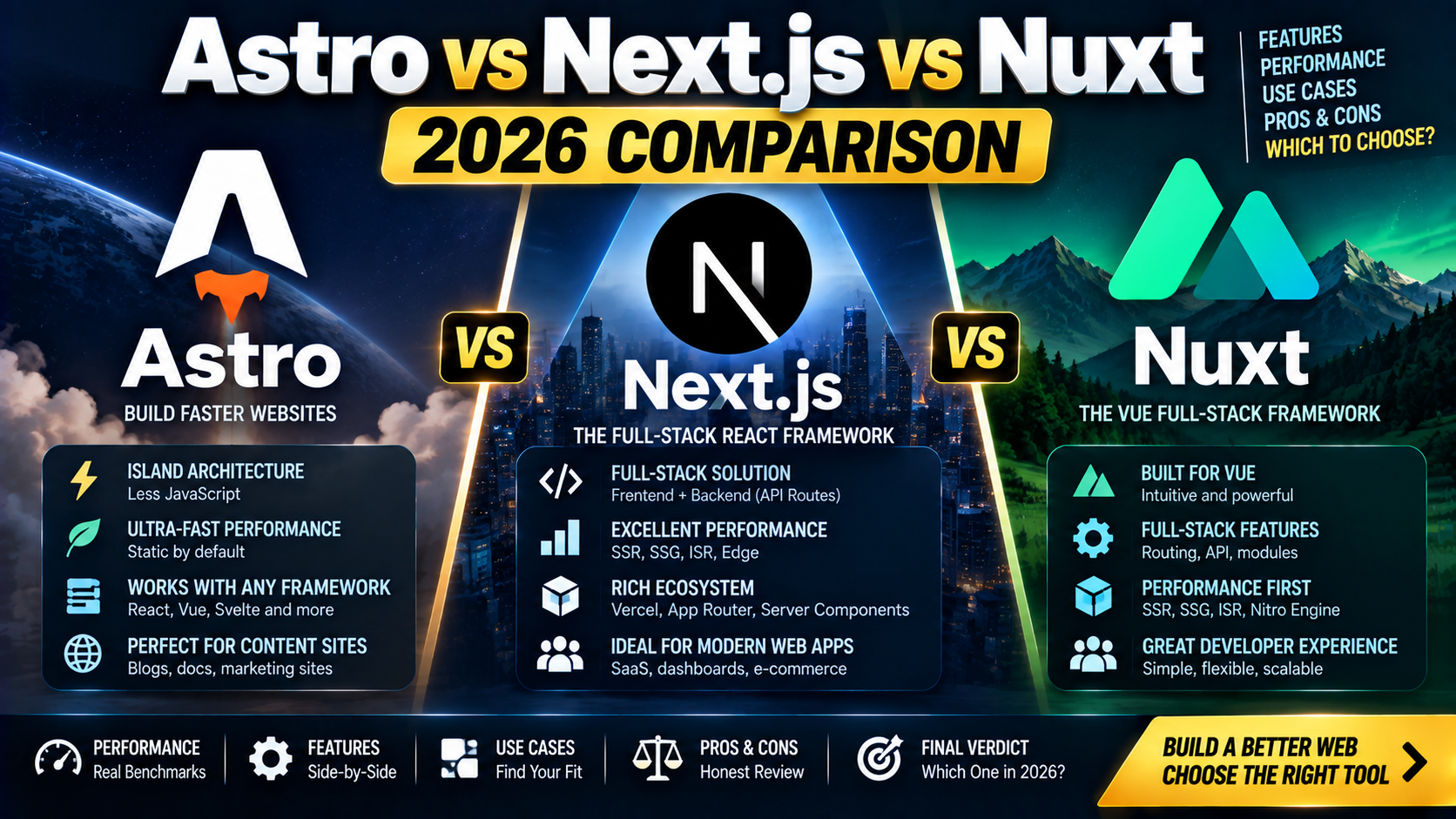
Rough decision matrix: pick Astro for content sites (blogs, docs, marketing, portfolios), Next.js for React-based apps with dynamic data (dashboards, SaaS, e-commerce), and Nuxt for the same category if your team prefers Vue over React. All three are production-ready and all three can build almost anything; the choice is about developer experience and ecosystem fit.
The three frameworks at a glance
| Aspect | Astro | Next.js | Nuxt |
|---|---|---|---|
| Base UI framework | Framework-agnostic (React, Vue, Svelte, Solid, or none) | React only | Vue only |
| Default rendering | Static (SSG) with zero JS by default | Server Components (2026: async server-rendered) | Universal (SSR + hydration) |
| JS ship policy | Islands architecture (opt-in per component) | Hydrate everything by default | Hydrate everything by default |
| Best for | Content, marketing, docs, blogs | Interactive apps, dashboards, e-commerce | Same as Next.js but Vue-flavored |
| Hosting | Any static host + optional Node/edge adapters | Vercel (native), Netlify, Cloudflare, self-host | Same range, plus Nitro deploy presets for every host |
| 2026 version | Astro 5.x | Next.js 15.x | Nuxt 3.x (Nuxt 4 in RC) |
Astro: content-first with Islands
Astro’s core idea is that most pages on the web are mostly static content. Ship zero JavaScript for those, and let developers opt in to interactivity for specific components (“Islands”). Result: default page weight is a fraction of a Next.js or Nuxt equivalent.
---
// src/pages/index.astro
import Newsletter from '../components/Newsletter.jsx';
const posts = await fetch('https://api.example.com/posts').then(r => r.json());
---

<html>
  <body>
    <h1>My Blog</h1>
    {posts.map(p => <article>{p.title}</article>)}

    <!-- This React component IS interactive (island) -->
    <Newsletter client:load />
  </body>
</html>
The client:load directive is what tells Astro to hydrate the component. Without it, the component still renders on the server but ships zero JS to the browser.
Astro strengths (2026)
- Best-in-class Lighthouse scores by default (typical: 100/100 for content sites)
- Works with any UI framework, mix React + Vue + Svelte in the same site if you must
- First-class Markdown / MDX / Content Collections (typed content out of the box)
- Astro DB (2024) + Astro Actions (2024) added real backend capabilities in v5
- Ecosystem of ~200 official + community integrations
Astro trade-offs
- Not designed for heavily-interactive apps (dashboards with 50+ live components, pick Next/Nuxt)
- Smaller ecosystem than Next.js (fewer example templates, fewer job postings, fewer hire-ready contractors)
- Islands hydration ordering can be tricky when islands need to share state
Next.js: React’s default meta-framework
Next.js is the React ecosystem’s default choice in 2026 for anything beyond a small SPA. Its App Router (production-stable since Next.js 14) delivers React Server Components, Server Actions, streaming, and built-in caching primitives.
// app/dashboard/page.tsx (Server Component by default)
import { db } from '@/lib/db';

export default async function Dashboard() {
  const orders = await db.orders.findMany();  // runs on server
  return <OrderList orders={orders} />;
}
Next.js strengths (2026)
- Largest job market share by a wide margin, hiring React devs is easy
- Largest ecosystem: every major SaaS, database, auth, CMS, and payment provider ships a Next.js SDK first
- Server Components + streaming: dynamic pages that feel as fast as static
- Deep Vercel integration: deploy on push, preview URLs per PR, edge functions, ISR built in
- Battle-tested at Uber, Netflix, TikTok, Shopify, Notion scale
Next.js trade-offs
- Steeper mental model: RSC vs Client Components, caching layers, revalidation strategies
- Bigger default bundle size than Astro (React runtime alone is ~40KB gzipped)
- Vercel-first optimization: self-hosting on Node with the same feature set is possible but requires more setup
- Frequent breaking API changes historically (App Router migration was disruptive)
Nuxt: Vue’s Next.js equivalent
Nuxt does for Vue what Next.js does for React: SSR, file-based routing, middleware, layouts, API routes, deploy presets for every host. Nuxt 3 (2022 rewrite) is TypeScript-first, uses Vite, and has Nitro under the hood for universal deployment.
<!-- pages/dashboard.vue -->
<script setup lang="ts">
const { data: orders } = await useFetch('/api/orders');
</script>

<template>
  <OrderList :orders="orders" />
</template>

<!-- server/api/orders.get.ts -->
export default defineEventHandler(async () => {
  return await db.orders.findMany();
});
Nuxt strengths (2026)
- Cleaner developer experience than Next.js for many teams (auto-imports, simpler mental model, less ceremony)
- Nitro server engine deploys to Node, Deno, Cloudflare Workers, AWS Lambda, Vercel, Netlify, same code
- Nuxt Modules ecosystem:
@nuxtjs/tailwindcss,@nuxt/content,@nuxt/image“just install and it works” - Vue’s Composition API is often easier to reason about than React’s hooks
Nuxt trade-offs
- Smaller job market than React/Next.js, harder to hire Vue devs (though not by as much as it was 5 years ago)
- Smaller ecosystem than Next.js (fewer SaaS SDKs ship Vue/Nuxt-first, most React-first, then Vue port)
- No direct equivalent to React Server Components yet (Nuxt uses SSR + hydration, still very fast in practice)
Real-world decision criteria
Pick Astro when
- Site is mostly content (blog, docs, marketing, portfolio, newsletter)
- Lighthouse / Core Web Vitals are business-critical (news, SEO-heavy)
- You want to mix UI frameworks or use no framework at all
- You prefer Markdown-first authoring with typed content
Pick Next.js when
- App is dynamic (dashboard, SaaS, e-commerce, social)
- Your team knows React and hiring more React devs matters
- You need the largest SDK ecosystem (Clerk, Stripe, Prisma, Sanity, Vercel AI, Supabase, PlanetScale all ship Next-first)
- You deploy on Vercel and want zero-config production
Pick Nuxt when
- Same use cases as Next.js, but your team prefers Vue
- You value simpler DX + auto-imports over the biggest ecosystem
- You need to deploy the same app to many different hosts
- You are coming from a Laravel + Blade background (Vue’s templates feel closest)
Performance in the real world (2026 benchmarks)
For a typical marketing homepage with an image gallery + one interactive form:
- Astro: ~5KB JS shipped (only the form island). Lighthouse Performance ~99. LCP under 1s on 4G.
- Next.js: ~80-120KB JS shipped (React + framework). Lighthouse Performance ~85-95. LCP 1.2-1.8s.
- Nuxt: ~70-100KB JS shipped (Vue + framework). Lighthouse Performance ~87-95. LCP 1.1-1.6s.
For heavily-interactive dashboards, Astro’s advantage disappears because you would hydrate most components anyway. In that regime, Next.js and Nuxt perform similarly well and both are appropriate.
Frequently Asked Questions
Can I use Astro for a dashboard with lots of interactivity?
You can, but you lose Astro’s biggest advantage. If most of the page is interactive, you are hydrating most components, which puts you back at Next.js or Nuxt shipping levels. In that case, use React/Vue directly through Next/Nuxt with better routing and data-fetching APIs for that scenario.
Is Next.js still the market leader in 2026?
Yes. Next.js remains the most-used React meta-framework by a large margin. Astro has grown fast in the content-site niche and Nuxt is dominant among Vue teams, but Next.js still has more job postings, more Stack Overflow questions, and more third-party SDK support than the other two combined.
Can I migrate from Next.js to Astro (or vice versa)?
Possible but not trivial. Astro can consume React components directly, so a Next-to-Astro migration usually keeps most components. Data fetching, routing, and middleware need to be rewritten. Going the other way (Astro to Next) is easier for components but harder because you have to add hydration to previously static parts.
What about SvelteKit, Remix, Qwik?
All viable choices with active communities. SvelteKit is Astro’s closest competitor for content sites and pairs well with Svelte 5. Remix merged into React Router 7 in 2024. Qwik’s resumability model is fascinating but adoption is still niche in 2026. For most teams, Astro / Next / Nuxt cover 95% of use cases.
Which has the cheapest hosting?
Astro on a plain static host (Cloudflare Pages, GitHub Pages, Netlify free tier) is essentially free at low traffic. Next.js and Nuxt need a Node runtime for SSR (Vercel free tier, Cloudflare Workers, or self-host). At scale, all three are similar because compute costs dominate over static file bandwidth.
Can I combine Astro with Next.js on the same domain?
Yes, via a reverse proxy or path-based routing (Cloudflare Workers, Nginx). A common pattern: Astro for the marketing site at /, Next.js for the app at /app/*. Adds operational complexity so only worth it when both sides really benefit from their respective framework.
Related Modern Web Dev tutorials
- Next.js 15 Complete Beginner Guide 2026 (First App)
- React 19 vs React 18 Migration Guide 2026
- Vue 3 Complete Beginner Guide 2026 (Composition API)
- Server Components vs Client Components 2026 (coming this week)
Official documentation
Official documentation
Recommended hosting for Astro, Next.js, and Nuxt sites
The links below are affiliate links. We may earn a commission at no extra cost to you. Full disclosure.
- Cloudways: managed cloud hosting with 1-click Node.js/Next.js/Vue deploys on DigitalOcean, Vultr, AWS, and Linode. Best for teams that want managed infrastructure without server admin.
- Kamatera: pay-per-hour cloud VPS starting at $4/month. Best for developers who want raw VPS control with quick provisioning.

Angel Jude Suarez
Full-Stack Developer at PIES IT Solution
Focuses on Python development, machine learning, and AI integration. Has built production AI systems including OpenAI Whisper integration for medical transcription and GPT-4o-powered diagnosis assistance. Strong background in pandas, scikit-learn, and TensorFlow.
Expertise: Python · PHP · Java · VB.NET · ASP.NET · Machine Learning · AI Integration · OpenCV · Django · CodeIgniter · View all posts by Angel Jude Suarez →