

The student management system class diagram is a form of structural (UML) diagram that depicts the data structure of student system. This is designed by displaying the system’s classes, attributes, methods, and the relationships between classes.
Class diagrams reveal the class structure blueprint of Student Management System. It is used to model the items that make up the system and depict their relationships. This is to define the function of an object and the operation it provides.
Student Management System Class Diagram: Project Details
The table shows the name and details of student system class diagram. It has the complete information on project components and diagraming tools.
| Name: | Student Management System Class Diagram |
| Abstract: | The Student Management System Class Diagram represents the structure of the project in terms of its classes. It contains the important details on the data characteristics present in the project. |
| UML Diagram: | Class Diagram |
| Users: | School Admin, Staff, and Student |
| Tools Used: | Diagram tools that provides class diagram symbols. |
| Designer: | ITSourceCode.com |
What is the Importance of Student Management System Class Diagram?
The Importance of Student System Class Diagram is that it helps in visualizing the classes that make up the system. It displays the classes’ connections and reports their characteristics, operations, and methods used.
Class diagram helps you understand the project’s classes. It gives you a lot of information on the structure of your system. It also provides a rapid summary of the synergy that occurs among the various system classes, as well as their qualities and interactions.
The class diagram aims to show the system’s static view. This diagram can be mapped with object-oriented languages, making it appropriate during the construction process.
Free tool
Generate this Class Diagram in 3 minutes
You have the structure. Now build it with your own entities. The School / Enrollment template comes pre-filled, so you rename what does not match your project and export straight into your Chapter 3.
Open the School / Enrollment template →3 free diagrams every week. No credit card needed.
How the Student Management System Class Diagram works?
The UML Class Diagram for Student Management in UML describes an entity or a group of objects with similar structure and characteristics. A box with three rows is used to represent them.
The class diagram is presented in a rectangle with three partitions. The upper part is for the name of the class, the middle is for its attributes and the bottom is for the methods. These partitions will clearly emphasize the details of the classes.
Student Management System Class Diagram: Benefits
Their Benefits are as follows:
- It aids in the better and more accurate illustration of data models.
- Explains more straightforward and clear understanding of the overall system or process’ overview and schematics.
- It provides a sense of direction.
- Gives a lot of information on the structure of your systems.
- Summarize the system’s static perspective.
- Enumerates how the parts of a static view work together.
- Defines the functions that the system does and Object-oriented programming languages are used to create software applications.
Class Diagram of Student Management System
The Simple Class Diagram for Student System resembles a flowchart in which classes are represented as boxes with three rectangles inside. The top rectangle has the class’s name; the middle rectangle contains the class’s properties; and the bottom rectangle contains the class’s methods, commonly known as operations.
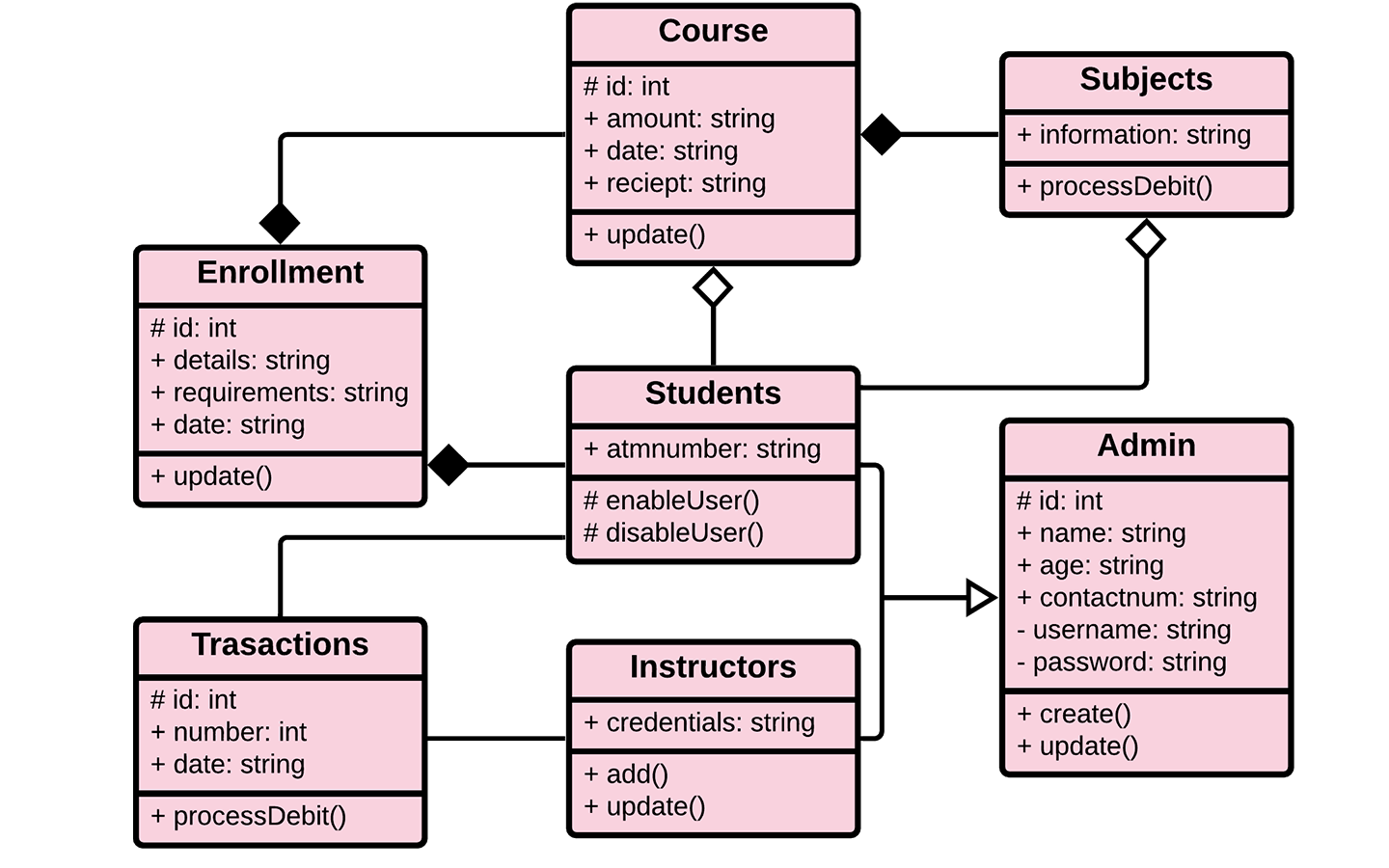
As you can see through the illustration, the classes were determined which is symbolized by boxes. They were designated with their corresponding attributes and shows the class’ methods. Their relationships are also plotted to show the connections between classes and their multiplicity.
Student Management System Class Diagram (Explanation)
The classes identified for Student Management System were the admin, students, instructors, enrollment, course, subjects and transactions. Their roles were explained in the middle part and called as their attributes. The function can be seen by reading through its’ methods.
Student Management System Class Diagram in Java (2026 Code Example)
Below is a complete Java implementation following the Class Diagram structure. You can copy these classes directly into your capstone project as a starting point:
The Student class
public class Student {
    private String studentId;
    private String name;
    private String email;
    private String course;
    private int yearLevel;
    private List<Enrollment> enrollments;

    public Student(String studentId, String name, String email, String course, int yearLevel) {
        this.studentId = studentId;
        this.name = name;
        this.email = email;
        this.course = course;
        this.yearLevel = yearLevel;
        this.enrollments = new ArrayList<>();
    }

    public void enroll(Subject subject) {
        Enrollment enrollment = new Enrollment(this, subject, new Date());
        enrollments.add(enrollment);
    }

    public List<Enrollment> getEnrollments() {
        return enrollments;
    }

    // Getters and setters
}
The Subject class
public class Subject {
    private String subjectCode;
    private String title;
    private int units;
    private String prerequisite;
    private Teacher teacher;

    public Subject(String subjectCode, String title, int units, Teacher teacher) {
        this.subjectCode = subjectCode;
        this.title = title;
        this.units = units;
        this.teacher = teacher;
    }

    public void assignTeacher(Teacher teacher) {
        this.teacher = teacher;
    }

    // Getters and setters
}
The Enrollment class (association class)
public class Enrollment {
    private Student student;
    private Subject subject;
    private Date enrollmentDate;
    private double finalGrade;

    public Enrollment(Student student, Subject subject, Date date) {
        this.student = student;
        this.subject = subject;
        this.enrollmentDate = date;
    }

    public void recordGrade(double grade) {
        this.finalGrade = grade;
    }

    // Getters and setters
}
This implementation directly mirrors the Class Diagram structure, the Student → Enrollment ← Subject relationship is a classic association class pattern used in real-world student information systems.
Student Management System Class Diagram in PHP (2026 Code Example)
Here’s the same Class Diagram implemented in modern PHP 8.x. This pattern works well for Laravel and CodeIgniter capstones:
Student.php
<?php

class Student {
    private string $studentId;
    private string $name;
    private string $email;
    private string $course;
    private int $yearLevel;
    private array $enrollments = [];

    public function __construct(
        string $studentId,
        string $name,
        string $email,
        string $course,
        int $yearLevel
    ) {
        $this->studentId = $studentId;
        $this->name = $name;
        $this->email = $email;
        $this->course = $course;
        $this->yearLevel = $yearLevel;
    }

    public function enroll(Subject $subject): void {
        $this->enrollments[] = new Enrollment($this, $subject, new DateTime());
    }

    public function getEnrollments(): array {
        return $this->enrollments;
    }

    // Getters and setters
}
Subject.php
<?php

class Subject {
    private string $subjectCode;
    private string $title;
    private int $units;
    private ?string $prerequisite;
    private ?Teacher $teacher;

    public function __construct(
        string $subjectCode,
        string $title,
        int $units,
        ?Teacher $teacher = null
    ) {
        $this->subjectCode = $subjectCode;
        $this->title = $title;
        $this->units = $units;
        $this->teacher = $teacher;
    }

    public function assignTeacher(Teacher $teacher): void {
        $this->teacher = $teacher;
    }

    // Getters and setters
}
Enrollment.php
<?php

class Enrollment {
    private Student $student;
    private Subject $subject;
    private DateTime $enrollmentDate;
    private ?float $finalGrade = null;

    public function __construct(Student $student, Subject $subject, DateTime $date) {
        $this->student = $student;
        $this->subject = $subject;
        $this->enrollmentDate = $date;
    }

    public function recordGrade(float $grade): void {
        $this->finalGrade = $grade;
    }

    // Getters and setters
}
For a Laravel implementation, these classes become Eloquent models with belongsTo() and hasMany() relationships. The Class Diagram’s multiplicity (1..* between Student and Enrollment) maps directly to hasMany('App\Models\Enrollment').
UML Class Diagram Symbols, Complete Reference Table
Use this reference table to read or draw any UML Class Diagram correctly. These symbols are standard across all UML modeling tools:
| Symbol | Name | Meaning |
|---|---|---|
| ― | Association | Solid line , basic “uses” or “knows about” relationship |
| ―◇ | Aggregation | Hollow diamond , weak “has-a” (part can exist without whole) |
| ―◆ | Composition | Filled diamond , strong “contains-a” (part dies with whole) |
| ―▷ | Inheritance / Generalization | Hollow triangle , “is-a” parent/child relationship |
| – – – ▷ | Realization | Dashed line with hollow triangle , interface implementation |
| – – – ► | Dependency | Dashed arrow , temporary “uses” relationship |
| + | Public visibility | Attribute or method accessible from anywhere |
| – | Private visibility | Attribute or method accessible only inside the class |
| # | Protected visibility | Accessible within the class and subclasses |
| ~ | Package visibility | Accessible within the same package (mostly Java) |
| 1, 0..1, 0..*, 1..* | Multiplicity | Cardinality at relationship endpoints (how many instances) |
Quick rule: If you’re unsure between aggregation and composition, ask: “If I destroy the whole, does the part still exist?” Yes = aggregation. No = composition.
How to Draw the Student Management System Class Diagram, Step by Step
Follow these 6 steps to draw this Class Diagram from scratch using draw.io (the recommended free tool for BSIT capstones):
Step 1, Open draw.io and set up the canvas
Go to app.diagrams.net → create a blank diagram → in the left shape panel, search “UML” and enable the UML shape library. You’ll now see Class, Interface, Enumeration shapes.
Step 2, Draw the Student class
Drag a Class shape onto the canvas. The shape has 3 compartments by default. Set:
- Top compartment: Class name “Student”
- Middle compartment: Attributes,
- studentId: String,- name: String,- email: String,- course: String,- yearLevel: int - Bottom compartment: Methods,
+ enroll(subject: Subject): void,+ getEnrollments(): List
The minus sign (-) indicates private; plus sign (+) indicates public.
Step 3, Draw the Subject and Teacher classes
Repeat the process for Subject (with attributes: subjectCode, title, units, prerequisite) and Teacher (with attributes: teacherId, name, department, specialization).
Step 4, Draw the Enrollment association class
Create an Enrollment class with attributes: - enrollmentDate: Date and - finalGrade: double. This is a special “association class”, it represents data that exists only because two other classes are related.
Step 5, Draw the relationships
From draw.io’s left panel, drag relationship lines between the classes:
- Student → Enrollment: Solid line with hollow diamond on the Student side (aggregation, 1..*)
- Subject → Enrollment: Solid line with hollow diamond on the Subject side (aggregation, 1..*)
- Subject → Teacher: Solid line (association, many-to-one)
Step 6, Add multiplicity labels
Click each relationship line and add multiplicity at both ends: e.g., “1” near Student, “0..*” near Enrollment. This tells the reader how many instances of each class participate in the relationship.
Export: File → Export As → PNG (for embedding in your capstone documentation) and PDF (for the printed manual). The PNG should be at least 1200px wide for readability in your defense slides.
💡 Pro tip: draw.io is completely free and our top pick. If you need more advanced features (auto-layout, version history, team collaboration), Lucidchart has a powerful UML tool with a free tier that’s sufficient for most capstone projects.
Common Mistakes Students Make with Class Diagrams
Avoid these mistakes that capstone defense panels frequently catch:
Mistake #1, Confusing aggregation with composition
Don’t default to composition (filled diamond) for everything. Ask: “Does the contained class continue to exist if I delete the container?” If yes (like a Student who exists outside any Course), use aggregation.
Mistake #2, Missing multiplicity
Every relationship MUST have multiplicity labels at both ends. A line without multiplicity is incomplete, defense panels deduct points for this. If unsure, default to 1..* (one or many) for collection-style relationships.
Mistake #3, Mixing database fields with class attributes
Class attributes are PROGRAMMING-LEVEL, they include foreign key OBJECTS (like teacher: Teacher), not foreign key IDs. Don’t write teacherId: int in a Class Diagram unless you specifically want to model a denormalized version.
Mistake #4, Putting “Database” or “Frontend” as a class
Class Diagrams model your DOMAIN, the business concepts (Student, Course, Teacher). Infrastructure like “Database,” “UI,” or “API” doesn’t belong in the Class Diagram. Use a Component Diagram or Deployment Diagram for that.
Mistake #5, Empty method compartments
If a class has no methods, you’ve probably forgotten to model its behavior. Most domain classes have at least 3-5 methods (getters/setters don’t count for documentation). Defense panel question: “What does this class actually DO?”, you need a concrete answer.
Mistake #6, Drawing in low resolution
Export Class Diagrams at minimum 1200px wide PNG. Blurry diagrams in defense slides instantly drop your grade. PDF export is even better for documentation.
Other UML diagrams for your Student Management System capstone
- All Student Management UML Diagrams, complete set
- Use Case Diagrams, model functional requirements
- Sequence Diagrams, model interactions over time
- Data Flow Diagrams (DFD), model data movement
- Entity-Relationship Diagrams, model database schema
- All UML Diagrams, browse the full UML category
Conclusion
It is essential for you to know the diagrams used to design and develop the student management system. That is because you cannot perfectly create a fully-functional system without it.
But if you create this class diagram, you will know the possible classes and scenarios that the system should process and perform. Not only that, you will find out the needed processes and connect them to the other UML Diagrams.
Need help with your full capstone documentation? Our Final Year Project resources include complete documentation templates, sample defense slides, and a full capstone writing guide. For UML modeling tools beyond draw.io, consider Visual Paradigm Community Edition, free for non-commercial use with full UML support.
Inquiries
If you have inquiries or suggestions about Student Management System Class Diagram, just leave us your comments below. We would be glad to hear to concerns and suggestions and be part of your learning.
Keep us updated and Good day!
Working student management source code that implements this diagram
The diagram above defines the flows; these are the actual student management systems on itsourcecode.com that implement them. Pick one in your team’s stack and you have a working reference to point your panel at when they ask “show me where this flow actually runs in code.”
PHP: Student Information Management in PHP
Vanilla PHP + MySQL. Student, Subject, Enrollment classes map to MySQL tables.

PHP (Enrollment): Online Student Enrollment in PHP
Vanilla PHP + MySQL. Heavier on the enrollment workflow if that is the focus of your class diagram.

VB.NET (Grading): Student Grading System in VB.NET
VB.NET + MySQL. Useful when your UML emphasises grading entities (Subject, Grade, Term).

Django (Python): Advanced Student Management in Django
Django 4 + Bootstrap. Django models = your class diagram in Python form.

CodeIgniter (PHP): Student Management in CodeIgniter
CI4 + Bootstrap. MVC variant for stronger panel framing than vanilla PHP.
How to use this for your Chapter 3 (Methodology): download the project in your stack, then map each process and data store in this diagram to a specific module, controller, or table in the downloaded source. That mapping IS the bridge between your design chapter and your implementation chapter, the single thing panels want to see traced end to end.
📌 Looking for your capstone project idea?
Browse our complete list of 150 Best Capstone Project Ideas for IT Students (2026 Edition), covering Web, Mobile, AI, Database, and Game Development capstone topics with full project descriptions.
Official documentation

Mary Grace G. Patulada
Programmer & Technical Writer at PIES IT Solution
Mary Grace G. Patulada (pen name ‘Nym’) is a programmer and writer at PIES IT Solution with a BSIT background from Carlos Hilado Memorial State College, Binalbagan Campus. Authored 370+ UML diagram tutorials and capstone documentation guides at itsourcecode.com. Specializes in UML (class, use case, activity, sequence, component, deployment), DFD, and ER diagrams for BSIT capstone projects.
Expertise: UML Diagrams · DFD · ER Diagrams · Use Case Diagrams · Activity Diagrams · Capstone Documentation · PHP
· View all posts by Mary Grace G. Patulada →
Working source code for this system
Download the actual implementation of this system in your preferred language. Each project includes source code, database, and setup instructions for BSIT capstone use.
- PHP: Student Information Management System in PHP
- VB.NET: Simple Student Enrollment System in MS Access Using VB.Net
- Java: Course Management System Project in Java With Source Code
- Python: Student Result Management System Project in Django
- Django: Student Management System in Django [Advance]
- Laravel: College Management System Project in Laravel with Source Code
2026 update: drawing student management class diagrams faster
Class diagrams for student management systems have not changed conceptually since UML 2.5 (2015), but the tools you use to draw them and the level of detail panel reviewers expect in 2026 have shifted.
- Draw the diagram in the tool your panel will look at, not your favorite editor. If your panel uses Microsoft Word during the defense, embed a PNG export from Draw.io or Lucidchart. If they use Visio, deliver a .vsdx file. Do NOT ship a .drawio or .lucid file as the primary submission because the reviewer often cannot open it.
- Include multiplicities on every association. A common panel deduction in 2026: forgetting to mark
1..*or0..*between Student and Enrollment, Course and Section, or Instructor and Class. Multiplicity is checked on every association line. - Method signatures should include return types. Reviewers now expect
+ enrollStudent(studentId: String, sectionId: String) : Boolean, not just+ enrollStudent(). Java, C#, and TypeScript panels all validate types. - Add stereotypes for AI/API integration. If your system talks to an AI service or external API, add a
<<service>>or<<api>>stereotype class showing method signatures for the external interface. Panels ask about integration surface area in 2026. - Data Privacy Act notation. If your Student class has fields like
birthDate,address, ormedicalRecords, tag them as{ dataPrivacy }constraint in the UML. Shows the panel you thought about RA 10173 compliance. - Consider the composition vs aggregation distinction on grade records. Grade is usually composition of Enrollment (filled diamond, cannot exist without the enrollment). Attendance is aggregation of Section (hollow diamond, exists independently). Panels test this distinction every year.
Free tools worth using in 2026: Draw.io (best for capstone defense, free), Lucidchart (free tier is limited but polished), and PlantUML (text-based, generates PNG/SVG, ideal if you version-control the diagrams alongside code). Avoid outdated tools like Rational Rose or Visual Paradigm Free Edition unless your school specifically requires them.
Frequently asked questions
What is a class diagram used for in BSIT capstone?
A class diagram shows the static structure of the system: classes, attributes, methods, and relationships (inheritance, association, aggregation, composition). It goes in Chapter 3 of the capstone documentation and communicates the object-oriented design of the system.
What tool should I use to draw the class diagram?
Free options: draw.io (browser-based, saves to Google Drive), Lucidchart free tier, PlantUML (text-based, version-controllable), StarUML (30-day trial then reduced feature set), Visual Paradigm Community Edition. Paid options: Microsoft Visio, Lucidchart pro, Enterprise Architect. For BSIT capstones, draw.io is the most commonly used free tool.
How detailed does the class diagram need to be for capstone defense?
Panel members expect the diagram to match the actual system implementation. Include every major class/use case/entity relevant to the system. Omit trivial helper classes. Every diagram element should have a clear justification. Aim for 1-2 diagrams that fully cover the system, not many partial ones.
Should I use black-and-white or colored diagrams?
Black-and-white is standard for capstone documentation to match the thesis format. Use color only if it improves clarity (e.g., grouping subsystems). Ensure text is readable at printed size (10pt minimum for labels).
Where does this diagram go in the capstone documentation?
Chapter 3 (System Design and Methodology) typically holds all UML diagrams. Introduce each diagram with a 1-paragraph description explaining what it shows and how to read it. Reference specific elements in the surrounding text so panel members can follow the design rationale.
Recommended books for UML class diagrams and OO documentation
The link below is an affiliate link. We may earn a commission at no extra cost to you. Full disclosure.
- Rheinwerk Publishing: comprehensive UML, database design, and software architecture textbooks used by BSIT programs worldwide. Recommended for capstone documentation, Chapter 3 references, and thesis bibliography entries.