
Polars vs pandas: the DataFrame library war of 2026. pandas has 15 years of ecosystem, Polars has 5-30x speed.
If you work with data in Python, which should you pick? This deep comparison covers speed, syntax, memory, ecosystem, and when to migrate.
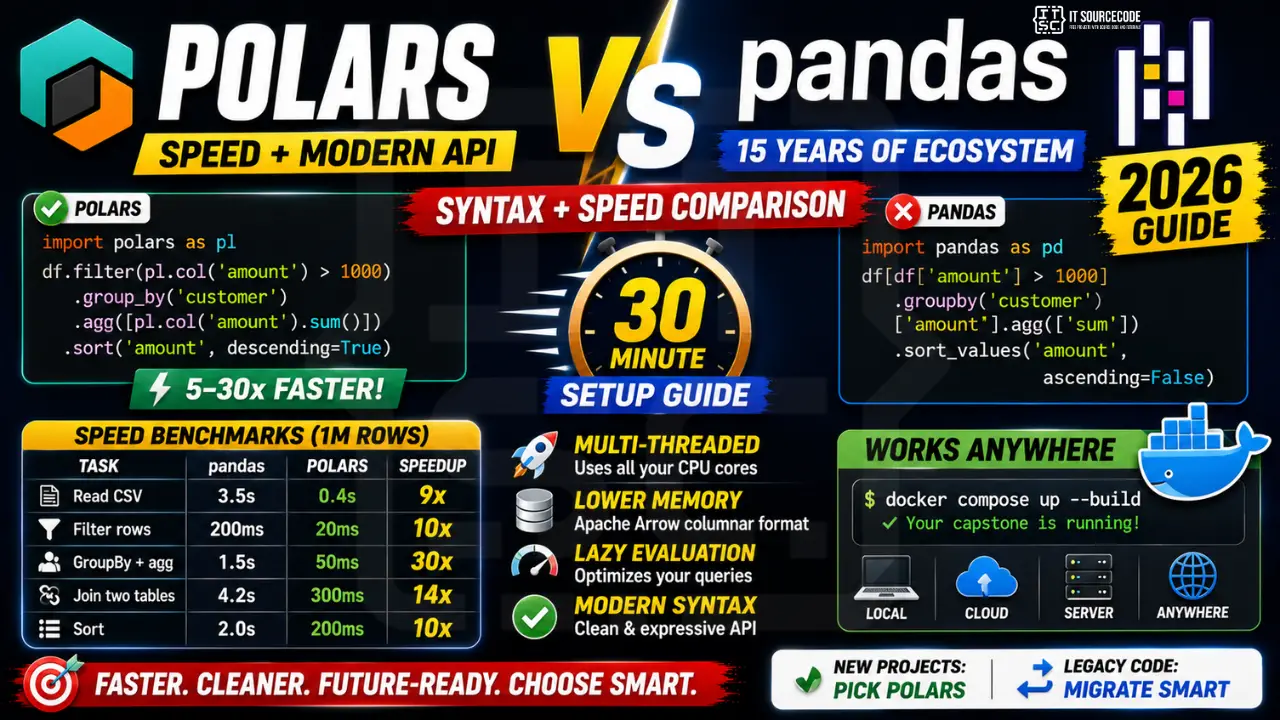
Quick verdict
- New projects: pick Polars. Faster, cleaner API, active development.
- Existing pandas code: migrate incrementally where speed matters.
- Learning data analysis: learn both, many jobs still list pandas.
- Legacy notebooks: keep pandas until performance actually hurts.
Speed benchmarks (typical workloads)
| Task (1M rows) | pandas | Polars | Speedup |
|---|---|---|---|
| Read CSV | 3.5s | 0.4s | 9x |
| Filter rows | 200ms | 20ms | 10x |
| GroupBy + agg | 1.5s | 50ms | 30x |
| Join two tables | 4.2s | 300ms | 14x |
| Sort | 2.0s | 200ms | 10x |
Polars uses Rust + multithreading + query optimization. pandas is single-threaded and interpreted.
Memory usage
- pandas: uses NumPy arrays + Python objects (heavy).
- Polars: uses Apache Arrow columnar format (half the memory).
- For a 10GB CSV: pandas often crashes (out of memory). Polars streams it.
Syntax comparison
### Filter rows

pandas:
df[df['amount'] > 1000]

polars:
df.filter(pl.col('amount') > 1000)

### Multiple conditions

pandas:
df[(df['amount'] > 1000) & (df['region'] == 'Manila')]

polars:
df.filter(
    (pl.col('amount') > 1000) & (pl.col('region') == 'Manila')
)

### Group by + aggregate

pandas:
df.groupby('customer')['amount'].agg(['sum', 'mean', 'count'])

polars:
df.group_by('customer').agg([
    pl.col('amount').sum(),
    pl.col('amount').mean(),
    pl.col('amount').count()
])

### Sort

pandas:
df.sort_values('amount', ascending=False)

polars:
df.sort('amount', descending=True)

### Add computed column

pandas:
df['total'] = df['price'] * df['qty']

polars:
df = df.with_columns((pl.col('price') * pl.col('qty')).alias('total'))
Ecosystem comparison
| Feature | pandas | Polars |
|---|---|---|
| Ecosystem | Huge (15 years) | Growing fast |
| scikit-learn | Native | Convert to numpy/pandas |
| matplotlib | Native | Convert to pandas |
| Streamlit / Dash | Full support | Growing support |
| Jupyter | Perfect | Perfect |
| Database | SQLAlchemy | connectorx (faster) |
| Cloud (AWS/GCP) | All support | All support |
Lazy evaluation (Polars superpower)
import polars as pl

# Polars lazy, plans query, executes when needed
result = (
    pl.scan_csv('huge_file.csv')      # doesn't load yet
    .filter(pl.col('year') >= 2024)
    .group_by('category')
    .agg(pl.col('amount').sum())
    .collect()                         # NOW execute
)

# Polars optimizes:
# - Reads only 2024+ rows from CSV
# - Skips unused columns
# - Parallelizes across cores
# Result: 100x faster than pandas equivalent for 10GB file
Interop (using both together)
import polars as pl
import pandas as pd

# Polars → pandas
polars_df = pl.read_csv('data.csv')
pandas_df = polars_df.to_pandas()

# pandas → Polars
pandas_df = pd.read_csv('data.csv')
polars_df = pl.from_pandas(pandas_df)

# Use case: heavy processing in Polars, feed to scikit-learn (needs pandas)
X = polars_df.select(['feature1', 'feature2']).to_pandas()
model.fit(X, y)
When to pick Polars
- Data > 100MB.
- Production ETL pipelines.
- New project starting from scratch.
- Multi-core CPU (better utilization).
- Streaming large files.
- Care about memory efficiency.
When to pick pandas
- Legacy codebase with dozens of pandas operations.
- Team standardized on pandas.
- Heavy scikit-learn / matplotlib integration.
- Small datasets where performance doesn’t matter.
- Following pandas-based tutorials or courses.
Migration strategy (gradual)
- Start with new modules: use Polars for new features.
- Migrate performance-critical code: identify slow pandas operations, convert.
- Keep pandas for scikit-learn interop: use
.to_pandas()at ML boundary. - Slowly rewrite legacy modules as needed.
- Full migration is not required, hybrid works.
Learning resources
- Polars docs (docs.pola.rs), excellent tutorial.
- Polars User Guide book.
- Ritchie Vink (creator) YouTube.
- pandas docs, still world class for pandas learning.
Common polars mistakes to avoid
- Skipping the “why” before adopting a new tool. Modern Python tools (uv, Ruff, Polars) are fast and clean. But adopting them without understanding what problem they solve wastes time. Read the tool’s motivation section first.
- Migrating everything at once. Legacy code bases have too many surprises. Migrate one module at a time and test after each step.
- Ignoring backwards compatibility. New Python tools sometimes break with older Python versions. Verify your target Python version supports the tool before committing.
- Trusting benchmarks blindly. “10x faster than X” often means “10x faster for one specific workload”. Test with YOUR data before assuming the benchmark generalizes.
- Not reading the CHANGELOG. Every dependency upgrade may break something. Skimming the changelog for breaking changes takes 2 minutes and saves hours.
Adoption path for polars
- Read official docs cover-to-cover for the core concepts. Yes, cover-to-cover.
- Complete the official tutorial project. Follow along exactly, no shortcuts.
- Adapt one small piece of your existing project to the new tool. Ship it.
- If it survives 2 weeks in production, expand adoption.
- If it caused issues, rollback and reassess whether the tool fits your use case.
When to use vs when to stick with what you know
Modern Python tools offer real improvements over their predecessors, but “better” is not the same as “necessary for you.” Consider adopting when:
- Your current tool is slow enough to block productivity (uv/Ruff speedups matter here).
- You are starting a new project with no legacy constraints.
- Your team has bandwidth to learn and support the new tool.
- The tool has been stable and community-adopted for 12+ months.
Stick with your existing tools when: production stability is critical and you have working infrastructure; your team is small and cannot afford learning curves; the tool is early-stage and API may change.
Ecosystem integration considerations
Every new Python tool interacts with the broader ecosystem. Before committing, check:
- Does your CI/CD pipeline support it? Most tools have GitHub Actions and GitLab CI templates.
- Does your IDE support it? VS Code and PyCharm have first-class support for most modern tools. Older editors may lag.
- Do dependency scanners (Snyk, Dependabot) recognize it? Ensures security updates get flagged.
- Is there production monitoring integration? Datadog, Sentry, New Relic support matters for production.
For teams shipping production Python code, the ecosystem answer is often more important than the tool answer. A slightly-worse tool that plays well with your stack beats a slightly-better tool that fights it.
Best practices summary
- Read the docs before Stack Overflow. Official docs are cleaner and more accurate than forum answers.
- Pin versions in production. Locked dependencies prevent surprise breakage. Update deliberately, not accidentally.
- Test after every dependency upgrade. Run the full test suite. Catch regressions before deployment.
- Contribute back. Report bugs, submit fixes, write tutorials. The tools improve when users engage.
- Reassess yearly. The Python ecosystem moves fast. What was best last year may be second-best today.
Official documentation
Recommended data science resources
The links below are affiliate links. We may earn a commission at no extra cost to you when you buy or sign up. See our affiliate disclosure.
Frequently Asked Questions
Is Polars ready for production?
Yes. Used in production at many companies. Development is active. API stabilized in 2024. Ready for enterprise workloads.
Will Polars replace pandas?
Eventually likely, but not overnight. pandas has 15-year ecosystem lead. New projects trend toward Polars. Both coexist for years.
Do employers ask for Polars?
Growing. Data engineering jobs increasingly list Polars as a plus. pandas still dominates job listings but Polars is climbing fast.
Which is better for machine learning?
Depends. Feature engineering: Polars faster. ML model training: scikit-learn requires pandas/numpy. Use Polars for prep, convert at ML boundary.
Learning curve compared to pandas?
Polars is easier for beginners (cleaner API). pandas users adapt in a day, 80% of concepts transfer. New method chaining feels natural after brief adjustment.