
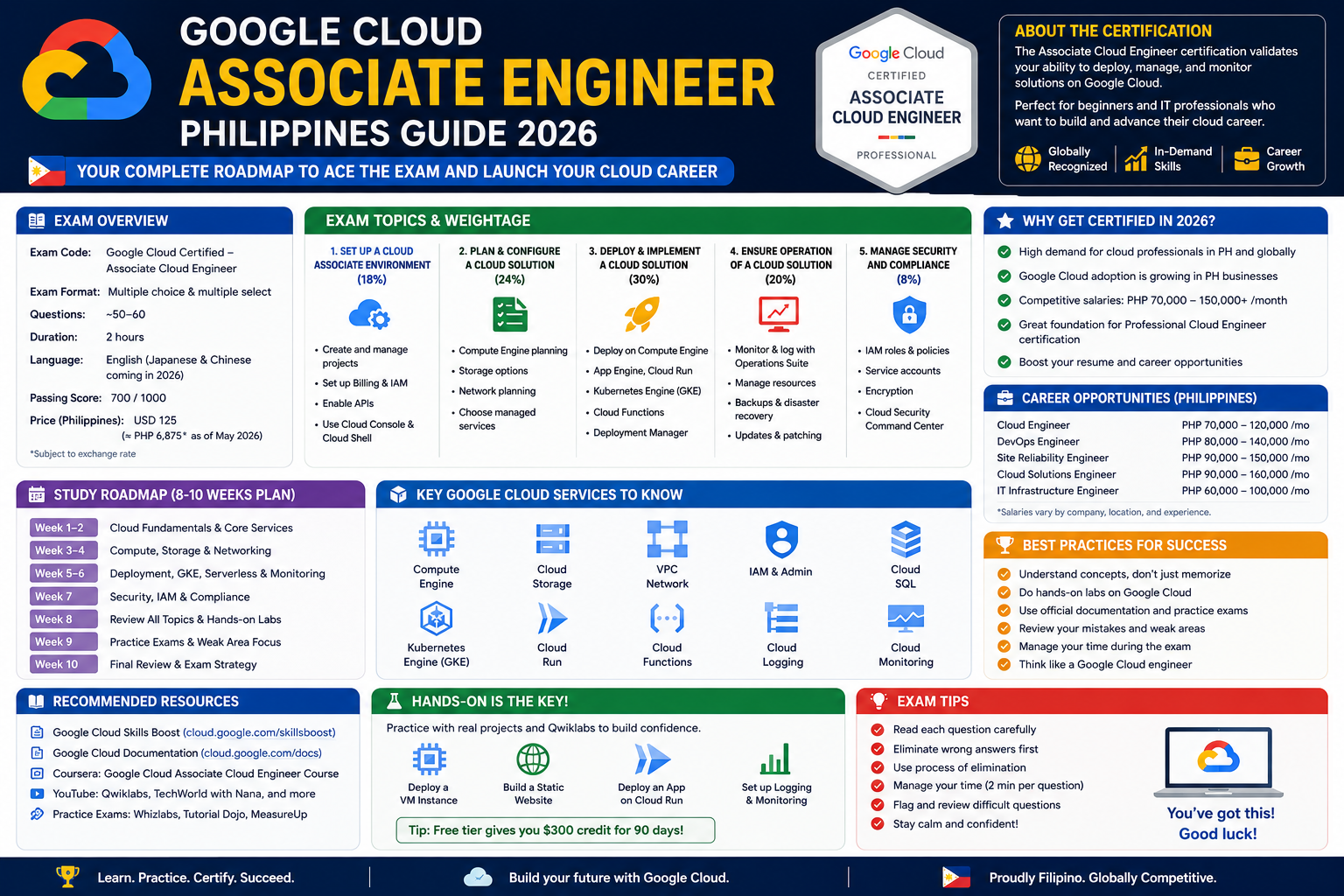
Google Cloud Associate Cloud Engineer (ACE) is the entry cert for GCP. Exam is 2 hours, 50-60 questions, and costs $125 USD (~₱7,250). Passing lands GCP-focused roles paying ₱45,000-₱90,000/month in the Philippines. Here is the complete 2026 Filipino guide: exam centers, study path, hands-on lab strategy, and real-world tips.
Exam basics (2026)
| Item | Detail |
|---|---|
| Cert name | Associate Cloud Engineer (ACE) |
| Cost (USD) | $125 |
| Cost (PHP est) | ~₱7,250 |
| Format | 50-60 multiple-choice, 2 hours |
| Passing score | Not published (est ~70%) |
| Validity | 3 years |
| Delivery | Kryterion Webassessor (in-person or online) |
Where to take it in Philippines
- Kryterion test centers: Metro Manila and select provincial centers. Book via kryteriononline.com.
- Online proctored: Take at home with webcam and quiet room. Same fee, cheaper logistics.
- Google Cloud Skills Boost: ~$29/month for practice labs (not the real exam).
8-week study plan (proven)
- Week 1-2: Fundamentals. Watch Google Cloud Digital Leader path free on Skills Boost. Focus on Compute Engine, Cloud Storage, IAM, VPC.
- Week 3-4: Deep dives. Ranga Karanam or Antoni Tzavelas Udemy course. Take detailed notes on GKE, Cloud SQL, Pub/Sub, Cloud Functions.
- Week 5-6: Hands-on labs. Skills Boost paid tier or Qwiklabs credits. Complete 15-20 labs on IAM, VPC, GKE, Load Balancing, monitoring.
- Week 7: Practice exams. Whizlabs or Tutorial Dojo GCP practice. Hit 75%+ on 3 full-length exams.
- Week 8: Weak topic review. Re-do labs for weakest topics. Skim exam guide + case studies.
Total cost breakdown (2026)
- Exam voucher: ₱7,250
- Udemy course (Karanam or Tzavelas): ₱500-₱1,500 on sale
- Qwiklabs or Skills Boost paid (1 month): ~₱1,700
- Whizlabs practice exams: ~₱600-₱1,000
- Free Google digital leader path: ₱0
- Total investment: ₱10,050-₱11,450
Salary impact after passing
ACE alone adds ₱8,000-₱18,000/month for existing engineers in Philippines. Fresh grads with ACE + a small GCP portfolio project (a deployed Cloud Run service, a BigQuery dashboard) land junior cloud engineer roles paying ₱45,000-₱75,000/month. GCP has fewer PH-based job listings than AWS but pays a small premium per role because talent is scarcer.
GCP vs AWS: which cert first?
- AWS CLF-C02 first: if you want maximum PH job listings and fastest hire velocity.
- GCP ACE first: if you target data/ML roles (Google’s BigQuery + Vertex AI are enterprise-friendly).
- Both eventually: senior cloud engineers in Philippines typically hold 2-3 cloud certs across AWS + GCP or AWS + Azure.
Common mistakes when preparing
- Skipping hands-on labs. ACE exam is scenario-heavy. You need to know what a real GKE cluster looks like, not just theory.
- Studying only via video. Google’s docs are dense but authoritative. Read the Cloud Architecture Framework white paper.
- Booking exam too early. Wait until you hit 75%+ on 3 consecutive full-length practice tests.
- Cramming BigQuery syntax. ACE exam does not go deep into SQL. Focus on services and integration patterns instead.
Common cloud engineer career-decision mistakes
- Chasing salary without considering fit. A 30% higher salary in a role you hate is a bad trade. Compensation matters, but company culture, learning growth, and manager quality often matter more.
- Ignoring specialization vs generalization. Early career benefits from being T-shaped (broad + one deep specialty). Mid-career should double down on your specialty. Late career loops back to leadership.
- Neglecting soft skills. The best cloud engineer professionals communicate clearly, build trust, and work well in teams. Technical skills alone plateau at mid-level.
- Not networking. Most senior jobs come through personal networks, not applications. Build authentic relationships before you need them.
- Undervaluing Philippines-based roles. Remote work has raised Philippines-based salaries dramatically. A Philippines developer working for a US company often earns 2-5x local rates.
Skills roadmap for cloud engineer
Whether you are transitioning into this field or leveling up, plan your learning in tiers:
- Fundamentals (0-6 months): Master the core concepts. Read one canonical book, complete one comprehensive course, build 3-5 small projects.
- Depth (6-18 months): Pick 1-2 specialization areas. Build 2-3 substantial projects that demonstrate your skills. Contribute to open source.
- Professional application (18+ months): Apply for junior positions. Portfolio + GitHub + one professional recommendation opens most doors.
- Continuous learning: Follow industry news, attend conferences, read papers. The field evolves; you must too.
Philippine-specific salary considerations
The Philippines tech market has three distinct salary tiers:
Local Philippine companies: ₱25,000-100,000/month for junior to senior roles. Traditional path but lowest ceiling.
Regional (SEA) companies: ₱60,000-200,000/month. Companies like Grab, Gojek, Coins.ph. Better than local but Manila-Singapore commute or full relocation often required.
Remote US/EU companies: $2,000-8,000/month ($24,000-96,000/year). Requires strong English, portfolio, and job-hunting persistence. Highest ceiling by far.
Certifications, portfolio strength, and English communication skills separate candidates competing for remote roles. Invest in all three.
Best career-building practices
- Build in public. Share your projects on LinkedIn and Twitter/X. Recruiters find you. Peers open opportunities.
- Get one industry-recognized certification. AWS, Google Cloud, PMP, or specialty cert opens doors and often justifies salary bumps.
- Contribute to open source. Even 5 hours per month on OSS pays dividends in networking and demonstrated skill.
- Track your accomplishments. Monthly journal of what you shipped. Feeds performance reviews and future job interviews.
- Invest in negotiation. Salary negotiation is a learnable skill. Read one book (Never Split the Difference is popular) and practice.
Salary negotiation for cloud engineer roles
Whether you are switching jobs or asking for a raise, negotiation is a skill you can practice. Most professionals leave money on the table because they never ask.
- Do market research first. Check LinkedIn Salary, Glassdoor, and levels.fyi for your role, region, and experience level. Know the numbers before you enter the conversation.
- Never disclose your current salary first. Say “I am looking for total compensation in the range of X to Y” instead of naming a single number.
- Negotiate the whole package. Base salary, bonus, equity, sign-on bonus, remote work flexibility, professional development budget. All are negotiable.
- Get everything in writing. Verbal offers change. Only the written offer letter matters legally.
- Be prepared to walk away. The best position in any negotiation is one where you have alternatives. Never negotiate from desperation.
Building your portfolio for cloud engineer
Portfolios prove skills better than resumes list them. For cloud engineer, focus your portfolio on demonstrating real problem-solving capability.
- 3-5 substantial projects, not 20 small ones. Deep quality beats broad quantity every time.
- Include the “why” and the outcome. Do not just show what you built. Explain the problem, your approach, tradeoffs, and impact.
- Host publicly. GitHub for code, Behance for design, personal website for writing. Employers should be able to find you.
- Solve real problems. Client work, open source contributions, or problems in your community beat generic tutorial recreations.
- Update quarterly. Stale portfolios signal stale skills.
Remote work opportunities for Philippine cloud engineer professionals
The pandemic normalized remote work, and Philippine professionals with strong English and technical skills now compete for global roles. Compensation can be 2-5x local rates.
Popular platforms for finding remote roles: LinkedIn Jobs (filter for remote), We Work Remotely, Remote OK, Toptal (for freelancers), Upwork, and direct application to US/EU startups. LinkedIn presence with detailed profile and regular content posting is often more effective than cold applications.
Remote work challenges include timezone alignment (US Pacific hours are 3 AM Philippine time), self-discipline in isolated environments, and building relationships across screen distance. Successful remote workers develop rituals: dedicated workspace, boundary rituals (dressing for work), and intentional community outside work hours.
Long-term career trajectory
Most tech careers follow a similar arc: individual contributor early, specialization mid-career, then a fork to management or deeper technical expertise (staff/principal engineer track). Neither path is universally better; both offer high compensation and meaningful work.
Management suits people who enjoy people problems: coaching, resource allocation, organizational politics. It often means less direct code contribution and more meetings.
Staff/principal engineer suits those who want to remain hands-on with technology while having broader influence. Compensation caps often equal management at senior levels.
Whichever path you take, reassess every 2-3 years. Careers evolve, and the right choice at 25 may not be the right choice at 35.
Official resources
Frequently Asked Questions
Is GCP or AWS more in demand in PH?
AWS has 3-4x more PH job listings. GCP pays slightly more per role because the talent pool is smaller. For volume, start AWS. For per-role rate, GCP works.
Can I skip Cloud Digital Leader and go straight to ACE?
Yes for developers with coding background. Cloud Digital Leader is for non-technical roles. ACE is the right first cert for developers.
Is online proctoring reliable in PH?
Yes but connection matters. Use fiber not mobile hotspot. Warn family/roommates not to enter the room. Any interruption fails the session.
Does GCP offer free credits for lab practice?
Yes. New accounts get $300 in free credits valid 90 days. Enough to practice most ACE lab scenarios. Also apply for Google for Startups if you have a real startup entity.
Should I combine ACE with Data Engineer cert?
Only after 1 year of GCP data work experience. Data Engineer Professional cert is significantly harder than ACE. Build data pipeline projects first.

Leah Whynett Dela Pena
Technology Writer at PIES IT Solution
Leah Whynett Dela Pena is a technology writer at PIES IT Solution, author of 93 career and IT education guides at itsourcecode.com. Specializes in tech career paths, degree and certification guidance, and IT industry how-to content for students and career changers.
Expertise: Tech Careers · IT Education · Web Development Careers · Software Engineering Careers · Cybersecurity Careers · IT Certifications · View all posts by Leah Whynett Dela Pena →