
uv is Astral’s Rust-built Python package and project manager that replaces pip, pip-tools, pipx, poetry, pyenv, and virtualenv in one tool.
It is 10-100x faster than pip. If you see ModuleNotFoundError: No module named ‘uv’, you actually want to install uv as a standalone CLI tool, not as a Python module.
uv pip install ..., uv run script.py), not as import uv in Python code. Install via curl or pipx, not regular pip install.Step 1: Install uv (recommended methods)
# Linux / macOS (recommended, isolated install):
curl -LsSf https://astral.sh/uv/install.sh | sh

# Windows PowerShell:
powershell -ExecutionPolicy ByPass -c "irm https://astral.sh/uv/install.ps1 | iex"

# Or via pipx (cross-platform):
pipx install uv

# Or via pip (if you really want it as a Python module):
pip install uv
Step 2: Verify install
uv --version
# uv 0.5.x

uv python list   # show available Python versions
uv python install 3.12   # install a specific Python
Step 3: Common uv workflows
# Create a new project (pyproject.toml + .venv):
uv init my-app
cd my-app
uv add requests pandas
uv run python main.py

# Add packages to existing project:
uv add fastapi 'uvicorn[standard]'

# Install from requirements.txt (replaces pip):
uv pip install -r requirements.txt

# Sync exact versions (replaces pip-tools):
uv lock
uv sync

# Run a one-off script with deps inline (PEP 723):
uv run script.py
Why this error happens
| Cause | Fix |
|---|---|
| Tried “import uv” expecting a library | uv is a CLI tool, run as “uv …” in terminal |
| Installed but not on PATH | Restart shell, or add ~/.cargo/bin (Linux) / %USERPROFILE%\.local\bin (Win) |
| Confused with libuv (C async library) | Different project; Astral uv is what you want |
| Old install, wants pyvenv-uv | Update with: curl -LsSf https://astral.sh/uv/install.sh | sh |
Official documentation
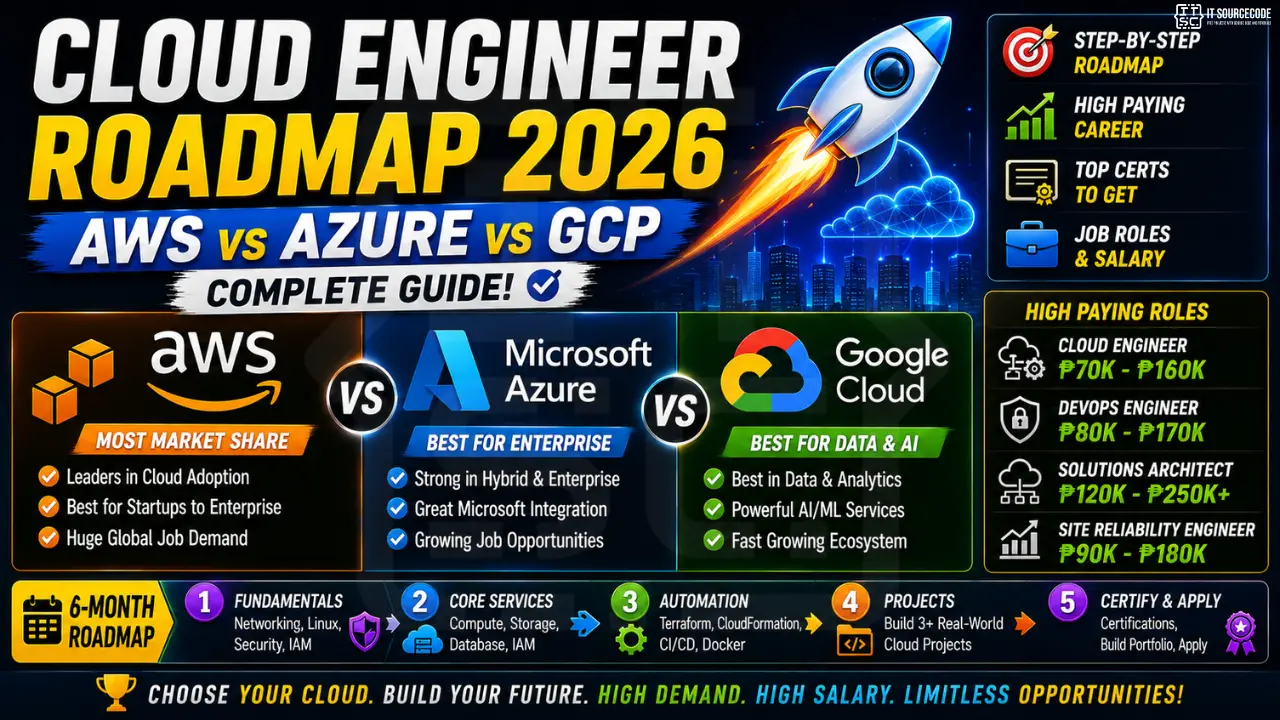
Which cloud platform to learn first as a Filipino developer
All three major clouds pay well and hire Filipino remote engineers. But your first cloud choice should match the job market you want to enter first, not the tech that looks coolest. Here is how I recommend choosing.
Start with AWS if…
You want the widest job market and the most job listings. AWS holds the largest cloud market share globally in 2026, and Philippine BPO clients and startups tend to build on AWS. The AWS Certified Cloud Practitioner is the easiest entry cert. Learn EC2, S3, IAM, Lambda, and RDS first.
Start with Azure if…
You already know .NET, Visual Studio, or Microsoft tools. Azure integrates natively with Windows environments and enterprise IT. Many Philippine banks, government agencies, and multinationals run on Azure. The AZ-900 Azure Fundamentals cert costs less than the AWS equivalent.
Start with GCP if…
You are focused on data engineering, ML, or Kubernetes. GCP has the strongest data and AI services (BigQuery, Vertex AI, Kubernetes Engine). Filipino ML engineers often prefer GCP because Google actively hires from the region and offers scholarships for the Associate Cloud Engineer cert.
Cloud engineer salary expectations in the Philippines (2026)
Salaries vary based on your certification level, hands-on experience, and whether you work locally or remotely for foreign employers. Here is what the market pays in 2026 based on real listings and Filipino engineer reports.
- Junior Cloud Engineer (0 to 2 years): PHP 40,000 to PHP 70,000 monthly for local employers. Remote roles for foreign clients start at USD 1,500 to USD 2,500 monthly.
- Mid-level Cloud Engineer (2 to 5 years): PHP 70,000 to PHP 150,000 monthly locally. Remote foreign roles pay USD 3,000 to USD 6,000 monthly.
- Senior Cloud Engineer (5+ years, multi-cloud): PHP 150,000 to PHP 300,000 monthly locally. Remote senior roles pay USD 6,000 to USD 12,000 monthly.
- Cloud Architect (7+ years, deep specialization): PHP 250,000 to PHP 500,000 monthly. Senior remote architects at US companies earn USD 15,000+ monthly.
The single biggest salary multiplier is holding certifications from more than one cloud. Multi-cloud engineers command 30 to 50 percent higher pay than single-cloud specialists. Start with one platform, get certified, ship real projects, then add the second cloud after your first year.
Quick summary
Cloud engineering is one of the strongest career paths for Filipino developers in 2026. AWS gives you the largest job market. Azure fits enterprise IT. GCP wins for data and AI work. Pick one, earn the entry-level certification, ship two real projects, and land your first cloud role within 6 to 9 months. Then add the second cloud to unlock senior salaries. The learning curve is steep but the payoff is worth it: cloud engineers earn among the highest tech salaries in the country, and remote roles for foreign employers regularly pay in US dollars.
Frequently Asked Questions
Why use uv instead of pip in 2026?
Speed: uv installs packages 10-100x faster than pip thanks to parallel downloads and a Rust-based resolver. It also bundles Python version management (replacing pyenv) and project management (replacing poetry). One tool, much less waiting.
Should I switch from poetry to uv?
For new projects in 2026, yes. uv has a near-identical pyproject.toml workflow, supports lockfiles, manages virtualenvs, and is dramatically faster. Existing poetry projects can usually be converted with: uv init –no-readme then uv add for each dep.
Does uv work with requirements.txt?
Yes. uv pip install -r requirements.txt is a drop-in replacement for pip install -r. You do not need to migrate to pyproject.toml just to use uv for speed.
Can uv install Python itself?
Yes. uv python install 3.12 downloads a portable Python build. uv automatically uses the right Python for each project based on pyproject.toml requires-python. Replaces pyenv for most users.
Is uv production-ready in 2026?
Yes. Reached 1.0-stable in late 2025. Used in major companies, including FastAPI, LangChain, and Polars CI pipelines. Backed by Astral (the team behind ruff). Open-source, MIT/Apache dual license.

Caren Bautista
Technical Writer at PIES IT Solution
Caren Bautista is a technical writer at PIES IT Solution. Responsible for crafting clear, well-structured, and beginner-friendly content across the platform. Handles the writing, proofreading, and editorial review of tutorials, guides, and documentation to ensure every article is accurate, readable, and easy to follow.
Expertise: Technical Writing, Content Creation, Documentation, Editorial Writing, JavaScript, TypeScript, Python, Python Errors, HTTP Errors, MS Excel · View all posts by Caren Bautista →