
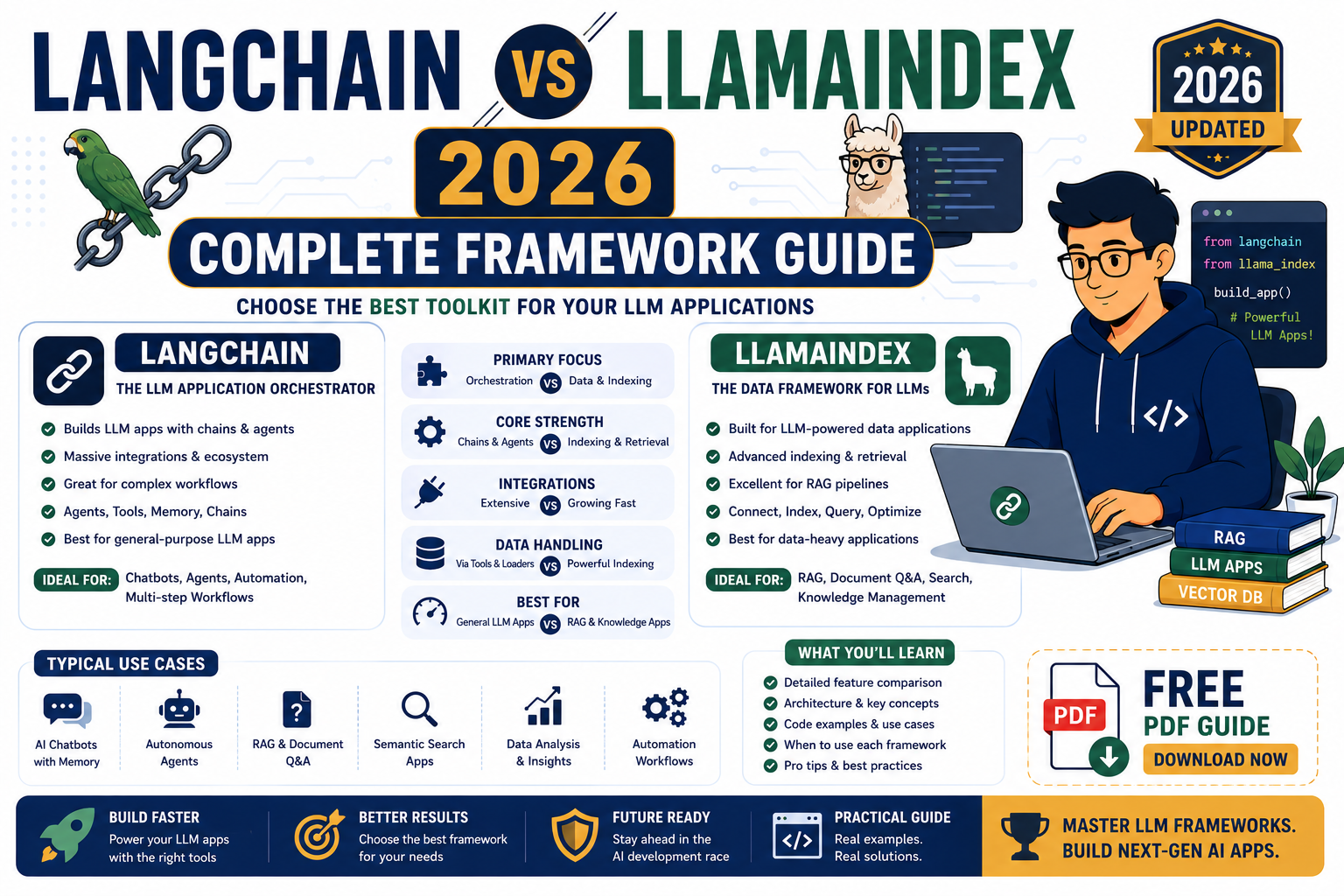
LangChain and LlamaIndex are the two dominant Python frameworks for building LLM-powered apps in 2026. Both help you wire up LLMs to your data, tools, and workflows. They overlap heavily but each has a clear best-fit. This is the honest developer guide after shipping production apps on both.
Quick answer for 2026
LangChain (with LangGraph) for agent workflows, multi-step reasoning chains, and apps that orchestrate many tools or LLM calls. LlamaIndex for RAG (Retrieval-Augmented Generation) apps where the main job is retrieving from documents and answering questions. Many production apps use both: LlamaIndex for data ingestion + retrieval, LangChain for agent orchestration.
What LangChain actually is in 2026
LangChain launched in late 2022 and reached its stable 1.0 release in 2024. By 2026 it has split into three related packages: langchain (core), langchain-community (integrations), and LangGraph (agent orchestration). LangGraph has become the primary way to build agents in 2026.
What LangChain gives you:
- Unified interface across 50+ LLM providers (OpenAI, Anthropic, Google, local Ollama, etc.)
- Prompt template system with variable substitution
- Chain composition (pipe LLM output to next step)
- 200+ pre-built integrations (databases, APIs, search engines, document loaders)
- LangGraph for stateful multi-step agent workflows
- LangSmith for tracing, evaluation, and debugging
Best use cases:
- Agents that plan tasks and use tools
- Multi-step workflows where each step feeds the next
- Apps switching between multiple LLM providers
- Complex integrations (multiple APIs, databases, search backends)
What LlamaIndex actually is in 2026
LlamaIndex (originally GPT-Index) launched in early 2023 focused specifically on RAG. By 2026 they have expanded into “LlamaCloud” (managed platform) and LlamaParse (best-in-class document parsing) but the core value remains RAG for structured and unstructured data.
What LlamaIndex gives you:
- Document loaders for 160+ file formats (PDFs, HTML, DOCX, images with OCR)
- Chunking strategies tuned for RAG performance
- Vector store integrations (Pinecone, Weaviate, Qdrant, Chroma, pgvector)
- Query engines (basic, sub-question, tree, multi-hop)
- LlamaParse for complex PDF layouts (tables, figures, math)
- Response synthesis modes (refine, compact, tree summarize)
Best use cases:
- Q&A over a corpus of documents (legal, medical, technical docs)
- Enterprise search on internal knowledge bases
- Chatbots grounded in company data
- PDF or complex document analysis with tables and structure
Real code comparison: basic RAG in both
LangChain RAG
from langchain_openai import ChatOpenAI, OpenAIEmbeddings
from langchain_community.vectorstores import Chroma
from langchain.text_splitter import RecursiveCharacterTextSplitter
from langchain_community.document_loaders import PyPDFLoader
from langchain.chains import RetrievalQA

# Load, split, index
loader = PyPDFLoader("company_handbook.pdf")
docs = loader.load()
splitter = RecursiveCharacterTextSplitter(chunk_size=1000, chunk_overlap=200)
chunks = splitter.split_documents(docs)
vectorstore = Chroma.from_documents(chunks, OpenAIEmbeddings())

# Query
llm = ChatOpenAI(model="gpt-5-mini")
qa = RetrievalQA.from_chain_type(llm=llm, retriever=vectorstore.as_retriever())
answer = qa.run("What is our PTO policy for new hires?")
LlamaIndex RAG
from llama_index.core import VectorStoreIndex, SimpleDirectoryReader
from llama_index.llms.openai import OpenAI

# Load, split, index (all in one)
documents = SimpleDirectoryReader(input_files=["company_handbook.pdf"]).load_data()
index = VectorStoreIndex.from_documents(documents)

# Query
query_engine = index.as_query_engine(llm=OpenAI(model="gpt-5-mini"))
answer = query_engine.query("What is our PTO policy for new hires?")
LlamaIndex hides more of the details for basic RAG (5 lines vs 10). LangChain exposes more knobs which matters when you need custom chunking, custom retrieval, or hybrid search.
Real code comparison: multi-step agent in both
LangGraph agent
from langgraph.prebuilt import create_react_agent
from langchain_openai import ChatOpenAI

def get_weather(city: str) -> str:
    # Your weather API call
    return f"Sunny, 28C in {city}"

def send_email(to: str, subject: str, body: str) -> str:
    # Your email service call
    return f"Email sent to {to}"

agent = create_react_agent(
    ChatOpenAI(model="gpt-5"),
    tools=[get_weather, send_email],
    prompt="You are a helpful assistant that helps schedule outdoor events.",
)

result = agent.invoke({"messages": [{"role": "user",
    "content": "Check weather in Manila and email [email protected] if it's sunny."}]})
LlamaIndex agent
from llama_index.core.agent.workflow import FunctionAgent
from llama_index.llms.openai import OpenAI
from llama_index.core.tools import FunctionTool

weather_tool = FunctionTool.from_defaults(fn=get_weather)
email_tool = FunctionTool.from_defaults(fn=send_email)

agent = FunctionAgent(
    tools=[weather_tool, email_tool],
    llm=OpenAI(model="gpt-5"),
    system_prompt="You are a helpful assistant that helps schedule outdoor events.",
)

result = await agent.run("Check weather in Manila and email [email protected] if it's sunny.")
Both work. LangGraph is genuinely better for complex agents with conditional branching, cycles, and state. LlamaIndex FunctionAgent is simpler and adequate for straightforward tool-use flows.
Framework comparison in 2026
| Dimension | LangChain / LangGraph | LlamaIndex |
|---|---|---|
| Primary strength | Agent orchestration | RAG on documents |
| Learning curve | Steeper (more concepts) | Gentler (opinionated defaults) |
| LLM provider support | 50+ | 30+ |
| Document loaders | 80+ | 160+ |
| Vector store support | 40+ | 35+ |
| Multi-step agents | Best-in-class (LangGraph) | Adequate (FunctionAgent) |
| Complex PDF parsing | Basic (via community) | Best-in-class (LlamaParse) |
| Managed platform | LangSmith ($39/user/mo) | LlamaCloud (usage-based) |
| Community size (2026) | Larger (105K GitHub stars) | Growing fast (45K stars) |
When to pick LangChain in 2026
- Building an agent that plans tasks and uses multiple tools
- Multi-step workflow with conditional branching (if X then A else B)
- Need to switch between LLM providers without code rewrite
- Complex integrations across many APIs and services
- Team already using LangSmith for tracing and evaluation
When to pick LlamaIndex in 2026
- Primary job is Q&A over documents (RAG chatbot)
- Processing PDFs with tables, images, math (LlamaParse is the best in class)
- You want opinionated defaults that work out of the box
- Building a search engine over internal knowledge base
- Simpler use case where LangChain’s flexibility is overkill
The hybrid pattern used in production
Many production apps in 2026 use both frameworks: LlamaIndex for the RAG portion (document ingestion, chunking, retrieval), LangChain for the agent orchestration (deciding when to retrieve, when to use other tools, when to answer directly).
from llama_index.core import VectorStoreIndex, SimpleDirectoryReader
from llama_index.core.tools import QueryEngineTool
from langgraph.prebuilt import create_react_agent
from langchain_openai import ChatOpenAI

# LlamaIndex handles the RAG part
docs = SimpleDirectoryReader("./company_docs").load_data()
index = VectorStoreIndex.from_documents(docs)
rag_query_engine = index.as_query_engine()

# Wrap as a tool for LangGraph agent
def search_company_docs(question: str) -> str:
    return str(rag_query_engine.query(question))

# LangGraph orchestrates the agent
agent = create_react_agent(
    ChatOpenAI(model="gpt-5"),
    tools=[search_company_docs, send_email, get_weather],
    prompt="You help employees with questions using company docs and tools.",
)
You get LlamaIndex’s superior RAG plus LangGraph’s superior agent orchestration. This pattern is used in most production customer-support and internal-tools LLM apps in 2026.
Frequently asked questions
Do I need a framework at all, or can I just call the LLM API directly?
For simple apps (one LLM call, no document retrieval, no tools), skip the framework and call the API directly. Frameworks add value once you need RAG, agents, multiple LLM providers, or complex chains. If your app is a chat interface over an existing PDF library, you need a framework. If your app just wraps GPT-5 to summarize URLs, direct API is simpler.
Are these frameworks worth learning if I only use one LLM provider?
Yes, but selectively. The provider-swap value is smaller if you never switch providers, but the RAG pipeline abstractions (LlamaIndex) and agent orchestration (LangGraph) are worth learning even if you never leave OpenAI. If you only need direct API calls with no RAG or agents, skip the frameworks. Otherwise the productivity gain is real.
Which is better for a Filipino BSIT capstone AI project?
LlamaIndex for capstone projects that ingest and answer questions from documents (school handbook chatbot, thesis library search, faculty knowledge base). LangGraph for capstone projects that involve multi-step reasoning (customer service agent, appointment booking bot). Both frameworks are free and open source. For panels, be ready to explain your framework choice (why LlamaIndex over LangChain for this specific problem).
How stable are these frameworks in 2026?
LangChain 1.0 (released 2024) and LlamaIndex have both stabilized their APIs by 2026. Breaking changes are rare and usually documented well in advance. Both maintain semantic versioning. Pin your dependencies to specific versions in production (langchain==0.3.x, llama-index==0.11.x style) and upgrade deliberately, not automatically.
Do these frameworks work with local models like Ollama in 2026?
Yes. Both frameworks support Ollama, LM Studio, and other local LLM runtimes via the langchain-ollama and llama-index-llms-ollama packages. Performance depends on your local hardware. A M-series Mac or gaming GPU with 16GB+ VRAM can run Llama 3.1 70B locally at reasonable speed. Local models are useful for privacy-sensitive apps or when you want zero API cost.
What about newer alternatives like Haystack or DSPy?
Haystack (from deepset) is a strong alternative for RAG-focused apps, comparable to LlamaIndex. DSPy takes a different approach (compiling prompts as optimizable programs). Both have real users but smaller communities than LangChain and LlamaIndex in 2026. For learning first, stick with LangChain or LlamaIndex. For specific use cases, evaluate the alternatives based on their unique strengths.
For structured LangChain and LlamaIndex training, Coursera and DataCamp both offer full RAG and agent-building tracks with hands-on notebooks that walk through the same code patterns above.
Bottom line for 2026 AI developers
LangChain and LlamaIndex are complementary tools in 2026, not competitors. Learn LlamaIndex first if your primary need is RAG on documents. Learn LangGraph first if your primary need is agent orchestration. Use both together when building sophisticated production apps. Both are free, well-documented, and battle-tested. The right pick depends on the job at hand, not on framework loyalty.
Official documentation
Related AI dev tools
The links below are affiliate links. We may earn a commission at no extra cost to you when you sign up. See our affiliate disclosure for full details.
- OnSpace AI — AI app builder with LangChain and LlamaIndex integrations. 20% revenue share.
- Thunderbit — AI web scraper for feeding real-time data into your LangChain or LlamaIndex apps.
- Cloudways — hosting for your LLM-powered production app. $14/mo starting.

Angel Jude Suarez
Full-Stack Developer at PIES IT Solution
Focuses on Python development, machine learning, and AI integration. Has built production AI systems including OpenAI Whisper integration for medical transcription and GPT-4o-powered diagnosis assistance. Strong background in pandas, scikit-learn, and TensorFlow.
Expertise: Python · Machine Learning · AI Integration · OpenCV · Django · PyTorch · TensorFlow · LangChain · OpenAI SDK · Anthropic SDK · View all posts by Angel Jude Suarez →