
You called response.json(), expected a list of results, and tried data[0], only to get IndexError: list index out of range. The API returned an empty list (valid response, no matching results). This guide shows the 3 safe-access patterns and how to design clients that handle empty responses gracefully.
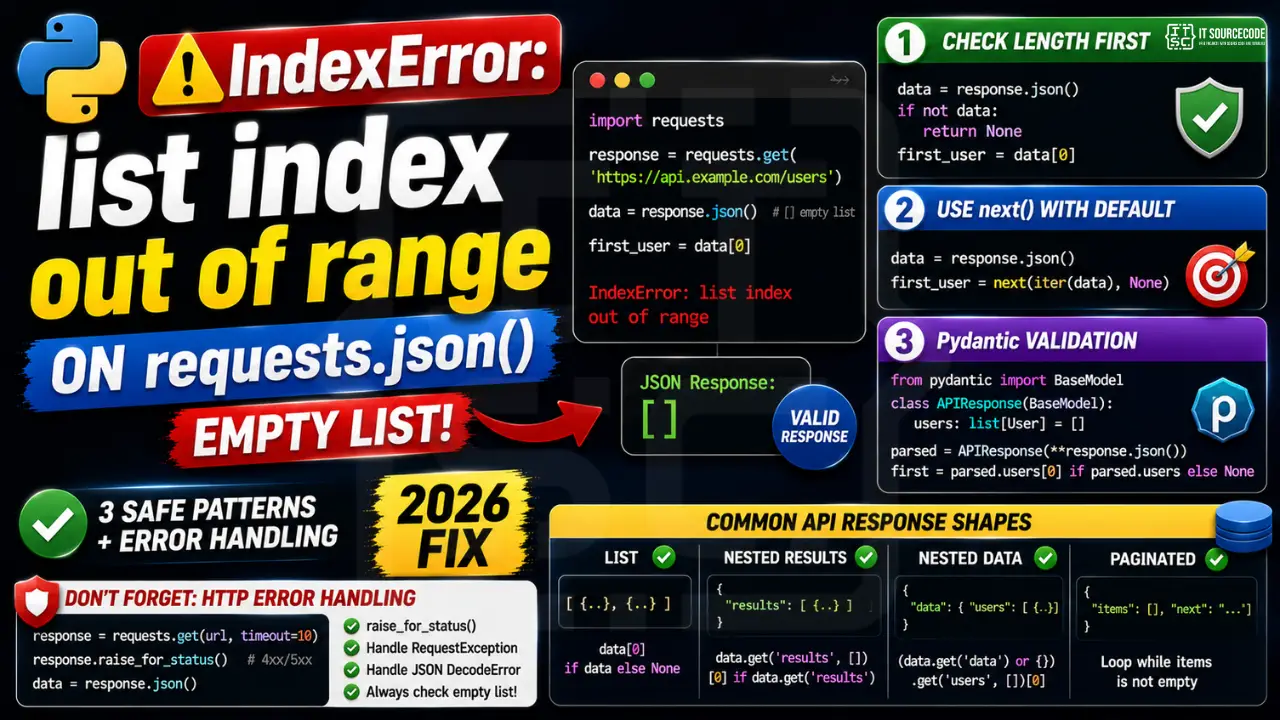
Minimal reproducer
import requests
response = requests.get('https://api.example.com/users', params={'name': 'nonexistent'})
data = response.json()  # [] empty list
first_user = data[0]    # IndexError
Fix 1: Check length first
data = response.json()
if not data:
    return None  # or handle empty result
first_user = data[0]
Fix 2: Use next() with default
data = response.json()
first_user = next(iter(data), None)
# or with a default object
first_user = next(iter(data), {'id': 0, 'name': 'Unknown'})
Fix 3: Validate with Pydantic for typed access
from pydantic import BaseModel
from typing import List

class User(BaseModel):
    id: int
    name: str

class APIResponse(BaseModel):
    users: List[User] = []

response = requests.get('https://api.example.com/users')
parsed = APIResponse(**response.json())
first = parsed.users[0] if parsed.users else None
Don’t forget HTTP error handling
import requests
from requests.exceptions import RequestException

def safe_get_first_user(name):
    try:
        response = requests.get('https://api.example.com/users',
                               params={'name': name},
                               timeout=10)
        response.raise_for_status()  # raises on 4xx/5xx
        data = response.json()
        return data[0] if data else None
    except RequestException as e:
        log.warning(f"API error: {e}")
        return None
    except ValueError:  # json decode error
        log.warning(f"Invalid JSON in response")
        return None
Common API response shapes
| Response shape | Safe access |
|---|---|
| [item, item, …] | data[0] if data else None |
| {“results”: [item, item, …]} | data.get(‘results’, [None])[0] |
| {“data”: {“users”: […]}} | (data.get(‘data’) or {}).get(‘users’, [None])[0] |
| Paginated {“items”: [], “next”: “…”} | while loop with empty check |
Debugging checklist for IndexError
Before diving into fixes, run through this diagnostic checklist. Nine times out of ten the answer surfaces here.
- Read the full traceback, not just the error message. The stack trace shows exactly which line and which call chain triggered the error. The last line names the immediate cause; earlier lines show how you got there.
- Add print or debug statements just before the failing line. Print the variable, its type, and its value. Nine out of ten error surprises come from the value being different from what you assumed.
- Check Python version compatibility. Errors sometimes result from APIs that changed between versions. Run your interpreter version check and compare against the library documentation for that version.
- Isolate the failing call in a minimal reproducer. Copy the failing line into a small standalone script with hardcoded inputs. If it fails there too, the bug is in your code. If not, something in your surrounding context is contributing.
- Search the exact error message. Include the class name and the specific text in your search. Chances are someone else hit the same issue and the fix is documented on Stack Overflow or the library’s GitHub issues.
Common causes for IndexError
Most instances of this error trace back to one of these root causes:
- Uninitialized or missing input. A variable was not populated before use, or the input source (file, API response, database row) did not contain the expected key or value.
- Type mismatch. The code expected a specific type (dict, list, string) but received something different. Python’s dynamic typing means this often surfaces at runtime, not at compile time.
- Version drift. The library API changed and your code assumes the old signature. Check the library’s changelog for breaking changes since the version you last used.
- Race condition or ordering issue. Async or concurrent code sometimes tries to access data before it is ready. Add awaits, locks, or explicit ordering to fix.
- Copy-paste from stale tutorial. Older tutorials may use APIs that no longer exist. Always check the official docs for the current version.
Testing and prevention
Preventing this class of error from recurring is more valuable than fixing it once. Build these habits into your workflow:
- Write tests that trigger the error path. If your test suite hits the error scenario, catch and assert it. A well-written test prevents the same bug from returning.
- Validate inputs at API boundaries. When data enters your code from external sources (HTTP requests, file uploads, database queries), validate structure and types immediately.
- Use type hints and static analysis. Tools like mypy for Python or TypeScript for JavaScript catch many type mismatches before you run the code.
- Log important state. Structured logging with context helps you debug production issues faster. Include enough context to reconstruct what happened.
- Read the library changelog. Before upgrading a dependency, skim the changelog for breaking changes. Two minutes of reading saves an hour of debugging.
When to ask for help
Some errors are worth solving yourself for the learning. Others are worth asking about early. Ask for help when: the error blocks a customer-facing feature, you have spent an hour without progress, the error involves security or data integrity, or you are unsure whether your fix will introduce new bugs. Post to Stack Overflow with a minimal reproducer, or ask a senior developer on your team. Time boxes are your friend.
Production hardening for IndexError
Fixing IndexError once is not enough. To prevent it from recurring in production, harden the surrounding code with these patterns.
- Defensive coding at API boundaries. Every function that receives external data (HTTP requests, database rows, file uploads, third-party API responses) should validate structure and types before proceeding. Use validation libraries like Pydantic (Python specific) to enforce schemas at the boundary.
- Structured logging with context. When IndexError occurs, your logs should include enough context to reconstruct the failure. Include the operation name, input values, user or request ID, and the full stack trace. Avoid logging sensitive data (passwords, tokens, PII).
- Error monitoring and alerting. Tools like Sentry, Rollbar, or Datadog capture production errors with stack traces and context. Set up alerts for IndexError so you know within minutes when it happens in production.
- Retry logic with exponential backoff. For transient errors (network failures, temporary API errors), retry with 1-second, 2-second, 4-second delays. Cap at 3-5 retries to prevent infinite loops.
- Circuit breakers for external dependencies. If an external service repeatedly fails, stop calling it for a period and return a fallback response. Prevents cascading failures.
Testing strategies to catch IndexError early
Investing in tests that specifically trigger the error path prevents regressions. Build these into your test suite:
- Unit tests for the failing function. Write a test that reproduces the exact conditions that caused IndexError. If your test fails, your fix works. If your test passes with the buggy code, your test is not testing the right thing.
- Property-based testing. Tools like Hypothesis for Python generate random inputs and check invariants hold. Great for catching edge cases you did not think of.
- Integration tests with real dependencies. Mock-heavy unit tests miss real-world issues. Have at least one integration test that hits a real database, API, or file system.
- Continuous integration. Run your test suite on every pull request. Catch bugs before they reach main.
Official documentation
Frequently Asked Questions
Why does my API sometimes return [] and sometimes raise?
Most REST APIs return an empty list [] for “no matching results” (200 OK) and raise 404 only for “endpoint or resource does not exist.” Both are valid; handle both with try/except RequestException AND empty-list check.
What is the difference between response.json() raising and returning empty?
response.json() raises requests.exceptions.JSONDecodeError (or ValueError) if the response body is not valid JSON (e.g. HTML error page returned with 500 status). It returns [] or {} only if the JSON itself is empty. Check response.headers[‘content-type’] before parsing.
Should I use requests or httpx for new code in 2026?
httpx for new code: async support, HTTP/2, type hints, modern API. requests for legacy compatibility or where you need maximum library compatibility (every guide and tutorial uses requests). Both raise IndexError if you access an empty list returned from .json().
How do I retry an API call that returns empty?
If empty means “rate-limited” or “still indexing,” retry with exponential backoff: tenacity library is the standard. If empty means “no results”, do NOT retry, return None and let caller handle. Distinguish via headers or status code.
Can I use response.json() without checking the status code first?
Risky. Some APIs return JSON error bodies on 4xx/5xx (good), others return HTML error pages (response.json() raises ValueError). Always either call response.raise_for_status() first OR check status_code before .json().

Angel Jude Suarez
Full-Stack Developer at PIES IT Solution
Focuses on Python development, machine learning, and AI integration. Has built production AI systems including OpenAI Whisper integration for medical transcription and GPT-4o-powered diagnosis assistance. Strong background in pandas, scikit-learn, and TensorFlow.
Expertise: Python, PHP, Java, VB.NET, ASP.NET, Machine Learning, AI Integration, OpenCV, Django, CodeIgniter · View all posts by Angel Jude Suarez →