
Writing the Room Management System project report For your BSIT capstone in 2026? This guide walks you through every chapter that examiners expect: the problem statement, system features, ER diagram, methodology, testing approach, and references. By the end you will know exactly what each chapter needs to contain, and what to leave out.
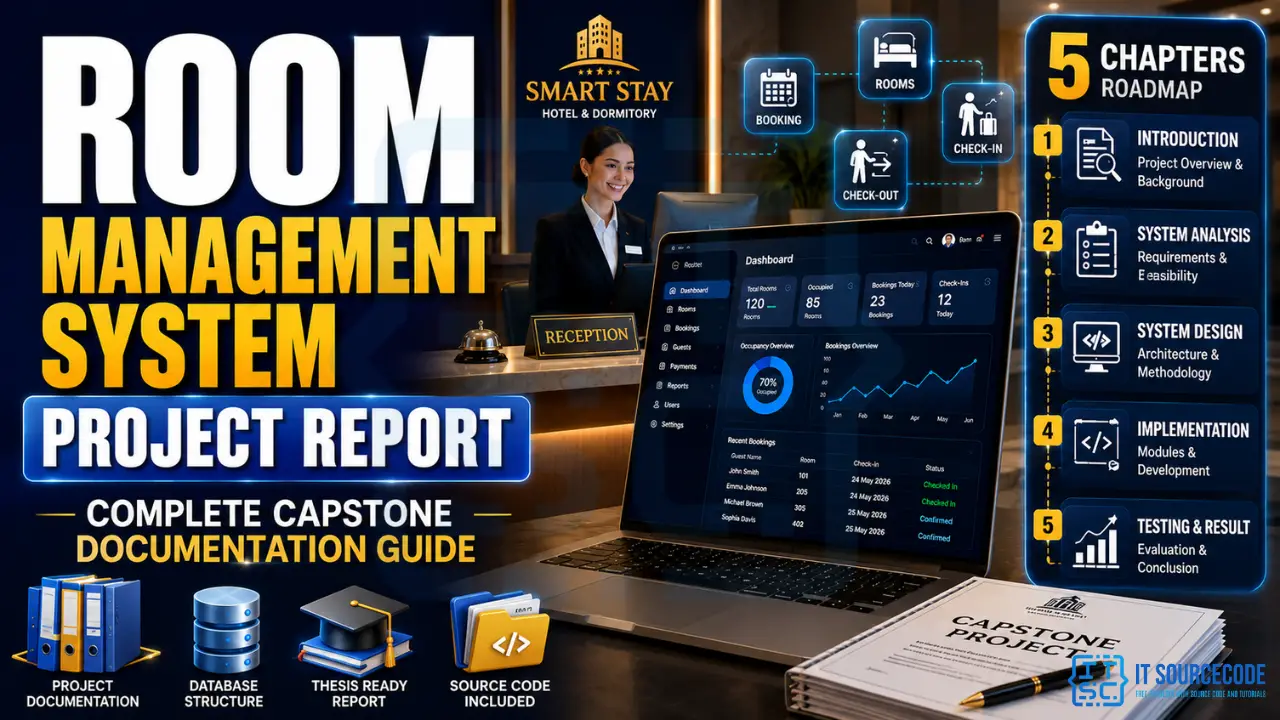
A Room Management System tracks dormitory rooms, lodging guests, hotel suites, or boarding-house bookings. It is one of the most common capstone topics because the data model is rich (rooms, guests, bookings, payments) without being unmanageable for a small team.
What Is a Room Management System?
A Room Management SystemIs a computerized system that automates the tracking, booking, and maintenance of rooms in a facility, typically a hotel, dormitory, hostel, apartment complex, or boarding house. It replaces paper logbooks with a database-backed application that handles check-in/check-out, billing, room status, and reporting.
The system serves three main user types: the front-desk staff(handling daily bookings), the manager(reviewing reports and managing rates), and the guest(checking availability and confirming a booking, if a public-facing module exists).
Chapter 1, Introduction and Problem Statement
Background of the Study
Most small-to-medium dormitories and lodgings still rely on manual logbooks, sticky notes, and spreadsheets to track room occupancy. This causes double-bookinglost payment recordsand delayed billing. The proposed Room Management System eliminates these problems with a centralized digital record.
Problem Statement
Frame the problem as three specific pain points your system solves:
- Manual records cause errors.Hand-written logbooks miss check-outs, double-book rooms, and lose payment slips.
- No real-time room status.Staff cannot see at a glance which rooms are available, occupied, reserved, or under maintenance.
- Difficult reporting.Generating month-end occupancy reports or revenue summaries from paper records takes days.
Objectives
- To design and develop a Room Management System that automates room booking, guest registration, and billing.
- To provide real-time room status visibility for front-desk staff.
- To generate accurate occupancy and revenue reports for management.
- To reduce double-booking incidents to zero through database-enforced constraints.
Chapter 2, Review of Related Literature
Cite 8–10 published sources on hospitality management systems, electronic booking platforms, and database-driven occupancy tracking. Group them into three sub-sections: local studies(Philippines/regional), foreign studiesand related systems(commercial software like Cloudbeds, RoomKey, Hostelworld, discuss what your project does differently).
For each source, write 2–3 sentences explaining its relevance to your project. Avoid the trap of summarizing the source without connecting it to your system.
Chapter 3, Methodology and System Design
Software Development Model
Use the Agile ScrumOr Iterative Waterfallmodel. Most BSIT panels in 2026 prefer Agile because it matches the way student teams actually work. Document your sprints (typically 2-week cycles) and what each sprint delivered.
System Features
- Room Inventory Managementadd, edit, deactivate rooms with details: room number, type (single/double/suite), rate per night, current status.
- Guest Registrationcapture guest details (name, ID, contact), upload ID image, store booking history.
- Booking & Check-inassign rooms, set check-in/check-out dates, prevent overlapping bookings via database constraints.
- Billing & Paymentscalculate stay charges (nights × rate + extras), record partial and full payments, generate receipts.
- Room Status Boardcolor-coded grid showing occupied/available/reserved/maintenance status for every room.
- Reports Moduledaily occupancy, monthly revenue, top-spending guests, room-type performance.
- User Managementrole-based access (admin, manager, front-desk staff) with audit logs.
Entity-Relationship Diagram (ER Diagram)
The Room Management System needs these core entities and relationships:
- Room(room_id PK, room_number, room_type_id FK, status, floor)
- RoomType(room_type_id PK, name, rate_per_night, capacity)
- Guest(guest_id PK, full_name, contact, id_type, id_number)
- Booking(booking_id PK, guest_id FK, room_id FK, check_in_date, check_out_date, status, total_amount)
- Payment(payment_id PK, booking_id FK, amount, payment_method, payment_date)
- User(user_id PK, username, password_hash, role, last_login)
The key relationships: one Guest can have many Bookings; one Booking has one Room and zero-or-more Payments; one RoomType has many Rooms. Use foreign-key constraints in MySQL to enforce these, that alone prevents most data integrity bugs.
Technology Stack
- Backend:PHP 8.x (vanilla or Laravel), most common, easy to defend in panel
- Database:MySQL 8, standard for BSIT capstone
- Frontend:Bootstrap 5 + jQuery (or vanilla JS in 2026)
- Server:XAMPP for local development; Apache + cPanel for deployment
- Version control:GitHub, examiners increasingly ask to see your commit history
Chapter 4, Implementation and Testing
Testing Strategy
- Unit Testingvalidate each function (calculate_total, check_room_availability, etc.) with at least 3 input cases.
- Integration Testingverify Booking → Payment → Receipt flow end-to-end.
- User Acceptance Testing (UAT)invite the dormitory/hotel manager to test real workflows. Document their feedback and your fixes.
- Stress Testingsimulate 100 simultaneous bookings to catch race conditions in the room-availability check.
System Requirements
- Hardware:Server with 4GB RAM minimum; client PCs with 2GB+ RAM and modern browser.
- Software:PHP 8.x, MySQL 8, Apache 2.4, modern browser (Chrome/Edge/Firefox).
- Network:LAN with static IP for the server; optional internet for backup syncing.
Chapter 5, Results, Conclusion, and Recommendations
Document quantitativeResults wherever possible: “Average booking time reduced from 8 minutes (manual) to 90 seconds (system).” Numbers strengthen your defense.
For Future Enhancementssuggest features your team did not implement but examiners might ask about: a mobile app for guests, online payment integration (PayMongo, GCash), housekeeping schedule module, and a guest-facing reservation portal.
Common Mistakes to Avoid in Your Report
- Copy-pasted boilerplate.Examiners read 30 reports a year, they spot generic text instantly. Tie every section to your specificDormitory or lodging.
- Missing screenshots in Chapter 4.Implementation chapters need actual screenshots of your running system, at least one per major module.
- No real testing data.Don’t write “we tested the system”, include a testing matrix with case ID, input, expected output, actual output, and pass/fail status.
- References-page mismatch.Every in-text citation must appear in the references; every reference must be cited at least once.
- No system limitations section.Honest acknowledgment of limitations earns more credit than over-claiming.
Free Resources for Your Capstone
- Best Final Year Projects for IT and CSE Students 2026
- More Final Year Project Ideas for IT Students
- Capstone Project Titles for IT Students
- Hotel Management System in PHP (similar topic with source code)
- Hostel Management System Project in PHP
- ER Diagram Reference for Hospitality Systems
Frequently Asked Questions
Official documentation
What is a Room Management System project report?
A Room Management System project report is the formal capstone documentation submitted by BSIT students that describes their developed system for tracking room bookings, guest registrations, and billing. It typically contains 5 chapters: Introduction, Related Literature, Methodology and System Design, Implementation and Testing, and Results with Recommendations.
How many chapters should a Room Management System capstone report have?
Five chapters is the standard structure most Philippine and South-Asian BSIT programs require in 2026: Chapter 1 (Introduction), Chapter 2 (Related Literature), Chapter 3 (Methodology), Chapter 4 (Implementation and Testing), and Chapter 5 (Results, Conclusion, Recommendations). Some institutions add a Chapter 6 for limitations and future work.
What technology stack is recommended for a Room Management System?
For a 2026 BSIT capstone, the most maintainable and defensible stack is PHP 8 (vanilla or Laravel) for the backend, MySQL 8 for the database, Bootstrap 5 with jQuery (or vanilla JavaScript) for the frontend, and XAMPP/Apache for hosting. This stack matches what examiners are most familiar with.
What are the main features of a Room Management System?
The core modules are: Room Inventory Management (add/edit rooms), Guest Registration (capture guest details), Booking and Check-in (assign rooms and prevent overlapping bookings), Billing and Payments (calculate stay charges and record payments), a Room Status Board (real-time occupancy view), Reports (occupancy and revenue), and User Management (role-based access).
What ER diagram entities does a Room Management System need?
Six core entities: Room (room_id, number, type, status), RoomType (type_id, name, rate, capacity), Guest (guest_id, name, contact, ID), Booking (booking_id, guest_id, room_id, dates, status), Payment (payment_id, booking_id, amount, method), and User (user_id, username, role). Foreign-key constraints between Booking-Guest-Room and Booking-Payment prevent most data integrity bugs.
Related Capstone Resources
- Best Final Year Projects for IT and CSE Students (2026)
- Capstone Project Titles for Information Technology
- More Final Year Project Ideas for IT Students
- Hotel Management System Project in PHP
- Hostel Management System Project in PHP
- Hotel Management System in Laravel
Frequently asked questions
How long should a BSIT capstone project take?
4-6 months is typical. Longer timelines encourage scope creep. Shorter timelines risk incomplete testing. Plan for parallel development + documentation to avoid last-minute rush.
What should I focus on first when starting a capstone?
Start with Chapter 3 (system design and methodology) — the diagrams and database schema force you to think about the whole system. Chapter 1 and 2 become easier once you know exactly what you are building.
Should I code first or document first?
Do both in parallel. Design in Chapter 3 first, then start coding while writing Chapter 1 and 2. Do not save documentation for the end. Panels can tell when documentation was rushed.
What common capstone mistakes should I avoid?
Do not over-scope. Do not copy from other capstones without attribution. Do not skip user testing. Do not defer documentation. Do not forget to back up your code and documents daily.
How do I balance capstone with regular coursework?
Block dedicated capstone time in your weekly schedule (10-15 hours minimum). Do not treat capstone as extra credit — it’s your thesis. Communicate schedule conflicts to your team early.

Joken E. Villanueva
Founder & Lead Developer at PIES IT Solution
Founder of PIES Information Technology Solutions, a software company building production-grade applications for institutions across the Philippines. Over 8 years of hands-on full-stack development experience, currently leading the development of ClinicAI, an AI-powered clinic management platform.
Expertise: PHP · MySQL · JavaScript · AI Integration · SaaS Architecture · VB.NET · Database Design · Capstone Documentation · Java · View all posts by Joken E. Villanueva →