

The QR Code Generator In Python is created using console based, and also this simple project is easy to understand the codes and its functions.
A Python QR Code Generator are used to encode and decode the data into a machine-readable form. The use of camera phones to read two-dimensional barcodes for various purposes is currently a popular topic in both types of research and practical applications.
Project Information’s
| Project Name: | QR Code Generator In Python with Source Code |
| Language/s Used: | Python (GUI) Based |
| Python version (Recommended): | 2.x or 3.x |
| Database: | None |
| Type: | Python App |
| Developer: | IT SOURCECODE |
| Updates: | 0 |
Additionally, This Project contains a grid of black squares on a white background, which can be read by any imaging device such as a camera, and processed to extract the required data from the patterns that are present in the horizontal components of the image.
Also, This Python QR Code Generator Example also includes a downloadable Project With Source Code for free, just find the downloadable source code below and click to start downloading.
By the way if you are new to python programming and you don’t know what would be the the Python IDE to use, I have here a list of Best Python IDE for Windows, Linux, Mac OS that will suit for you.
I also have here How to Download and Install Latest Version of Python on Windows.
To start creating a QR Code Generator In Python, make sure that you have installed Python 3.9 and PyCharm in your computer.
How To Make A QR Code Generator in Python?
Here’s the steps on How To Make A QR Code Generator in Python.
Step 1: Import Library
Code:
import pyqrcodeExplanation:
The code given above is the required library to be installed in our project.
Step 2: Accept User Input
Code:
data = input("Enter the text or link to generate QR code: ")Explanation:
The code given above is for the function when we accept user input.
Step 3: Create A QR Code of The Input Data
Code:
qr = pyqrcode.create(data)Explanation:
The code given above is, we are using pyqrcode.create() to create a qr code of the input data.
Step 4: Save The QR Code as SVG File
Code:
qr.svg('qr_code.svg', scale = 8)Explanation:
The code given above is, we are using .svg method to save the qr code as SVG file of provided name & scale.
Complete Source Code
import pyqrcode

data = input("Enter the text or link to generate QR code: ")

# Using pyqrcode.create() to create a qr code of the input data
qr = pyqrcode.create(data)

# Using .svg method to save the qr code as SVG file of provided name & scale
qr.svg('qr_code.svg', scale = 8)
Steps on how to run the project
Time needed: 5 minutes
These are the steps on how to run QR Code Generator In Python With Source Code
- Step 1: Download the given source code below.
First, download the given source code below and unzip the source code.

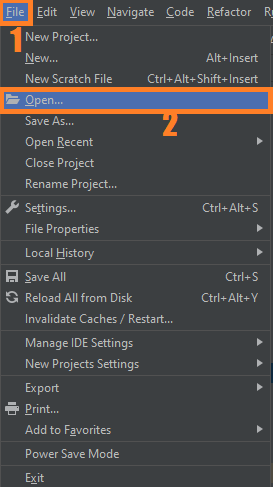
- Step 2: Import the project to your PyCharm IDE.
Next, import the source code you’ve download to your PyCharm IDE.

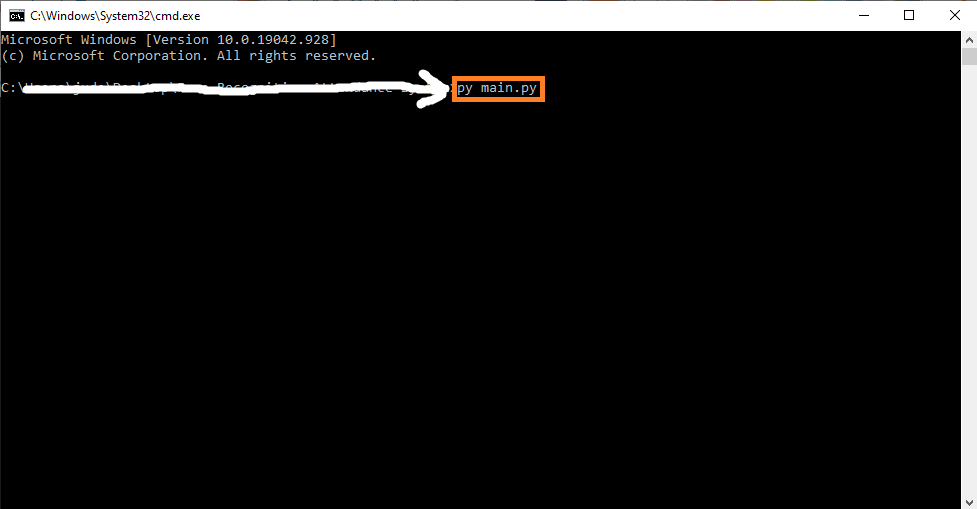
- Step 3: Run the project.
last, run the project with the command “py main.py”


Download Source Code below
Summary
This Simple Project With Source Code contains a grid of black squares on a white background, which can be read by any imaging device such as a camera, and processed to extract the required data from the patterns that are present in the horizontal components of the image.
Related Articles
- Code For Game in Python: Python Game Projects With Source Code
- Best Python Projects With Source Code 2020 FREE DOWNLOAD
- How to Make a Point of Sale In Python With Source Code 2021
- Python Code For Food Ordering System | FREE DOWNLOAD | 2020
- Inventory Management System Project in Python With Source Code
Inquiries
If you have any questions or suggestions about QR Code Generator In Python With Source Code, please feel free to leave a comment below.
Technology stack and requirements
To run this Python project on your development machine, you need:
- Python 3.10 or higher. Download from python.org or install via Anaconda if you prefer bundled packages.
- pip package manager. Comes with Python. Used to install project dependencies from requirements.txt.
- Virtual environment. Use venv or conda to isolate project dependencies from your global Python install.
- VS Code or PyCharm. Free code editors with Python syntax highlighting, IntelliSense, and debugging.
- Git. For version control and cloning source code repositories.
Installing the source code
- Download or clone the repository. Get the ZIP archive from the download link on this page and extract it.
- Create a virtual environment. Open a terminal in the project folder and run: python -m venv venv, then activate it (venv\Scripts\activate on Windows or source venv/bin/activate on Mac/Linux).
- Install dependencies. Run pip install -r requirements.txt to install all libraries the project needs.
- Configure environment variables. If the project uses API keys (OpenAI, Anthropic, database), create a .env file and set the required keys.
- Run the project. Follow the run command in the README (usually python main.py or streamlit run app.py).
Using this project for your BSIT capstone
- Chapter 1 (Introduction). Discuss the real-world problem this system solves. Cite Philippine or international use cases where the manual process could be automated.
- Chapter 2 (RRL). Compare your project against 5-10 similar published works. Cite ACM, IEEE, or arXiv papers for academic-standard sources.
- Chapter 3 (Methodology). Document the model architecture, training data, hyperparameters, and evaluation metrics used.
- Chapter 4 (Results). Report accuracy, precision, recall, F1-score, and confusion matrix. Screenshot the running app on real inputs.
- Chapter 5 (Conclusion). Identify features for Version 2: better model, larger dataset, mobile deployment, or REST API.
Modules typical of QR Code Generator
- Text preprocessing. Tokenization, lowercasing, stop-word removal, lemmatization with NLTK or spaCy.
- Feature extraction. TF-IDF, word embeddings (GloVe), or transformer embeddings (BERT).
- Model training. scikit-learn baseline (Naive Bayes, SVM) or HuggingFace fine-tuned transformer.
- Evaluation. Accuracy, precision, recall, F1 for classification; BLEU/ROUGE for generation.
- Inference API. Flask or FastAPI endpoint for real-time predictions.
- UI or demo. Streamlit dashboard for interactive testing.
Common enhancements for capstone review
- Multilingual support. Extend to Filipino, Cebuano, or other Philippine languages with translation preprocessing.
- Real-time streaming. Add WebSocket support for continuous input classification.
- Explainability. Use LIME or SHAP to visualize why the model made a specific prediction.
- Batch mode. Add CSV upload for bulk classification, useful for research analysis.
Official documentation
Frequently Asked Questions
How does this Python QR code project work?
Uses qrcode library for generation (qrcode.make(data).save(‘out.png’)) and pyzbar for scanning. Common use cases: contact-tracing logs, event ticketing, attendance check-in via QR badges, payment links.
What Python version and libraries does this project require?
Most projects in this batch use Python 3.10, 3.11, or 3.12 (avoid 3.13 until library wheels catch up). Standard libs: tkinter (built-in), sqlite3 (built-in). External: pip install pillow opencv-python pygame mysql-connector-python reportlab requests beautifulsoup4. Check the requirements.txt file (if included) for exact versions.
How do I set up the database for this Python project?
For SQLite (most common, no setup needed): the .db file auto-creates on first run. For MySQL: install MySQL Server + MySQL Workbench, create an empty database, import the included .sql file, edit the connection string in db.py (or db_connect.py) with your host, user, password, database name.
Can I use this Python project for a BSIT capstone or thesis?
Yes. Python is rising fast in Philippine BSIT panels. Extend it: add user roles via auth module, dashboards (matplotlib charts), PDF reports (reportlab), email notifications (smtplib), real domain extension (analytics, audit log, multi-branch support). Pair with Chapter 1-5 documentation matching your panel’s rubric.
Why am I getting ‘ModuleNotFoundError’ or ‘No module named X’?
Three common Python issues: (1) Module not installed: pip install
Where can I find more Python projects with source code?
Browse the Python Projects hub for the full library. For computer vision specifically see OpenCV Projects (46 vision systems). For ML / AI capstones see Machine Learning Projects. For BSIT capstone idea lists see 150 Best Capstone Project Ideas.

Angel Jude Suarez
Full-Stack Developer at PIES IT Solution
Focuses on Python development, machine learning, and AI integration. Has built production AI systems including OpenAI Whisper integration for medical transcription and GPT-4o-powered diagnosis assistance. Strong background in pandas, scikit-learn, and TensorFlow.
Expertise: Python · PHP · Java · VB.NET · ASP.NET · Machine Learning · AI Integration · OpenCV · Django · CodeIgniter
· View all posts by Angel Jude Suarez →