
Getting registered with BIR is the least fun part of going freelance in the Philippines. I put it off for almost 2 years when I started PIES IT Solutions back in 2018, and it cost me a small penalty when I finally caught up. Do not make the same mistake. The whole process takes 1 day of your time and one visit to your local RDO, and it saves you serious problems later when your USD income from US clients starts showing up in bank inflow reports that BIR audits.
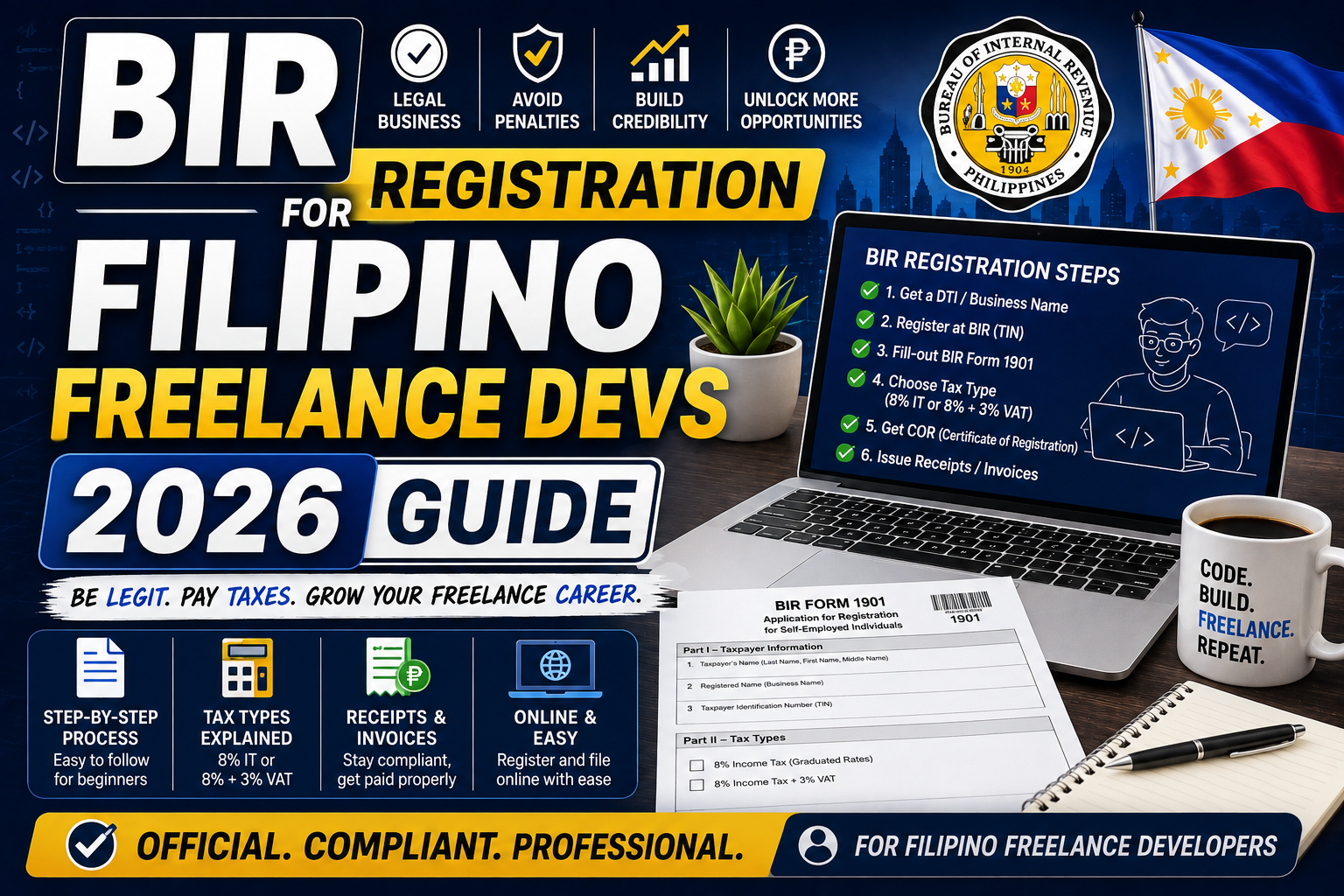
This guide walks through the exact registration flow I use with every freelance dev I mentor. Forms, order of steps, real fees, and how to pick between the 8 percent flat rate and graduated income tax. Written from actual 2025-2026 experience going through the process 3 times (once for me, twice helping team members).
Before you start (prerequisites)
- A valid government ID. Passport, driver license, UMID, or PhilID all work.
- Your birth certificate (PSA copy). Get from PSAHelpline or your local PSA office if you do not have a copy.
- Cash for fees. Total cost is roughly PHP 1,000 (registration fee PHP 500 + documentary stamps PHP 30 + Books of Accounts PHP 200-400 + certificate PHP 100).
- 1 day of free time. BIR RDO visits typically take 3-5 hours from arrival to leaving with your certificate.
- Your business name decided. For solo freelance devs, this is usually just your legal name. If you want a trade name (like PIES IT Solutions), register with DTI first (PHP 200 online, same day).
Step 1: Determine your correct BIR RDO
Every taxpayer belongs to one Revenue District Office (RDO) based on residence. You cannot register at any RDO, only your assigned one.
- Go to bir.gov.ph and use the RDO Finder tool (search “RDO finder” on the site).
- Enter your address. The system returns your assigned RDO number (e.g., RDO 40 – Cubao) and address.
- Google the address to find operating hours (most RDOs are 8 AM to 5 PM weekdays, closed for lunch 12 PM to 1 PM).
- Take note of parking availability. Some RDOs (like RDO 39 – QC South) have very limited parking. Plan to arrive by 8 AM.
If you have an existing TIN from a past employer, your RDO is where that TIN was issued. You may need to file BIR Form 1905 to transfer your RDO to your current residence before registering as self-employed. That transfer takes an extra 1-2 days.
Step 2: Fill out Form 1901 (Application for Registration)
Form 1901 registers you as self-employed. Download it from bir.gov.ph (search “Form 1901”) or grab a physical copy at the RDO.
Key fields:
- Taxpayer type: Individual, Self-Employed (Professional or Single Proprietor)
- Line of business: “Software Development” or “IT Services” or “Computer Programming”
- Registration date: Today’s date
- Estimated gross annual income: Best-guess based on what you expect from US clients (e.g., PHP 500,000 or PHP 1,000,000 or PHP 3,000,000)
- Tax type: Income Tax (mandatory). Check Percentage Tax and VAT only if you specifically opt for the 3 percent or graduated income tax route.
- Availment of 8 percent income tax: Yes if your gross annual income will be under PHP 3 million. Check this box carefully because it locks in your election for the year.
Fill it out completely at home before going to the RDO. Missing fields mean a return trip.
Step 3: At the RDO, submit Form 1901 plus your requirements
Bring these physical copies to the RDO:
- Completed Form 1901 (2 copies)
- Photocopy of your government ID
- Photocopy of your birth certificate (PSA)
- DTI Business Name Certificate (if using a trade name; skip if registering under your legal name)
- Barangay Business Clearance (some RDOs require this; check with yours in advance)
- Mayor’s Permit application receipt (some RDOs require this; check in advance)
- Take a queue number at the “New Registration” window.
- When called, submit your Form 1901 and requirements to the officer.
- Wait for them to verify (usually 15-30 minutes).
- They issue you Form 0605 (Payment Form) with the exact fees due.
The officer will point you to the payment counter next.
Step 4: Pay the registration fee via Form 0605
The BIR registration fee is PHP 500 flat for self-employed individuals. Payment options:
- Cash at the RDO’s Landbank or DBP counter (fastest, on-site). This is what most people do.
- eBIRForms and pay via GCash, Maya, or bank transfer (if RDO allows electronic filing; not all do).
- Authorized Agent Bank (any accredited bank branch nearby).
After paying, keep the official receipt (OR). You will need to show it in Step 5.
Step 5: Purchase Books of Accounts and get them stamped
BIR requires self-employed taxpayers to maintain physical Books of Accounts (columnar books for manual bookkeeping). You will need:
- Journal Book (single entry): PHP 100-150
- Ledger Book: PHP 100-150
- Optional: Cash Receipts Book and Cash Disbursements Book if you handle a lot of cash transactions (most freelance devs skip these because payments are all bank/Payoneer).
You buy these from an office supply store (National Bookstore, Fully Booked, or the vendors right outside most RDO buildings sell them cheaper).
- Bring the unstamped books to the RDO’s “Books of Accounts” or “Registration” counter.
- The officer stamps the first and last pages with the BIR RDO stamp.
- Sign the acknowledgment form.
These stamped books are your legal proof of bookkeeping. Keep them for 10 years (statute of limitations for tax audits).
Step 6: Apply for Authority to Print Invoices via Form 1906
You need official BIR-registered receipts or invoices to bill clients. For freelance devs, “Official Receipts” is the correct type (you provide services, not goods).
- Fill out Form 1906 at the RDO (single page, straightforward).
- Submit at the “Invoice/OR” counter along with your Form 2303 (issued after registration; see Step 7).
- The RDO gives you an Authority to Print (ATP) certificate.
- Take the ATP to any BIR-accredited printer. They will print your first booklet of 50 receipts (cost PHP 500-800).
- Turnaround at the printer is typically 3-5 business days.
Alternative for tech-savvy freelancers: apply for e-invoicing through the BIR Electronic Invoicing System (EIS). This lets you generate BIR-compliant PDF invoices without printed receipts. EIS approval takes 2-4 weeks but saves you the printer cost long-term.
Step 7: Receive Certificate of Registration (Form 2303)
After Steps 3-6 are complete, the RDO issues your Certificate of Registration (BIR Form 2303). This is your legal proof of BIR registration. Frame it (seriously, you are required to display it in your place of business).
What Form 2303 includes:
- Your TIN and RDO code
- Your business name (legal name or DTI trade name)
- Registered address
- Tax types you are subject to (Income Tax, Percentage Tax if applicable, VAT if applicable)
- Your election for 8 percent income tax rate (if you checked that box on Form 1901)
Total time from arriving at RDO to leaving with Form 2303: 3-5 hours for most people. First-time registrants sometimes need to come back the next day if lines are long or if a document is missing.
Which tax route: 8 percent flat vs graduated income tax
The most important choice on Form 1901 is your tax route. Here is the honest comparison:
8 percent flat rate:
- Applies to gross annual income above PHP 250,000 (below that is tax-free)
- Only available if your gross annual income is under PHP 3 million
- Simple: one number times 8 percent equals your tax
- Replaces income tax + percentage tax + VAT with one flat rate
- You cannot deduct business expenses
Graduated income tax (0-35 percent brackets):
- Traditional Philippine income tax brackets
- You can deduct business expenses (Optional Standard Deduction of 40 percent gross, OR itemized deductions)
- Additionally required: 3 percent Percentage Tax (or 12 percent VAT if gross above PHP 3 million)
- More paperwork, more forms per quarter
Which to pick:
- Gross annual income under PHP 3 million AND you have low business expenses (under 20 percent of gross): pick 8 percent flat
- Gross annual income under PHP 3 million AND you have high business expenses (over 40 percent of gross, e.g., office rent + team salaries + tools): pick graduated income tax + OSD
- Gross annual income over PHP 3 million: you are forced into graduated + VAT anyway
For most solo freelance devs earning PHP 500K to PHP 2M gross with minimal deductible expenses, 8 percent flat is the right choice. Confirm with a BIR-registered accountant for your specific situation (consult costs PHP 3,000-5,000 and can save you 5-figure amounts if you pick wrong).
After registration: your quarterly filing schedule
Once registered, you file:
- Form 1701Q (Quarterly Income Tax Return): due 45 days after each quarter ends. So Q1 due May 15, Q2 due August 15, Q3 due November 15.
- Form 1701 (Annual Income Tax Return): due April 15 of the following year.
- Form 2551Q (Quarterly Percentage Tax): if you elected graduated income tax + Percentage Tax route. Due 25 days after each quarter.
- Books of Accounts monthly bookkeeping: record every receipt and disbursement in your stamped books.
All forms can be filed online via eBIRForms or through the BIR’s newer Electronic Filing and Payment System (EFPS). Filing online is faster than showing up at the RDO every quarter.
Common mistakes to avoid
Mistake 1: Not registering because “US client income is not taxable in PH.” False. Philippine tax residents pay PH tax on worldwide income. This is the single most common mistake I see, and it becomes a real problem when BIR cross-checks your bank inflows against declared income (which they do more aggressively since 2023).
Mistake 2: Registering at the wrong RDO. If you register at an RDO other than your legally assigned one, BIR may reject the application or require transfer paperwork. Use the RDO Finder tool first.
Mistake 3: Forgetting to elect 8 percent on Form 1901. If you skip the box, you default to graduated income tax + percentage tax + VAT registration. Changing later requires Form 1905 and takes a full quarter to process.
Mistake 4: Not printing invoices before your first client payment. BIR technically requires you to issue an official receipt for every payment received. You cannot legally receive payment without a valid OR. Get your receipts printed within 2 weeks of registration.
Mistake 5: Losing your Certificate of Registration. Form 2303 is your primary tax document. Frame it, and keep a scanned PDF backup on Google Drive. Reissuing takes 1-2 weeks and a return trip to the RDO.
Bottom line
BIR registration takes 1 day of your time and roughly PHP 1,000 in fees. Compared to the risk of unregistered income being flagged in a BIR audit (which can trigger penalties of 25-50 percent of tax due plus interest), it is one of the highest-value hours you will spend as a freelance dev.
The 8 percent flat rate is the right choice for most solo freelance devs. Elect it on Form 1901 unless you have significant deductible business expenses.
I hope this walkthrough saves you the confusion I went through my first time. Feel free to comment below if you have questions about your specific situation, or reach out via our contact page. Once you are registered, you sleep better and your Payoneer or Wise USD income sits cleanly in your books.
Official documentation
Quick step-by-step summary (click to expand)
- Determine your correct BIR RDO. Use the RDO Finder at bir.gov.ph based on your residence address.
- Fill out Form 1901 (Application for Registration). Fill out at home, elect 8 percent income tax if under PHP 3M annual income.
- Submit Form 1901 at the RDO with your requirements. Bring ID, birth certificate, DTI cert if using trade name.
- Pay the registration fee via Form 0605. PHP 500 flat, cash at Landbank counter on-site.
- Purchase Books of Accounts and get them stamped. Journal + Ledger from any office supply store, then RDO stamps them.
- Apply for Authority to Print Invoices via Form 1906. Submit Form 1906, get ATP certificate, take to accredited printer.
- Receive Certificate of Registration (Form 2303). Your primary tax document. Display in your place of business.
Payment platforms for your registered freelance income (affiliate)
Once registered, you need reliable payment platforms for your USD client income. Links below are referral or affiliate links. See our affiliate disclosure.
- Payoneer (both get USD 25 after first USD 1,000), our top pick for PH freelancers receiving USD
- Wise Multi-Currency, best for USD 3,000+ invoices
- Deel, if a US client wants to hire you as full employee-of-record
Frequently asked questions
Do I really have to register if I only work with US clients?
Yes. Philippine tax residents (which you are if you live in the PH more than 183 days per year) pay Philippine tax on worldwide income. BIR has become much more aggressive since 2023 in cross-checking bank inflows against declared income. Registering costs 1 day and PHP 1,000, and it protects you from penalties that can reach 25-50 percent of tax due plus interest.
How much does BIR registration actually cost?
Roughly PHP 1,000 total for a solo freelance dev: PHP 500 BIR registration fee (Form 0605), PHP 30 documentary stamps, PHP 200-400 Books of Accounts (Journal + Ledger), PHP 100 miscellaneous fees at the RDO. If you also want DTI Business Name Certificate for a trade name, add PHP 200. If you need printed receipts, budget PHP 500-800 for the first booklet.
Can I do BIR registration entirely online?
Not fully in 2026. Some initial steps can be done via eBIRForms and BIR’s ORUS (Online Registration and Update System), but you still need one physical visit to the RDO for verification, Books of Accounts stamping, and Authority to Print. Online systems handle subsequent quarterly filings and payments smoothly.
Should I hire an accountant before registering?
For most solo freelance devs, no. The registration process is straightforward if you follow the 7 steps in this guide. However, a one-time consult with a BIR-registered accountant (PHP 3,000-5,000) is worth it to confirm which tax route (8 percent vs graduated) fits your situation best. After registration, you can DIY the quarterly filings using eBIRForms.
What if I already have a TIN from a past employer?
You use the same TIN, no new number issued. But you must first file BIR Form 1905 to change your taxpayer classification from Employee to Self-Employed and (if needed) transfer your RDO to your current residence. Form 1905 processing takes 1-3 business days. Only after this transfer clears can you proceed with Form 1901.
What happens if I ignore BIR registration entirely?
Short term, nothing visible. Long term, if BIR audits your bank inflows and finds undeclared USD income, penalties are severe: 25 percent surcharge on tax due, 12 percent annual interest, and potentially 50 percent surcharge if fraud is proven. For a freelance dev earning PHP 1M per year with no registration for 3 years, penalties can easily reach PHP 200,000-400,000. Registration costs PHP 1,000 and takes 1 day.

Joken E. Villanueva
Founder & Lead Developer at PIES IT Solution
Founder of PIES Information Technology Solutions, a software company building production-grade applications for institutions across the Philippines. Over 8 years of hands-on full-stack development experience, currently leading the development of ClinicAI, an AI-powered clinic management platform.
Expertise: PHP · MySQL · JavaScript · AI Integration · SaaS Architecture · VB.NET · Database Design · Capstone Documentation · Java · View all posts by Joken E. Villanueva →