
Best Python IDE trends show the landscape shifted more between 2024 and 2026 than in the entire previous decade. AI‑first editors — Cursor, Windsurf, Zed, and Trae — evolved from niche experiments into serious daily drivers. Microsoft also introduced agentic GitHub Copilot inside VS Code.
JetBrains rebuilt PyCharm’s AI assistant on a frontier model backend. The result: the “best Python IDE” question now has a very different answer than it did 18 months ago.
This guide compares the 10 editors and IDEs that matter for Python in 2026 — from heavyweight PyCharm down to the lightest beginner pick. We tested each one on the same five tasks (writing a Flask API, refactoring a legacy script, debugging a NumPy notebook, generating tests, and shipping a small Django project) and ranked them honestly by use case, not by popularity.
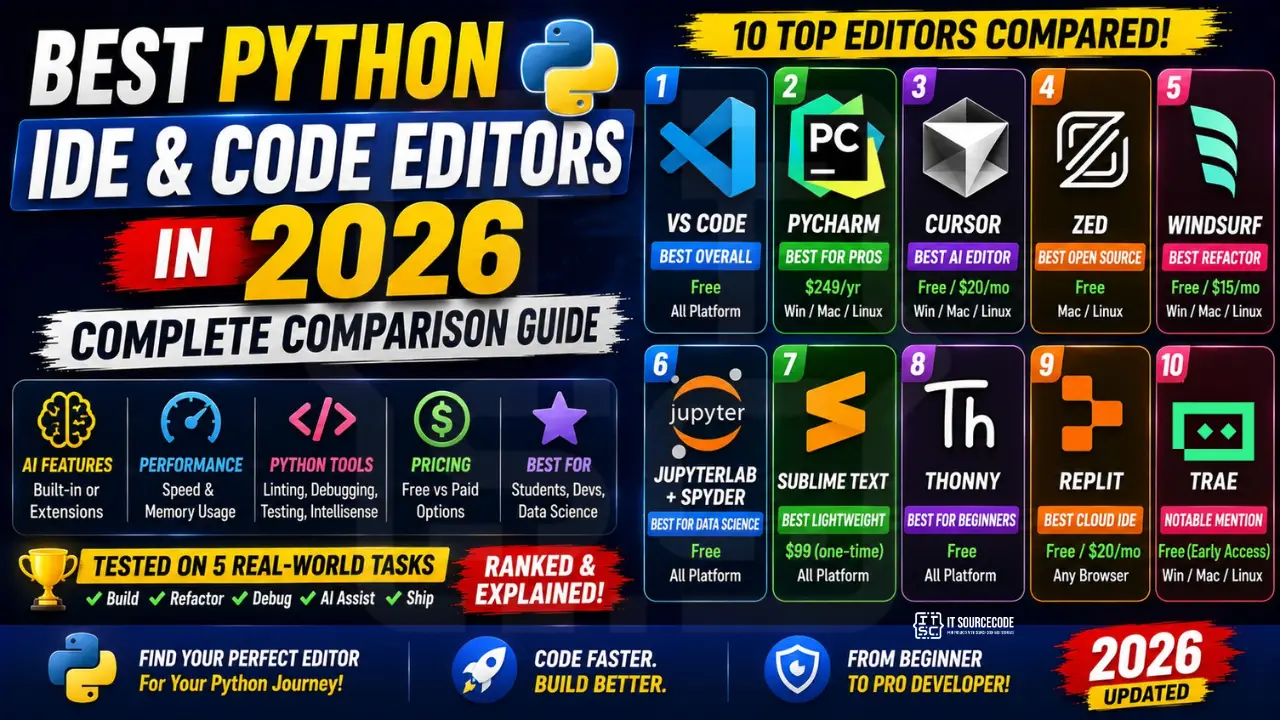
📌 Quick answer: The best all-around Python editor in 2026 is VS Code with the Python + Pylance extensions — it’s free, runs on every OS, and now includes solid agentic AI via Copilot. For professional Django/Flask work, PyCharm Professional remains the gold standard. For developers who want AI baked into every keystroke, Cursor is the strongest pick — it’s a VS Code fork with a much deeper AI integration than the extension model can offer.
How We Tested
We avoided the usual “list of features copy-pasted from each product page” approach. Every editor in this guide was installed on a clean profile and used to complete the same five Python tasks:
- New project bootstrap — create a Flask app with a single endpoint, install dependencies into a virtualenv, run it. Measured time-to-first-request.
- Refactor — open a 600-line monolithic script and split it into modules. Measured how well rename-symbol, move-symbol, and import-fix worked.
- Debug — set a breakpoint inside a NumPy data-processing function and inspect a 10,000-row DataFrame. Measured debugger responsiveness.
- AI assist — generate pytest tests for an existing module without copying code into a separate chat window. Measured how well the AI saw the surrounding code.
- Ship — run linting (Ruff), type-check (Pyright), format (Black), and commit. Measured how much friction the editor added between “done writing” and “pushed to git”.
Scoring criteria, weighted: AI quality (25%), debugging (20%), refactoring (15%), performance/RAM (15%), beginner-friendliness (15%), price/licensing (10%). Hardware: M2 MacBook Air (8GB) and a Ryzen 5 7530U / 16GB Windows laptop — the same class of machine most BSIT students actually own. No 64GB workstations — that would not reflect real-world results for our audience.
Top 10 Python IDEs & Editors in 2026
#1 — VS Code — Best Overall
Price: Free • Platforms: Windows / macOS / Linux • RAM idle: ~350 MB • AI: GitHub Copilot (paid, $10/mo student-free)
Why it wins: The Python + Pylance combo is now mature enough that PyCharm’s lead has shrunk to a few specific Django features. Pylance gives you fast type inference, inline error highlights, and good rename-symbol.
Copilot’s 2026 agentic mode can take multi-file tasks — “add CSRF protection to all my Flask routes” — and actually do them. The extension marketplace covers every Python tool you’ll ever need: Jupyter, Ruff, Black, Mypy, Pyright, Docker, Remote-SSH for remote dev boxes.
Best for: 80% of Python developers. Especially anyone who also writes JavaScript, Go, or Rust — one editor for everything.
Watch out: Extensions add memory fast. A loaded VS Code profile with Pylance + Jupyter + Copilot can easily hit 1.5 GB. On 8 GB machines, close unused workspaces.
#2 — PyCharm Professional — Best for Professional Python Devs
Price: Professional $249/yr (free for students with .edu email) • Community Edition free • Platforms: Win / macOS / Linux • RAM idle: ~900 MB • AI: JetBrains AI Assistant ($10/mo bundled)
Why we recommend: PyCharm is still better than VS Code for serious Django and Flask work. The Django console understands your models out of the box. The database tool window is genuinely best-in-class — you can query MySQL / PostgreSQL directly in your IDE without leaving the project.
Refactoring is more accurate than Pylance, especially across packages. The 2026 AI Assistant is finally usable (it was rough in 2024).
Best for: Backend Django/Flask engineers, anyone managing a multi-package monorepo, students who want one IDE that won’t surprise them in 4 years.
Watch out: Heavy. On an 8 GB machine, PyCharm + Chrome will swap. Community Edition is free but cuts the Django, JS, and DB tools — exactly the features you’d switch from VS Code for. If you can’t get the student license, Professional is hard to justify over VS Code.
#3 — Cursor — Best AI-First Editor (NEW for 2026)
Price: Free tier (limited) • Pro $20/mo • Platforms: Win / macOS / Linux • RAM idle: ~450 MB • AI: Built-in (Claude, GPT, custom models)
Why we recommend: Cursor is a VS Code fork that put AI at the center of the editor instead of bolting it on. Tab-completion sees your whole repo, not just the current file. Cmd+K rewrites selections inline. The Composer mode handles multi-file edits — “add a User model, a migration, a serializer, and tests for it” — in one shot. For Python specifically, Cursor’s understanding of import graphs is noticeably better than Copilot in VS Code.
Best for: Developers who already rely on AI heavily, fast prototypers, anyone shipping side projects. Also strong for students learning — Cursor can explain unfamiliar code right where you’re reading it.
Watch out: $20/mo adds up. The free tier is genuinely limited (a few hundred requests/month). If you’re disciplined about using AI sparingly, VS Code + Copilot Student (free) is the cheaper path. Cursor’s debugging UX is identical to VS Code’s — you’re not paying for that part.
#4 — Zed — Best Open Source AI Editor (NEW for 2026)
Price: Free, open source • Platforms: macOS / Linux (Windows in preview) • RAM idle: ~180 MB • AI: Bring-your-own-key (Claude, GPT, Ollama)
Why we recommend: Zed is written in Rust and it shows — it’s the fastest editor in this guide by a wide margin. Cold start under a second. No lag on large Python files. The AI integration uses your own API keys (Anthropic, OpenAI, or a local Ollama model) so you pay per use, not per month. The 2026 release added Python language server support via Pyright and Ruff out of the box.
Best for: Developers on older laptops who need speed, privacy-conscious devs (you control where prompts go), Linux users tired of Electron memory bloat.
Watch out: Smaller plugin ecosystem than VS Code. Some integrations (notebooks, full debugger) are less mature. The bring-your-own-key model means you have to manage costs and rate limits yourself.
#5 — Windsurf — Best for Multi-File Refactoring (NEW for 2026)
Price: Free tier • Pro $15/mo • Platforms: Win / macOS / Linux • RAM idle: ~500 MB • AI: Built-in Cascade agent

Why we recommend: Windsurf (from Codeium) is the other major AI-first editor competing with Cursor. Its standout feature is “Cascade” — an agent mode that traces dependencies across your whole Python project before making changes. We asked it to rename a function used in 23 files; it found all 23, including string references in templates, and got it right on the first pass. The free tier is more generous than Cursor’s.
Best for: Large refactors, anyone maintaining legacy Python codebases, teams who want a generous free tier.
Watch out: The non-agent (manual completion) UX is a bit behind Cursor. If you mostly want fast tab-complete, Cursor or VS Code feel snappier.
#6 — JupyterLab + Spyder — Best for Data Science
Price: Free, open source • Platforms: Web (JupyterLab) / Desktop (Spyder) • RAM idle: JupyterLab ~200 MB, Spyder ~400 MB • AI: Jupyter AI extension (optional)
Why we recommend: If your day is 80% pandas, NumPy, scikit-learn, or PyTorch, you do not want a code-first editor — you want a notebook-first one. JupyterLab is the modern Jupyter interface; Spyder is closer to MATLAB and has a built-in variable explorer that’s genuinely useful for inspecting big DataFrames. VS Code’s Jupyter support is good, but for full notebook workflows the dedicated tools still win.
Best for: Data science students, capstone projects using ML, anyone doing exploratory analysis on tabular data.
Watch out: Not great for production code. Notebooks encourage messy state. Use them to prototype, then move the code into proper modules edited in VS Code or PyCharm.
#7 — Sublime Text — Best Lightweight Editor
Price: $99 one-time (free unlimited evaluation) • Platforms: Win / macOS / Linux • RAM idle: ~80 MB • AI: Third-party plugins only
Why we recommend: Sublime is still the snappiest “real” editor — opens instantly, never lags on huge files. With LSP-pyright installed it has solid Python autocomplete and error highlighting. For quick edits or working on machines where VS Code is too heavy, nothing else feels this fast.
Best for: Single-file edits, low-RAM machines, devs who want to escape Electron, anyone editing config files and small scripts all day.
Watch out: AI story is weak in 2026 — there’s no first-class Copilot equivalent. Debugging is via the command line. If your work involves large multi-file projects, you’ll outgrow it.
#8 — Thonny — Best for Absolute Beginners
Price: Free, open source • Platforms: Win / macOS / Linux • RAM idle: ~120 MB • AI: None (intentional)

Why we recommend: Thonny was built for teaching Python. It ships with Python included, so a brand-new student doesn’t need to install Python separately or fight PATH variables. The step-by-step debugger visualizes each function call and variable change — perfect for understanding how loops, recursion, and dictionaries actually work. Used in CS courses across many universities for a reason.
Best for: First-week Python learners, high school and freshman BSIT students, teachers running classroom labs.
Watch out: You will outgrow it within a semester. The moment you’re building anything multi-file, switch to VS Code.
#9 — Replit — Best Cloud-Based IDE
Price: Free tier • Core $20/mo • Platforms: Browser (any OS, including tablets) • RAM idle: N/A (cloud) • AI: Replit Agent (paid)

Why we recommend: Replit removes the entire local install problem. Open a browser, write Python, run it, share a URL — no setup. Useful in computer labs where you can’t install software, on Chromebooks, or for sharing a snippet with a classmate. Replit Agent (their AI feature) can scaffold whole projects from a prompt.
Best for: Students on Chromebooks, classroom demos, quick code-sharing, collaborative pair programming.
Watch out: Free tier projects can sleep and be slow to wake. Heavy ML workloads need the paid tier. Internet-dependent — useless offline.
#10 — Trae — Notable Mention (NEW for 2026)
Price: Free (currently) • Platforms: Win / macOS / Linux • RAM idle: ~450 MB • AI: Built-in

Why we mention it: Trae is ByteDance’s entry into the AI-editor space — another VS Code fork, but with strong support for “Builder mode” agentic tasks and unusually polished UI/UX. As of mid-2026 it’s free while in early-access, which makes it the cheapest way to try a Cursor-style workflow.
Best for: Curious devs who want to try an AI-first editor without paying for Cursor, students on tight budgets.
Watch out: Newer and less battle-tested than Cursor or Windsurf. Pricing model will change once it leaves early access. Don’t rely on it for production work yet — but worth a free trial.
Quick Comparison Table
| Editor | Price | AI Built-in? | RAM (idle) | Beginner-friendly? |
|---|---|---|---|---|
| VS Code | Free | Via Copilot ($10/mo, free for students) | ~350 MB | Yes |
| PyCharm Pro | $249/yr (free students) | Yes (AI Assistant) | ~900 MB | Mostly |
| Cursor | Free / $20 Pro | Yes (deeply) | ~450 MB | Yes |
| Zed | Free, open source | BYO API key | ~180 MB | Mostly |
| Windsurf | Free / $15 Pro | Yes (Cascade agent) | ~500 MB | Yes |
| JupyterLab | Free | Optional extension | ~200 MB | Yes (for notebooks) |
| Sublime Text | $99 one-time | No | ~80 MB | No |
| Thonny | Free | No | ~120 MB | Yes (designed for it) |
| Replit | Free / $20 Core | Yes (Agent) | Cloud | Yes |
| Trae | Free (early access) | Yes (Builder) | ~450 MB | Yes |
Which Python IDE Should I Use? (Use-Case Matrix)
| If you are… | Use this |
|---|---|
| A first-week Python student | Thonny, then VS Code after 2-4 weeks |
| A BSIT student doing capstone (Flask/Django) | VS Code or PyCharm Community (free student Pro if you can) |
| A professional backend Python engineer | PyCharm Professional or VS Code + Copilot |
| A data scientist / ML researcher | JupyterLab + VS Code for production code |
| Someone who lives in AI-assisted coding | Cursor or Windsurf |
| Working on an older laptop (4-8 GB RAM) | Zed, Sublime Text, or Thonny |
| On a Chromebook or shared lab machine | Replit |
| Privacy-conscious or working on a corporate codebase | Zed (BYO key, can use local Ollama) |
| Refactoring a large legacy Python project | Windsurf or PyCharm |
| Curious and want to test an AI editor for free | Trae or Windsurf free tier |
Setup Tips Worth 20 Minutes Now
Whichever editor you pick, four small habits make your Python life noticeably better:
1. Always use a virtual environment. Inside your project folder, run python -m venv .venv then activate it (.venv\Scripts\activate on Windows, source .venv/bin/activate on macOS/Linux). VS Code, PyCharm, Cursor, and Windsurf all detect .venv automatically and use it for running, debugging, and AI context.
2. Install Ruff as your linter and formatter. Ruff replaces Black, isort, and Flake8 in one fast Rust binary. pip install ruff, then add the Ruff extension. Auto-format on save eliminates 80% of style arguments.
3. Turn on type-checking (Pyright/Pylance). Catches half your bugs before you run the code. In VS Code, set "python.analysis.typeCheckingMode": "basic" in settings.json — that’s the sweet spot between strict and lenient.
4. Sync settings. VS Code, Cursor, and PyCharm all support cloud settings sync. Turn it on now — when your laptop dies (and it will), restoring your setup takes 2 minutes instead of 2 hours.
# Minimum recommended VS Code settings for Python (settings.json)
{
  "python.analysis.typeCheckingMode": "basic",
  "python.analysis.autoImportCompletions": true,
  "editor.formatOnSave": true,
  "editor.defaultFormatter": "charliermarsh.ruff",
  "[python]": {
    "editor.codeActionsOnSave": {
      "source.organizeImports": "explicit",
      "source.fixAll": "explicit"
    }
  }
}
Frequently Asked Questions
What is the best Python IDE in 2026?
Is PyCharm still worth it over VS Code in 2026?
Should I use Cursor or VS Code for Python?
Is Cursor free for Python development?
What is the best free Python IDE for beginners?
How much RAM do I need to run VS Code or PyCharm for Python?
Which Python editor uses the least memory?
Is Jupyter an IDE?
Can I use AI coding tools on a free Python editor?
What’s the difference between PyCharm Community and Professional?
Final Recommendation
The Python IDE question in 2026 is no longer “VS Code or PyCharm.” It’s “VS Code or PyCharm, and how much AI?” Pick from this three-tier framework:
- If you want one editor that does everything well: install VS Code, add the Python + Pylance + Ruff extensions, and turn on Copilot (free for students). This covers 80% of Python work.
- If you live inside Django or Flask at a company: use PyCharm Professional. The database tool window and refactor accuracy pay for themselves.
- If AI is at the center of how you code: try Cursor or Windsurf. The whole-repo context and agent modes are real, not marketing.
🏆 Our 2026 pick for BSIT students: VS Code as your daily driver + JupyterLab for any data/ML capstone work + Thonny if you’re still in your first month. Everything is free. Total install time: under 30 minutes.
- Pick one editor from the use-case matrix and install it today — don’t try three at once
- Run through the four setup tips (virtualenv, Ruff, type-checking, settings sync)
- Need a project to test it on? Browse our best Python projects with source code
- Need a laptop that runs all this smoothly? See our 2026 laptop guide for programming students
- New to Python? Start with our free Python tutorial
- Hitting errors as you learn? Our Python KeyError guide covers the most common one
Using a Python editor we didn’t cover, or have a strong opinion about Cursor vs Windsurf vs Zed? Drop it in the comments — we update this guide quarterly based on what readers are actually using.

Mary Grace G. Patulada
Programmer & Technical Writer at PIES IT Solution
Mary Grace G. Patulada (pen name ‘Nym’) is a programmer and writer at PIES IT Solution with a BSIT background from Carlos Hilado Memorial State College, Binalbagan Campus. Authored 370+ UML diagram tutorials and capstone documentation guides at itsourcecode.com. Specializes in UML (class, use case, activity, sequence, component, deployment), DFD, and ER diagrams for BSIT capstone projects.
Expertise: UML Diagrams · DFD · ER Diagrams · Use Case Diagrams · Activity Diagrams · Capstone Documentation · PHP · View all posts by Mary Grace G. Patulada →
I want to know the offline ones
Good post