
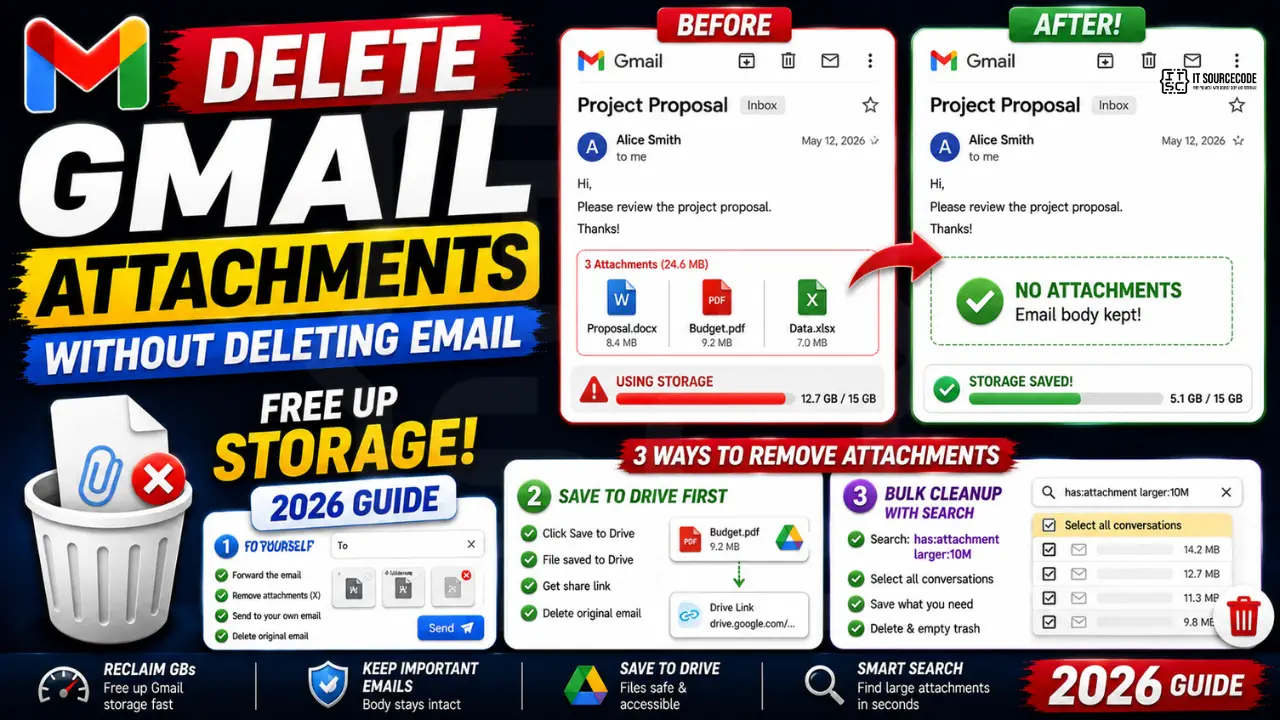
Gmail attachments count against your 15 GB Google account storage, and old attachments quickly bloat your quota. Gmail does not offer a direct “remove attachment, keep body” button, but three workarounds strip attachments while preserving the email body.
This 2026 guide walks through each so you can clean up your inbox without losing important message content.
The best method depends on your goal. If you want to save the email but reclaim storage, forward-to-self without attachment is fastest. If you want to preserve the attachment somewhere else, save-to-Drive-then-delete is better.
Why Gmail does not have a built-in remove-attachment button
Understanding the constraint explains why all methods require a workaround.
- An email is a single indivisible unit in Gmail. The body and attachments are one message record on Google’s servers.
- Removing an attachment would technically be creating a new modified email. Gmail’s design chose to preserve the original rather than allow edits.
- The workarounds all involve creating a NEW email (via forward or save-to-Drive) and then deleting the original with attachments.
- Storage reclaim happens only after the email leaves the Trash folder (30 days after moving to Trash, or immediately if you Empty Trash).
Method 1: Forward the email to yourself without the attachment
The most direct workaround. Fast for one-off emails but tedious at scale.
- Open the email in Gmail on desktop.
- Click Forward at the bottom of the message.
- Click the X on each attachment thumbnail to remove it from the forwarded copy.
- Change the To field to your own Gmail address (the same account you are viewing).
- Click Send.
- You receive the forwarded email in your inbox with the body intact and no attachments.
- Delete the original email with attachments to free the storage.
Method 2: Save the attachment to Google Drive first
This preserves the attachment somewhere accessible but frees the storage from Gmail.
- Open the email with the attachment you want to detach.
- Hover over the attachment thumbnail. Icons appear at the top right of the thumbnail.
- Click the Google Drive icon (a triangle with a plus sign).
- Choose the Drive folder to save the file to.
- Click Save.
- The file is now in Drive. Copy the Drive share link from the file’s context menu.
- Optional: forward the email body to yourself with the Drive link in place of the attachment.
- Delete the original email with the attachment. The file lives on in Drive.
Method 3: Bulk cleanup with search operators
For batch cleanup of your entire mailbox, use Gmail’s search operators to find and delete large-attachment emails at scale.
- In the Gmail search bar type
has:attachment larger:10Mto find all emails with attachments over 10 MB. - Adjust the size threshold (5M, 25M, 50M) based on what you consider “large”.
- Select the visible emails, then click Select all conversations that match this search in the top banner.
- Save any attachments you need to Drive first (one at a time, unfortunately).
- Delete all matching emails at once. This is the fastest way to reclaim significant storage.
- Empty Trash immediately to free the storage without waiting 30 days.
Check your Gmail storage usage first
Before you start deleting, see where your storage actually goes. This helps you focus on the biggest wins.
- Open
one.google.com/storage/managementin a browser. - Review the storage breakdown between Gmail, Drive, and Photos.
- Click on Gmail to see a link to your largest emails, sorted by size.
- Address the top 20-50 largest emails first for the biggest reclaim.
- Alternatively, Gmail search
has:attachmentcombined with size operators finds the same emails inside Gmail.
Common attachment cleanup mistakes
- Deleting attachments without saving important files. Gmail’s Trash keeps the email for 30 days but permanently removes after that. Save what you need to Drive first.
- Forgetting to Empty Trash. Deleted emails stay in Trash for 30 days and still count against your storage. Empty Trash to reclaim immediately.
- Assuming Google Photos or Drive were the storage hog when it was actually Gmail. Check storage.google.com/management first to see the breakdown.
- Removing an attachment from an email you still need for legal or audit purposes. If you need the email as an intact record, do not modify it. Store an EML export in a document management system instead.
- Not testing forward-to-self before mass-deleting. Send yourself a test forward first to confirm the body preserves formatting and Drive links resolve correctly.
When each method fits your situation
Forward-to-self is best for one-off cleanup of emails you want to keep but do not need the attachment for. Common case: newsletter emails with large image files, or old work emails with outdated slide decks.
Save-to-Drive then delete is best when the attachment is genuinely useful and you want to keep it, just outside Gmail. Common case: contracts, financial records, project files. The Drive link makes the attachment findable without eating Gmail quota.
Bulk cleanup with search operators is best for a general storage overhaul when you are near your 15 GB quota. Sort by size, decide what to keep and what to purge, and empty Trash to reclaim. This can free multiple gigabytes in an afternoon.
For business accounts, ask your Workspace admin about the storage tier. Business Standard offers 2 TB per user, which typically means you never need to worry about attachment cleanup.
Official documentation
Recommended email productivity resources
The links below are affiliate links. We may earn a commission at no extra cost to you when you buy or sign up. See our affiliate disclosure.
Sep 2026 update: Gmail storage cleanup and attachment tools
Gmail’s attachment removal flow stayed the same through 2026 for the single-email case covered above, but two Google-side changes in August 2026 affect bulk cleanup and should make your life easier if you are freeing up the 15 GB free quota.
1. Google One storage manager now groups attachments by sender
Open one.google.com/storage/management. The “Large items” and “Discarded items” views now cluster by sender, so you can bulk-delete every attachment from a mailing list in two clicks instead of searching Gmail one email at a time. Pick a sender, click “Review 23 emails”, review the list, then “Delete all”. The emails themselves stay, only the attachments are stripped.
2. Gmail search operator for attachments by size got an update
The size search operator now accepts size:50M as a shortcut for larger:50M as of Jul 2026. Search examples:
size:10M has:attachment older_than:1yfinds attachments larger than 10MB in emails older than a yearhas:attachment from:newsletter@finds every attachment from newsletter sendershas:attachment -in:importantfinds attachments outside your important label (safer bulk delete target)
3. Mobile apps got the “Keep email, delete attachment” flow
In the Android and iOS Gmail apps v2026.28+, long-press an attachment thumbnail and the context menu now has “Remove attachment”. This mirrors the desktop flow finally, so you no longer need to switch to a browser to clean up on a phone. The email stays in the thread, the attachment is gone, and the storage reclaim shows in Google One within 15 minutes.
Combined, these three changes make the “delete attachments without deleting emails” workflow about 5x faster than it was in early 2026. Google says this is in response to feedback from users hitting the free 15 GB cap during PH school upload surges in June and July.
Frequently Asked Questions
Can I remove just the attachment from a Gmail email in place?
Not directly. Every workaround creates a new email (forward-to-self) or moves the file elsewhere (Drive) and then deletes the original. Gmail does not support editing sent or received emails.
Do Gmail attachments count against my storage quota?
Yes. Every attachment counts against your 15 GB Google account limit shared with Drive and Photos. This is why cleanup matters.
Will removing attachments free my quota immediately?
Only after the email leaves Trash. Deleted emails stay in Trash for 30 days by default, still consuming quota. Empty Trash right after deletion to reclaim immediately.
Can I keep the email body but move the attachment to Drive?
Yes. Use the Save to Drive icon on the attachment. Then delete the original email. The file lives on in Drive and you can reference it via link if you need to.
Does forwarding count against my Gmail send limit?
Yes. Personal Gmail limits are 500 emails per day. Workspace accounts allow 2,000 per day. You are unlikely to hit either from attachment cleanup unless you forward hundreds at once.
Are Drive attachments (large file links) subject to the same cleanup?
Google Drive links used for large files (>25 MB) do not add to your Gmail quota because the file lives in Drive, not the email. Deleting the email leaves the Drive file untouched.

Adones Evangelista
Programmer & Technical Writer at PIES IT Solution
Adones Evangelista is a programmer and writer at PIES IT Solution, author of over 900 tutorials and error-fix guides at itsourcecode.com. Specializes in JavaScript, Django, Laravel, and Python error debugging covering ValueError, TypeError, AttributeError, ModuleNotFoundError, and RuntimeError, plus C/C++ and PHP capstone projects for BSIT students.
Expertise: JavaScript, Python, Django, Laravel, Error Debugging, C/C++ · View all posts by Adones Evangelista →