

The Online Movie Ticket Booking System Use Case Diagram is one of the methods used to show the processes involved in online movie ticket booking system. It depicts the system’s supposed structure and behavior.
Additionally, the diagram consists of processes (use cases) and users or “actors”. It uses defined symbols to describe the overall flow of the system.
For more information and learning opportunities, see our Recommended and Related Articles.
- Use Case Diagram for Online Ticket Reservation System
- DFD Diagram for Online Movie Ticket Booking System
- ER Diagram for Online Movie Ticket Booking System
- Movie Ticketing System Database Design
Project Overview
| Name: | Online Movie Ticket Booking System Use Case Diagram in UML |
| Users: | Movie Ticketing Booth or Company and Customers. |
| Tools Used: | Any Diagram tools that provide use case diagram symbols. |
| Designer: | ITSourceCode.com |
What is a Use Case Diagram?
The use case diagram shows the supposed behavior of the movie ticket booking. It includes the project functions using use cases, actors, and their connections.
Moreover, the diagram assists you to define and organize project needs. This also provides a clear picture of the user and system relationships. Therefore, this diagram depicts the complex functions of a system including how the user reacts to it.
Free tool
Generate this Use Case Diagram in 3 minutes
You have the structure. Now build it with your own entities. The Booking / Reservation template comes pre-filled, so you rename what does not match your project and export straight into your Chapter 3.
Open the Booking / Reservation template →3 free diagrams every week. No credit card needed.
Importance of UML Use Case Diagram
Helping the developers and businesses with system management is one of the importance of the UML use case diagram. It includes the procedures from the viewpoint of users.
Furthermore, the diagram serves as the system analysis to identify, clarify, and organize the project needs. This diagram works best with other UML Diagrams for Online Movie Ticket Booking System. Other UML diagrams include activity, class, sequence, deployment, and component diagrams.
Online Movie Ticket Booking System Use Case Diagram
The use case diagram example for online movie ticket booking system has two main illustrations. These illustrations describe the system’s general and specific processes using include and extend.
Online Movie Ticket Booking System General Use Case Diagram
The general use case diagram shows the main functions of the system. It is based on the transactions done during online movie ticketing management.
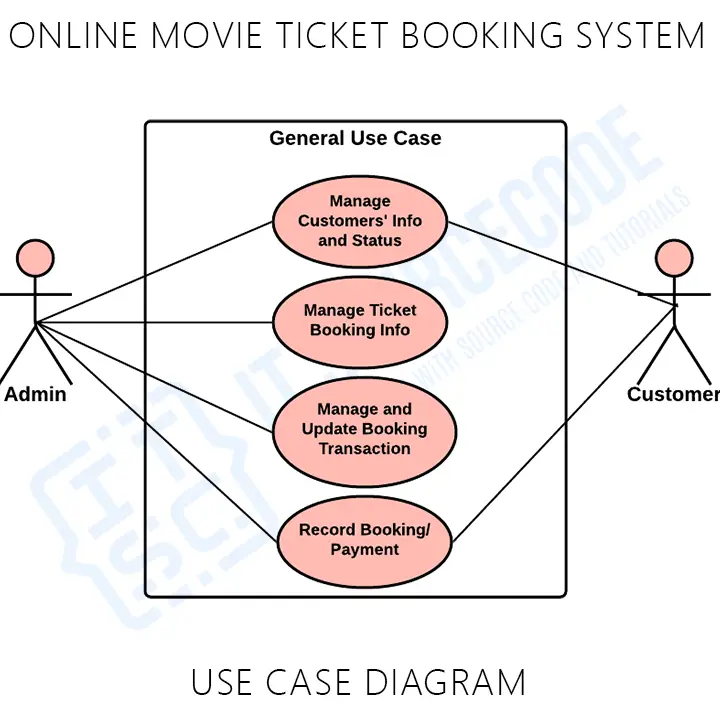
The general use case is the most common application of a use case diagram. The use case diagrams depict the system’s main components as well as the flow of information between them.
Use Case Diagram for Online Movie Ticket Booking System using Include and Extend
The use case diagram using include and extend is used to elaborate the proceeding diagrams. The terms include and extend in the use case diagram are known as indicators.
The label include indicates that the sub-processes of the main processes must be included to complete the task. Extend, on the other hand, declares that the sub-processes can only be performed when needed.
Manage Customers’ Information and Status Use Case Diagram
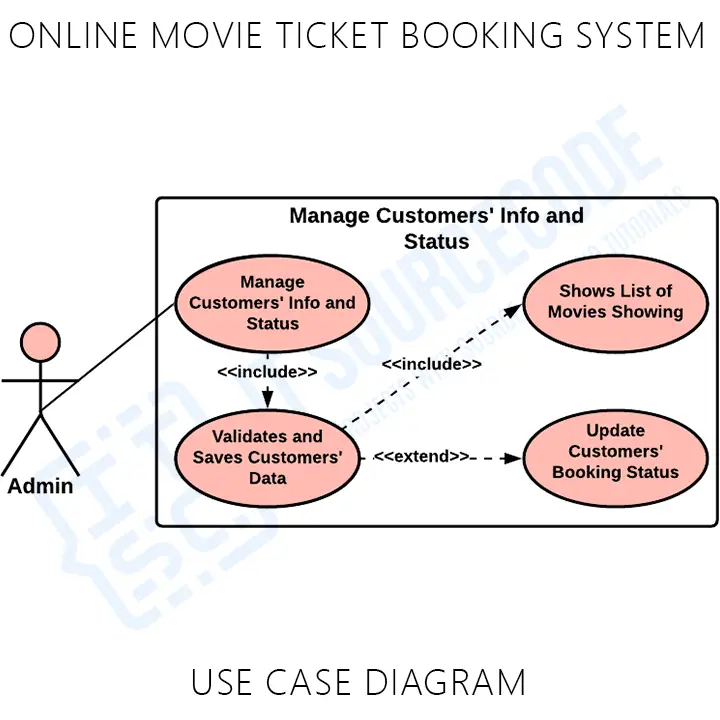
This illustration shows the process when the admin monitors the customers’ information and status. In this process, they were able to know the basic info of their customer as well as their reservation information.
Manage Movie Ticket Information Use Case Diagram
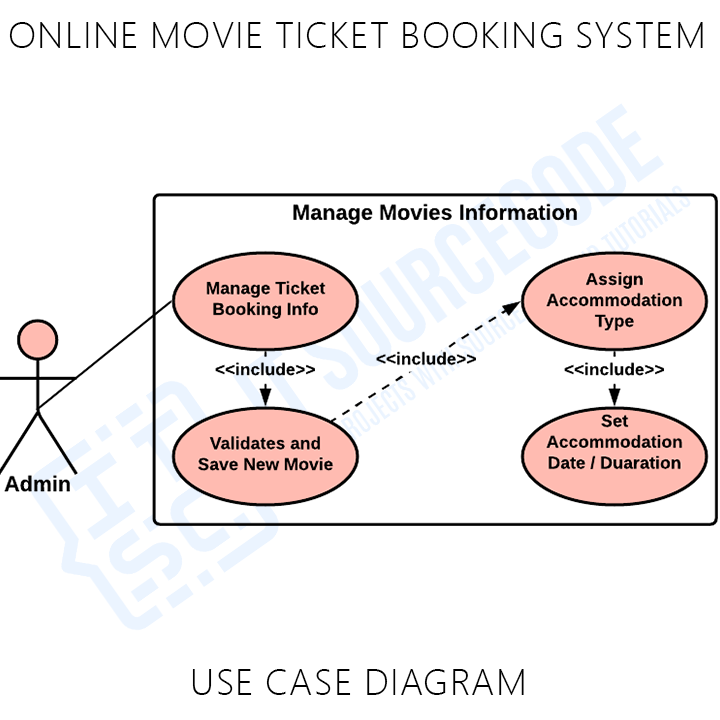
The processes shown include the list of reservations offered by the establishment. It monitors the individuals who have access to the reservations offered and promos. The admin can also update the reservations depending on the available accommodation and schedules.
Manage Ticket Booking Transaction Use Case Diagram
The illustrations show how the admin handles every transaction or reservation made by the customers. This helps the management avoid conflicts among schedules and reservations. It includes validating customers’ reservations, updating the information, and recording it.
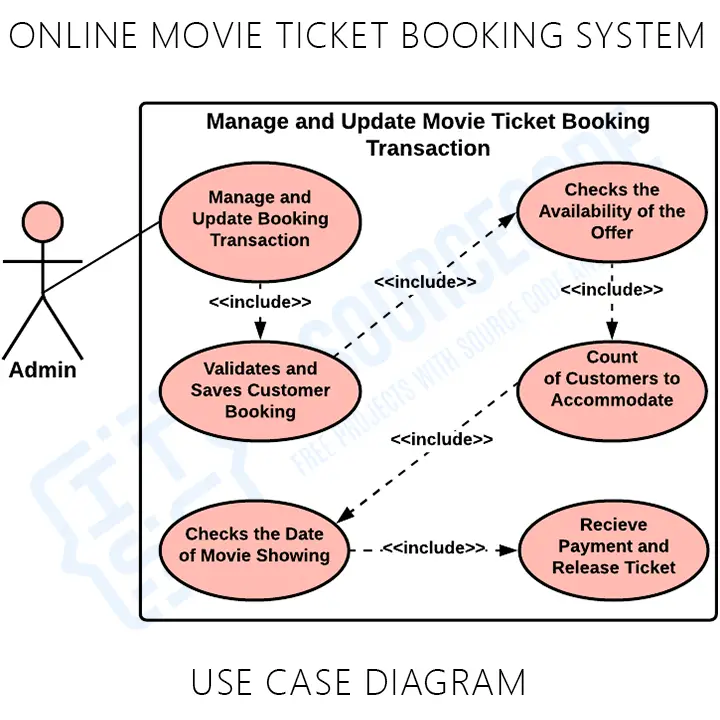
You can add more to this illustration and it is up to you how will you create your diagram. But make sure to have precise information and consider the included use cases.
Use Case Diagram for Online Movie Ticket Booking System Pdf
How to draw a Use Case Diagram?
Time needed: 5 minutes
Here’s the complete guide on how to draw a use case diagram for online movie ticket booking system.
- Step 1: Familiarize Use Case Diagram Symbols
For beginners, you need to familiarize first with use case symbols to be used.
- Step 2: Determine the system processes
The next step is to determine the system’s processes. They will be the use cases of your project.
You may ask the users about the typical activities done in ticket booking management.
- Step 3: Analyze the use cases included
The gathered information from the users needs to be evaluated to know the general use cases.
From the general use cases, you will see the sub-cases that are included. But, only include the useful processes related to the online movie ticket booking system.
- Step 4: Plot the Use Case Diagram
To plot the diagram you will need the users, use cases, container (scope), and their indicators (association). You will base the flow of use cases on the evaluated information from the users.
Your first move is to place the users involved.
Next, put the container in the plotted diagram to separate the objects (users and system) scope.
Then place the use cases of the online movie ticket booking.
Finally, you need to map out the association of the use cases to show the interactions between the user/s and the system.
Conclusion
The UML use case diagram represents the methodology used in system development. It helps developers know the possible inputs that the project should process and perform.
Furthermore, you will discover the needed processes and connect them to the other UML Diagrams. The diagram is also applicable in modeling the software’s use cases (processes). It captures the system’s flow from one process to the next.
Inquiries
If you have concerns about the Online Movie Ticket Booking System Use Case Diagram, just leave us your comments below.
How to read a use case diagram
A use case diagram has 3 main elements: actors (stick figures outside the system), use cases (ovals inside the system boundary), and relationships between them.
- Actor. A role played by a human or external system that interacts with the system.
- Use case. A specific goal the actor accomplishes with the system.
- System boundary. The rectangle around the use cases marks what is inside vs outside.
- Association. Line between an actor and a use case they perform.
Use case relationships
- Include. Dashed arrow with “<<include>>” — one use case ALWAYS calls another (e.g., Login is included in Place Order).
- Extend. Dashed arrow with “<<extend>>” — an optional add-on to a base use case (e.g., Apply Discount extends Place Order).
- Generalization. Solid arrow with hollow triangle — one actor or use case is a specialized form of another.
Common capstone mistakes to avoid
- Too granular. Do not create a use case for each button. Focus on business goals like “Manage Inventory.”
- Missing actors. Every use case must be associated with at least one actor.
- Confusing include vs extend. Include is mandatory; Extend is optional.
- System actors as human. External payment gateways, email servers, etc. are actors too.
- No system boundary. Missing rectangle is a common panel critique.
Where the use case diagram fits in Chapter 3
- Section 3.1 (System Overview) or 3.2 (Functional Requirements).
- List each use case with a brief description in a table alongside the diagram.
- Reference each use case when explaining the workflow in later sections.
Official documentation
Working source code for this system
Download the actual implementation of this system in your preferred language. Each project includes source code, database, and setup instructions for BSIT capstone use.
Frequently asked questions
What is a use case diagram used for in BSIT capstone?
A use case diagram shows what the system does from the user’s perspective: actors, use cases, and their relationships (include, extend, generalization). It goes in Chapter 3 and communicates the functional requirements of the system.
What tool should I use to draw the use case diagram?
Free options: draw.io (browser-based, saves to Google Drive), Lucidchart free tier, PlantUML (text-based, version-controllable), StarUML (30-day trial then reduced feature set), Visual Paradigm Community Edition. Paid options: Microsoft Visio, Lucidchart pro, Enterprise Architect. For BSIT capstones, draw.io is the most commonly used free tool.
How detailed does the use case diagram need to be for capstone defense?
Panel members expect the diagram to match the actual system implementation. Include every major class/use case/entity relevant to the system. Omit trivial helper classes. Every diagram element should have a clear justification. Aim for 1-2 diagrams that fully cover the system, not many partial ones.
Should I use black-and-white or colored diagrams?
Black-and-white is standard for capstone documentation to match the thesis format. Use color only if it improves clarity (e.g., grouping subsystems). Ensure text is readable at printed size (10pt minimum for labels).
Where does this diagram go in the capstone documentation?
Chapter 3 (System Design and Methodology) typically holds all UML diagrams. Introduce each diagram with a 1-paragraph description explaining what it shows and how to read it. Reference specific elements in the surrounding text so panel members can follow the design rationale.

Mary Grace G. Patulada
Programmer & Technical Writer at PIES IT Solution
Mary Grace G. Patulada (pen name ‘Nym’) is a programmer and writer at PIES IT Solution with a BSIT background from Carlos Hilado Memorial State College, Binalbagan Campus. Authored 370+ UML diagram tutorials and capstone documentation guides at itsourcecode.com. Specializes in UML (class, use case, activity, sequence, component, deployment), DFD, and ER diagrams for BSIT capstone projects.
Expertise: UML Diagrams · DFD · ER Diagrams · Use Case Diagrams · Activity Diagrams · Capstone Documentation · PHP
· View all posts by Mary Grace G. Patulada →
Increase Your Businesses with Occupancy Rate with Powerful Booking System. An online ticket booking system is the best option to create a successful company.
CW ticketing system is an online ticket booking system or online reservation system to manage ticket booking process for bus, train, taxi, cable car, etc. The bus ticketing system makes your daily life so easy to the booked an online ticket booking system. Online ticket booking system helps to grow your company. The online reservation system is very easy to booked Online Bus Ticketing System. When people busy their work Bus ticket bo
Contact us to get this system
http://www.cwticketingsystem.com