
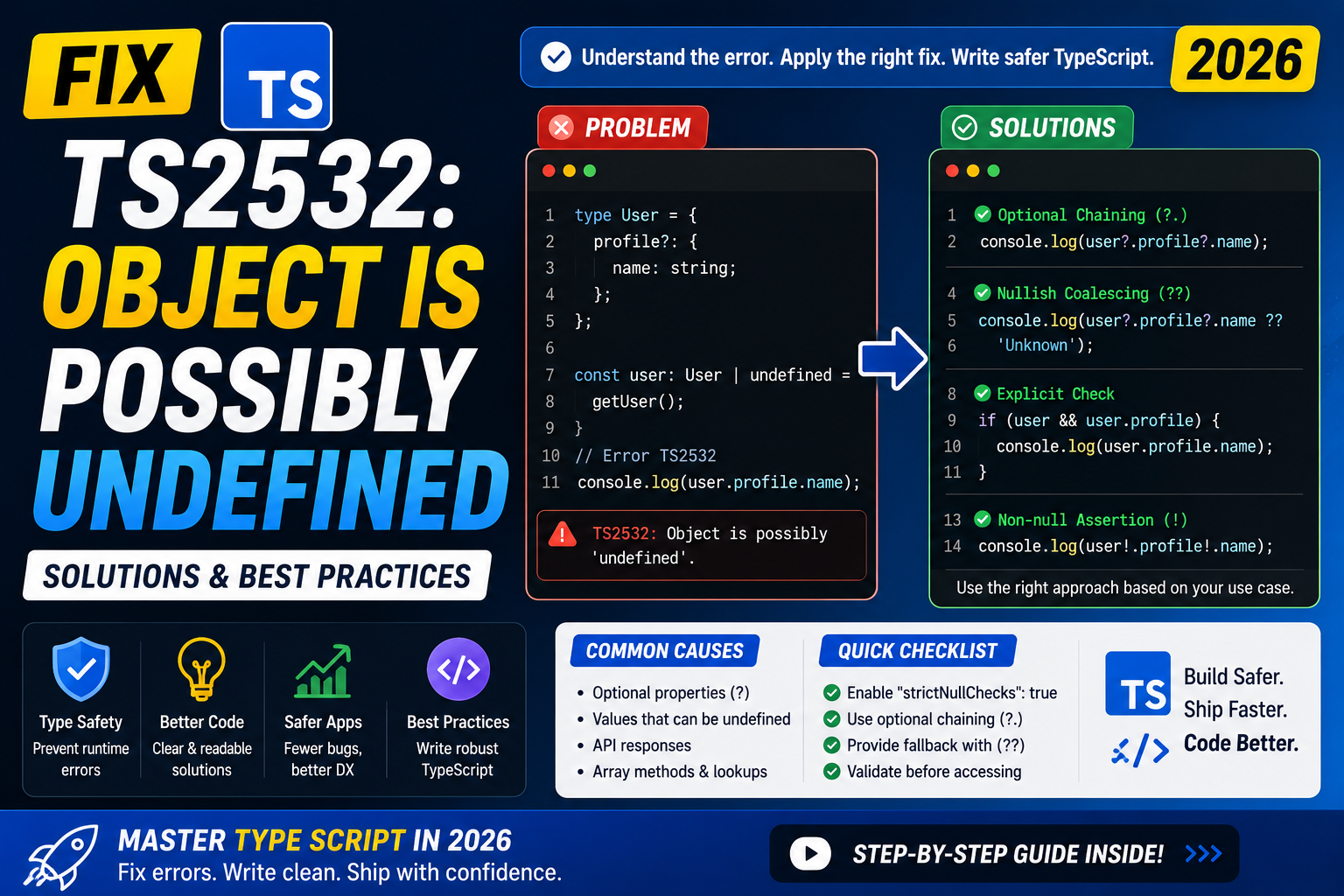
TypeScript throws TS2532 when you try to use a value that could be undefined. The message reads:
Object is possibly 'undefined'. ts(2532)
This appears when strictNullChecks is on (which comes with strict: true in tsconfig.json). It is one of TypeScript’s most useful checks because it forces you to handle the case where a value might not exist. Here are five ways to fix it.
The simplest reproducer
function greet(name?: string) {
  console.log(name.toUpperCase());  // TS2532
}
The ? in the parameter makes name either a string or undefined. Calling .toUpperCase() on undefined would crash at runtime, so TypeScript blocks it at compile time.
Fix 1: Guard with an if check
The most explicit fix. It also narrows the type automatically inside the block:
function greet(name?: string) {
  if (name) {
    console.log(name.toUpperCase());  // OK, narrowed to string
  }
}
Use this when the code that follows only makes sense with a defined value. If undefined should also be handled, add an else branch.
Fix 2: Optional chaining
When you just want to access a property or method safely and get undefined if the value is missing, use the ?. operator:
function greet(name?: string) {
  console.log(name?.toUpperCase());  // OK, logs undefined if name is undefined
}

const user = getUser();
const city = user?.address?.city;  // safely walks the chain
Optional chaining short-circuits: if any part of the chain is null or undefined, the whole expression evaluates to undefined without throwing. Great for API responses where nested properties might be missing.
Fix 3: Nullish coalescing for defaults
When you want a fallback value when the original is undefined or null, use ??:
function greet(name?: string) {
  const displayName = name ?? "Guest";
  console.log(displayName.toUpperCase());  // OK, displayName is string
}
Do not use || for this. || also falls back on 0, empty string, and false, which is often a bug. ?? only falls back on null and undefined.
Fix 4: Default parameter value
If the value is a function parameter and you always want a default, set it in the signature:
function greet(name: string = "Guest") {
  console.log(name.toUpperCase());  // OK, name is always string
}
Cleaner than doing the default check inside the function body. Works for function parameters and destructured object properties.
Fix 5: The non-null assertion (use with care)
If you know the value cannot be undefined at that point but the compiler cannot prove it, use the ! operator:
function greet(name?: string) {
  // I validated name upstream and I know it is defined here
  console.log(name!.toUpperCase());
}
This turns off the check but does not add any runtime safety. If you are wrong, the code crashes at runtime with “Cannot read property ‘toUpperCase’ of undefined”. Only use this when you are truly certain and the alternative would be very awkward. In most cases, a proper guard is a better choice.
Common places TS2532 shows up
- Array.find results.
arr.find(x => x.id === 5)returnsT | undefined. You need a guard before using the result. - Map.get results. Same story:
map.get("key")may return undefined. - Regex match results.
"hello".match(/x/)returns undefined on no match. - Object destructuring with missing keys. If the type allows an optional key, the destructured variable inherits that optionality.
- API response parsing. If your type says a nested property is optional (marked with
?), any access needs a guard or optional chain.
Which fix should you pick?
- You want different behavior for missing vs present: Fix 1 (if guard).
- You just want to safely read a nested property: Fix 2 (optional chaining).
- You have a fallback value: Fix 3 (nullish coalescing).
- The value is a function parameter and has an obvious default: Fix 4 (default parameter).
- You are certain it is defined but the compiler cannot see the proof: Fix 5 (non-null assertion), sparingly.
Fix 1 through 4 add real safety to your code. Fix 5 removes safety and should be a last resort.
Verifying your fix
npx tsc --noEmit
If TS2532 no longer appears in the output, the fix is applied. Also check your linter (ESLint with typescript-eslint) is not warning about the non-null assertion if you used one.
Official documentation
Frequently asked questions
What is the difference between TS2532 and TS2533?
TS2532 fires when the value is possibly undefined. TS2533 fires when the value is possibly null or undefined. The fixes are the same: guard, optional chain, nullish coalescing, or default value.
Can I disable strictNullChecks to make TS2532 go away?
Yes but do not. Disabling it removes one of TypeScript’s most valuable protections. Every value becomes implicitly nullable and you lose the safety net for a class of runtime bugs. Keep strictNullChecks on and fix each TS2532 individually.
Why does TS2532 fire after I already checked the value?
TypeScript narrows types only within simple guards. If the check is in a callback, or the value is a class property that could be mutated between the check and the use, TypeScript widens back to include undefined. Assign to a local const inside the guard to keep the narrowed type.
Is optional chaining slower than a regular property access?
Negligibly. The engine adds one nullish check per link in the chain. On modern V8 (Node.js 18+) this is faster than the ternary or if-check equivalents you would write by hand. Do not avoid optional chaining for performance reasons.
Should I use || or ?? for defaults?
Use ?? by default. || falls back on any falsy value, which includes 0, empty string, and false. ?? only falls back on null and undefined, which is almost always what you want. Legacy code often uses || out of habit but modern TypeScript uses ??.
Does TS2532 apply to arrays?
By default no, because TypeScript trusts your index. Turn on noUncheckedIndexedAccess in tsconfig for the safer behavior where arr[0] is typed as T | undefined. It catches many real bugs where you assumed an array had a value at a certain index.