
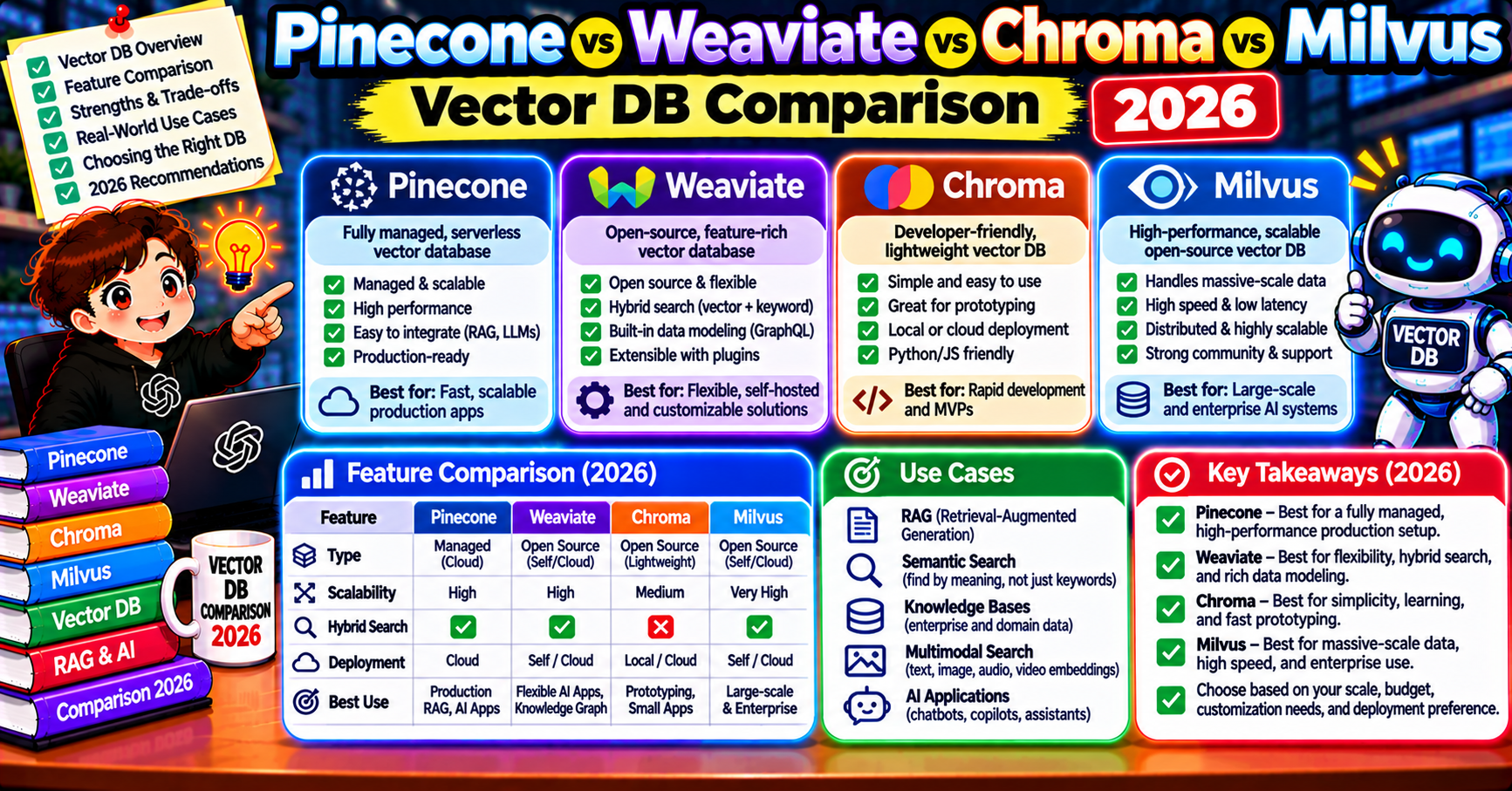
Pinecone vs Weaviate vs Chroma vs Milvus 2026: Vector DB Comparison
The short answer
Four vector databases dominate production RAG in 2026. Chroma wins for local prototypes and small projects (free, SQLite-like simplicity). Pinecone wins for managed production (fast setup, pay-per-query). Weaviate wins when you need hybrid search and GraphQL (best developer ergonomics). Milvus wins at 10M+ vector scale (lowest query latency at scale, highest operational cost). Match the pick to deployment stage; migration between them is straightforward once the schema is settled.
The vector database market has consolidated around four production-grade options. Pinecone leads as the managed-service default. Weaviate owns the open-core hybrid-search niche. Chroma dominates local-first and prototype workflows. Milvus leads on scale and operational maturity for self-hosted deployments.
Each one works. The question is which fits your constraints. This comparison walks through pricing, scale, hybrid search, metadata filtering, multi-tenancy, and operational burden, with concrete picks per use case.
Positioning at a glance
Short version of where each one lives in the market:
- Pinecone. Fully managed, serverless, zero ops. Pay per read and per gigabyte stored. The default when you want to ship fast and never touch infrastructure.
- Weaviate. Open-source core with a hosted cloud option. Strong hybrid search, strong module ecosystem (built-in rerankers, embedders, Q&A chains).
- Chroma. Developer-first, local-first. Runs in-process with Python or as a lightweight server. The right place to prototype a RAG system.
- Milvus. Enterprise-scale open source. Billions of vectors, GPU acceleration, serious Kubernetes operator. Zilliz Cloud is the managed version.
Qdrant, pgvector, and LanceDB are also legitimate, but these four cover 80% of production RAG deployments in 2026.
Pricing: the real number per million vectors
At 1 million vectors of 1536 dimensions each (standard for OpenAI text-embedding-3-small), 500 queries per minute:
- Pinecone Serverless: around $70 per month for storage, roughly $0.33 per million read units. For 500 queries/min that is about $700 per month in read charges. Total: $770/mo.
- Weaviate Cloud Starter: fixed $295/mo for the small cluster, which handles this load comfortably.
- Chroma self-hosted: a single $40/mo t3.medium handles 1M vectors at this query rate. $0 in software licenses.
- Milvus self-hosted on Kubernetes: 3 nodes at $100/mo each, so about $300/mo total, plus the operational cost of running a cluster.
- Zilliz Cloud (managed Milvus): around $65/mo for CU-1 instance at this scale.
Chroma self-hosted is the cheapest. Zilliz Cloud is the cheapest managed option. Pinecone becomes expensive when query volume climbs because reads are priced per unit, but it is the easiest to operate.
Scale: when each option stops working
Rough breakpoints based on 2026 production reports:
- Chroma: fine up to 10 million vectors on a single node, degrades noticeably past that.
- Pinecone: scales to billions, latency stays under 100ms, no sharding work on your end.
- Weaviate: handles hundreds of millions comfortably on sharded clusters.
- Milvus: handles tens of billions, which is the pick when scale is non-negotiable.
Most RAG systems never cross 10 million vectors. Chroma is enough for the vast majority of RAG use cases. The scale question only matters when you are indexing something like the whole web, every PubMed paper, or every GitHub repo.
Hybrid search: dense + sparse together
Hybrid search combines vector similarity (dense retrieval) with keyword matching (sparse retrieval like BM25). It catches queries that pure vector search misses: exact product codes, acronyms, uncommon proper nouns, legal citations.
- Weaviate: hybrid search built in since 1.17. Just set
hybrid={"query": q, "alpha": 0.5}. The alpha knob controls dense-vs-sparse weighting. - Pinecone: hybrid search available on serverless indexes using sparse-dense vectors. You generate sparse vectors (BM25 or SPLADE) at index time.
- Milvus: hybrid search since 2.4, with a RRF (reciprocal rank fusion) option built in.
- Chroma: no built-in hybrid search in 2026. Implement BM25 separately and merge in your own code.
Weaviate has the cleanest hybrid-search API. Pinecone’s hybrid is powerful but requires a sparse embedding step. If hybrid matters and you want it to just work, Weaviate wins.
Metadata filtering: the quiet differentiator
Every production RAG system eventually needs filters. Filter by date, by author, by access level, by tenant ID, by document type. The performance of filtered queries depends heavily on the implementation.
Pinecone. Pre-filtered queries. The filter runs before the ANN search, so filtered queries can be fast but behavior depends on filter selectivity. Highly selective filters (narrowing to under 1% of the corpus) can degrade.
Weaviate. Post-filtered or pre-filtered depending on filter type. Generally performant, with a mature filter language supporting nested boolean conditions.
Chroma. Post-filtered. Simple and fast on small-to-mid indexes. Breaks down past 10M vectors if filters are selective.
Milvus. Supports both pre-filter and post-filter. Attribute filtering is a first-class citizen, and the IVF indexes handle it well.
For heavy metadata filtering workloads (multi-tenant SaaS, document management with ACLs), Pinecone and Milvus handle it best. Weaviate is close behind.
Multi-tenancy: isolation patterns
Three ways to isolate tenants in a vector DB:
- Collection per tenant. Each tenant gets its own index/collection. Full isolation, straightforward security, but it does not scale past a few hundred tenants.
- Namespace / partition per tenant. Tenants share an index but query a specific slice. Scales to tens of thousands of tenants with minimal overhead.
- Metadata filter per tenant. One index, every query carries a tenant_id filter. Scales infinitely but security relies on your application correctly adding the filter every time.
Pinecone namespaces, Weaviate multi-tenancy mode, and Milvus partitions all do option 2 natively. For SaaS applications with many small tenants, namespace-based isolation is the right pattern. For enterprise B2B with high per-tenant security requirements, collection-per-tenant is safer even if more operationally heavy.
Operational burden: who manages what
Honest look at what you take on with each:
Pinecone. Zero ops. No backups, no scaling, no version upgrades, no capacity planning. The flip side is you cannot tune the engine or run it in air-gapped environments.
Weaviate Cloud. Managed cluster. You pick cluster size, Weaviate handles the rest. Open source lets you self-host too, which means Kubernetes operator, backups, upgrades, monitoring, all on you.
Chroma. If you use it in-process (as a Python library), there is no server to manage. If you run the Chroma server, it is a single container. Minimal.
Milvus. Self-hosted Milvus is a serious infrastructure commitment: etcd, MinIO or S3, Pulsar or Kafka, multiple services. The Milvus Operator for Kubernetes helps, but you need an SRE in the loop. Zilliz Cloud offloads this.
Teams without dedicated infra engineers should use Pinecone, Weaviate Cloud, or Zilliz Cloud. Teams with Kubernetes expertise and specific compliance needs can self-host Milvus or Weaviate.
Ecosystem fit and integrations
LangChain, LlamaIndex, Haystack, and Semantic Kernel all support all four vendors. The integration quality varies:
- LangChain: Chroma is the default in tutorials, Pinecone has the richest adapter.
- LlamaIndex: all four are first-class, with Weaviate and Milvus adapters particularly polished.
- Haystack: deepest Weaviate integration.
Weaviate’s module system is a differentiator worth mentioning. It bundles embedders, rerankers, generators, and Q&A chains inside the database, so a simple RAG pipeline can run as a single Weaviate query. That reduces round-trips but ties the pipeline to Weaviate.
Pragmatic picker
Six questions, in order:
- Prototyping or under 100K vectors? Chroma.
- Multi-tenant SaaS with thousands of tenants and tight metadata filtering? Pinecone or Milvus.
- Need hybrid search out of the box? Weaviate.
- Scale is tens or hundreds of millions of vectors and you have Kubernetes expertise? Milvus self-hosted.
- Need managed, zero-ops, scales serverless? Pinecone.
- Need to stay on your network for compliance? Weaviate self-hosted or Milvus self-hosted.
Most teams end up with Chroma for prototyping and Pinecone or Weaviate for production. Rebuilding an index from text is cheap, so being wrong about this early does not cost much. Starting with Chroma, measuring, and then migrating when scale demands is a defensible path.
Benchmarks worth running yourself
Vendor benchmarks are everywhere and all cherry-picked. Run three measurements on your actual workload before committing:
- P50 and P99 query latency at your expected concurrency.
- Recall at k=10 against a ground-truth set of 50-100 queries you labeled by hand.
- Cost per 1M queries at your expected volume and index size.
Spin up free tiers of Pinecone, Weaviate Cloud, and Zilliz Cloud. Load the same 100K-vector sample into all three. Run the queries. The three measurements take an afternoon and tell you more than any blog post.
Frequently asked questions
Official documentation
What is the best vector database in 2026?
There is no single best. Pinecone wins on ease of operation. Weaviate wins on hybrid search and modular ecosystem. Chroma wins on prototyping and local-first. Milvus wins on scale. The right pick depends on your constraints: team size, operational tolerance, scale, hybrid search needs, and compliance requirements.
Is Chroma production-ready in 2026?
For small-to-mid workloads (under 10 million vectors, under 500 queries per second), yes. Chroma is widely used in production RAG systems at that scale. Beyond 10M vectors or heavy multi-tenant filtering, Pinecone, Weaviate, or Milvus handle the load more cleanly.
Should I use pgvector instead of a dedicated vector DB?
pgvector works well up to about 1 million vectors with simple ANN queries. Past that, it starts to feel the lack of a purpose-built index. If your application already runs Postgres and the vector workload is modest, pgvector saves you from running a second database. For anything bigger or more demanding, use a purpose-built vector DB.
How much does Pinecone cost at scale?
On the serverless tier, storage is around $0.33 per GB per month and reads are around $0.33 per million read units. A production RAG system with 10M vectors and 100 queries per second runs roughly $500-1,500 per month depending on index configuration. For high-query-volume applications, costs can climb fast; it is worth benchmarking against Zilliz Cloud or Weaviate Cloud at your expected volume.
Can I switch vector databases later?
Yes, with some work. Vectors are not portable across embedding models, so switching DBs usually means re-embedding or exporting raw vectors from the old DB. The actual migration is a loop that reads chunks from the old DB and writes to the new one. For 1 million vectors, this is a few hours of work plus the cost of API calls.
Does the vector DB choice affect retrieval quality?
Minimally. All four support exact or approximate nearest neighbor search with HNSW or IVF indexes, and recall at k=10 is within 1-2% across them at default settings. Hybrid search and reranking integration affect quality more. The DB mostly affects cost, scale, latency, and operational burden, not quality.
Pick based on your deployment and scale constraints. All four options are good enough that embedding choice, chunking, and reranking will matter more to final RAG quality than which database stores the vectors.

Angel Jude Suarez
Full-Stack Developer at PIES IT Solution
Focuses on Python development, machine learning, and AI integration. Has built production AI systems including OpenAI Whisper integration for medical transcription and GPT-4o-powered diagnosis assistance. Strong background in pandas, scikit-learn, and TensorFlow.
Expertise: Python · PHP · Java · VB.NET · ASP.NET · Machine Learning · AI Integration · OpenCV · Django · CodeIgniter · View all posts by Angel Jude Suarez →