
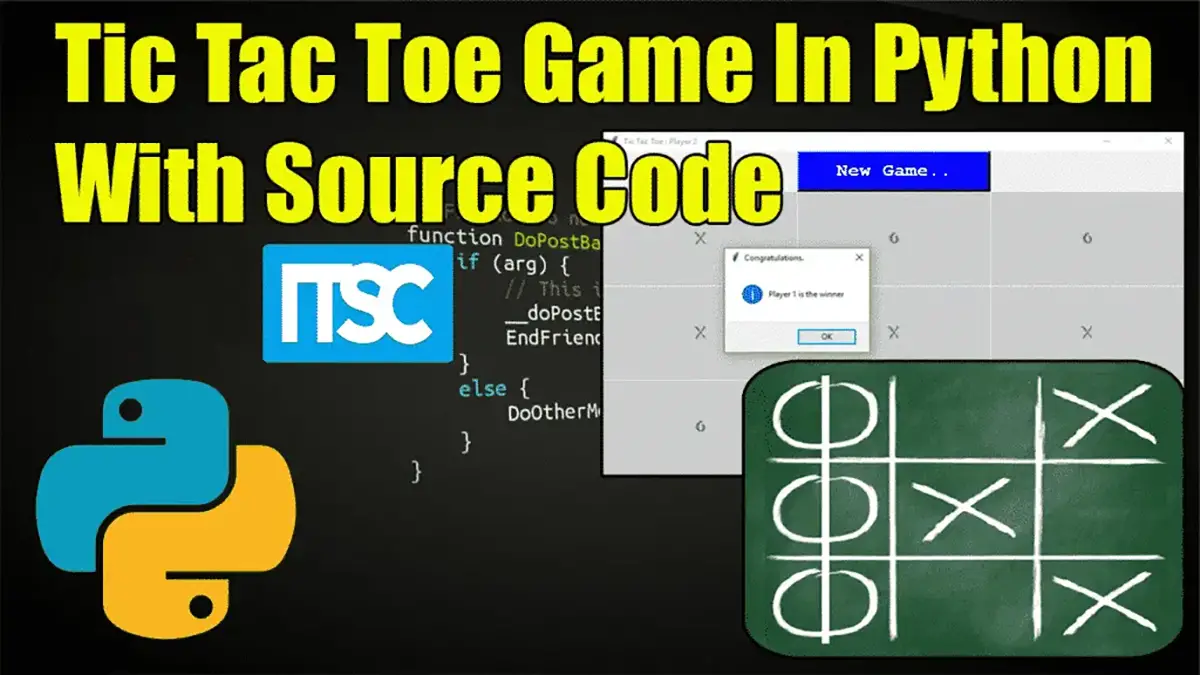
The Tic Tac Toe In Python is written in Python programming language, this Tic Tac Toe Game In Python is a simple GUI based strategy game board that is very easy to understand and use.
All the playing rules are the same just like we play in real-time tic-tac-toe, it is a simple multiplayer game.
Tic Tac Toe Game In Python: Project Information
| Project Name: | Tic Tac Toe Game In Python |
| Language/s Used: | Python (GUI) Based |
| Python version (Recommended): | 2.x or 3.x |
| Database: | None |
| Type: | Python App |
| Developer: | IT SOURCECODE |
| Updates: | 0 |
A Tic Tac Toe In Python Using Tkinter game starts with a GUI board. First, the player has to click on any box to start the game. It contains the Minimax algorithm; which is a decision rule used for a two-player game.
A simple Tic Tac Toe 2 Player 2D GUI is provided for easy gameplay. The gameplay design is so simple that users won’t find it difficult to use and understand.
Anyway, if you want to level up your knowledge in programming especially games in Python, try this new article I’ve made for you Code For Game in Python: Python Game Projects With Source Code.
This project also includes a downloadable Tic Tac Toe for free, just find the downloadable source code below and click to start downloading.
To start creating a Tic Tac Toe Game In Python, make sure that you have PyCharm IDE installed on your computer.
By the way, if you are new to Python programming and don’t know what Python IDE is and its usage, I have here a list of the Best Python IDE for Windows, Linux, and Mac OS that will suit you.
I also have here How to Download and Install the Latest Version of Python on Windows.
How to Create Tic Tac Toe in Python with Source Code
Time needed: 5 minutes
These are the Steps on How to Create a Tic Tac Toe Game In Python With Source Code
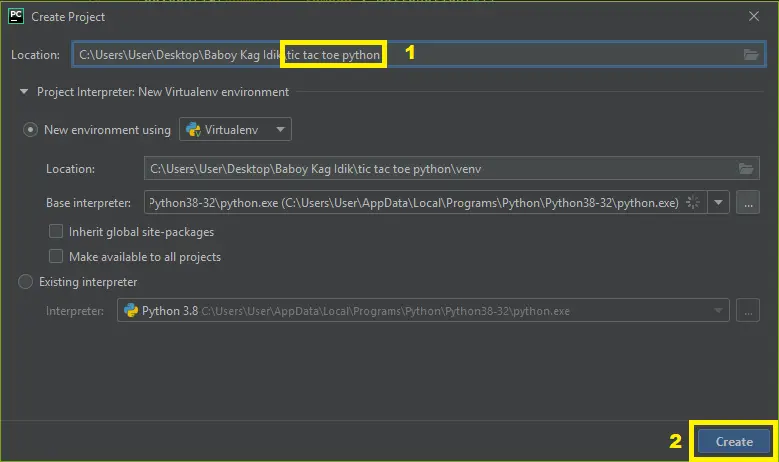
- Step 1: Create a project name.
First, open Pycharm IDE and then create a “project name” After creating a project name click the “create” button.

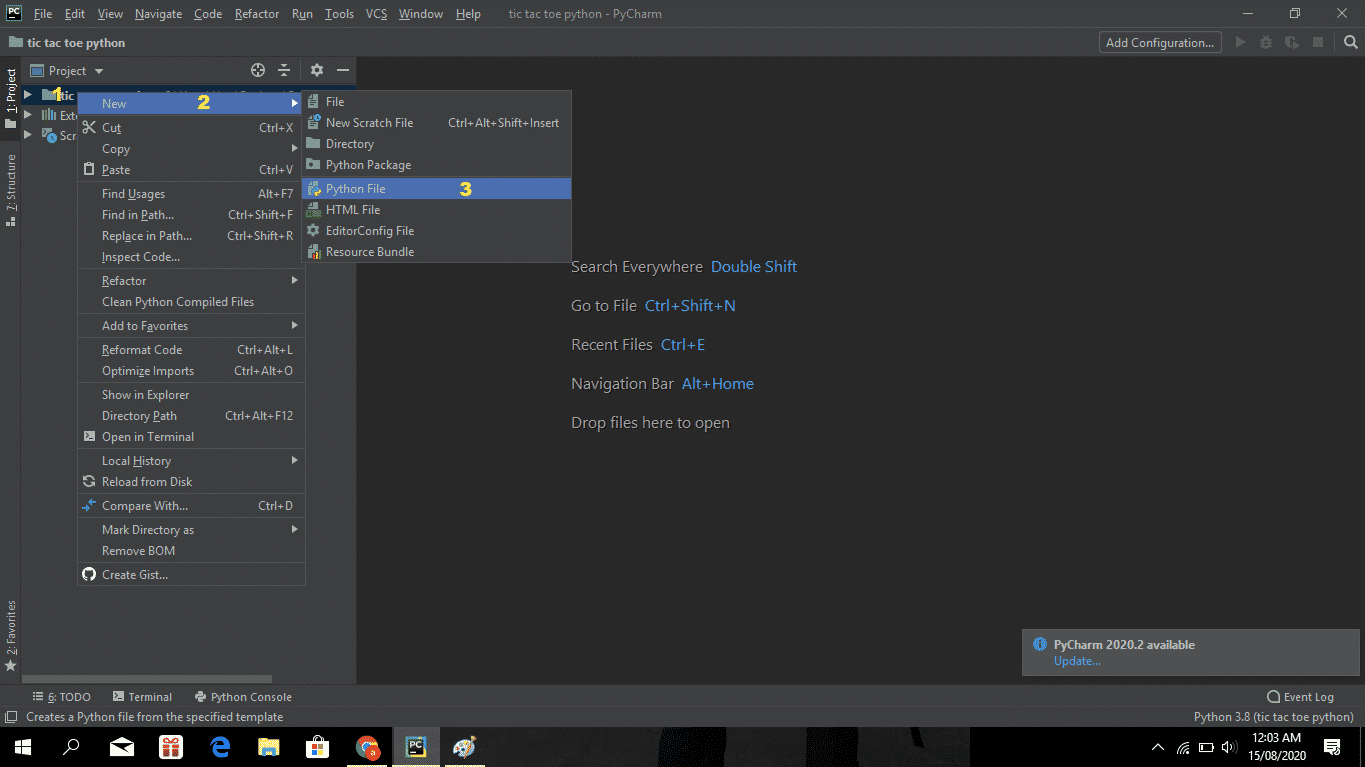
- Step 2: Create a python file.
Second, after creating a project name, “right click” your project name and then click “new” After that click the “python file“.

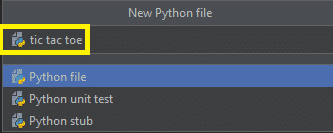
- Step 3: Name your python file.
Third, after creating a Python file, Name your Python file after that click “enter“.

- Step 4: The actual code.
You are free to copy the code given below and download the full source code below.
Code Explanations
1. The Code Given Below Is For Importing Modules
Code:
from tkinter import Tk,ttk,Button
from tkinter import messagebox
from random import randint
Explanation:
The code is given which is importing all modules or libraries.
2. The Code Given Below Is For The Module Lay Out
Code:
def SetLayout(id,player_symbol):
    if id==1:
        b1.config(text= player_symbol)
        b1.state(['disabled'])
    elif id==2:
        b2.config(text= player_symbol)
        b2.state(['disabled'])
    elif id==3:
        b3.config(text= player_symbol)
        b3.state(['disabled'])
    elif id==4:
        b4.config(text= player_symbol)
        b4.state(['disabled'])
    elif id==5:
        b5.config(text= player_symbol)
        b5.state(['disabled'])
    elif id==6:
        b6.config(text= player_symbol)
        b6.state(['disabled'])
    elif id==7:
        b7.config(text= player_symbol)
        b7.state(['disabled'])
    elif id==8:
        b8.config(text= player_symbol)
        b8.state(['disabled'])
    elif id==9:
        b9.config(text= player_symbol)
        b9.state(['disabled'])
Explanation:
In this module which is setting the layout of its player symbol.
3. The Code Given Below Is For The Check Winner Module
Code:
def CheckWinner():
    global mov
    winner = -1

    if(1 in p1) and (2 in p1) and (3 in p1):
        winner = 1
    if(1 in p2) and (2 in p2) and (3 in p2):
        winner = 2

    if(4 in p1) and (5 in p1) and (6 in p1):
        winner = 1
    if(4 in p2) and (5 in p2) and (6 in p2):
        winner = 2

    if(7 in p1) and (8 in p1) and (9 in p1):
        winner = 1
    if(7 in p2) and (8 in p2) and (9 in p2):
        winner = 2

    if(1 in p1) and (4 in p1) and (7 in p1):
        winner = 1
    if(1 in p2) and (4 in p2) and (7 in p2):
        winner = 2

    if(2 in p1) and (5 in p1) and (8 in p1):
        winner = 1
    if(2 in p2) and (5 in p2) and (8 in p2):
        winner = 2

    if(3 in p1) and (6 in p1) and ( 9 in p1):
        winner = 1
    if(3 in p2) and (6 in p2) and (9 in p2):
        winner = 2

    if(1 in p1) and (5 in p1) and ( 9 in p1):
        winner = 1
    if(1 in p2) and (5 in p2) and (9 in p2):
        winner = 2

    if(3 in p1) and (5 in p1) and ( 7 in p1):
        winner = 1
    if(3 in p2) and (5 in p2) and (7 in p2):
        winner = 2

    if winner ==1:
        messagebox.showinfo(title="Congratulations.",
            message="Player 1 is the winner")
    elif winner ==2:
        messagebox.showinfo(title="Congratulations.",
            message="Player 2 is the winner")
    elif mov ==9:
        messagebox.showinfo(title="Draw",
            message="It's a Draw!!")
Explanation:
In this module which is checking the winner of two players.
4. The Code Given Below Is For The Module Button Click
Code:
def ButtonClick(id):
    global ActivePlayer
    global p1,p2
    global mov

    if(ActivePlayer ==1):
        SetLayout(id,"X")
        p1.append(id)
        mov +=1
        root.title("Tic Tac Toe : Player 2")
        ActivePlayer =2

    elif(ActivePlayer==2):
        SetLayout(id,"O")
        p2.append(id)
        mov +=1
        root.title("Tic Tac Toe : Player 1")
        ActivePlayer =1
    CheckWinner()
Explanation:
In this module which is the button click of two players and its conditions.
5. The Code Given Below Is For The Module Restart
Code:
def Restart():
    global p1,p2,mov,ActivePlayer
    p1.clear(); p2.clear()
    mov,ActivePlayer = 0,1
    root.title("Tic Tac Toe : Player 1")
    EnableAll()
Explanation:
In this module which is the restarting or the new game module of the game.
Complete Source Code
from tkinter import Tk,ttk,Button
from tkinter import messagebox
from random import randint

ActivePlayer = 1
p1 = []
p2 = []
mov = 0

def SetLayout(id,player_symbol):
    if id==1:
        b1.config(text= player_symbol)
        b1.state(['disabled'])
    elif id==2:
        b2.config(text= player_symbol)
        b2.state(['disabled'])
    elif id==3:
        b3.config(text= player_symbol)
        b3.state(['disabled'])
    elif id==4:
        b4.config(text= player_symbol)
        b4.state(['disabled'])
    elif id==5:
        b5.config(text= player_symbol)
        b5.state(['disabled'])
    elif id==6:
        b6.config(text= player_symbol)
        b6.state(['disabled'])
    elif id==7:
        b7.config(text= player_symbol)
        b7.state(['disabled'])
    elif id==8:
        b8.config(text= player_symbol)
        b8.state(['disabled'])
    elif id==9:
        b9.config(text= player_symbol)
        b9.state(['disabled'])

def CheckWinner():
    global mov
    winner = -1

    if(1 in p1) and (2 in p1) and (3 in p1):
        winner = 1
    if(1 in p2) and (2 in p2) and (3 in p2):
        winner = 2

    if(4 in p1) and (5 in p1) and (6 in p1):
        winner = 1
    if(4 in p2) and (5 in p2) and (6 in p2):
        winner = 2

    if(7 in p1) and (8 in p1) and (9 in p1):
        winner = 1
    if(7 in p2) and (8 in p2) and (9 in p2):
        winner = 2

    if(1 in p1) and (4 in p1) and (7 in p1):
        winner = 1
    if(1 in p2) and (4 in p2) and (7 in p2):
        winner = 2

    if(2 in p1) and (5 in p1) and (8 in p1):
        winner = 1
    if(2 in p2) and (5 in p2) and (8 in p2):
        winner = 2

    if(3 in p1) and (6 in p1) and ( 9 in p1):
        winner = 1
    if(3 in p2) and (6 in p2) and (9 in p2):
        winner = 2

    if(1 in p1) and (5 in p1) and ( 9 in p1):
        winner = 1
    if(1 in p2) and (5 in p2) and (9 in p2):
        winner = 2

    if(3 in p1) and (5 in p1) and ( 7 in p1):
        winner = 1
    if(3 in p2) and (5 in p2) and (7 in p2):
        winner = 2

    if winner ==1:
        messagebox.showinfo(title="Congratulations.",
            message="Player 1 is the winner")
    elif winner ==2:
        messagebox.showinfo(title="Congratulations.",
            message="Player 2 is the winner")
    elif mov ==9:
        messagebox.showinfo(title="Draw",
            message="It's a Draw!!")

def ButtonClick(id):
    global ActivePlayer
    global p1,p2
    global mov

    if(ActivePlayer ==1):
        SetLayout(id,"X")
        p1.append(id)
        mov +=1
        root.title("Tic Tac Toe : Player 2")
        ActivePlayer =2

    elif(ActivePlayer==2):
        SetLayout(id,"O")
        p2.append(id)
        mov +=1
        root.title("Tic Tac Toe : Player 1")
        ActivePlayer =1
    CheckWinner()

def AutoPlay():
    global p1; global p2
    Empty = []
    for cell in range(9):
        if(not((cell +1 in p1) or (cell +1 in p2))):
            Empty.append(cell+1)
    try:
        RandIndex = randint(0,len(Empty) -1)
        ButtonClick(Empty[RandIndex])
    except:
        pass

def EnableAll():
    b1.config(text= " ")
    b1.state(['!disabled'])
    b2.config(text= " ")
    b2.state(['!disabled'])
    b3.config(text= " ")
    b3.state(['!disabled'])
    b4.config(text= " ")
    b4.state(['!disabled'])
    b5.config(text= " ")
    b5.state(['!disabled'])
    b6.config(text= " ")
    b6.state(['!disabled'])
    b7.config(text= " ")
    b7.state(['!disabled'])
    b8.config(text= " ")
    b8.state(['!disabled'])
    b9.config(text= " ")
    b9.state(['!disabled'])


def Restart():
    global p1,p2,mov,ActivePlayer
    p1.clear(); p2.clear()
    mov,ActivePlayer = 0,1
    root.title("Tic Tac Toe : Player 1")
    EnableAll()


root = Tk()
root.title("Tic Tac toe : Player 1")
st = ttk.Style()
st.configure("my.TButton", font=('Chiller',24,'bold'))

b1 = ttk.Button(root, text=" ", style="my.TButton")
b1.grid(row=1, column=0, sticky="nwse", ipadx=50,ipady=50)
b1.config(command = lambda : ButtonClick(1))


b2 = ttk.Button(root, text=" ",style ="my.TButton")
b2.grid(row=1, column=1, sticky="snew", ipadx=50, ipady=50)
b2.config(command = lambda : ButtonClick(2))

b3= ttk.Button(root, text=" ",style="my.TButton")
b3.grid(row=1, column=2, sticky="snew", ipadx=50,
        ipady=50)
b3.config(command = lambda : ButtonClick(3))

b4 = ttk.Button(root, text=" ",style="my.TButton")
b4.grid(row=2, column=0, sticky="snew", ipadx=50,
        ipady=50)
b4.config(command = lambda : ButtonClick(4))

b5 = ttk.Button(root, text=" ",style="my.TButton")
b5.grid(row=2, column=1, sticky="snew", ipadx=50,
        ipady=50)
b5.config(command = lambda : ButtonClick(5))

b6 = ttk.Button(root, text=" ",style="my.TButton")
b6.grid(row=2, column=2, sticky="snew", ipadx=50,
        ipady=50)
b6.config(command = lambda : ButtonClick(6))

b7 = ttk.Button(root, text=" ",style="my.TButton")
b7.grid(row=3, column=0, sticky="snew", ipadx=50,
        ipady=50)
b7.config(command = lambda : ButtonClick(7))

b8 = ttk.Button(root, text=" ",style="my.TButton")
b8.grid(row=3, column=1, sticky="snew", ipadx=50,
        ipady=50)
b8.config(command = lambda : ButtonClick(8))

b9 = ttk.Button(root, text=" ",style="my.TButton")
b9.grid(row=3, column=2, sticky="snew", ipadx=50,
        ipady=50)
b9.config(command = lambda : ButtonClick(9))

Button(text="New Game..", font=('Courier new', 22, 'bold'), bg='blue', fg='white',
            border=5, width=4,command = lambda :Restart()).grid(row=0, column=1, sticky="we")
root.resizable(0,0)
root.mainloop()
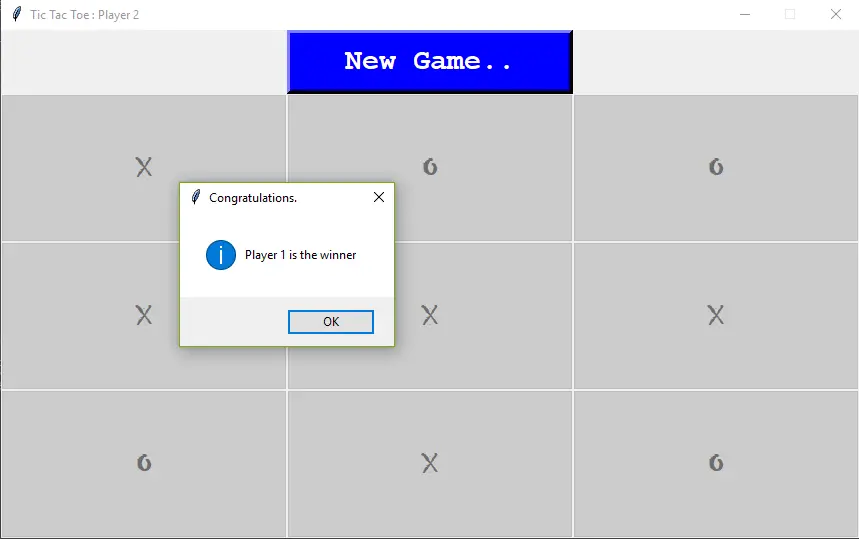
Output:
Downloadable Source Code
I have here the list of Best Python Projects with Source code free to download for free, I hope this can help you a lot.
Summary
The Tic Tac Toe Game In Python is written in Python programming language, Python is very easy to research the syntax emphasizes readability and it is able to reduce time ingesting in developing.
This is a simple GUI-based system, specially written for beginners. The Tic Tac Toe project with source code is free to download. Use for education purposes only!
Also, this tutorial is the simplest way for beginners or students to enhance their logical skills in programming. This game project is a way for students or beginners to design and develop games.
Related Articles
- Tank Game Python with Source Code
- Tetris In Python Code
- Mario Game In Python With Source Code
- Hangman Game In Python With Source Code
- Aircraft War Game in Python with Source Code
Inquiries
If you have any questions or suggestions about Tic Tac Toe In Python, please feel free to leave a comment below.
Official documentation
Frequently Asked Questions
How do you play this Python Tic Tac Toe game?
Two players take turns placing X and O on a 3×3 grid. Click any empty cell to place your mark (the current player’s symbol toggles after each move). The first player to align 3 marks horizontally, vertically, or diagonally wins. If all 9 cells fill without a winner, the game is a draw. The simple AI version included uses the minimax algorithm so the computer never loses, useful for demonstrating game-tree search algorithms in your defense.
What Python version do I need to run this game?
Python 3.8 or newer works. We recommend Python 3.11 or 3.12 because Pygame ships pre-built wheels for those versions (faster pip install, no compilation errors). Python 3.13 may need a slightly older Pygame release because some wheels lag the latest CPython. Verify your version with python –version on Windows or python3 –version on Mac/Linux.
How do I install Pygame for this project?
Run pip install pygame in your terminal (Windows: open Command Prompt, Mac/Linux: open Terminal). On Windows, if pip is not recognized, try python -m pip install pygame instead. On Linux, you may need sudo apt install python3-pygame if pip fails. Verify with python -c “import pygame; print(pygame.version.ver)”.
Can I use this Python game as my BSIT capstone project?
On its own, no, most Philippine BSIT panels expect a full system with users, data, reports, and a real-world problem. A single Pygame game is too narrow for capstone scope. BUT, you can use this game as ONE module inside a larger capstone (e.g. a gamified learning system, a math practice tool for elementary students with this game as the reward layer, or an arcade-style POS for an internet cafe). Pair the game with a Django backend, a database, and analytics for a defensible capstone.
Can I package this game as a standalone .exe to distribute?
Yes, use PyInstaller. Run pip install pyinstaller then pyinstaller –onefile –windowed your_game.py from the project folder. PyInstaller bundles Python and Pygame into a single .exe (Windows) or .app (Mac) that runs without Python installed on the target machine. Include asset files (images, sounds) with –add-data “assets;assets”. Output goes to the dist/ folder.
Where do I get help if the game does not run?
Check the top 3 most common failures: (1) Pygame is not installed correctly, re-run pip install pygame. (2) The game cannot find an asset file (image/sound), make sure you run python from the project folder so relative paths resolve. (3) Wrong Python version, this code expects Python 3.8+; older Python 2.x or 3.6 raises syntax errors. If you still hit a wall, drop a comment on this article with the exact error message, our team monitors comments daily.

Angel Jude Suarez
Full-Stack Developer at PIES IT Solution
Focuses on Python development, machine learning, and AI integration. Has built production AI systems including OpenAI Whisper integration for medical transcription and GPT-4o-powered diagnosis assistance. Strong background in pandas, scikit-learn, and TensorFlow.
Expertise: Python · PHP · Java · VB.NET · ASP.NET · Machine Learning · AI Integration · OpenCV · Django · CodeIgniter · View all posts by Angel Jude Suarez →