
The Address Book Project In Python is written in Python programming language, this Address Book Python Project is an interesting project.
The user can add the phone number of contact details and you can see the details stored in the list form. The user can delete the contact records if he/she wants to remove it.
This is a simple GUI-based project which is very easy to understand and use.
Creating an Address Book in Python – Project Information
| Project Name: | Address Book In Python |
| Language/s Used: | Python (GUI) Based |
| Python version (Recommended): | 2.x or 3.x |
| Database: | None |
| Type: | Python App |
| Developer: | IT SOURCECODE |
| Updates: | 0 |
A Python Address Book Example feature is the user can make a list of contacts with their name, and address, and keep them as records.
You just have to type the contact information in the text fields and click on the add button to add the information to the record.
Also, this Address Book In Python includes a downloadable Address Book Python Code for free, just find the downloadable source code below and click to start downloading.
To start creating an Address Book In Python, make sure that you have PyCharm IDE installed on your computer.
Steps In Creating an Address Book In Python with Source Code
Time needed: 5 minutes
These are the steps In Creating an Address Book In Python With Source Code
- Step 1: Create a project name.
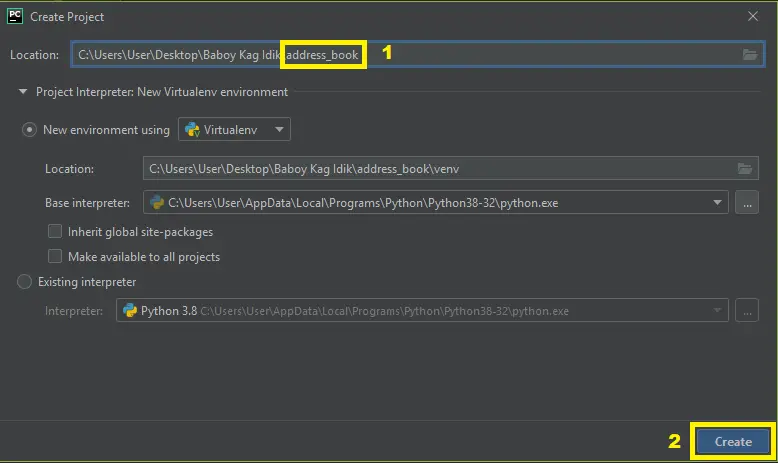
First, open Pycharm IDE and then create a “project name.” After creating a project name click the “create” button.

- Step 2: Create a python file.
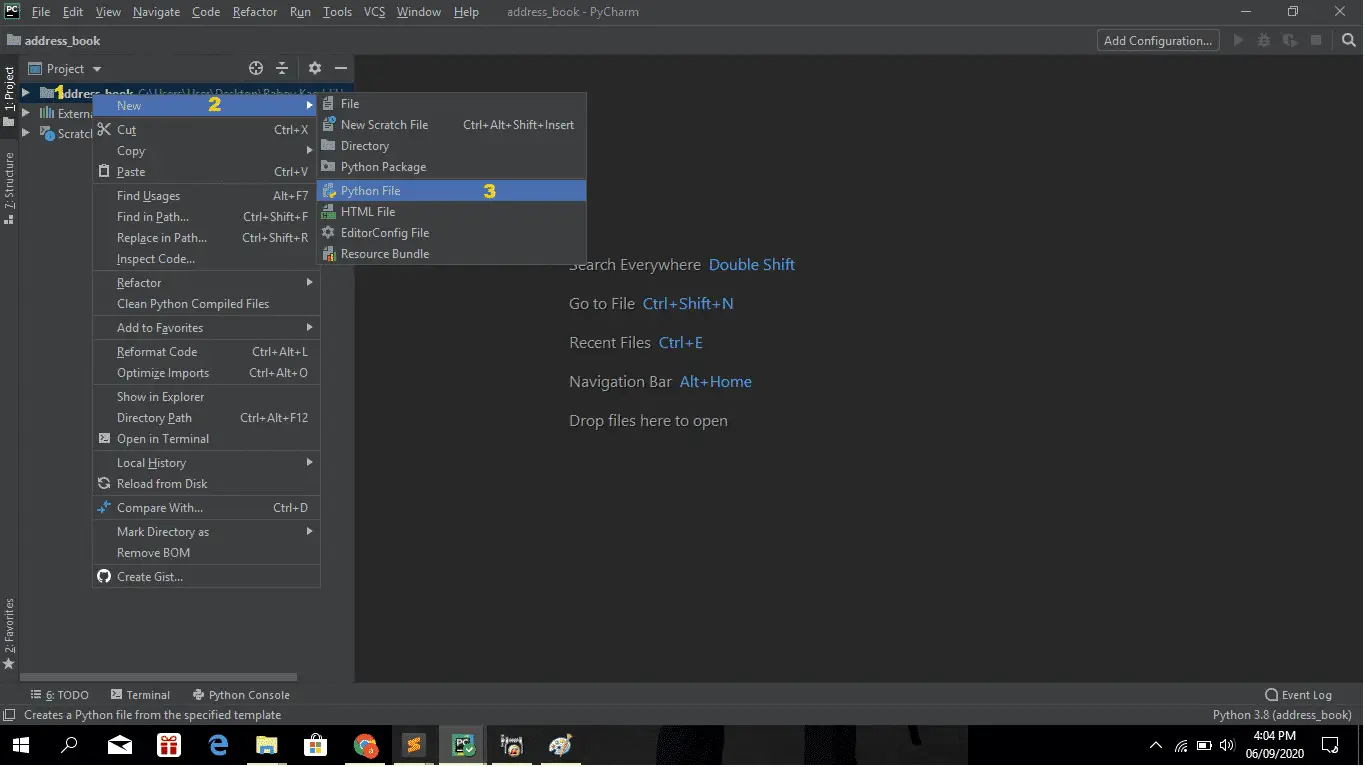
Second, after creating a project name, “right click” your project name and then click “new.” After that click the “python file“.

- Step 3: Name your python file.
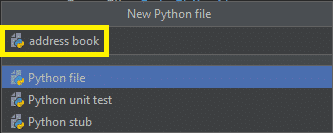
Third, after creating a Python file, Name your Python file after that click “enter“.

- Step 4: The actual code.
You are free to copy the code given below and download the full source code below.
Code Explanations
1. Importing Libraries
Code:
import sys

sys.path.insert(0, 'GUI')

import tkinter as Tk
import db
import new
Explanation:
In the code given which is importing the given libraries.
2. The Code Given Below Is For The Get Data Module
Code:
def get_contact(contact):
    """Returns a contact.

    Keyword arguments:
    contact -- First and Last name of a contact entry
    """
    entry = []

    try:
        if contact.split()[1]:
            entry.append(contact.split()[0])
            entry.append(contact.split()[1])
    except:
        entry.append('')
        entry.append(contact.split()[0])

    for row in db.get_entry(db.get_id(entry)):
        return row
Explanation:
In this module which is the module for getting contact.
3. The Code Given Below Is For The Adding Data Module
Code:
def add_contact(contact):
    """Adds a contact to the database.

    Keyword arguments:
    contact -- List containing contact entry information
    """
    db.insert_entry(contact)
Explanation:
This module is the module for adding the data.
4. The Code Given Below Is For The Removing Data Module
Code:
def remove_contact(contact):
    """Removes a contact.

    Keyword arguments:
    contact -- First and Last name of a contact entry
    """
    entry = []
    try:
        entry.append(contact.split()[0])
    except:
        entry.append('')

    try:
        entry.append(contact.split()[1])
    except:
        entry.append('')

    db.delete_entry(db.get_id(entry))
Explanation:
This module is the module for removing the data.
5. The Code Given Below Is For The Modify Module
Code:
def edit_contact(entry_id, contact):
    """Edits a contact.

    Keyword arguments:
    entry_id -- rowid for contact entry
    contact -- List containing contact entry information
    """
    db.edit_entry(entry_id, contact)
Explanation:
This module is the module for modifying the data.
6. The Code Given Below Is For The Search Module
Code:
def search(search_string, sort):
    """Searches the database and returns the results.

    Keyword arguments:
    search_string -- (str) Search term
    sort -- (str) Sorting method (Last Name or Zip)
    """
    return db.search_entry(search_string, sort)
Explanation:
This module is the module for searching the data that is stored in the SQLite database.
Complete Source Code
import sys

sys.path.insert(0, 'GUI')

import tkinter as Tk
import db
import new


def get_contact(contact):
    """Returns a contact.

    Keyword arguments:
    contact -- First and Last name of a contact entry
    """
    entry = []

    try:
        if contact.split()[1]:
            entry.append(contact.split()[0])
            entry.append(contact.split()[1])
    except:
        entry.append('')
        entry.append(contact.split()[0])

    for row in db.get_entry(db.get_id(entry)):
        return row


def add_contact(contact):
    """Adds a contact to the database.

    Keyword arguments:
    contact -- List containing contact entry information
    """
    db.insert_entry(contact)


def remove_contact(contact):
    """Removes a contact.

    Keyword arguments:
    contact -- First and Last name of a contact entry
    """
    entry = []
    try:
        entry.append(contact.split()[0])
    except:
        entry.append('')

    try:
        entry.append(contact.split()[1])
    except:
        entry.append('')

    db.delete_entry(db.get_id(entry))


def edit_contact(entry_id, contact):
    """Edits a contact.

    Keyword arguments:
    entry_id -- rowid for contact entry
    contact -- List containing contact entry information
    """
    db.edit_entry(entry_id, contact)


def search(search_string, sort):
    """Searches the database and returns the results.

    Keyword arguments:
    search_string -- (str) Search term
    sort -- (str) Sorting method (Last Name or Zip)
    """
    return db.search_entry(search_string, sort)


if __name__ == "__main__":
    root = Tk.Tk()
    new.New_AddBookWindow(root)
    root.mainloop()
Downloadable Source Code
I have here the list of Best Python Project with Source code free to download for free, I hope this can help you a lot.
Summary
The Address Book Project In Python is written in Python programming language, Python Code Project is very smooth to research the syntax emphasizes readability and it is able to reduce time ingesting in developing.
Also, in this tutorial is the simplest way for beginners or students to enhance their logical skills in programming. Also, this System project is a way for the students or beginners to design and develop the systems.
Inquiries
If you have any questions or suggestions about the Address Book Project In Python, please feel free to leave a comment below.
Official documentation
Frequently Asked Questions
How does this Python project work?
Built with Python 3.10+ and either Tkinter (desktop GUI), Django (web), or Flask (lightweight web). Standard structure: main.py launches the app, modules organized by feature, SQLite/MySQL for persistence.
What Python version and libraries does this project require?
Most projects in this batch use Python 3.10, 3.11, or 3.12 (avoid 3.13 until library wheels catch up). Standard libs: tkinter (built-in), sqlite3 (built-in). External: pip install pillow opencv-python pygame mysql-connector-python reportlab requests beautifulsoup4. Check the requirements.txt file (if included) for exact versions.
How do I set up the database for this Python project?
For SQLite (most common, no setup needed): the .db file auto-creates on first run. For MySQL: install MySQL Server + MySQL Workbench, create an empty database, import the included .sql file, edit the connection string in db.py (or db_connect.py) with your host, user, password, database name.
Can I use this Python project for a BSIT capstone or thesis?
Yes. Python is rising fast in Philippine BSIT panels. Extend it: add user roles via auth module, dashboards (matplotlib charts), PDF reports (reportlab), email notifications (smtplib), real domain extension (analytics, audit log, multi-branch support). Pair with Chapter 1-5 documentation matching your panel’s rubric.
Why am I getting ‘ModuleNotFoundError’ or ‘No module named X’?
Three common Python issues: (1) Module not installed: pip install
Where can I find more Python projects with source code?
Browse the Python Projects hub for the full library. For computer vision specifically see OpenCV Projects (46 vision systems). For ML / AI capstones see Machine Learning Projects. For BSIT capstone idea lists see 150 Best Capstone Project Ideas.

Angel Jude Suarez
Full-Stack Developer at PIES IT Solution
Focuses on Python development, machine learning, and AI integration. Has built production AI systems including OpenAI Whisper integration for medical transcription and GPT-4o-powered diagnosis assistance. Strong background in pandas, scikit-learn, and TensorFlow.
Expertise: Python · PHP · Java · VB.NET · ASP.NET · Machine Learning · AI Integration · OpenCV · Django · CodeIgniter · View all posts by Angel Jude Suarez →