
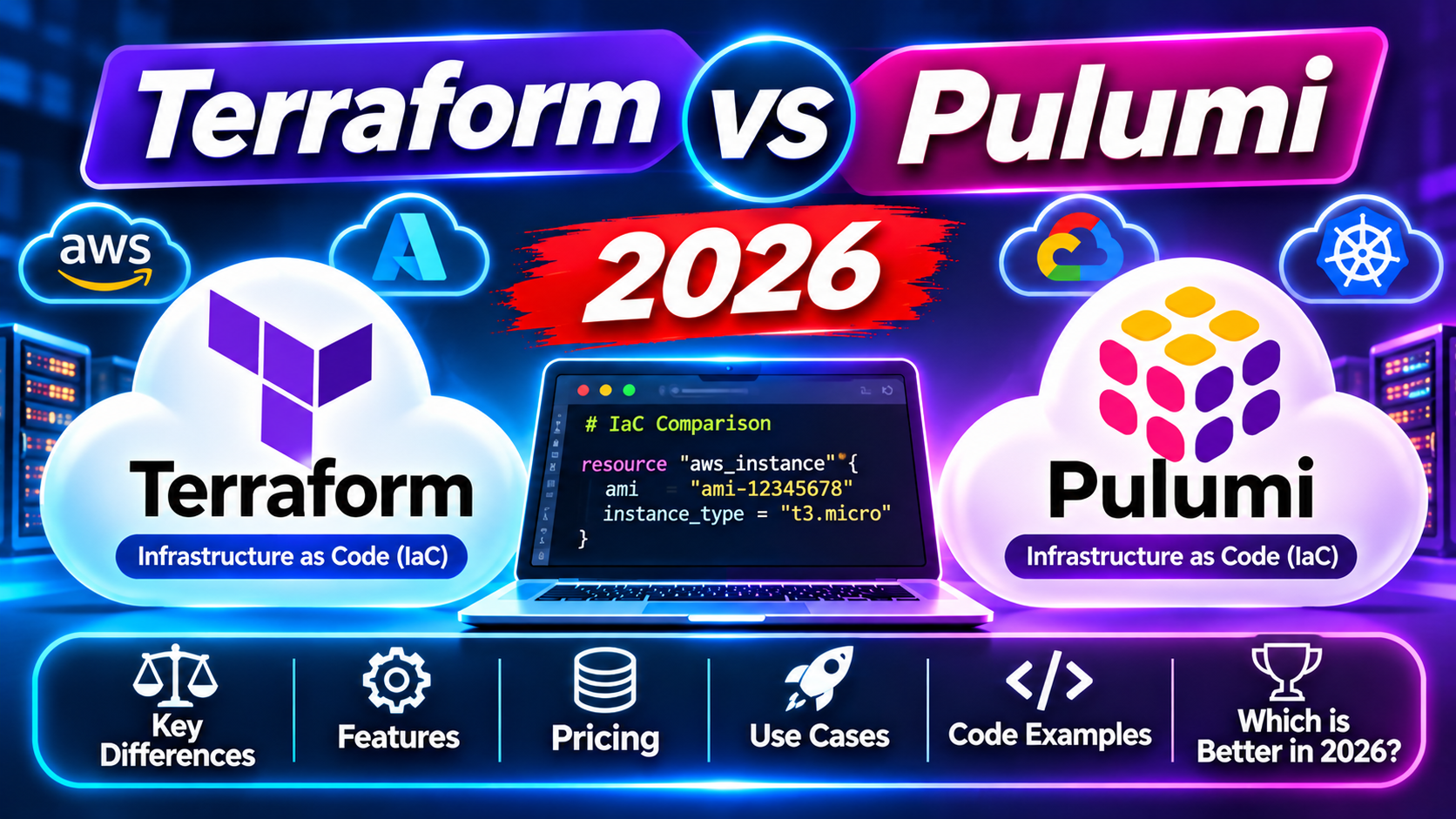
The short answer
Terraform wins on ecosystem maturity, provider coverage, and hiring. Pulumi wins on expressiveness because your infrastructure is real code in Python, TypeScript, or Go. For teams starting fresh in 2026, Pulumi is the pragmatic pick if you already code daily. For teams with existing Terraform or needing audit-friendly declarative state, stay on Terraform.
I shipped production infrastructure on both tools this year. Terraform on AWS for a client with 40 services across three environments. Pulumi on GCP for a startup that wanted test coverage on their infra code. The experience was different enough that I would not call this a draw.
This guide compares syntax, state management, testing, drift detection, and cost at scale. You will see the actual code side by side and the decision tree we use when we onboard a new team.
Same resource, two syntaxes
An S3 bucket in Terraform HCL:
resource "aws_s3_bucket" "logs" {
  bucket = "my-app-logs-${var.env}"
  tags = {
    Environment = var.env
    Team        = "platform"
  }
}
The same bucket in Pulumi Python:
import pulumi
from pulumi_aws import s3

config = pulumi.Config()
env = config.require("env")

logs = s3.Bucket(
    "logs",
    bucket=f"my-app-logs-{env}",
    tags={"Environment": env, "Team": "platform"},
)
Terraform’s HCL is purpose-built and reads clean for simple cases. Pulumi gives you real variables, loops, and functions without the gymnastics of HCL’s dynamic blocks or for_each.
State management
Terraform state is a JSON file. Local by default, remote in S3 or Terraform Cloud for teams. State locking prevents concurrent apply. Importing existing resources is a well-documented flow.
Pulumi defaults to Pulumi Cloud (hosted, free tier for individuals). You can self-host state in S3 or Azure Blob. The import story is comparable, with a UI in Pulumi Cloud that helps.
For teams worried about vendor lock-in, both tools let you switch backends. Terraform’s open-core model gives you more off-ramp options today.
Provider ecosystem
Terraform has official providers for every major cloud plus several hundred third-party ones (Cloudflare, GitHub, Datadog, PagerDuty, Stripe). The registry is the deepest in the IaC space.
Pulumi wraps Terraform providers under the hood for most third-party integrations, so coverage is close to parity. For bleeding-edge AWS features, Terraform tends to get them first by weeks.
Testing
This is where Pulumi pulls ahead for teams that take infrastructure seriously. You write pytest or Jest tests against your infrastructure definitions. Mock providers let you assert that a bucket has encryption enabled, a VPC has the right CIDR, or a Lambda function is wired to the correct event source. All before anything deploys.
def test_bucket_encrypted():
    stack = infra.create_stack()
    bucket = next(r for r in stack.resources if r.type == "aws:s3/bucket:Bucket")
    assert bucket.server_side_encryption_configuration is not None
Terraform has Terratest (Go-based) for integration tests but lacks a first-class unit testing story. The gap is real.
Drift detection
Both tools detect drift when you run plan or preview. Pulumi Cloud has automated drift detection as a background job; Terraform Cloud has the same feature on paid tiers. If you are self-hosting, you write a cron that runs terraform plan -detailed-exitcode and alerts on changes.
Hiring and team ramp
Terraform engineers are easier to find and cheaper to hire. Most DevOps job descriptions list Terraform; a minority list Pulumi. For teams that need to scale headcount quickly, this matters more than any technical difference.
Pulumi ramp for an experienced Python or TypeScript developer is faster than Terraform ramp for the same person. They are already fluent in the language; they just need to learn the resource model.
Cost
Both open-source cores are free. Terraform Cloud starts at $20 per user per month beyond the free tier. Pulumi Cloud is free for individuals and small teams, paid tiers start at $75 per user per month for team features.
If you self-host state, both tools cost only the storage (pennies per month for state in S3). The paid tiers buy you policy enforcement, team SSO, audit logs, and support.
When to pick Terraform
Pick Terraform if you have existing Terraform modules or hiring constraints. If your team includes non-developers (SREs, security engineers) who prefer declarative configuration, HCL is friendlier than full programming languages.
Pick Terraform if you need maximum auditability. The declarative model makes it easier to prove what the infrastructure will look like after a change, because you cannot embed arbitrary logic that only runs at apply time.
When to pick Pulumi
Pick Pulumi if your team codes daily and you want testable infrastructure with real abstractions. The ability to write a function that builds a complete microservice stack, with parameters, is powerful and reduces the gap between application code and infrastructure code.
Pick Pulumi if you want strong typing (TypeScript or Go). Catching a wrong resource property at compile time beats catching it in apply failure.
Common pitfalls to avoid
- Checking in state files to git. State contains sensitive values and can leak credentials. Use remote state from day one.
- Running apply without plan first. Both tools make dry-run cheap and essential; skipping it leads to surprises in production.
- Mixing manual console changes with IaC. Drift piles up and the first apply that notices wipes your manual edits. Enforce IaC as the only source of truth.
- Over-modularizing early. Start with flat files; extract modules when you have a clear second use case. Premature abstraction creates coupling that is painful to unwind.
- Using count instead of for_each on Terraform resources that may be removed from the middle of a list. Indices shift and resources rebuild unexpectedly.
Which tool fits your team size
For a solo engineer or team of 2 to 3 shipping fast, Pulumi’s expressiveness pays off because you can write reusable infrastructure functions in your existing language. For a team of 5 plus with mixed skill levels, Terraform’s declarative HCL reduces the chance of someone writing clever code that nobody else can maintain.
Frequently asked questions
Can I migrate from Terraform to Pulumi?
Yes. Pulumi ships a converter that turns HCL into Python, TypeScript, or Go source. Expect some manual cleanup for complex modules, but the import flow handles state transfer so your deployed resources stay put.
Which is faster to apply changes?
About the same. Both tools parallelize resource creation and respect dependency graphs. For a 200-resource stack, expect 3 to 8 minutes depending on the cloud provider’s own latency. Neither tool is the bottleneck.
Does Pulumi support Kubernetes resources?
Yes, natively. The @pulumi/kubernetes package handles Deployments, Services, Ingresses, and custom resources. You can also import existing YAML with pulumi.yaml. Terraform does the same via the kubernetes provider.
What about CDK for Terraform (CDKTF)?
CDKTF lets you write Terraform in Python, TypeScript, Java, C#, or Go. It is closer to Pulumi’s model but still generates HCL under the hood. It is maintained by HashiCorp but has smaller adoption than either Terraform HCL or Pulumi.
Which one has better secrets handling?
Pulumi has first-class config secrets with encryption at rest in state. Terraform requires you to be careful: sensitive = true on variables helps, but state can still leak values if misconfigured. Both support external secret stores like AWS Secrets Manager.
Can I use both in the same organization?
Yes, and many teams do. Platform infra on Terraform, application infra on Pulumi. Or Terraform for legacy, Pulumi for greenfield. The tools do not conflict as long as they manage different resources.