
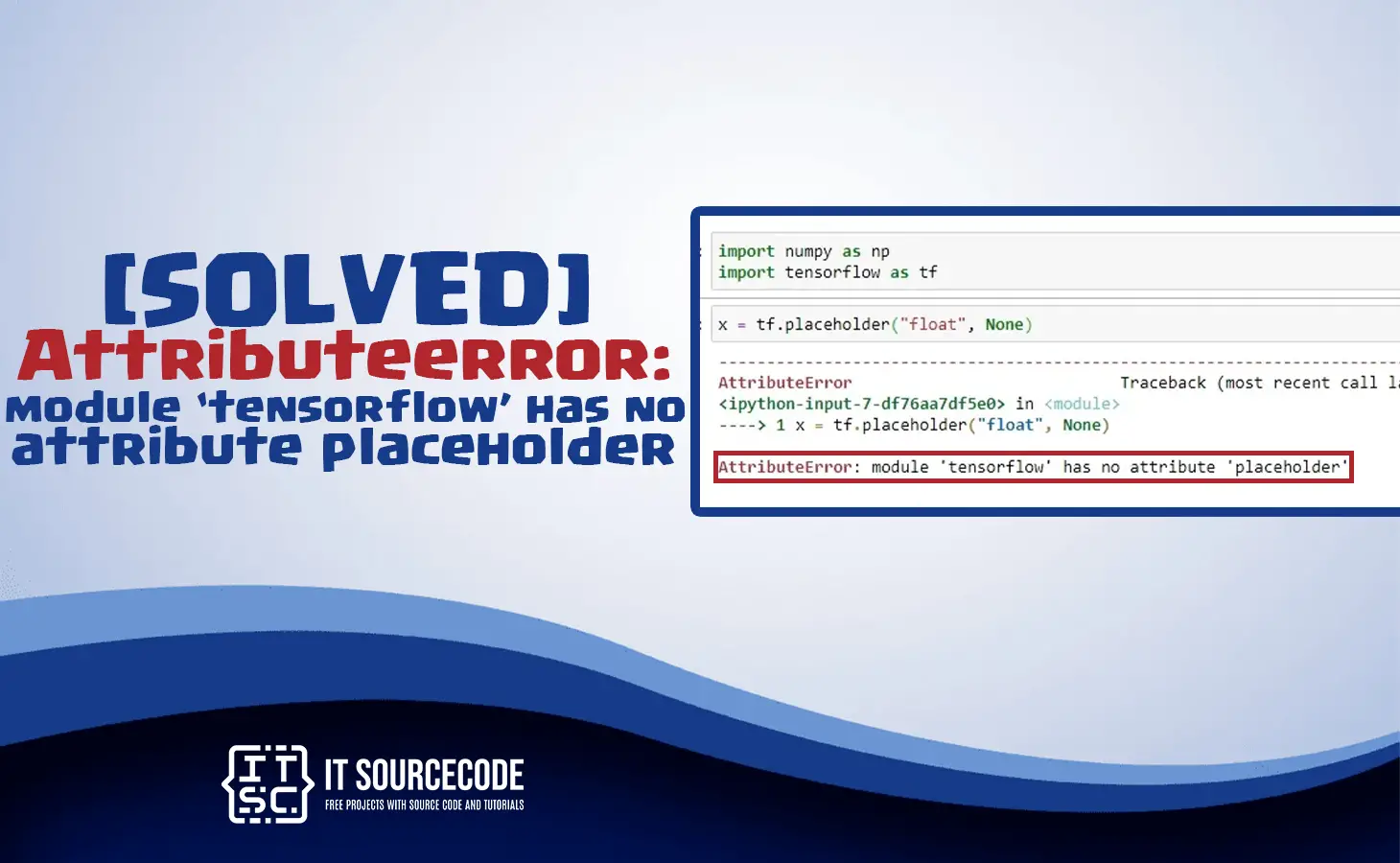
The Attributeerror: module tensorflow has no attribute placeholder is an error message that suggests when you are trying to access the function tf.placeholder, but it does not exist in the TensorFlow version that has been installed in your computer.
In TensorFlow 2.x, tf.placeholder has been replaced and removed with the tf.Tensor objects. Rather than using the tf.placeholder, you can create a tf.Tensor with the tf.constant function and can change later by its value by just passing it to the feed_dict argument in a TensorFlow session’s run method.
The following is an example of how to use the tf.constant:
import tensorflow as tf

# Create a Tensor with a default value
x = tf.constant(20, dtype=tf.int32)

# Evaluate the Tensor in a TensorFlow session
with tf.Session() as sess:
  print(sess.run(x)) # Output: 20
In some instances, you can use alternatively the tf.Variable objects, that can allow you to change the value during the course of the TensorFlow session.
Example
import tensorflow as tf

# Create a TensorFlow variable
x = tf.Variable(20, dtype=tf.int32)

# Initialize the variable
init = tf.global_variables_initializer()

# Evaluate the variable in a TensorFlow session
with tf.Session() as sess:
  sess.run(init)
  print(sess.run(x)) # Output: 20
Solution – Attributeerror: module TensorFlow has no attribute placeholder
The following are the alternative solutions for the Attributeerror: module TensorFlow has no attribute placeholder:
- Disable the Tensorflow 2. x behavior
- Complete the program code conversion from 1. x to 2. x
- Downgrade the version of TensorFlow
Disable the Tensorflow 2. x behavior
Tensorflow 2.x also provides an option to disable the behavior of the tf tf.disable v2_behavior. You just need to import the tensorflow.compat.v1 and simply disable the v2_behavior in the code of the program. You will just need to add two lines of code to your program. But always make sure that the other part of the code that you write or be used should be in the TensorFlow 1. x.
#import the TensorFlow
import tensorflow.compat.v1 as tf

#disable the tf.disable_v2_behavior()
tf.disable_v2_behavior()
Complete the program code conversion from 1. x to 2. x
Since you have already installed on your computer the TensorFlow 2.0 x version and you want to run 1. x and the supportive code as well. Consequently when you are getting this attributeerror. Once we convert our code from 1. x to 2. x so there will be no error in our program. Don’t worry about it because it is very easy and the compatibility script is provided by TensorFlow 2. x.
Just simply use the following command below.
tf_upgrade_v2 \
  --intree code/ \
  --outtree code_v2/ \
  --reportfile text.txt
Downgrade the version of TensorFlow
You can simply downgrade the TensorFlow existing version to 1. x. The following is the below command.
pip install tensorflow==1.15.5
Python Error-Related Articles
- ModuleNotFoundError: No Module Named Termcolor
- Modulenotfounderror: No Module Named ‘Pandas’
- ModuleNotFoundError: No Module Named django_heroku
- Modulenotfounderror: No Module Named Requests
- Modulenotfounderror: No Module Named Numpy
Conclusion
I hope this article has helped you solve your problem about the Attributeerror: module TensorFlow has no attribute placeholder. Check out my previous and latest articles for more life-changing tutorials which could help you a lot.
TensorFlow AttributeError patterns
TensorFlow AttributeErrors most often come from API changes between TF 1.x and 2.x, Keras deprecations, or the tf.compat module.
Common triggers
- TF 1.x code in TF 2.x.
tf.Session(),tf.placeholder()are TF 1.x — moved under tf.compat.v1 in TF 2.x. - Keras standalone vs tf.keras.
from keras.models import ...is standalone Keras;from tensorflow.keras.models import ...is bundled. Do not mix. - Removed features. Many TF 2.x releases dropped experimental APIs. Check the release notes.
- Tensor vs eager tensor. Some methods only work on eager tensors (default in TF 2.x).
Diagnostic pattern
# BAD — TF 1.x pattern in TF 2.x
import tensorflow as tf
sess = tf.Session()  # AttributeError: module 'tensorflow' has no attribute 'Session'

# GOOD — TF 2.x uses eager execution by default
import tensorflow as tf
result = tf.constant([1, 2, 3]) * 2  # runs immediately

# Or explicitly use TF 1.x compat
tf.compat.v1.disable_eager_execution()
sess = tf.compat.v1.Session()
Best practices
- Use TF 2.x eager execution for new code. TF 1.x graph mode is legacy.
- Use tf.keras, not standalone Keras. Bundled with TensorFlow — better integration.
- Check version.
tf.__version__before debugging any API issue. - Consider PyTorch for new projects. Cleaner API, better debugging.
Official documentation
Frequently Asked Questions
What is Python AttributeError and what causes it?
AttributeError is raised when you access an attribute or method that doesn’t exist on the object. Most common cause: calling a method on None (NoneType has no attribute X). Other causes: typo in method name, wrong object type (str when you expected list), or using a feature removed in a newer library version. The error names exactly which type and which missing attribute.
How do I fix ‘NoneType object has no attribute’?
The variable you’re accessing is None, but you expected an object. Trace back to where it was assigned: a function returning None instead of an object (forgot to return), a database query returning no rows (Model.objects.first() returns None when empty), or an API call that failed silently. Safe pattern: if obj is not None: obj.method() OR use the walrus operator: if (obj := get_obj()): obj.method().
How do I check if an attribute exists before accessing it?
Use hasattr(obj, ‘attr_name’) for runtime check, or getattr(obj, ‘attr_name’, default) to get-with-default. For frequent attribute checks, consider type hints + mypy/pyright which catch most AttributeErrors at static-analysis time before runtime.
How do I prevent AttributeError from None values?
Three patterns: (1) Always validate function returns (if result is None: raise). (2) Use type hints with Optional[X] to make None-ability explicit. (3) Use the walrus operator + early return: if (val := get_val()) is None: return default; use val. Defensive coding around None-able returns prevents 90% of AttributeError in production.
Where can I find more AttributeError fixes?
Browse the AttributeError reference hub for 170+ specific fixes (NoneType, pandas, NumPy, sklearn, Selenium). For related errors see TypeError. For Python debugging fundamentals see Python Tutorial hub.

Glenn Azuelo
Programmer & Technical Writer at PIES IT Solution
Glenn Azuelo is a programmer and writer at PIES IT Solution, author of 40+ PHP tutorials at itsourcecode.com.
Expertise: PHP, Java, Windows Forms, Python, Pygame, Capstone Projects · View all posts by Glenn Azuelo →