
The Online Examination System Sequence Diagram is a UML diagram that shows the sequence of events that should be present in the Online Examination System.
Furthermore, this sequence diagram for the online examination system gives enlightenment and a guide to the programmers and developers on how they should build the system. The idea presented in a sequence diagram will improve the efficiency of the Online Examination System’s development.
Moreover, The idea of the online examination method is to assess students’ subject understanding. In comparison to the traditional pen-and-paper examination, such a technique avoids logistical issues and disadvantages.
How to create a Sequence Diagram for Online Examination System
Now, to create the sequence diagram for the online examination system, you must first be familiar with its symbols. This is to know how you would emphasize the whole content of your online examination system. With the symbol’s familiarization, you’ll then easily understand the ways of the system’s development.
Also, for a better understanding of system development, there are a lot of UML diagrams available on this site. Because aside from the system sequence diagram, there are still use cases, activities, and other essential diagrams needed.
Simple (UML) Online Examination System
Now in this article, I will be showing you the sequence illustration of the online examination system. This design will enlighten you on how the system and the actor should approach each other. This will also teach you how to develop the system to achieve its desired behavior.
Sequence Diagram for Online Examination System Design
The design that I will be showing you is a detailed illustration of the sequence of events that happen in the Online Examination System.
This carefully designed sequence diagram is able to show programmers and readers about the sequence of messages between the actor and the objects.
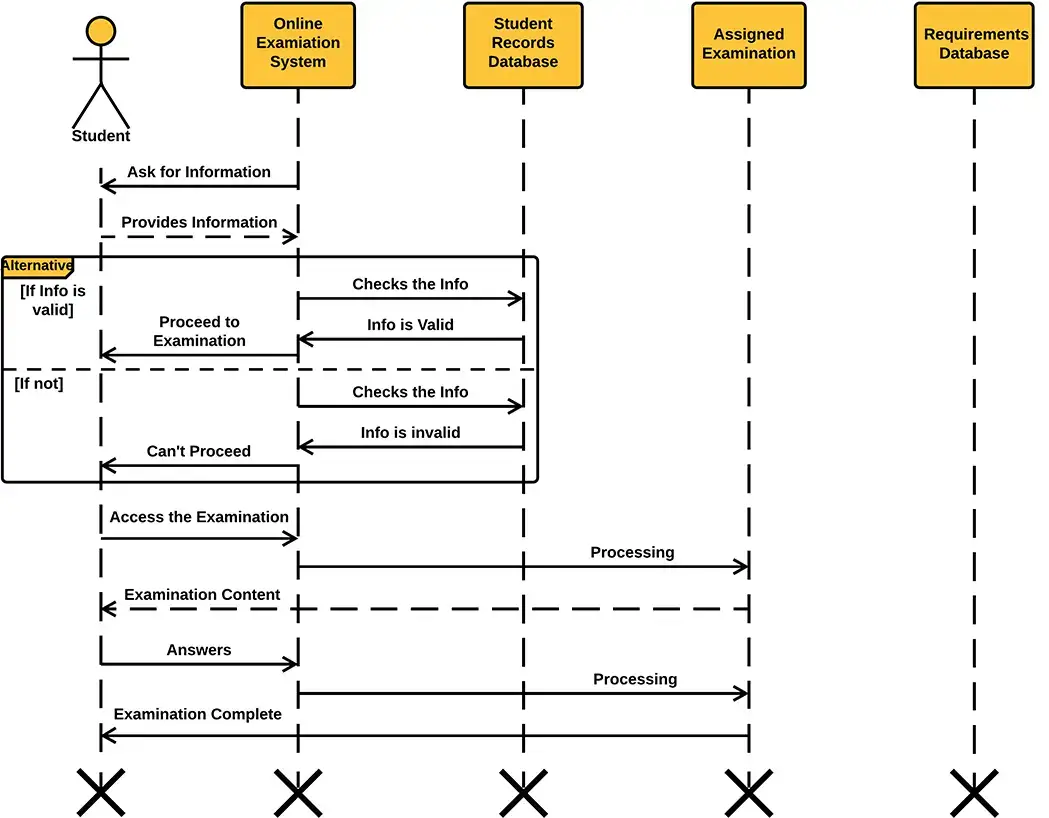
As you can see in the illustration, the conditions and interactions are emphasized. These interactions are essential for the development of the online examination system.
The series of messages is shown and labeled to guide you in building an online examination system. You can modify the design if you have more ideas. You can also add more features to this design and use it as your project blueprint.
You’ll be able to understand and educate yourself on how the online examination system works by creating a sequence diagram. because it determines the needed objects, actors, and messages and their interactions.
Additional Knowledge on Online Examination System
A computer-based test system that may be used to conduct computer-based tests online is known as an “online examination system.” This test method requires fewer resources and eliminates the need for question papers and answer scripts, as well as exam room scheduling, invigilator coordination, and more.
Alternatively, candidates taking online tests must complete the questions within a set time limit. Once the exam is completed, the test window closes, and institutes receive real-time reports. Evaluators rate the responses based on their evaluation.
Online examination systems can imply savings in both time and money. The saving of time and money spent is also the most significant benefit of doing an online examination. It can improve security and privacy and is environmentally friendly. Both teachers and students will find it very useful.
Conclusion
The online examination system is a sort of interaction sequence diagram that shows how a group of items interacts and in what order. Software engineers and business experts use these diagrams to understand the requirements for a new system or to describe an existing process.
In addition, this online examination system must have a designed diagram to define event sequences that will result in a desired outcome. The context in which communications appear is more important than the message itself. The majority of sequence diagrams, on the other hand, will show what messages are transmitted and in what order they usually occur.
And that completes our discussion, fellas! And I hope that this article about the online examination system will help you a lot.
Related Articles
- Online Examination System UML Diagrams
- Online Examination System Use Case Diagram | UML
- Online Examination System Class Diagram | UML
- Activity Diagram for Online Examination System
Inquiries
If you have inquiries or suggestions about the Online Examination System Sequence Diagram, just leave us your comments below. We would be glad to hear your concerns and suggestions and be part of your learning.
How to read a sequence diagram
A sequence diagram shows the messages exchanged between objects over time, top to bottom. Each object has a vertical lifeline (dashed line); messages are horizontal arrows between them.
- Lifeline. Vertical dashed line representing the object’s presence during the interaction.
- Activation bar. Thin rectangle on a lifeline showing when the object is actively processing.
- Synchronous message. Solid arrow with filled triangle — sender waits for a return.
- Asynchronous message. Solid arrow with stick arrowhead — sender does not wait.
- Return message. Dashed arrow with stick arrowhead going back to the sender.
Combined fragments (control flow)
- alt. Alternative paths (if/else).
- opt. Optional path.
- loop. Repeated messages.
- par. Parallel execution.
Common capstone mistakes
- Missing return messages. Every synchronous call needs a return arrow.
- Wrong order. Top-to-bottom = time order.
- Too many objects. Focus on one use case per sequence diagram.
- No control-flow fragments. Use alt/opt/loop.
Where the sequence diagram fits
- Section 3.2 (System Design).
- One per major use case.
- Reference the use case.
Official documentation
Working source code for this system
Download the actual implementation of this system in your preferred language. Each project includes source code, database, and setup instructions for BSIT capstone use.
- PHP: Online Examination System in PHP with Free Source Code
- VB.NET: Mini Quiz System Using Visual Basic 2013
- Java: Quiz Management System Project In Java With Source Code
- Python: Django Online Examination System with Source Code
- Django: Django Online Examination System with Source Code
- Laravel: Online Quiz Management System Project in Laravel with Source Code
Frequently asked questions
What is a sequence diagram used for in BSIT capstone?
A sequence diagram shows how objects interact over time to accomplish a specific use case: the messages, calls, and return values in chronological order. It complements the use case and class diagrams in Chapter 3.
What tool should I use to draw the sequence diagram?
Free options: draw.io (browser-based, saves to Google Drive), Lucidchart free tier, PlantUML (text-based, version-controllable), StarUML (30-day trial then reduced feature set), Visual Paradigm Community Edition. Paid options: Microsoft Visio, Lucidchart pro, Enterprise Architect. For BSIT capstones, draw.io is the most commonly used free tool.
How detailed does the sequence diagram need to be for capstone defense?
Panel members expect the diagram to match the actual system implementation. Include every major class/use case/entity relevant to the system. Omit trivial helper classes. Every diagram element should have a clear justification. Aim for 1-2 diagrams that fully cover the system, not many partial ones.
Should I use black-and-white or colored diagrams?
Black-and-white is standard for capstone documentation to match the thesis format. Use color only if it improves clarity (e.g., grouping subsystems). Ensure text is readable at printed size (10pt minimum for labels).
Where does this diagram go in the capstone documentation?
Chapter 3 (System Design and Methodology) typically holds all UML diagrams. Introduce each diagram with a 1-paragraph description explaining what it shows and how to read it. Reference specific elements in the surrounding text so panel members can follow the design rationale.

Mary Grace G. Patulada
Programmer & Technical Writer at PIES IT Solution
Mary Grace G. Patulada (pen name ‘Nym’) is a programmer and writer at PIES IT Solution with a BSIT background from Carlos Hilado Memorial State College, Binalbagan Campus. Authored 370+ UML diagram tutorials and capstone documentation guides at itsourcecode.com. Specializes in UML (class, use case, activity, sequence, component, deployment), DFD, and ER diagrams for BSIT capstone projects.
Expertise: UML Diagrams · DFD · ER Diagrams · Use Case Diagrams · Activity Diagrams · Capstone Documentation · PHP
· View all posts by Mary Grace G. Patulada →