
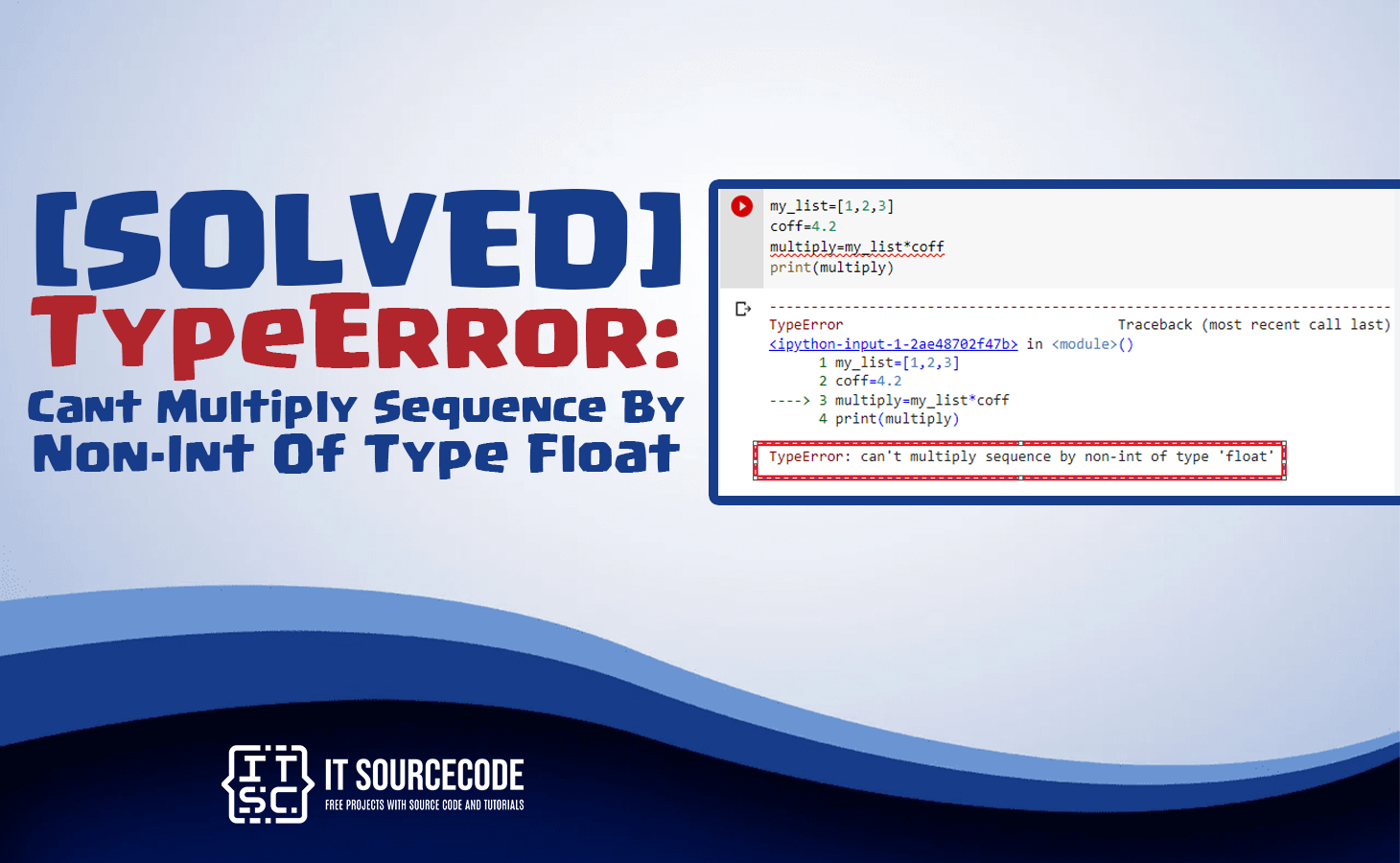
The “TypeError: Cant Multiply Sequence By Non-Int Of Type Float” error usually occurs in Python when you attempt to multiply a sequence (e.g., a list or a string) by a floating point number, which is not permitted in Python.
Why Can’t Multiply Sequence By Non-Int Of Type ‘Float’?
This is because a sequence can only be multiplied by an integer, and the result of the multiplication is a repetition of the sequence. If you try to multiply a sequence by a floating-point number, Python will throw a TypeError to indicate that the operation is not supported.

Here’s an example to demonstrate this error:
>>> my_list = [1, 2, 3]
>>> my_list * 2.5
Traceback (most recent call last):
  File "<stdin>", line 1, in <module>
TypeError: can't multiply sequence by non-int of type 'float'
How To Fix This Error?
To fix this error, you need to convert the floating-point number to an integer before multiplying the sequence. For example:
>>> my_list = [1, 2, 3]
>>> my_list * int(2.5)
[1, 2, 3, 1, 2, 3]
Conclusion
The “TypeError: Cant Multiply Sequence By Non-Int Of Type Float” error usually occurs in Python when you attempt to multiply a sequence which is not permitted in Python. To avoid this error, you need to convert the floating-point number to an integer before multiplying the sequence.
Related Articles
- Modulenotfounderror: no module named corsheaders
- Attempted Relative Import With No Known Parent Package
- ModuleNotFoundError: no module named django_heroku mac m1
Inquiries
By the way, if you have any questions or suggestions about this python error tutorial, please feel free to comment below.
Understanding int/str/float TypeErrors
Python separates numeric types from strings strictly. Concatenating, comparing, and arithmetic across type boundaries requires explicit conversion.
Common triggers
- User input is always str.
input()always returns str. Wrap withint()orfloat(). - CSV cells are all str. Even numeric-looking columns are strings until converted.
- JSON numbers vs str. json.loads preserves the JSON type — but only “123” as string in the JSON becomes str in Python.
- Format string mismatch.
"%d" % "5"raises TypeError. Useint("5")first. - Compare int and str. Python 3 fails on
"1" < 2. Convert one side first.
Diagnostic pattern
# BAD — user input treated as int
age = input("Enter your age: ")
if age >= 18:  # TypeError: '>=' not supported between 'str' and 'int'
    print("Adult")

# GOOD — convert first, guard failure
try:
    age = int(input("Enter your age: "))
except ValueError:
    print("Invalid age")
    age = 0

if age >= 18:
    print("Adult")
Best practices
- Convert at boundaries. Convert input, config values, and API responses to the right type immediately after loading.
- Use pydantic or dataclasses. Modern data validation libraries convert and check types automatically.
- Avoid == across types. Compare like-to-like.
Official documentation
Frequently Asked Questions
What is Python TypeError and what causes it?
TypeError is raised when an operation is applied to an object of the wrong type. Common patterns: calling a non-callable object, adding incompatible types (str + int), passing the wrong number of arguments, or accessing attributes on a NoneType. Each TypeError message names the operation and expected vs actual types, the fix is almost always to convert types explicitly (int(), str()) or fix the wrong variable assignment.
How do I quickly debug a Python TypeError?
Three steps: (1) Read the full error message, it names the exact operation and types involved. (2) Print the type of every variable in that line: print(type(var1), type(var2)). (3) Check what the function expected vs what you passed. Most TypeError fixes are 1-line type casts or fixing a variable that became None unexpectedly.
Should I catch TypeError or let it propagate?
For internal code, let TypeError propagate, it’s almost always a real bug (wrong type passed). For boundary code (parsing user input, third-party API responses), catch TypeError + ValueError together: try: parsed = int(value) except (TypeError, ValueError): parsed = 0. Catching internal TypeErrors hides bugs.
How do I prevent TypeError in production?
Three patterns: (1) Use type hints (def add(a: int, b: int) -> int) and check with mypy / pyright in CI. (2) Validate inputs at boundaries (Pydantic for FastAPI, DRF serializers for Django). (3) Default values that match expected types (return 0 not None for numeric functions). Static typing catches 80% of TypeErrors before runtime.
Where can I find more TypeError fixes?
Browse the TypeError reference hub for 220+ specific TypeError fixes. For broader Python debugging, see the Python Tutorial hub. For related error types, see ValueError and AttributeError guides.

Angel Jude Suarez
Full-Stack Developer at PIES IT Solution
Focuses on Python development, machine learning, and AI integration. Has built production AI systems including OpenAI Whisper integration for medical transcription and GPT-4o-powered diagnosis assistance. Strong background in pandas, scikit-learn, and TensorFlow.
Expertise: Python · PHP · Java · VB.NET · ASP.NET · Machine Learning · AI Integration · OpenCV · Django · CodeIgniter
· View all posts by Angel Jude Suarez →
how to access a database in this your proyect help pls https://itsourcecode.com/free-projects/python-projects/student-management-system-project-in-django-with-source-code/
To access database in Django you need to download sqlite server