
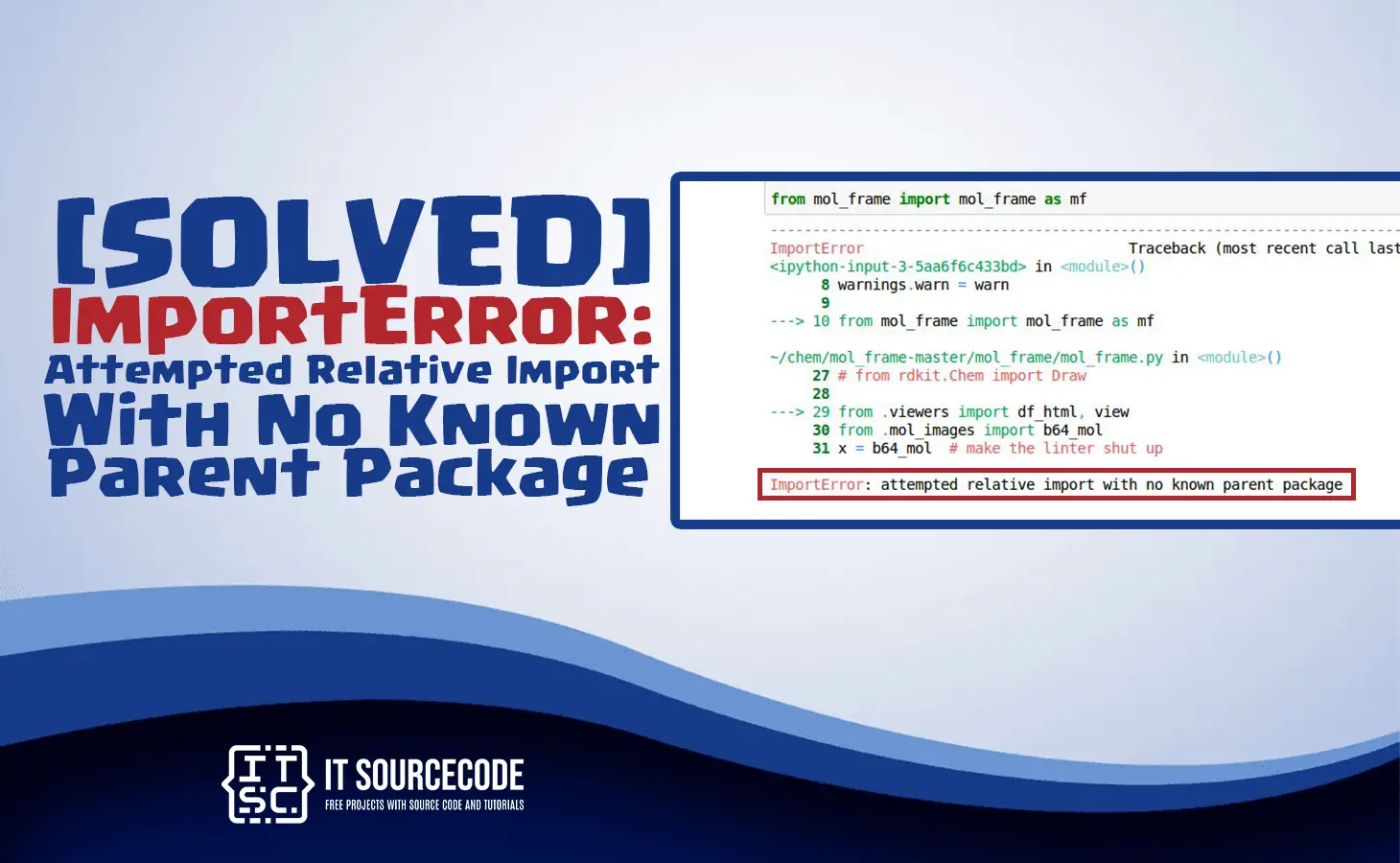
The ImportError: Attempted Relative Import With No Known Parent Package error occurs in Python when a relative import is attempted from a module that is not part of a package.
Relative imports are used in Python to import modules from the same package. A relative import, on the other hand, is not possible if the module is not part of a package. An absolute import must be used instead.

Here’s an example on how you might encounter this error:
# file: my_module.py
from . import myothermodule
If ‘my_module.py‘ is run as a standalone script, it will raise the following error:
ImportError: Attempted relative import with no known parent packageHow to fix ImportError: Attempted Relative Import With No Known Parent Package Error?
To fix this error, you can either move the ‘my_module.py‘ into a package or use an absolute import instead:
# file: my_module.py
import myothermodule
Alternatively, if you want to use a relative import, you can create an init.py file in the same directory as my_module.py, which will turn that directory into a Python package.
Conclusion
The ImportError: Attempted Relative Import With No Known Parent Package error occurs in Python when a relative import is attempted from a module that is not part of a package.
To fix this error, you can either move the python file into a package or use an absolute import instead.
Related Python Tutorials
- Python Import From Parent Directory In Simple Way
- Python Module Vs Package Vs Library
- Python Import Class From Another File With Examples
- Solved Python No Module Named Error
- Modulenotfounderror No Module Named Attrdict Solved
- Modulenotfounderror No Module Named Gensim Solved
Inquiries
By the way, if you have any questions or suggestions about this python error tutorial, please feel free to comment below.
Common use cases for Attempted Relative Import With No Known Parent Package
- Data pipelines. Python is the standard for ETL, data analysis, and ML workflows.
- Web development. Django and FastAPI power modern web backends and APIs.
- Automation and scripting. System administration, file processing, web scraping, and cron jobs.
- Machine learning. scikit-learn, PyTorch, TensorFlow, Hugging Face for AI/ML projects.
- Educational tools. Python’s readability makes it the go-to teaching language.
Working code example
from typing import Optional

def process_data(items: list[dict]) -> Optional[dict]:
    """Process a list of items and return summary stats."""
    if not items:
        return None
    return {
        "count": len(items),
        "total": sum(item.get("value", 0) for item in items),
        "avg": sum(item.get("value", 0) for item in items) / len(items),
    }

# Usage
data = [{"value": 10}, {"value": 20}, {"value": 30}]
summary = process_data(data)
print(summary)  # {'count': 3, 'total': 60, 'avg': 20.0}
Best practices
- Use type hints. list[dict], Optional[str], and TypedDict make code self-documenting and enable static analysis.
- Follow PEP 8. Consistent style improves readability. Use black or ruff to auto-format.
- Prefer f-strings. f”{value}” is cleaner than str.format() or % formatting.
- Write tests with pytest. Aim for 70%+ coverage on business-critical modules.
- Use ruff or pylint. Static analysis catches many bugs before code runs.
Common pitfalls
- Mutable default arguments. def f(x=[]) reuses the same list across calls. Use x=None then check.
- Integer division. 5/2 gives 2.5 in Python 3. Use // for floor division.
- Missing self on methods. Class methods need self as first parameter.
- Late binding closures. Loops that create lambdas can capture variables late.
Debugging Python code effectively
- print() with context. Add variable names and types: print(f”user_id={user_id} type={type(user_id)}”)
- pdb / breakpoint(). Call breakpoint() anywhere to drop into interactive debugger.
- VS Code debugger. Set breakpoints in the editor, run F5, step through with F10.
- logging over print. import logging; logging.debug() is toggleable and thread-safe for production.
- Read full tracebacks. The bottom-most line usually shows what happened; the stack shows how you got there.
Modern Python tooling
- uv. Ultra-fast package installer and resolver (10-100x faster than pip). Standard in 2026.
- ruff. Fast linter + formatter (replaces flake8, black, isort in one binary).
- mypy. Type checker. Add types incrementally to catch bugs at design time.
- pytest. Standard test framework. Simpler than unittest.
- rich. Beautiful terminal output for CLI tools.
Where to go next after this tutorial
- Learn a web framework. Django for full-stack apps; FastAPI for APIs; Streamlit for data dashboards.
- Study a data library. pandas for data analysis; polars for large-scale processing; DuckDB for embedded SQL analytics.
- Practice with real projects. Browse itsourcecode.com Python Projects for 250+ capstone-ready systems (LLM apps, ML models, chatbots, dashboards).
- Read PEP 20 (Zen of Python). import this in an interpreter to see 19 lines of Python philosophy.
Official documentation
Frequently Asked Questions
What Python version does this tutorial target?
How do I install Python for this tutorial?
Do I need pip and virtual environments?
Can I use this in a Jupyter notebook or Google Colab?
Where can I find more Python practice projects?

Angel Jude Suarez
Full-Stack Developer at PIES IT Solution
Focuses on Python development, machine learning, and AI integration. Has built production AI systems including OpenAI Whisper integration for medical transcription and GPT-4o-powered diagnosis assistance. Strong background in pandas, scikit-learn, and TensorFlow.
Expertise: Python · PHP · Java · VB.NET · ASP.NET · Machine Learning · AI Integration · OpenCV · Django · CodeIgniter
· View all posts by Angel Jude Suarez →