

What is Color Dialog Box in VB.net?
The Color Dialog Box in VB.net is used to show the Color Dialog Box and let the Microsoft Windows Application user choose colors.
It lets users change or set the color of an object, like the color of a control’s background or the color used to paint an object.
Also, the control dialog box gives the user the option to mix all of the other colors in the Color Dialog Box to make a new color.
We have learned how to use the Dialog Boxes in VB.net in the previous lesson.
In this lesson, we shall learn How To Write a Program for a Color Dialog Box in VB.net.
ColorDialog Box in VB.net Properties
In VB.net, the Color Dialog Box in the Windows Form has the following Properties.
| # | ColorDialog Box in VB.net Properties | Description |
|---|---|---|
| 1. | AllowFullOpen | Gets or sets a value indicating whether the user can use the dialog box to define custom colors. |
| 2. | AnyColor | Gets or sets a value indicating whether the dialog box displays all available colors in the set of basic colors. |
| 3. | CanRaiseEvents | Gets a value indicating whether the component can raise an event. |
| 4. | Color | Gets or sets the color selected by the user. |
| 5. | CustomColors | Gets or sets the set of custom colors shown in the dialog box. |
| 6. | FullOpen | Gets or sets a value indicating whether the controls used to create custom colors are visible when the dialog box is opened. |
| 7. | ShowHelp | Gets or sets a value indicating whether a Help button appears in the color dialog box. |
| 8. | SolidColorOnly | Gets or sets a value indicating whether the dialog box will restrict users to selecting solid colors only. |
ColorDialog Box in VB.net Methods
Here are some of the most common ways that the ColorDialog Box in VB.net Methods is used.
| # | ColorDialog Box in VB.net Methods | Description |
|---|---|---|
| 1. | ShowDialog() | The ShowDialog () method is used to run a common dialog box with the default setting. |
| 2. | Dispose() | The Dispose() method is used to free all resources used by the Control or component in the Color Dialog Box. |
| 3. | Equals() | The Equals() method is used to check whether the current or defined object is the same. |
| 4. | OnHelpRequest() | It is used to call the HelpRequest event in the dialog box. |
| 5. | Reset() | The Reset() method is used to reset all changes to their default values. For example, the last selected color to be black, and the custom color to be their default values. |
| 6. | RunDialog() | It is used to override a derived class to create a common dialog box. |
ColorDialog Box in VB.net Events
Here are some of the most common ways that the ColorDialog Box in VB.net Events is used.
| # | ColorDialog Box in VB.net Events | Description |
|---|---|---|
| 1. | Disposed | When control or component is terminated by calling the Dispose method, a Dispose event occurs. |
| 2. | HelpRequest | When a user clicks the help button of the Color dialog box, the HelpRequest event is called. |
Let’s make a simple program that uses VB.NET Windows Forms to show the Color Dialog Box.
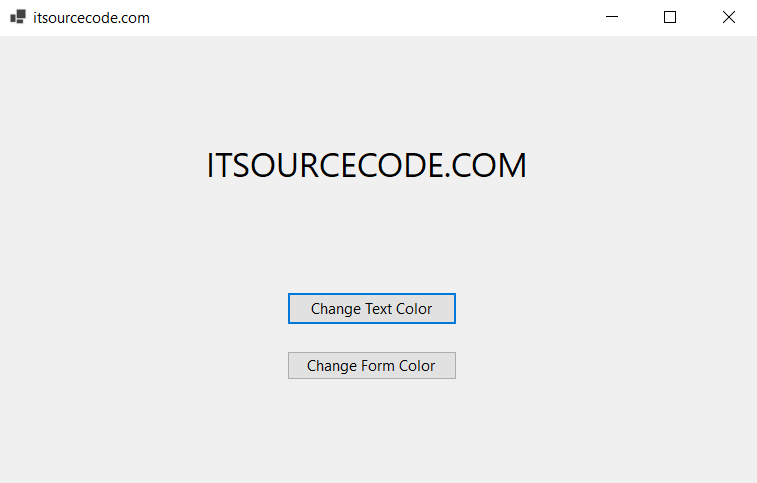
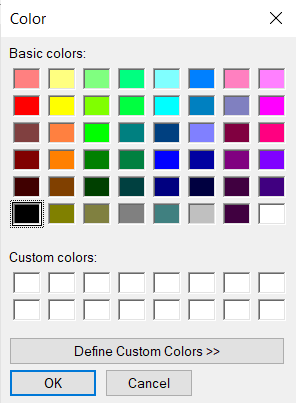
When we click on any of the two buttons, the Color popup window appears, as shown in the image below.
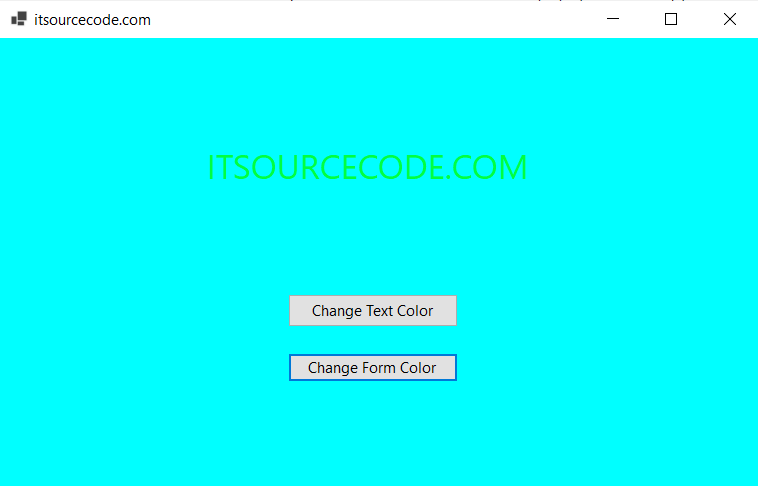
If you click the OK button, the colored Windows Form will appear, as shown below.
Summary
A ColorDialog Control in VB.net lets users open the Windows Color Dialog and choose a solid color or make their own color from the colors that are available.
In this article, we talked about how to use a Windows Color Dialog in a Windows Forms application using Microsoft Visual Studio and how to set its properties.
PREVIOUS

NEXT

Common use cases for Color Dialog Box
Color Dialog Box appears in most Windows Forms applications. Typical scenarios:
- File save operations. Prompt users to pick a target file name and format before writing data.
- File open operations. Let users browse for spreadsheets, images, PDFs, or configuration files to import.
- Font selection. Give users control over typography in rich-text editors, report designers, or accessibility settings.
- Color selection. Used in drawing apps, chart configurators, and theme editors.
- Print previews. Route content to the printer with pagination and margins under user control.
Best practices when using Color Dialog Box
- Always set a default. Users expect a sensible starting value (e.g., the last used color or the current font).
- Handle DialogResult. Check whether the user clicked OK vs Cancel before applying changes.
- Set filters correctly. For file dialogs, restrict extensions to the ones your app actually reads.
- Wrap in Using blocks. Dialog objects hold OS resources; Using ensures cleanup.
- Test on high-DPI monitors. Dialogs render differently at 125% and 150% scaling.
Working code example
Full working example showing Color Dialog Box in a real Windows Forms context:
Private Sub btnPick_Click(sender As Object, e As EventArgs) Handles btnPick.Click
    Using dlg As New OpenFileDialog()
        dlg.Title = "Select a file"
        dlg.Filter = "Text files (*.txt)|*.txt|All files (*.*)|*.*"
        dlg.InitialDirectory = Environment.GetFolderPath(Environment.SpecialFolder.Desktop)

        If dlg.ShowDialog() = DialogResult.OK Then
            Dim contents As String = System.IO.File.ReadAllText(dlg.FileName)
            txtOutput.Text = contents
        End If
    End Using
End Sub
Troubleshooting common issues with Color Dialog Box
- Dialog does not appear. Confirm ShowDialog() is called on the UI thread. Cross-thread invocations must marshal via Control.Invoke().
- File permission errors. Wrap file operations in Try/Catch. UAC-protected folders throw UnauthorizedAccessException.
- Filter string ignored. Filters use the exact “Description|*.ext|Description2|*.ext2” format. A single stray character breaks parsing silently.
- Font not applied. After dialog closes, assign dlg.Font to the target control’s Font property explicitly.
- Print job silently drops. Confirm PrinterSettings.IsValid before calling Print().
Official documentation
Frequently Asked Questions
What is the Color Dialog Box in VB.NET?
How do I show the Color Dialog Box in code?
How do I know if the user clicked OK on the Color Dialog Box?
Why does the Color Dialog Box appear behind my form?
Can I customize the Color Dialog Box appearance?

Angel Jude Suarez
Full-Stack Developer at PIES IT Solution
Focuses on Python development, machine learning, and AI integration. Has built production AI systems including OpenAI Whisper integration for medical transcription and GPT-4o-powered diagnosis assistance. Strong background in pandas, scikit-learn, and TensorFlow.
Expertise: Python · PHP · Java · VB.NET · ASP.NET · Machine Learning · AI Integration · OpenCV · Django · CodeIgniter
· View all posts by Angel Jude Suarez →