
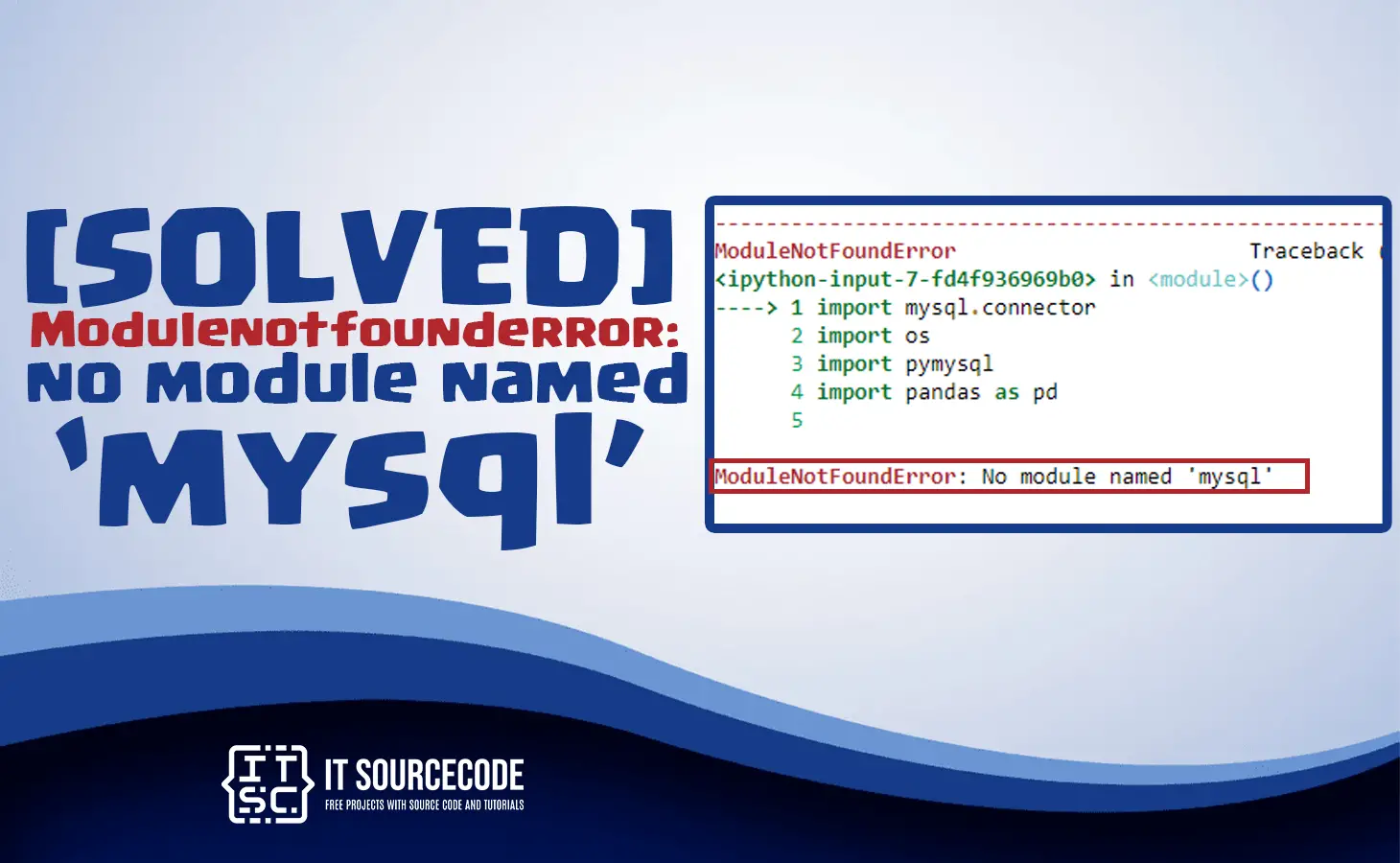
In this article, we will provide detailed solutions on how to solve the error modulenotfounderror: no module named mysql.
Furthermore, the MySQL is one of the systems which applies SQL to manage the data. The ‘no module named mysql’ error has occurred.
If the MySQL is utilized with Python in a Linux, Windows, MacOS, Anaconda, and CentOS.
Moreover, the error no module named ‘mysql appears because the system environment is unable to find the installed mysql.
Also you may read: Modulenotfounderror no module named ‘pygame’
How to solve the no module named mysql?
Time needed: 3 minutes
In your project directory folder open CMD(Command Prompt) and install the mysql-connector-python package.
- Solution 1: Install mysql in Python 2
The following command to install mysql in Python 2:
“pip install mysql-connector-python“ - Solution 2: Install mysql in Python 3
This is the command to install mysql in Python 3:
“pip3 install mysql-connector-python“and Install Pip in Python 3:
“python3 -m pip install mysql-connector-python“
- Solution 3: Install mysql in for Getting Permissions Error
This is the command to install mysql for Getting Permissions Error.
“sudo pip3 install mysql-connector-python“or
“pip install mysql-connector-python –user“
- Solution 4: Install Pip in Path Environment Variable
This is the following command to install the Pip in Path Environment Variable with MySQL.
“python -m pip install mysql-connector-python“ - Solution 5: Install py alias(windows)
This is the following command to install mysql in py alias(windows):
“py -m pip install mysql-connector-python“ - Solution 6: Install in Anaconda
This is the following command to install mysql in Anaconda:
“conda install -c anaconda mysql-connector-python“ - Solution 7: Install in Jupyter Notebook
This is the following command to install mysql in Jupyter Notebook:
“!pip install mysql-connector-python“
The Simple Causes of Error’s:
These are the common reasons that the modulenotfounderror: no module named mysql:
- The “mysql-connector-python” module is not installed.
- You installed the module in a various python version compared to the one you’re using.
- You installed the module globally not within your virtual environment.
- You run the IDE within an incorrect python version.
Read also: Modulenotfounderror: no module named skimage [SOLVED]
Diagnostic checklist for “No module named ‘mysql'”
- Verify pip install target. Run
pip show mysql— if not installed, runpip install mysql. - Check the active Python interpreter.
which python(mac/Linux) orwhere python(Windows). Both pip and python must point to the same environment. - Check virtual environment activation. If you use venv/conda, activate before installing:
source .venv/bin/activate. - Rule out uppercase/lowercase. Python imports are case-sensitive:
import PyPDF2notimport pypdf2. - Rule out the pip-vs-package-name mismatch. Some packages install under a different name than you import (e.g.
pip install beautifulsoup4→import bs4).
Installing mysql
# Standard pip install
pip install mysql

# In a virtual environment (recommended)
python -m venv .venv
source .venv/bin/activate  # or .venv\Scripts\activate on Windows
pip install mysql

# With uv (faster alternative)
uv pip install mysql
Common causes for “No module named ‘mysql'”
- Python interpreter mismatch. Multiple Python installations can confuse pip. Verify with
which pythonandwhich pip. - Virtual environment not activated. If the venv isn’t activated, pip installs to your system Python instead.
- Notebook kernel mismatch. Jupyter uses a kernel that may differ from your terminal Python. Use
%pip install mysqlinside the notebook. - Import name differs from install name. pip install beautifulsoup4 → import bs4. Check the package’s PyPI page.
- Windows PATH issues. Ensure Python is on PATH; use
python -m pip installto invoke pip via the correct Python.
Working code example
# Verify install worked
import mysql
print(getattr(mysql, '__version__', 'no version attribute'))
Best practices
- Always use a virtual environment. Avoids most module-not-found errors.
- Use pip freeze to lock versions.
pip freeze > requirements.txtmakes your setup reproducible. - Consider uv or Poetry. Modern package managers with better dep resolution and reproducibility.
Official documentation
Frequently Asked Questions
What is Python ModuleNotFoundError and what causes it?
ModuleNotFoundError (a subclass of ImportError) is raised when Python cannot find the module you tried to import. Common causes: the package isn’t installed (pip install missing), wrong virtual environment activated, typo in module name, or Python can’t find your local module on the import path. The error message names exactly which module is missing.
How do I fix ‘ModuleNotFoundError: No module named X’?
Run pip install X first. If that succeeds but you still get the error, check which Python you’re using (which python OR python –version) vs which pip (which pip OR pip –version), they must match. Common gotcha: pip points to system Python 3.9 but you’re running python3.11 in a venv. Inside the venv, use python -m pip install X to be sure pip matches the active Python.
Why does my code work in one environment but not another?
Different Python versions or different installed packages. To diagnose: pip freeze > requirements.txt on the working environment, then pip install -r requirements.txt on the broken one. Use virtualenv (python -m venv venv) or conda for every project to avoid system-wide package collisions.
Is ModuleNotFoundError the same as ImportError?
ModuleNotFoundError is a subclass of ImportError added in Python 3.6. It specifically means ‘no such module exists.’ Plain ImportError covers a wider set: module exists but a name inside it can’t be imported (e.g. ‘cannot import name X from Y’). except ImportError catches both; except ModuleNotFoundError catches only the missing-module case.
Where can I find more ModuleNotFoundError fixes?
Browse the ModuleNotFoundError reference hub for 198+ specific module fixes (TensorFlow, Flask, Django, pandas, numpy, etc.). For related issues see ImportError. For broader Python setup see Python Tutorial hub.
Conclusion
To conclude, in this article if you encountered this error “ModuleNotFoundError: No module named ‘mysql“. The above solutions are the best way to solve your errors.

Adones Evangelista
Programmer & Technical Writer at PIES IT Solution
Adones Evangelista is a programmer and writer at PIES IT Solution, author of over 900 tutorials and error-fix guides at itsourcecode.com. Specializes in JavaScript, Django, Laravel, and Python error debugging covering ValueError, TypeError, AttributeError, ModuleNotFoundError, and RuntimeError, plus C/C++ and PHP capstone projects for BSIT students.
Expertise: JavaScript · Python · Django · Laravel · Error Debugging · C/C++
· View all posts by Adones Evangelista →