
Classroom Management System Thesis Documentation Chapter 4
This Chapter of Classroom Management System Thesis Documentation Chapter 4, discusses the results of the used parameters to give the proponents the analysis and knowledge about how the system helps or meet the needs in Automated Scheduling that they aimed.
PRESENTATION AND DISCUSION OF RESULT
This chapter presents the parameters, questionnaires and result of the analysis based on the data given by the responders to evaluate the usability and function of the system.
This chapter also discusses the results of the used parameters to give the proponents the analysis and knowledge about how the system helps or meet the needs in Automated Scheduling that they aimed.
The gathered results regarding the survey will be evaluated based on the PSSUQ survey questionnaire to measure the users’ satisfaction about the system.
Classroom Management System Thesis Documentation Chapter 4 : Experts Result of Evaluation
The proponents have conducted a survey to five Experts in Basketball Scheduling like Referees, Coaches, Sport Coordinator to evaluate the System using the PSSUQ criteria.
Table 16: Experts Result of Evaluation
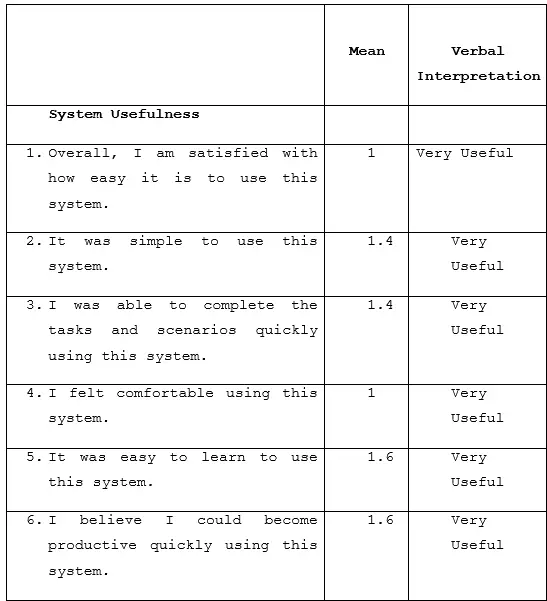
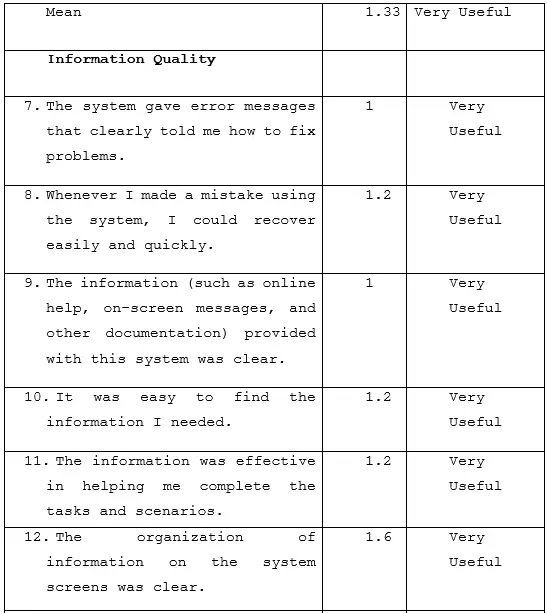

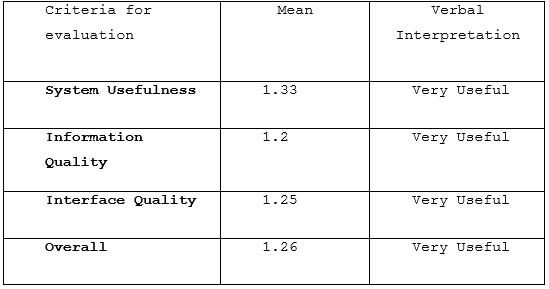
Based on the survey conducted to the experts, they strongly agree about the systems’ usefulness, they agree with the Information Quality and Interface Quality. Overall, the experts’ evaluation agrees with the systems’ functionality.
Classroom Management System Thesis Documentation Chapter 4 : End-users’ Survey Result
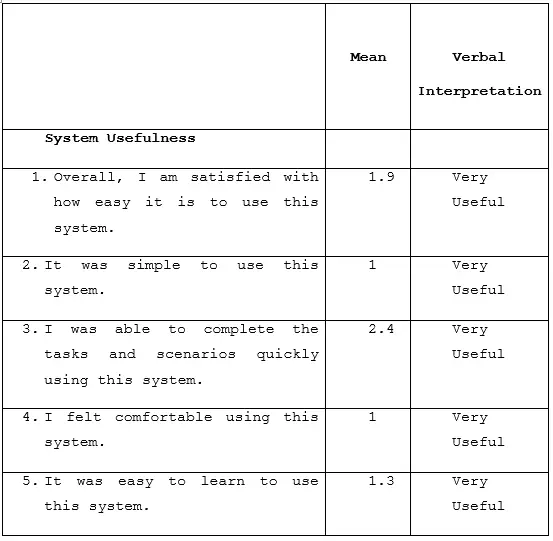
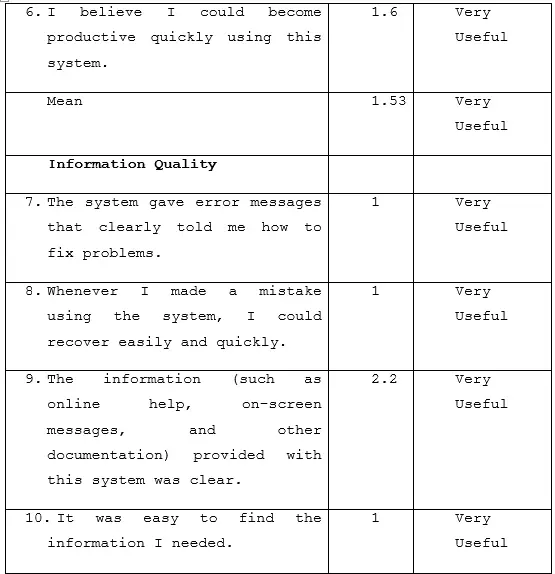
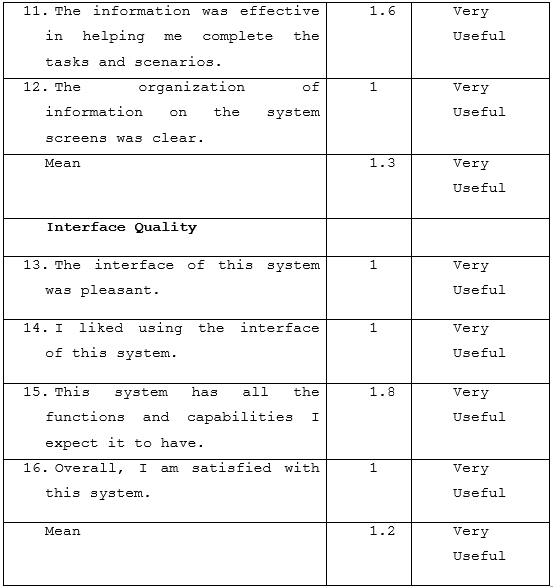
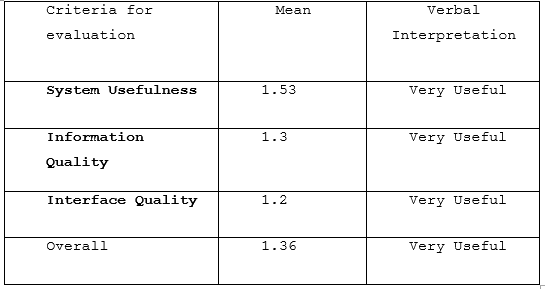
The proponents conducted a survey to 10 random users for the system evaluation using the PSSUQ criteria.
Table 17: End-users’ Survey Result
Related Capstone Resources
- Classroom Management System Thesis Documentation Chapter 1
- Classroom Management System Thesis Documentation Chapter 2
- Classroom Management System Thesis Documentation Chapter 3
- Law Firm Management System Thesis Chapter 3
- Online Supply And Inventory System Thesis Documentation Chapter 1
- Crane Thesis Documentation Chapter 1
- Crane Thesis Documentation Chapter 3 Methodology
- Thesis Documentation Online Supply And Inventory System Chapter 3
- Crane Thesis Documentation Chapter 2 Related Literature
Inquiries
if you have any questions or suggestions about Classroom Management System Thesis Documentation Chapter 4, please let’s me know by dropping your comment below.
Capstone chapter writing checklist
Structuring a BSIT capstone chapter correctly saves rework and eases the defense. Follow this checklist for consistent quality across all 5 chapters.
- Draft the outline first. Every section header first, then fill in the content.
- Write the methodology before the introduction. Chapter 3 (methodology) forces you to think through the system; Chapter 1 becomes easier after.
- Include diagrams early. UML diagrams in Chapter 3 clarify what you’re building.
- Cite sources as you write. Do not defer citations. Use Zotero or Mendeley to track sources.
- Get adviser feedback per chapter. Do not write all 5 chapters then ask for review.
- Number figures and tables. Figure 3.1, Table 4.2, etc. Panels reference these numbers.
- Follow the school template exactly. Font, margins, spacing — do not deviate.
Common capstone mistakes to avoid
- Copying without attribution. Panels use Turnitin. Cite everything you did not write yourself.
- Over-scoping the project. A well-executed simple system beats a poorly-executed ambitious one.
- Deferring documentation. Documentation quality is a big part of the grade.
- Skipping user testing. Panels ask about user feedback. Have real data.
- Ignoring adviser feedback. Advisers know what the panel will ask.
Recommended free tools for capstone projects
- draw.io / diagrams.net. UML diagrams for Chapter 3.
- Google Docs. Collaboration + version history + adviser comments.
- Zotero or Mendeley. Reference management + auto-formatted citations.
- GitHub. Version control for the source code (also earns E-E-A-T signal on your CV).
- Grammarly. Language + tone check on the documentation.
- Turnitin. Plagiarism check before submission (some schools provide access).
- ChatGPT or Claude. For outline scaffolding — not for writing the actual content.
Where to get more capstone resources
- Capstone project ideas. Browse itsourcecode.com/topics/fyp/ for 140+ tested capstone concepts.
- Working source code. itsourcecode.com/topics/free-projects/ has 1,000+ downloadable projects.
- UML diagrams. itsourcecode.com/uml/ has 300+ free UML examples for Chapter 3.
- ER diagrams. itsourcecode.com/topics/uml/erd/ for database schemas.
Official references
Frequently asked questions
How many pages should a BSIT capstone chapter be?
Chapter 1 (Introduction) is typically 8-12 pages. Chapter 2 (RRL) is 15-25 pages. Chapter 3 (Methodology and System Design) is 15-30 pages depending on diagram count. Chapter 4 (Results) is 10-20 pages. Chapter 5 (Conclusions) is 5-10 pages. Total: 60-100 pages for the whole capstone.
What order should I write the chapters in?
Recommended order: Chapter 3 first (system design and methodology — most concrete), then Chapter 1 (introduction with the problem statement), then Chapter 2 (RRL to justify Chapter 1), then Chapter 4 (results — after implementation), then Chapter 5 (conclusions). This avoids rewrites and speeds up defense readiness.
What formatting style should I use for the capstone documentation?
Most Philippine BSIT programs require IEEE or APA 7th edition. Confirm with your adviser first. Use Times New Roman 12pt, double-spaced, 1-inch margins, and page numbers. Reference all sources properly and use consistent citation style throughout.
How many references do I need per chapter?
Chapter 1: 5-10 references. Chapter 2 (RRL): 20-40 references. Chapter 3: 10-15 references. Chapter 4-5: minimal, mostly self-referential. Recent sources (last 5 years) are strongly preferred over older ones.
What tools help write the capstone chapters?
Zotero or Mendeley for reference management, Grammarly for language check, Turnitin for plagiarism scan, Google Docs for collaboration with adviser, LaTeX (Overleaf) for advanced formatting, and ChatGPT or Claude for outline scaffolding (not for writing the actual content).

Adrian Mercurio
Full-Stack Developer at PIES IT Solution
Specializes in building complete capstone projects with full documentation. Strong background in PHP/MySQL development and database design. Has personally built and tested over 30 capstone-ready projects with ER diagrams, DFDs, and chapter-by-chapter thesis documentation.
Expertise: PHP, Laravel, Database Design, Capstone Projects, C#, C, C++, Python, AI Projects · View all posts by Adrian Mercurio →