
Hello Guys! This project is all about the library Management System Project in PHP. You can download this project source code for free.
About the Project
The Project was developed using PHP, JavaScript, and CSS. This Website Project contains an admin and user side.
The admin side manages all the management like adding and managing categories, authors, books, issued books, and so on.
The admin has an important role in the management of this online library system.
Library Management System Project in PHP: Project Information
| Project Name: | Library Management System In PHP |
| Language/s Used: | PHP, CSS, and JavaScript |
| PHP version (Recommended): | Any |
| Database: | MySQL Database |
| Type: | Web Application |
| Developer: | IT SOURCECODE |
| Updates: | 0 |
A library management system makes a convenient way for students and the library to keep records of books, borrowing and returning of books.
The Download Library Management System Project in PHP Source code can be used by programmers who want to develop the (LMS) using PHP and MySQL.
Why Library Management System Project in PHP is Important?
library management system Project in PHP is important because It enhances the efficiency of librarians and library users.
It is also easy for the librarians to catalog the books and keep proper records of books issued, reissued, and not returned.
Furthermore, library users can easily find the availability of any book Which one they need.
The focus of the Library Management System
The main focus of this library management system in PHP with source code is to help the user manage the books.
According to Stuart Ferguson, and Rodney Hebels, in Computers for Librarians (Third Edition), 2003, A library management system is an example of an information system.
Information resources in a library collection. Regardless, of whether they are using a computerized system or not.
The Library Management System has two modules
- Admin Module
- Student Module
For Admin Module Features:
- Admin Dashboard
- Can manage category
- Manage author
- Book Management
- Admin can issue a new book to a student
- Update the details when the student returns the book
- Search students by using their student ID
- View student details
- Change own password
For Students Module Features:
- Register yourself and after registration; they will get student id
- Students can view the dashboard,
- Update personal profile,
- View issued book and book return date-time.
- Change their password, and
- Recover personal password.
Log-in Credentials:
Admin:
Username: admin
Password: Test@123
Student:
Username: clive21@yahoo.com
Password: adminclive
Screenshots:
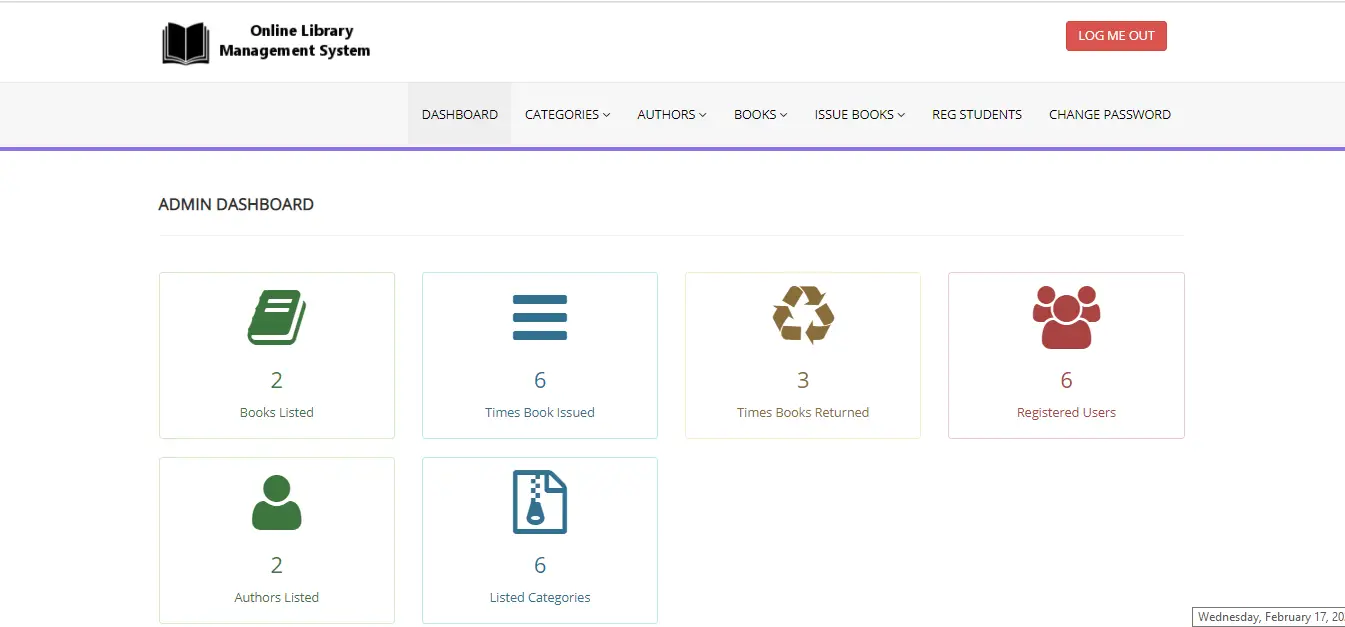
In this screenshot which is the dashboard of the system.
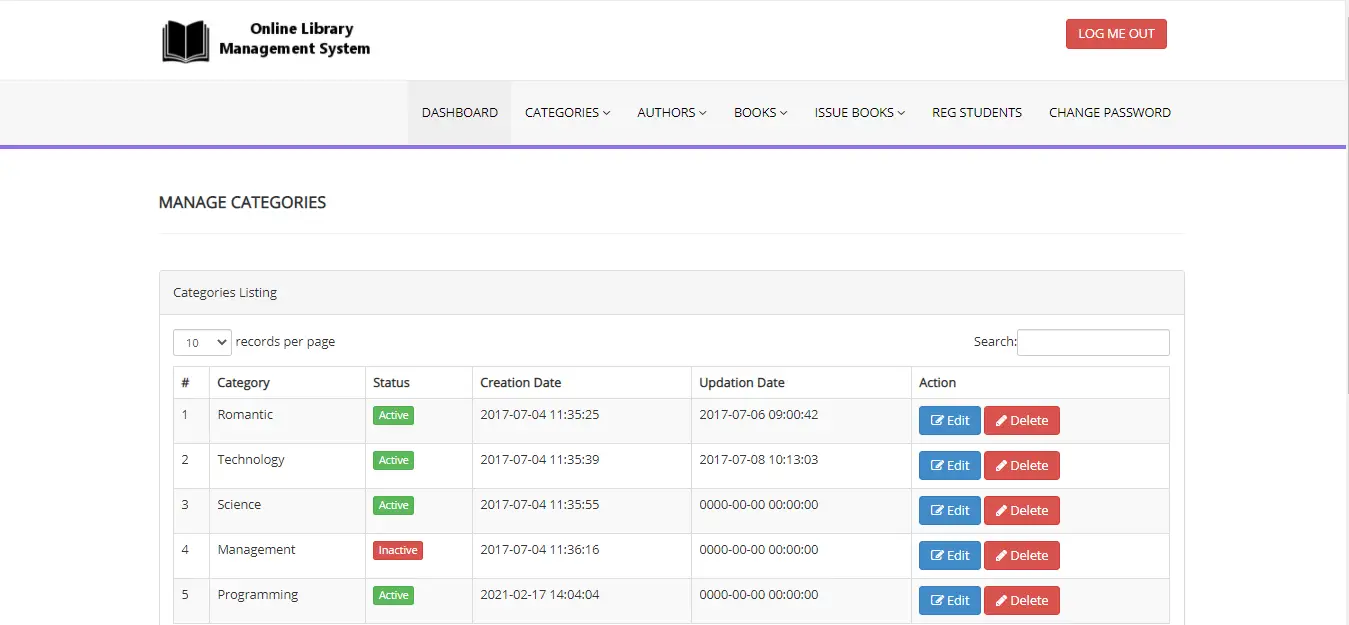
In this screenshot which is the categories of the library.
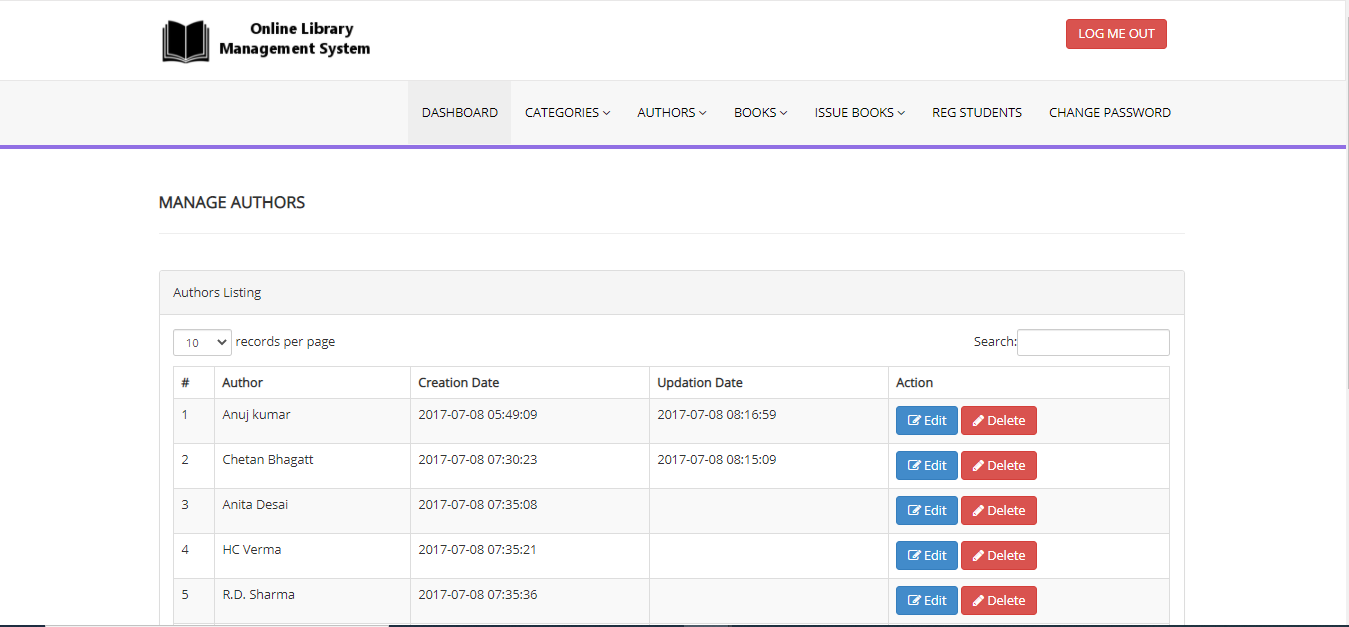
In this screenshot which is the module for the author.

In this screenshot which is the books module.
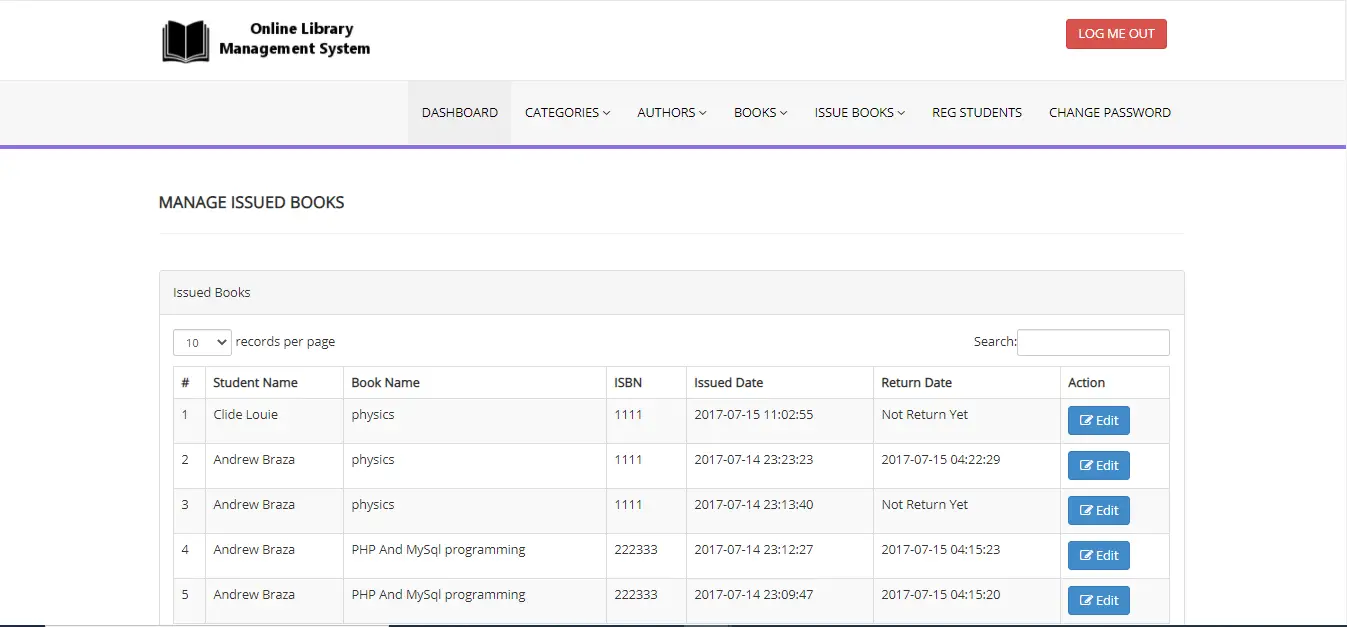
In this screenshot which is the issued books module.

In this screenshot which is the registered students module.
To start executing this project, make sure that you have sublime or any platform of PHP and MySQL installed on your computer.
Steps on How to Run Library Management System Project in PHP with Source Code
Time needed: 5 minutes
These are the steps on how to run an Online Library Management System in PHP Source Code
- Step 1: Download the source code.
First, download the source code given below.

- Step 2: Extract file.
Second, after you finish downloading the source code, extract the zip file.

- Step 3: Copy the project folder.
Third, copy the project folder and paste it into the xampp/htdocs folder.

- Step 4: Open the xampp.
Fourth, open xampp and start Apache and MySQL.

- Step 5: Open the browser.
Fifth, Open a browser and go to the URL “http://localhost/phpmyadmin/”

- Step 6: Create a database.
Sixth, click on the databases tab and Create a database named “library”.

- Step 7: Import “library1.sql”.
Seventh, Click on browse file and select “library1.sql” file which is inside the “database” folder, and after import click “go“.

- Step 8: Open the browser and type the folder name.
Eight, Open a browser and go to URL “http://localhost/library/”.

- Step 9: Explore manipulating.
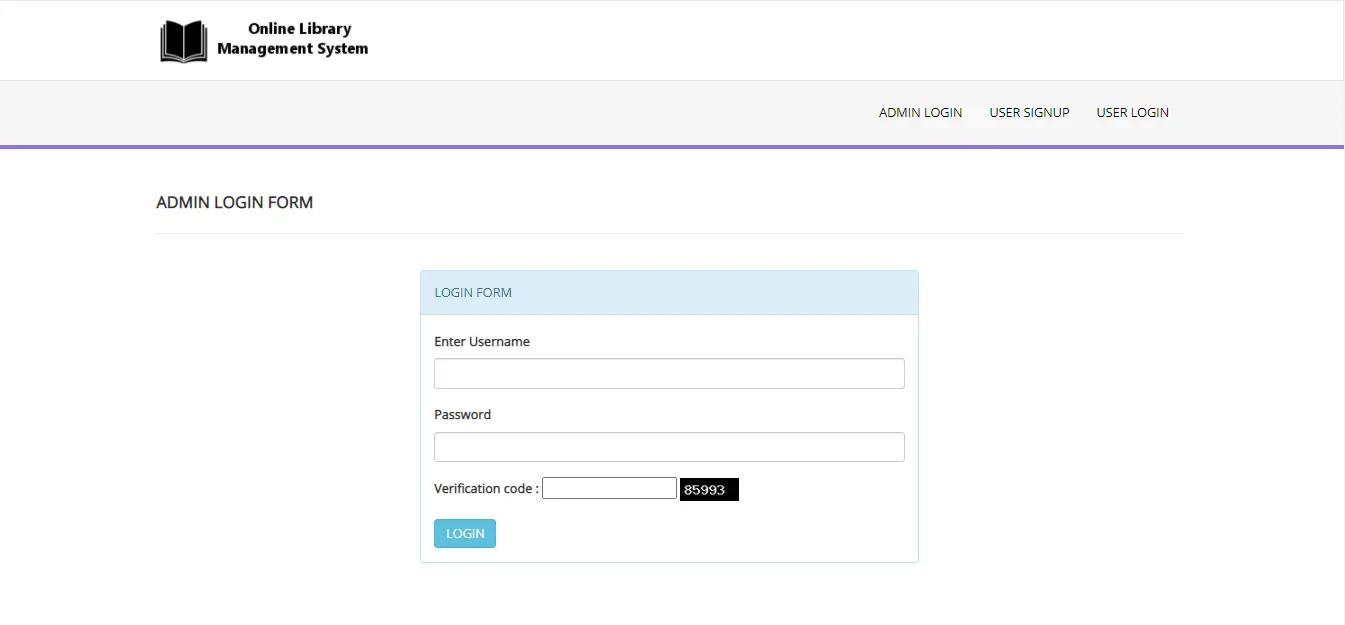
Final step, Login from the User’s login side. Just provide the Admin’s login details, and it will redirect you to the Admin panel.





Downloadable Source Code
Database Included in the link.
Summary
In this article about the Library Management System Project in PHP, we discussed the functions and its features, this project can boost your knowledge for being a web developer someday.
I hope this project will help you to build your own website.
If you have any comments or suggestions about the Online LMS Please Message us directly.
Don’t forget to share this with your friend and continue to support Itsourcecode.com Happy Coding! 🙂
Technology stack and requirements
To run this PHP project, you need these tools on your development machine:
- XAMPP or WAMP server. Bundles Apache, MySQL, and PHP so you can run PHP on Windows without individual installs. Free from apachefriends.org.
- PHP 8.0 or higher. Included with XAMPP. Older versions (5.x, 7.x) may work but modern PHP features improve security and performance.
- MySQL or MariaDB. Comes with XAMPP. phpMyAdmin manages the database through a browser UI.
- VS Code or PhpStorm. Free code editor with PHP syntax highlighting, IntelliSense, and debugging support.
- Web browser. Chrome, Firefox, or Edge for testing the running app.
Installing the source code
- Download the archive. Get the ZIP file from the download link on this page and extract it.
- Move to htdocs. Place the extracted folder inside C:\xampp\htdocs\ so Apache can serve it.
- Import the database. Open http://localhost/phpmyadmin, click Import, and select the .sql file included in the archive.
- Update database credentials. Open the config.php or connection.php file and set the correct database name, username, and password (default XAMPP: root / empty password).
- Run the project. Start Apache + MySQL in XAMPP, then visit http://localhost/your-project-folder/ in a browser.
Using this project for your BSIT capstone
This PHP project maps cleanly to standard BSIT capstone documentation. Suggested chapter alignment:
- Chapter 1 (Introduction). Discuss the problem the system solves in real-world context. Cite Philippine business or academic use cases where a manual process could be replaced.
- Chapter 2 (Review of Related Literature). Compare this system’s features against 5-10 similar published projects. Cite journals like IJERT or IEEE Access for academic-standard sources.
- Chapter 3 (Methodology). Include Use Case Diagram, Data Flow Diagram, Entity Relationship Diagram, and Activity Diagram covering all major workflows.
- Chapter 4 (Results and Discussion). Screenshot each module of the running system with a caption explaining what data it processes and which user role interacts with it.
- Chapter 5 (Conclusion and Recommendations). Identify features that could be added in a Version 2, such as mobile app, REST API export, or AI-powered analytics.
Modules typical of Library Management System Project
- Student information. Personal info, guardian details, enrollment status, program of study.
- Enrollment / registration. Term-by-term subject selection with prerequisite checking.
- Grading system. Teacher input for quiz, exam, and project scores with weighted average.
- Report card generation. Printable grade slip and transcript of records.
- Library / borrowing (optional). Track book borrowing, return date, fine computation.
- Announcements. Post school-wide bulletins visible from the login screen.
Common enhancements for capstone review
- Online portal. Add PHP or ReactJS portal so parents and students see grades from home.
- SMS grade notification. Auto-send new-grade alerts to parent’s mobile via a service like Semaphore.
- Digital ID card. Print student ID with photo, QR code, and academic year.
- Alumni tracking. Extend the database to include post-graduation contact info.
Official documentation
Quick step-by-step summary (click to expand)
- Install XAMPP. Download and install XAMPP from apachefriends.org. XAMPP bundles Apache, PHP, and MySQL so you can run the app locally.
- Extract source into htdocs. Unzip the source into C:\xampp\htdocs\library\ (Windows). The folder name becomes part of the local URL.
- Import the SQL database. Start Apache and MySQL from the XAMPP Control Panel. Open http://localhost/phpmyadmin, create a database, then import the included .sql file.
- Update database credentials. Open config.php or db.php inside the project folder and update the database name and password to match your XAMPP setup.
- Log in and test. Visit http://localhost/library/ in your browser. Log in with the default admin credentials from the SQL file, then add books and members.
Frequently Asked Questions
How does this PHP library management system work?
Book catalog (ISBN, categories, copies), member registration, borrow/return workflow with due dates, fine calculation, reservations, reports. Auto-fine via PHP cron script.
What PHP and MySQL versions does this project require?
Most projects in this batch run on PHP 7.4 to PHP 8.2 with MySQL 5.7+ or MariaDB 10+. A few older projects need PHP 5.6 (deprecated, use XAMPP 7.x). To run: install XAMPP / WAMP / Laragon, extract project to htdocs, import the included .sql file via phpMyAdmin, edit the connection file (usually config.php or db_connect.php) with your DB credentials, browse to the project URL in your browser.
How do I set up the database for this PHP project?
Open phpMyAdmin (http://localhost/phpmyadmin/ on XAMPP), create a new empty database with the name specified in the project’s config.php. Click the Import tab, choose the included .sql file, click Go. Then edit config.php (or includes/connection.php) with: ‘localhost’, your MySQL username (usually ‘root’), your MySQL password (usually blank for XAMPP), and the database name.
Can I use this PHP project for a BSIT capstone or thesis?
Yes, but extend it. A bare CRUD app is too narrow for full capstone scope. Add: user roles via session checks, reports/dashboards (Chart.js + AJAX), PDF exports (TCPDF library), email notifications (PHPMailer), real domain extension (analytics, audit log, multi-branch support). Pair with Chapter 1-5 documentation matching your panel’s rubric.
Why am I getting ‘connection error’ or ‘undefined function mysqli_connect’?
Three common PHP issues: (1) Connection error: Apache + MySQL services not running in XAMPP control panel, OR database name in config.php does not match what you created in phpMyAdmin. (2) ‘undefined function mysqli_connect’: MySQL extension not enabled, in php.ini uncomment extension=mysqli (then restart Apache). (3) ‘No such file or directory’: MySQL socket path wrong, use 127.0.0.1 instead of localhost in the connection string.
Where can I find more PHP projects with source code?
Browse the PHP Projects hub for the full library (300+ vanilla PHP systems). For modern PHP MVC alternatives see Laravel Projects (74 systems) or CodeIgniter Projects (32 systems). For BSIT-focused capstone idea lists see 150 Best Capstone Project Ideas.
Related PHP Projects
- Library Management System Project In Laravel With Source Code
- Leave Management System PHP Source Code
- Directory Management System Source Code
- Farm Management System In PHP With Source Code
- Employee Management System PHP MySQL Source Code
- File Management System In PHP With Source Code

Angel Jude Suarez
Full-Stack Developer at PIES IT Solution
Focuses on Python development, machine learning, and AI integration. Has built production AI systems including OpenAI Whisper integration for medical transcription and GPT-4o-powered diagnosis assistance. Strong background in pandas, scikit-learn, and TensorFlow.
Expertise: Python · PHP · Java · VB.NET · ASP.NET · Machine Learning · AI Integration · OpenCV · Django · CodeIgniter
· View all posts by Angel Jude Suarez →
is a good sistem I like
There is no payment module in case where a student delays with the book
chuppp bhai
Fantastic blog.Really looking forward to read more. Cool.
Capture not loading when I run the code
my captcha does not load when I’m trying to login what might be the problem?
same problem with me
Same problem
found the solution you need to access to your php.ini and uncomment the extension=gd
How to display sinhala in the website?
In database, it works as I selected utf8_unicode_ci
But in website its displayed like below.
à·�à·�à¶à·�à¶à·�ය
Capture does not work completely
Thank you so much it is fantastic, I am having problem login in into the admin panel. I used Username: admin, Password: Test@123 and it says invalid user
ME TOO IM HAVING THAT PROBLEM TOO
someone help me with the captcha code
mine is not working/loading
same problem right now.
Can you please guide me, how i can update the SID012, in student.txt after signing a new student in the system, coz its now update which that lead to not allow another student to registered
can’t open the database.
same problem right now.
i have problem with captcha code
What is the problem?
WHATS IS THE PASSWORD OF ZIP FILE
what is the verification code???
What do you mean verification code?
Can’t see captcha?
try to connect it with internet
Is there any way I can use thai language in this project?
Yes you can change it into thai language.
Captcha not showing and i am connected to the internet. what could be the problem
i cant login as an admin or even a user because im asked for a verification code where can i get the code
i have the same problem i think the problem is in that the verifaction code is not showing in the first place (it should be next to the input box in login page)
The verification code is in the right side of the input box
The verification code is in the right side of the input box.
where can i find the verificatrion code
The verification code is in the rightside of the input box
founbd the solution you need to access to your php.ini and uncomment the extension=gd
how to do that?
pls help
what to put in verification code area
The verification code is in the right side of the input.
how to remove the verification?
The verification code isn’t loading, how to fix it? Is there a guide to fix it? Please do leave a reply if you found one
The verification code for that is there is no loading if you click register it is automatically provide the verification load
Why can’t I view the issued book in the Student account? Is the Book Issued and Books Not Returned Yet clickable? How do I see them? Also when I login in the student account I can’t see any books even tho in the admin account there’re a lot of books that has been created. Anyways, thank you very much for creating this Library Management System!
http://localhost/library/ I’m stuck in this part. Can’t open it.
What xampp version did you used?