
Bank Management System Project In Java NetBeans With Source Code
The Bank Management System Project In Java NetBeans was developed using Java programming language, this Bank Management System In Java project with tutorial and guide for developing a code.
In this Bank Account Management System In Java is an open source you can Download zip and edit it as per you need.
An online Bank Management System Project In Java is a simple and basic-level project for learning purposes. Also, you can modify this system as per your requirements and develop a perfect advanced-level project.
This Bank Queue Management System In Java desktop application is 100% working smoothly without any bugs. It is developed using Java and Database MySQL.
This software code is helpful in academic projects for final-year students. We have a great collection of Java projects.
This Bank Management System In Java Source Code also includes a Bank Management System Project In Java Free Download, just find the downloadable source code below and click to start downloading.
To start executing a Bank Management System Project In Java NetBeans make sure that you have NeatBeans IDE or any platform of Java installed on your computer.
How to run the project Bank Management System Project In Java NetBeans With Source Code?
Time needed: 5 minutes
These are the steps on how to run a Bank Management System Project In Java NetBeans With Source Code
- Step 1: Download the source code.
First, download the source code given below.

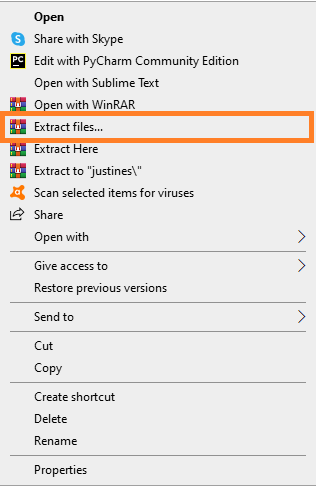
- Step 2: Extract file.
Second, after you finish downloading the source code, extract the zip file.

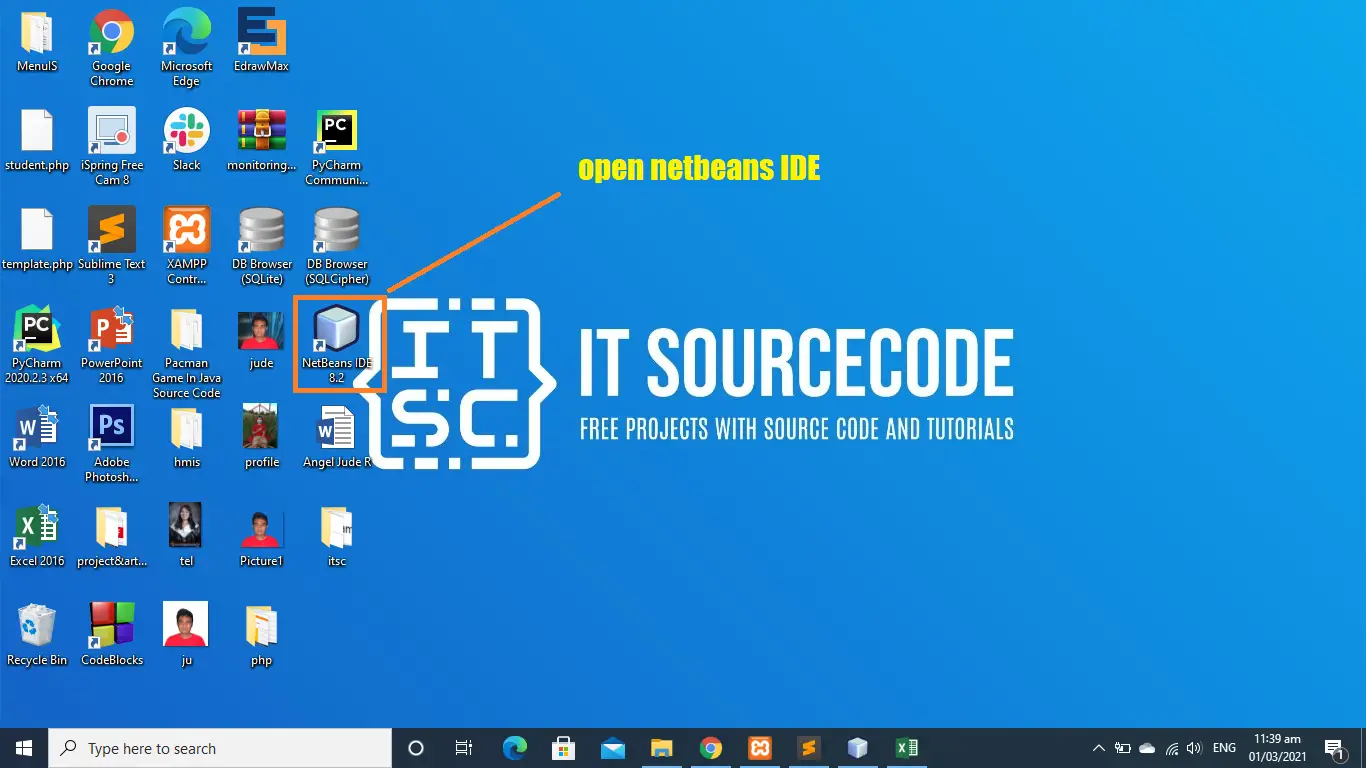
- Step 3: Open Netbeans.
Third, open “Netbeans IDE”.

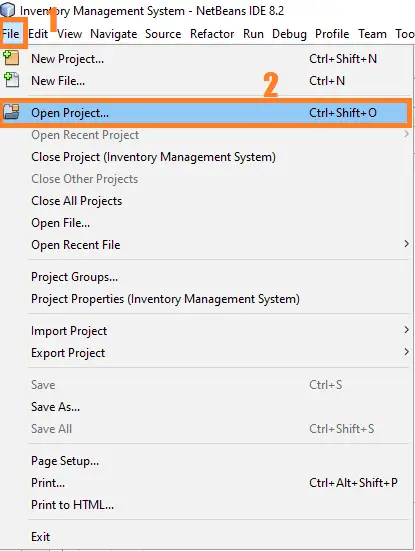
- Step 4: Click open project.
Fourth, click Open Project and choose your download source code.

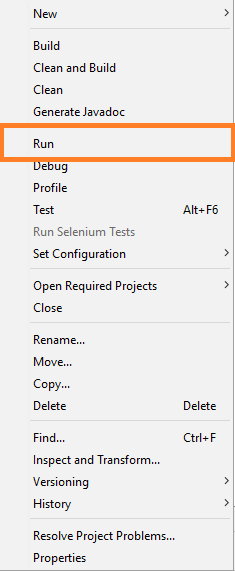
- Step 5: Run the project.
Fifth, right-click the project folder and click run.

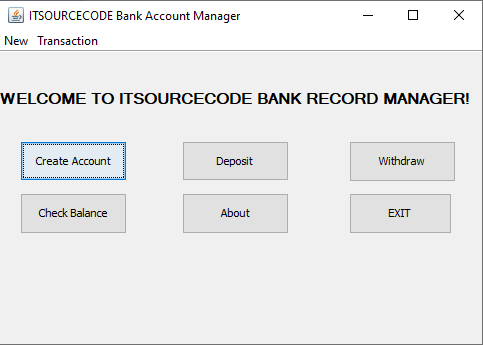
- Step 6: The project design
The actual design of the project.


The Code Given Below Is For The Account Module
package BankAccount;

public class Account
{
    private double balance;
    private long accNum;
    private String accHolder;

     public Account(String name, long num)
     {
    	 accHolder = name;
         accNum = num;
         balance = 0.00;
    	 System.out.println("Account Created");
     }

     public void deposit(double amt)
     {
    	 balance = balance + amt;
    	 System.out.println("Amount Deposited.");
     }

     public void withdraw(double amt) throws BankAccountException
     {
    	 try
    	 {
    	    if(balance >= amt)
    	    {
    		    balance = balance - amt;
        	    System.out.println("Amount Withdrawn");
    	    }
    	    else
    	    {
    		    throw new BankAccountException("Could not Withdraw: Insufficent Amount.");
    	    }
    	 }
    	 catch(BankAccountException bae)
    	 {
              bae.printStackTrace();
         }
     }

     public void printBalance()
     {
    	 System.out.println("Current balance: " + balance);
     }
     public double getBalance()
     {
         return balance;
     }
}
In this module which is the account module of the system.
The Code Given Below Is For Creating an Account for the Module
String name;
        long num;
        name = JOptionPane.showInputDialog(null, "Please Enter Account Holder Name:", "Create Account", 1);
        num = 1332522123;
        acc = new Account(name, num);
        JOptionPane.showMessageDialog(null, "Account Succesfully Created!", "Create Account", 1);
In this module which is creating a new account.
The Code Given Below Is For Deposit Module
try
        {
           String num;
           num = JOptionPane.showInputDialog(null, "Enter a Value To Deposit:", "Deposit Amount", 1);
           double num1 = Double.parseDouble(num);
           acc.deposit(num1);
        }
        catch(NumberFormatException | NullPointerException nfe1)
        {
            JOptionPane.showMessageDialog(null, nfe1, "Error", 2);
        }
In this module which is the deposit module of the system.
The Code Given Below Is For The Withdraw Module
try
           {
               String num;
               num = JOptionPane.showInputDialog(null, "Enter a Amount To Withdraw:", "Withdraw Amount", 1);
               double num1 = Double.parseDouble(num);
               acc.withdraw(num1);
           }
           catch(BankAccountException | NumberFormatException | NullPointerException ex)
           {
               JOptionPane.showMessageDialog(null, ex, "Error", 2);
           }
This module which is the withdrawal module of the system
The Code Given Below Is For Check Balance Module
try
       {
         double num = acc.getBalance();
         JOptionPane.showMessageDialog(null, "Current Balance: " + num, "Current Balance", 1);
       }
       catch(NullPointerException npe)
       {
           JOptionPane.showMessageDialog(null, npe, "Error", 2);
       }
In this module which is the check balance module of the system.
About The Bank Management System In Java
| Project Name: | Bank Management System |
| Language/s Used: | JAVA |
| Database: | MySQL |
| Type: | Desktop Application |
| Developer: | IT SOURCECODE |
| Updates: | 0 |
Downloadable Source Code Below
Anyway, if you want to level up your programming knowledge, especially Java, try this new article I’ve made for you Best Java Projects With Source Code For Beginners Free Download.
Summary
The Java Project With Source Code is built fully in Java and MySQL Database. It has a full-featured Graphical User Interface (GUI) with all the functionalities
This Article is a way to enhance and develop our skills and logic ideas which is important in practicing the Java programming language which is the most well-known and most usable programming language in many companies.
Related articles below
- Load data from MySQL database to Combo box Using Java
- How to use Scanner in Java Tutorial Using Netbeans IDE
- Update Data using MySQL Database and Java with Netbeans IDE
- Join Two String Value using MySQL CONCAT Function in Java
- How to convert text to speech in Java Tutorial using Netbeans IDE
Inquiries
If you have any questions or suggestions about the Bank Management System Project In Java NetBeans With Source Code, please feel free to leave a comment below.
Official documentation
Frequently Asked Questions
How does this Java banking system work?
Customer account opening, deposit/withdrawal transactions, fund transfers, loan applications, ATM-style PIN auth, transaction history, monthly statements.
What Java JDK and MySQL versions does this project require?
Most projects in this batch use Java JDK 8 or 11 with MySQL 5.7+ or MariaDB 10+. To run: install JDK (Adoptium / Oracle), install MySQL Server + MySQL Workbench, install NetBeans IDE (15+ supports modern JDK), open the project (.zip extracted folder), right-click + Open Project, add MySQL JDBC driver to Project Libraries, run.
How do I set up the database for this Java project?
Open MySQL Workbench (or phpMyAdmin if you have XAMPP), create a new empty database with the name specified in the project. Import the included .sql file via Server, Data Import in Workbench (or Import tab in phpMyAdmin). Update the connection class (usually DBConnection.java or DatabaseConnection.java) with your MySQL host, port, username, password, and database name.
Can I use this Java project for a BSIT capstone or thesis?
Yes, Java is one of the most accepted languages by Philippine BSIT panels. Extend it: add role-based access (admin/staff/customer login redirect), JasperReports printable reports, dashboards with JFreeChart, audit log, multi-branch support. Pair with Chapter 1-5 documentation matching your panel’s rubric.
Why am I getting ‘ClassNotFoundException: com.mysql.jdbc.Driver’ or ‘No suitable driver’?
Three common Java JDBC issues: (1) MySQL JDBC driver JAR not added to project Libraries. Right-click Project, Properties, Libraries, Add JAR/Folder, select mysql-connector-java-X.X.X.jar. (2) Wrong driver class name. Modern (8.0+) uses com.mysql.cj.jdbc.Driver, legacy (5.x) uses com.mysql.jdbc.Driver. (3) Connection URL missing serverTimezone parameter, add ?serverTimezone=UTC to the URL.
Where can I find more Java projects with source code?
Browse the Java Projects hub for the full library (120+ Java desktop systems). For modern Java web alternatives consider Spring Boot. For other desktop stacks see VB.NET Projects or C# Projects. For BSIT capstone idea lists see 150 Best Capstone Project Ideas.

Angel Jude Suarez
Full-Stack Developer at PIES IT Solution
Focuses on Python development, machine learning, and AI integration. Has built production AI systems including OpenAI Whisper integration for medical transcription and GPT-4o-powered diagnosis assistance. Strong background in pandas, scikit-learn, and TensorFlow.
Expertise: Python · PHP · Java · VB.NET · ASP.NET · Machine Learning · AI Integration · OpenCV · Django · CodeIgniter · View all posts by Angel Jude Suarez →
I want full project and source code on topic online bank management system in jaava
interesting project and topic . i would love to use this project.
where is the database