
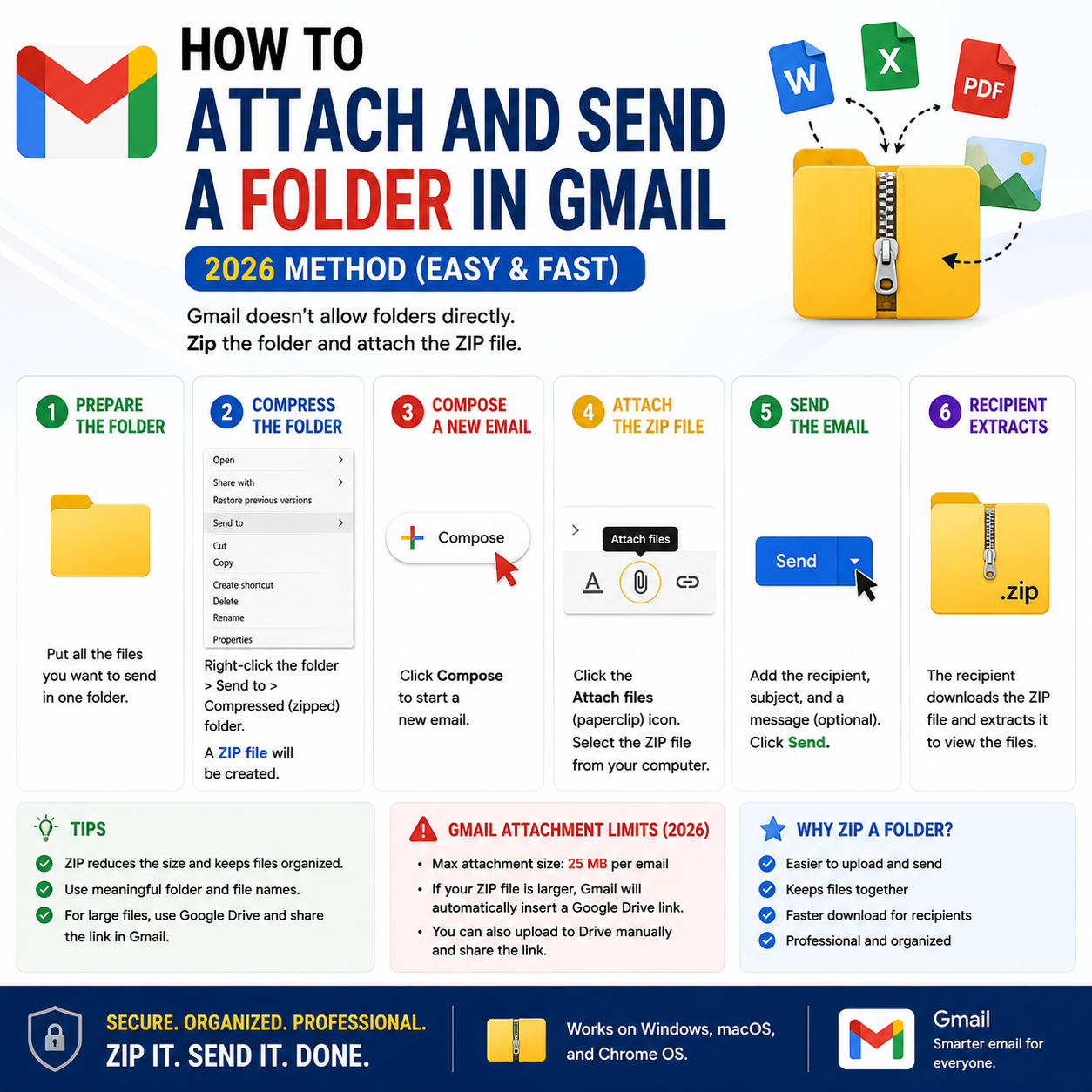
Gmail does not allow direct folder attachment. To send a folder in Gmail, you either compress the folder into a zip file first (which becomes a single attachment) or upload the folder to Google Drive and share the link. This 2026 guide walks through both paths, including size limits, common gotchas, and when each method fits your situation.
The zip approach is fastest for small folders. The Drive approach is better for large folders or when the recipient needs to browse the contents individually.
Why Gmail cannot attach folders directly
Understanding the constraint prevents wasted time looking for a folder-attach button that does not exist.
- Gmail attachments are individual files. The compose window’s attach button opens a file picker that lets you select files, not folders.
- The email format itself was designed decades ago for individual file attachments only. Folder structure would require a container.
- Zip files serve as that container. When you zip a folder, Gmail sees the zip as a single file to attach.
- For very large folders, Google Drive is the professional-grade solution: no size limits, folder browsing intact, per-user permissions.
Method 1: Compress the folder into a zip file (Windows)
The fastest path for folders under 25 MB total.
- Open File Explorer and navigate to the folder you want to send.
- Right-click the folder.
- Choose Send to > Compressed (zipped) folder.
- Windows creates a .zip file with the same name in the same location.
- Open Gmail Compose, click the paperclip icon, and select the .zip file.
- Gmail attaches the zip. Complete your email and send.
Method 1: Compress the folder into a zip file (Mac)
Mac has native zip support built into Finder.
- Open Finder and navigate to the folder.
- Right-click the folder.
- Choose Compress “foldername”.
- Mac creates a .zip file in the same location.
- Attach the zip to Gmail compose and send.
Method 2: Upload the folder to Google Drive and share the link
The right choice for larger folders or when the recipient needs to see the folder structure.
- Open
drive.google.comin a browser. - Drag the entire folder from your computer directly into Drive. Or click New > Folder upload and select the folder.
- Wait for the upload to complete (progress bar shows in the bottom right of Drive).
- Right-click the uploaded folder in Drive and click Get link.
- Set the sharing permission: Anyone with the link (public), Restricted (only added emails), or Organization only.
- Click Copy link.
- Open Gmail Compose, paste the Drive link into the email body, and send.
- The recipient clicks the link and browses the folder in Drive.
Set Drive share permissions carefully
The share permission you choose affects who can see and download the folder.
- Anyone with the link (Viewer): no login required, can view/download but not edit. Simplest for external recipients.
- Anyone with the link (Editor): can also add, delete, or modify files. Grant only when needed.
- Restricted: only specific email addresses can access. Most secure, but recipients must have a Google account.
- Organization only (Workspace): visible to anyone in your Workspace domain. Good default for internal team folders.
Send multiple folders in one Gmail
Combining approaches for multi-folder sends.
- Zip each folder individually, then attach all zips to one Gmail. Works if total size is under 25 MB.
- Upload all folders to a parent folder in Drive, then share the parent. Recipient sees the whole tree.
- Zip the folders together into one master zip, then attach or upload. Recipient extracts to get all folders back.
- For very large sends (10+ GB), use Drive with organization sharing. Zip cannot practically handle these sizes.
Common folder-attachment mistakes
- Trying to drag a folder into Gmail compose. Gmail intercepts folder drops and does nothing. Zip first, then drag the zip.
- Sending a zip over 25 MB. Gmail auto-converts to a Drive link at 25 MB. This is usually fine but the recipient sees a link instead of an attachment.
- Choosing Editor permission for public shares. Anyone with the link can then modify or delete your files. Use Viewer permission unless collaboration is the goal.
- Sending sensitive folders via public Drive link. Anyone who intercepts the link can access. Use Restricted permission and add specific recipient emails.
- Forgetting to check zip integrity. Sometimes zip files corrupt during compression. Extract your own zip locally before sending to confirm it works.
When to zip vs when to use Drive
Zip is best for small folders (under 25 MB), one-time sends, and when the recipient is on a slow connection or offline (they get the entire folder in one download, no dependency on Drive).
Drive is best for large folders (over 25 MB), when you want to update the shared content later (edit files in Drive, recipient sees updates), or when you need to track who accessed the folder (Drive shows viewer activity).
For business use, Drive is almost always the right choice. It preserves folder hierarchy, supports fine-grained permissions, and integrates with Google Workspace’s audit and DLP systems.
Power-user tips for folder sharing
- Compress before Drive upload for speed. Uploading 100 small files takes longer than uploading one zip. Zip first, then upload the zip to Drive.
- Set expiration dates. Drive Workspace supports expiration for shared links. Set 30 days for temporary sharing.
- Password-protect sensitive zips. Use 7-Zip or a similar tool to add password encryption to sensitive folders. Send the password separately.
- Notify recipients via Drive. When sharing via Drive, use the “Notify people” option to send an email automatically, without a separate Gmail send.
- Track download activity. Drive shows a “Recent activity” panel for shared folders. See who accessed and when.
Official documentation
Recommended email productivity resources
The links below are affiliate links. We may earn a commission at no extra cost to you when you buy or sign up. See our affiliate disclosure.
Quick step-by-step summary (click to expand)
- Zip the folder. Right-click the folder on desktop, choose Compress (Mac) or Send to Zipped folder (Windows). Gmail cannot attach folders directly.
- Compose a new email in Gmail. Click Compose. Add recipient, subject, and message body.
- Attach the zip file. Click the paperclip icon. Select the zipped folder. Wait for upload progress bar.
- Handle files over 25 MB. If the zip exceeds 25 MB, Gmail auto-suggests Google Drive. Click Insert as Drive link.
- Send. Click Send. Recipients get either the zip attachment or a Drive link based on file size.
Frequently Asked Questions
Can I attach a folder directly in Gmail?
No. Gmail attaches individual files only. To send a folder, zip it first or upload to Google Drive and share the link.
What is the Gmail attachment size limit?
25 MB per email. Larger attachments auto-convert to Google Drive links. The recipient still sees the file, just as a Drive link instead of a direct download.
Do recipients need Google Drive to open a shared folder?
They need any Google account for Restricted sharing. For Anyone with the link, no account is required. Set permissions based on your recipient’s setup.
Are zipped folders safe to send in Gmail?
Yes, Gmail scans zip contents for malware. Common file types (.pdf, .docx, .txt, images) inside zips are fine. Executable files (.exe, .bat) are often blocked.
Can I attach multiple folders in one Gmail?
Yes. Zip each folder separately and attach all zips to one email. Or upload them all to a parent folder in Drive and share the parent.
How do I password-protect a zip file before sending?
Use 7-Zip (Windows), Keka (Mac), or the built-in zip encryption tools. Set a password when creating the zip. Send the password to the recipient through a separate channel (SMS, phone call).

Adones Evangelista
Programmer & Technical Writer at PIES IT Solution
Adones Evangelista is a programmer and writer at PIES IT Solution, author of over 900 tutorials and error-fix guides at itsourcecode.com. Specializes in JavaScript, Django, Laravel, and Python error debugging covering ValueError, TypeError, AttributeError, ModuleNotFoundError, and RuntimeError, plus C/C++ and PHP capstone projects for BSIT students.
Expertise: JavaScript · Python · Django · Laravel · Error Debugging · C/C++ · View all posts by Adones Evangelista →