

In this article, we are going to solve Attributeerror: can’t set attribute. We will discuss why and how this error occurs, a brief discussion about this error. Also, step by step on how to solve this error.
Why this Attributeerror: can’t set attribute occur?
“AttributeError: can’t set attribute” occurs when you try to set an attribute that cannot be set. This can happen in many different situations. Generally, it means that the object you are trying to modify does not allow changes to that particular attribute.
For Example,
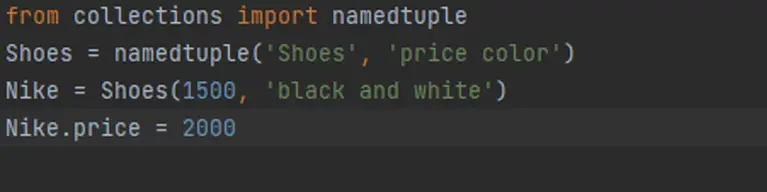
In the given example above, we create a named tuple called Shoes using the collections module in Python. This named tuple has two fields – price and color.
Next, a new instance of the Shoes named tuple is created and assigned to the variable Nike. The price and color fields of this instance are initialized with values 1500 and ‘black and white‘, respectively.
However, in the next line of code, Nike.price = 2000, an attempt is made to change the value of the price field of the Nike instance. This operation will fail with an error.
This will be its output:
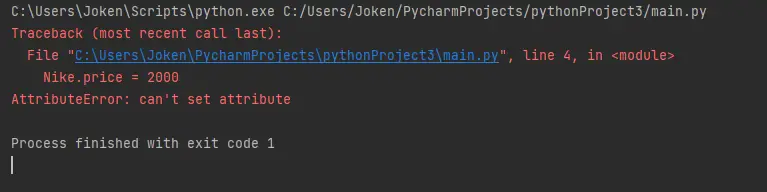
So now let’s understand why this error occurs.
Why this error occurs?
Attributeerror: can’t set attribute occurs because named tuples are immutable, which means that their values cannot be changed once they are created.
For example, you cannot change a tuple (‘1500’, ‘black and white’) to (‘2000’, ‘green’) without creating a new one.
If you try to modify the value of an attribute in a namedtuple object in Python, you are attempting to change an immutable object. As a result, Python will raise an error with the message “can’t set attribute“, indicating that the object cannot be modified.
How to fix Attributeerror: can’t set attribute?
Here are the solutions of Attributeerror: can’t set attribute you can try.
1. Use the _replace() method.
To avoid Attributeerror: can’t set attribute, you can create a new named tuple with the updated values using the _replace() method, as shown below:

This method returns a new named tuple that has the same values as the original named tuple, except for the modified field(s).
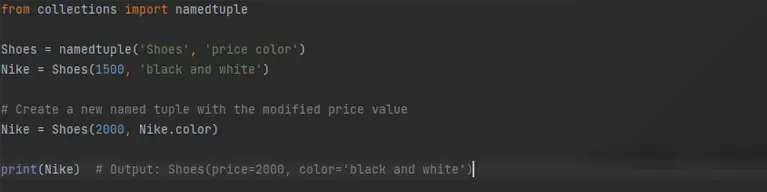
2. Creating a new named tuple.
We can also create a new named tuple with the modified values by unpacking the original named tuple and passing the modified value(s) to the constructor.
3. Converting the named tuple to a dictionary.
We can convert the named tuple to a dictionary, modify the value of the desired field in the dictionary, and then create a new named tuple from the modified dictionary.

Conclusion
In conclusion, the error “AttributeError: can’t set attribute” occurs when you try to set an attribute that cannot be set. It means that the object you are trying to modify does not allow changes to that particular attribute.
By following the given solution above, it is possible you can be able to fix the error.
If you have any questions or suggestions, please leave a comment below, and for more attributeerror tutorials in Python, visit our website.
Python AttributeError debugging checklist
- Print the actual type. Insert
print(type(obj))before the failing line — usually reveals the mismatch immediately. - Use dir().
print(dir(obj))lists all available attributes on the object. - Check version compatibility. Many AttributeErrors come from methods that were renamed or removed between library versions.
- Guard with hasattr().
if hasattr(obj, "method"): obj.method()— useful for cross-version code. - Use type hints + mypy. Static type checking catches most AttributeErrors before you run the code.
Common root causes across all AttributeError variants
- None return values. A function returned None when the caller expected an object.
- Version drift. Library API changed between versions.
- Variable overwrite. A local variable was reassigned with the wrong type (list → dict, str → int).
- Method vs attribute confusion. Calling a property with () or accessing a method without ().
- Missing initialization. Some frameworks require
init()before accessing certain attributes.
Modern Python tooling to prevent AttributeError
- Type hints + Optional[T]. Explicit null-handling in signatures.
- mypy or Pyright. Runs your codebase through a type checker before you run it.
- Ruff. Fast linter that catches many attribute-access issues.
- pydantic v2. Runtime validation with the same syntax as static types.
- pytest fixtures. Test with edge-case inputs to catch AttributeError paths early.
Official documentation
Frequently Asked Questions
What is Python AttributeError and what causes it?
AttributeError is raised when you access an attribute or method that doesn’t exist on the object. Most common cause: calling a method on None (NoneType has no attribute X). Other causes: typo in method name, wrong object type (str when you expected list), or using a feature removed in a newer library version. The error names exactly which type and which missing attribute.
How do I fix ‘NoneType object has no attribute’?
The variable you’re accessing is None, but you expected an object. Trace back to where it was assigned: a function returning None instead of an object (forgot to return), a database query returning no rows (Model.objects.first() returns None when empty), or an API call that failed silently. Safe pattern: if obj is not None: obj.method() OR use the walrus operator: if (obj := get_obj()): obj.method().
How do I check if an attribute exists before accessing it?
Use hasattr(obj, ‘attr_name’) for runtime check, or getattr(obj, ‘attr_name’, default) to get-with-default. For frequent attribute checks, consider type hints + mypy/pyright which catch most AttributeErrors at static-analysis time before runtime.
How do I prevent AttributeError from None values?
Three patterns: (1) Always validate function returns (if result is None: raise). (2) Use type hints with Optional[X] to make None-ability explicit. (3) Use the walrus operator + early return: if (val := get_val()) is None: return default; use val. Defensive coding around None-able returns prevents 90% of AttributeError in production.
Where can I find more AttributeError fixes?
Browse the AttributeError reference hub for 170+ specific fixes (NoneType, pandas, NumPy, sklearn, Selenium). For related errors see TypeError. For Python debugging fundamentals see Python Tutorial hub.

John Paul Blauro
Programmer & Technical Writer at PIES IT Solution
John Paul Blauro is a programmer and writer at PIES IT Solution, author of 55 Python error-fix tutorials at itsourcecode.com. Specializes in Python TypeError debugging (str/int type errors, unsupported operand types, iterable-related issues) and AttributeError debugging (NoneType, dict/list/series object attribute errors) for developers and BSIT students.
Expertise: Python · Python TypeError · Python AttributeError · Type Debugging · Error Handling
· View all posts by John Paul Blauro →