
Welcome to this complete guide on solving the ValueError: cannot reindex on an axis with duplicate labels error in Python.
This error is commonly encountered when you are working with pandas, a popular data manipulation library.
In this article, we will provide example codes and solutions to help you fix this issue effectively.
Understanding the ValueError
The ValueError: cannot reindex on an axis with duplicate labels error occurs when you try to reindex a DataFrame or a Series object, but the target axis consists of duplicate values.
This error is raised by pandas to shown that the reindexing operation cannot be accomplished due to the presence of duplicate indices or columns.
How the Error Reproduce?
To acquire a better understanding of the Valueerror cannot reindex on an axis with duplicate labels error, let’s take a look at some example codes that show of how the error occurs.
import pandas as pd

# Creating a DataFrame with duplicate indices
example_data = {'X': [1, 2, 3, 4], 'Y': [5, 6, 7, 8]}
dataframe = pd.DataFrame(example_data, index=['x', 'x', 'y', 'z'])

# Attempting to reindex the DataFrame
new_index_result = ['x', 'y', 'x', 'w']
dataframe.reindex(new_index_result)
Output:
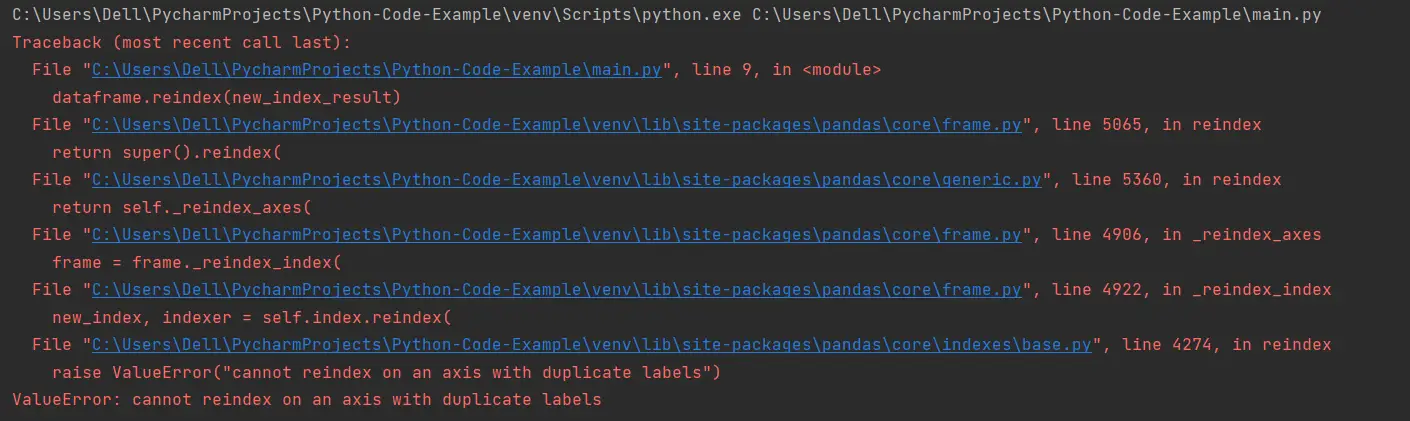
In this code, we create a dataframe with duplicate indices (‘x’ appears twice).
Then, we try to reindex the dataframe using the reindex() method with a new set of indices.
However, if we run this code it will result in the ValueError.
How to Fix the Valueerror cannot reindex on an axis with duplicate labels?
Here are the following examples and solutions to solve the valueerror with the message “cannot reindex on an axis with duplicate labels“.
Solution 1: Dropping Duplicate Values
The first solution to solve the ValueError is to remove the duplicate values from your DataFrame.
This can be obtain using the drop_duplicates() method.
Let’s see an example code:
import pandas as pd

# Creating a DataFrame with duplicate indices
example_data = {'X': [1, 2, 3, 4], 'Y': [5, 6, 7, 8]}
dataframe = pd.DataFrame(example_data, index=['x', 'x', 'y', 'z'])

# Dropping duplicate values
dataframe = dataframe[~dataframe.index.duplicated(keep='first')]

# Reindexing the DataFrame
new_index_result = ['x', 'y', 'x', 'w']
dataframe.reindex(new_index_result)
print(dataframe)
Output:
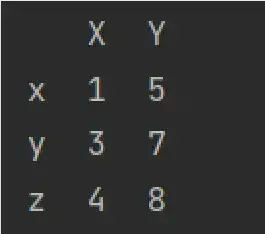
By using the “~ ” operator and the duplicated() method, we can drop the duplicate indices from the DataFrame.
After that, we can proceed to reindex the DataFrame without encountering the ValueError anymore.
Solution 2: Resetting the Index
Another way to resolving the ValueError is to reset the index of the DataFrame.
This can be done using the reset_index() method.
Let’s take a look at an example:
import pandas as pd

# Creating a DataFrame with duplicate indices
example_data = {'X': [1, 2, 3, 4], 'Y': [5, 6, 7, 8]}
dataframe = pd.DataFrame(example_data, index=['x', 'x', 'y', 'z'])

# Dropping duplicate values
dataframe = dataframe.reset_index(drop=True)

# Reindexing the DataFrame
new_index_result = ['x', 'y', 'x', 'w']
dataframe.reindex(new_index_result)
print(dataframe)
Output:
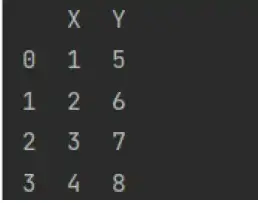
In this code, we reset the index of the DataFrame using the reset_index() method with the drop=True parameter.
This is to make sure that the old index is eliminated, and a new default numerical index is assigned.
Once the index is reset, we can safely reindex the DataFrame without encountering the ValueError.
Solution 3: Using the loc Function to Reindex
The loc function in pandas provides a great way to access and manipulate data.
It can also be used to reindex a DataFrame. Let’s see how this solution can help you to solve the ValueError:
import pandas as pd

# Creating a DataFrame with duplicate indices
example_data = {'X': [1, 2, 3, 4], 'Y': [5, 6, 7, 8]}
dataframe = pd.DataFrame(example_data, index=['x', 'x', 'y', 'z'])

# Dropping duplicate values
dataframe = dataframe.reset_index(drop=True)

# Reindexing the DataFrame
new_index_result = ['x', 'y', 'z', 'w']
dataframe = dataframe.loc[dataframe.index.intersection(new_index_result)]
print(dataframe)
Output:
Empty DataFrame
Columns: [X, Y]
Index: []
By using the loc function and the intersection() method, we can select only the rows with indices present in both the original index and the new index.
This effectively filters out the duplicate indices, allowing us to reindex the DataFrame successfully.
Solution 4: Handling Duplicate Index Values
When dealing with duplicate index values, pandas provides different options to handle this scenarios.
One of the solution is to combine the duplicate values using functions like groupby() and mean() function.
Let’s see an example:
import pandas as pd

# Creating a DataFrame with duplicate indices
example_data = {'X': [1, 2, 3, 4], 'Y': [5, 6, 7, 8]}
dataframe = pd.DataFrame(example_data, index=['x', 'x', 'y', 'z'])

# Dropping duplicate values
dataframe = dataframe.groupby(level=0).mean()

# Reindexing the DataFrame
new_index_result = ['x', 'y', 'z', 'w']
dataframe.reindex(new_index_result)
print(dataframe)
Output:
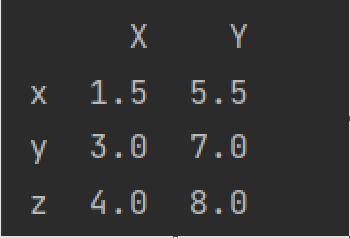
In this example code, we use the groupby() method along with the mean() function to combine the duplicate values based on the index.
This is to make a new DataFrame with unique indices. Then, we can safely reindex the DataFrame without encountering the ValueError.
Frequently Asked Questions
The Valueerror cannot reindex on an axis with duplicate labels error occurs when we attempt to reindex a DataFrame, but there are duplicate values in the index.
You can check if your DataFrame has duplicate indices by using the duplicated() method on the index.
No, you cannot reindex a DataFrame with duplicate indices directly. You need to handle the duplicate values by either dropping them, or resetting the index
Yes, you can merge DataFrames with duplicate indices using the merge() function in pandas.
Conclusion
In this article, we’ve discuss the different example codes and solutions to solve the Valueerror: cannot reindex on an axis with duplicate labels error in pandas.
We learned about the causes of this error and discussed different solutions to resolve it. By understanding these solutions, you can effectively handle duplicate indices and reindex your DataFrames without encountering any errors.
Additional Resources
- Valueerror negative dimensions are not allowed
- Valueerror: incompatible indexer with series
- Valueerror: circular reference detected
Python ValueError debugging checklist
- Read the full traceback. The message often names the exact value that failed.
- Print repr(value) before the failing call — shows quotes, whitespace, and hidden chars.
- Check library version. Many ValueErrors come from API changes across pandas / numpy / sklearn versions.
- Guard at boundaries. Wrap risky conversions in try/except and provide sensible defaults.
- Use pydantic or dataclasses. Modern validation catches ValueError at input time with clean error messages.
Common ValueError sources across libraries
- Conversion failures. int(“abc”), float(“$100”), datetime.strptime with wrong format.
- Shape/length mismatches. pandas assignment, numpy arithmetic, sklearn fit input.
- Iterable unpacking. Too many or not enough values.
- JSON parsing. Malformed JSON strings.
- Domain-specific validation. Custom validators that raise ValueError on invalid input.
Modern tooling to prevent ValueError
- pydantic v2. Runtime validation with clean error messages.
- dataclasses with __post_init__. Validate at construction time.
- argparse type=. Auto-convert and validate CLI args.
- FastAPI request models. Web boundary validation without your code touching raw input.
- polars strict types. Catches type/value issues at load time.
Official documentation

Adones Evangelista
Programmer & Technical Writer at PIES IT Solution
Adones Evangelista is a programmer and writer at PIES IT Solution, author of over 900 tutorials and error-fix guides at itsourcecode.com. Specializes in JavaScript, Django, Laravel, and Python error debugging covering ValueError, TypeError, AttributeError, ModuleNotFoundError, and RuntimeError, plus C/C++ and PHP capstone projects for BSIT students.
Expertise: JavaScript · Python · Django · Laravel · Error Debugging · C/C++
· View all posts by Adones Evangelista →
Frequently asked questions
What is a Python ValueError?
ValueError is raised when a function receives an argument of the correct type but an inappropriate value. Common cases include int() on non-numeric strings, unpacking mismatched sequences, and library-specific validation failures.
What is the difference between ValueError and TypeError?
TypeError fires when the type is wrong (adding int + str). ValueError fires when the type is correct but the value is not accepted (int(‘abc’) is str + str behavior but the value ‘abc’ cannot be parsed to int).
How do you catch ValueError in Python?
Wrap the risky call in try/except ValueError. Provide a fallback value or re-raise with more context. Never use bare ‘except:’ — that catches SystemExit and KeyboardInterrupt too.
Should you use validation libraries to prevent ValueError?
Yes. pydantic v2 and dataclasses with __post_init__ can validate at boundaries. For CLI arguments, argparse’s type= parameter converts and validates. For web APIs, FastAPI’s request models catch invalid input before your code runs.
What tools help debug ValueError?
The full traceback shows the exact line, print(repr(value)) shows the actual received value including whitespace, and pydantic + type hints catch many ValueErrors statically before runtime.