
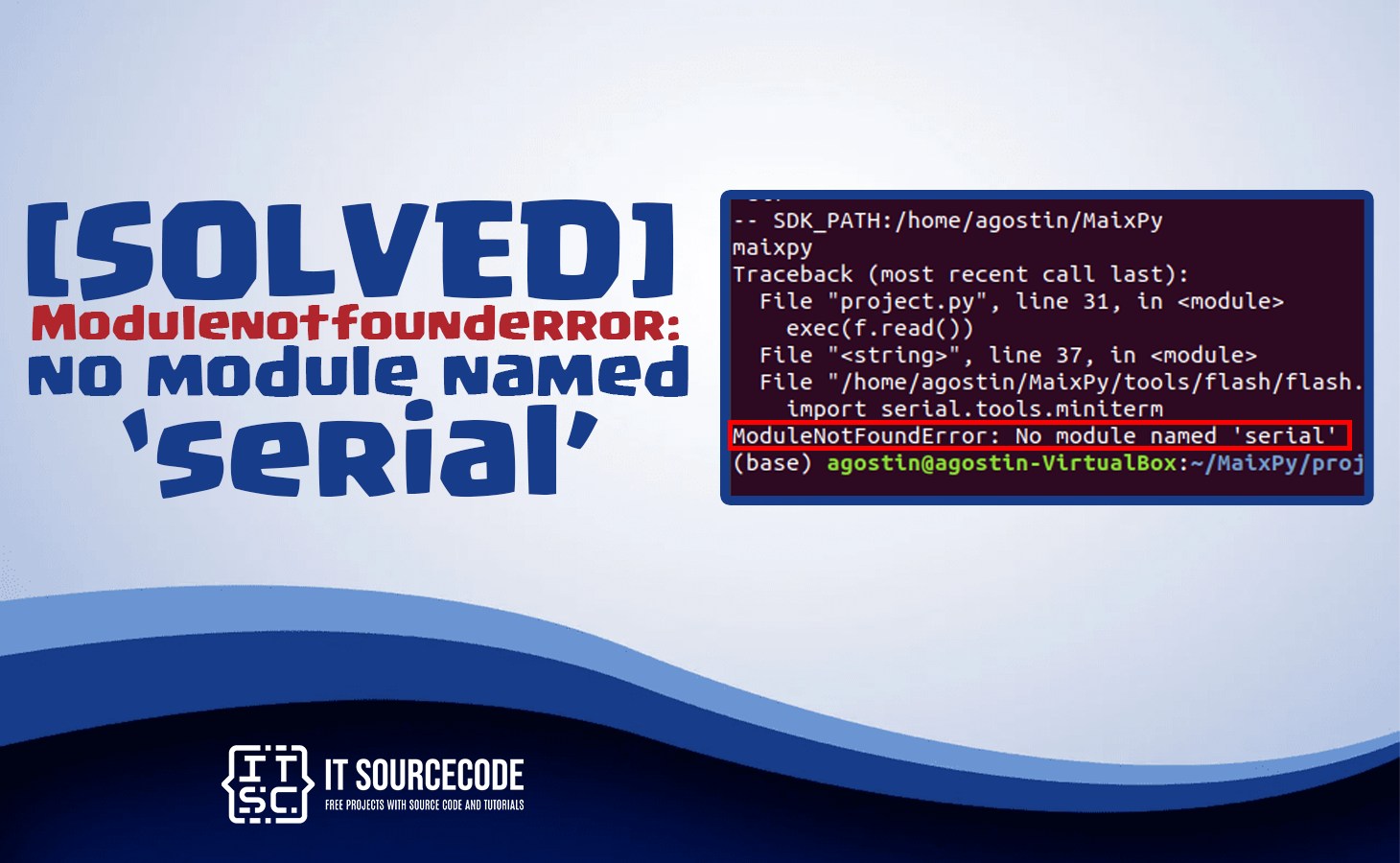
In this article, we will show solutions for Modulenotfounderror no module named serial error which will help to fix it. Aside from that, we will look into the causes of this error.
This error would be frustrating, especially if we are trying to work on serial ports of Python.
What is no module named serial?
The ModuleNotFoundError: No module named ‘serial’ error occurs when the Python interpreter cannot find the serial module. Typically, this module is used for communication with serial ports, wherein commonly used in devices such as microcontrollers, sensors, and other electronic devices.
In addition to this if your python code requires the serial module and you receive this error message. This means that the module is not installed on your system.

How to Solve Modulenotfounderror no module named serial
Since we already know what is Modulenotfound error: No module named serial. Now we will explore solutions in order to resolve it. The following guide is given below:
- Install or update module.
The first way to remove this error is to install serial module on your system. To install the module, you can use the following command in your terminal or command prompt:
pip install pyserial

If you are module is already installed, you might need to update it to the latest version using the following command:
pip install --upgrade pyserial
- Check the module name
Once the module is installed, but you are still receiving the error. Then you should double-check the module name in your code to ensure that it matches the name of the installed module.
To do this try to run the following command in your console.
import serial

Note: If you receive an error message indicating that the module cannot be found, double-check the spelling and ensure that the name matches the installed module.
- Check python version compatibility.
Now that you confirmed that the module is installed and the module named is correct, but still getting the modulenotfounderror. Then it could be the incompatibility of Python version.
Therefore check the serial module documentation and ensure that it is compatible with your python version. However if not, you need to upgrade to a new version of Python that is compatible with the module.
To check your python version, use the following command:
python ---version




Causes of Modulenotfounderror: no module named ‘serial’
There are common causes why we encounter this error ModuleNotFoundError: No module named ‘serial’. These include the following:
- Missing or outdated module
One of the most common reasons for this error message is that the “serial” module is not installed on your system or is outdated. If this is the case, you will need to install or update the module to resolve the error. - Incorrect module name
Another reason for the error message is that the module name may be misspelled or incorrectly entered in the code. This can happen if the code was copied and pasted from another source, and the module name was not updated to match the name of the module on your system. - Python version compatibility
The “serial” module may also be incompatible with your version of Python. If you are using an older version of Python, you may need to upgrade to a newer version that is compatible with the module.
Summary
Encountering the “ModuleNotFoundError: No module named ‘serial’” error message can be frustrating, but it is a common issue that can be resolved with a few simple steps.
By ensuring that the “serial” module is installed, double-checking the module name in your system, this will resolve the error.
We hope you’ve learned a lot from this. If you have any questions or suggestions, please leave a comment below, and for more Python tutorials, visit our website.
Thank you for reading.
Related Python Tutorials
- Modulenotfounderror No Module Named Flask Ext
- Modulenotfounderror No Module Named Torch Solved
- Modulenotfounderror No Module Named Gensim Solved
- Modulenotfounderror No Module Named Pyodbc Solved
- Modulenotfounderror No Module Named Mlxtend Solved
- Modulenotfounderror No Module Named Pymysql Solved
Root causes of Modulenotfounderror no module named serial
- Package not installed. The module you’re importing was never installed in the current environment. Fix: pip install <package-name>.
- Wrong virtual environment active. You installed in one venv but running from a different environment. Verify with which python and which pip.
- Multiple Python versions. pip installs for one Python, but you’re running a different version. Use python -m pip install <package> to force it.
- Typo in module name. Case-sensitive imports. Beautiful_Soup vs beautifulsoup4 vs bs4. Check the actual import name in the package docs.
- Package uninstalled or corrupted. Try pip install –force-reinstall <package> to freshen the install.
Step-by-step debugging
- Verify Python path. import sys; print(sys.executable) shows which Python is running.
- Check installed packages. pip list | grep <package> confirms it’s actually installed.
- Match environment. Confirm the terminal that ran pip install is the same environment your code runs in.
- Reinstall cleanly. pip uninstall <package> then pip install <package>.
- Try python -m install. python -m pip install <package> avoids PATH mismatches.
Working install pattern
# Create fresh environment (recommended for any new project)
python -m venv myenv
source myenv/bin/activate  # Windows: myenv\Scripts\activate

# Install requirements
pip install --upgrade pip
pip install <package-you-need>

# Verify install
pip list | grep <package>
python -c "import <package>; print(<package>.__version__)"
When the error persists
- Check for typos. Module names can differ from PyPI names (opencv-python vs cv2, beautifulsoup4 vs bs4).
- Update Python or downgrade the package. Some packages have version-specific compatibility.
- Restart the interpreter or kernel. Jupyter and IDEs cache import state.
- Check for conda/pip conflicts. If using Anaconda, prefer conda install <package> over pip.
Official documentation
Frequently Asked Questions
What Python version does this tutorial target?
How do I install Python for this tutorial?
Do I need pip and virtual environments?
Can I use this in a Jupyter notebook or Google Colab?
Where can I find more Python practice projects?

Glay Eliver
Programmer & Technical Writer at PIES IT Solution
Glay Eliver is a programmer and writer at PIES IT Solution, author of over 600 tutorials at itsourcecode.com. Specializes in JavaScript tutorials, Microsoft Office how-tos (Excel, Word, PowerPoint), and Python error debugging covering ImportError, TypeError, AttributeError, ModuleNotFoundError, and JavaScript ReferenceError. Authored several of the site’s highest-traffic Excel and MS Office reference articles.
Expertise: JavaScript · MS Excel · MS Word · MS PowerPoint · Python · Python ImportError · Python TypeError · Python AttributeError · ModuleNotFoundError · JavaScript ReferenceError · Pygame
· View all posts by Glay Eliver →